UAE Electrical Cable Imports From Bangladesh: Jebel Ali and Duty
Jebel Ali or Khalifa Port, the ECAS certificate for the exact construction, and a broker-confirmed duty line decide a UAE cable import before price does. This guide sets the entry door, the conformity file and the border checks in order, with a worked landed-cost example in dirhams.
Short answer
Importing electrical cables from Bangladesh to the UAE works when the entry door, the conformity certificate, and the border file are settled before price is discussed. Choose mainland import or free-zone entry by where the cable will be sold, hold the conformity certificate naming the exact construction, and have a broker confirm the 12-digit tariff line, the duty, and the VAT treatment in writing before the order is priced.

On this page
Key takeaways
Decide the entry door first: mainland import for sale across the UAE, free-zone entry at Jebel Ali for storage and re-export, with duty falling due only when goods cross into the mainland.
Hold a conformity certificate that names the exact construction, backed by test reports from an accredited laboratory, before the cable is offered for sale in the UAE.
Settle the emirate customs file early: trade licence, customs code, Mirsal 2 declaration, and a 12-digit tariff code read from the schedule in force.
No duty rate is stated in this guide: the broker must confirm the tariff line, the duty, any preference position, and the VAT treatment in writing.
Price from the worked landed-cost table in dirhams, with duty and VAT as separate lines to be inserted from the broker and accountant figures.
A buyer in the UAE faces a different first decision than a buyer in Europe. Before the cable construction, before the supplier, and before the price, the buyer has to settle which door the shipment uses: a mainland import that releases the cable for sale and use inside the Emirates, or a free-zone entry that keeps it outside the customs territory until it moves onward. After the door comes the conformity certificate, which must exist before the cable can be sold. After that comes the customs file in the emirate of entry, where the duty figure is read off the tariff schedule in force rather than taken from a headline rate. This guide works through those decisions in the order a UAE import actually demands them, for a buyer importing electrical cables from Bangladesh who wants the entry route, the certificate file, the gateway, and the border figures fixed before money moves.
Settle the entry door first: mainland import or free-zone entry
Dubai processes imports through Mirsal 2, an electronic declaration platform, and a business clearing goods under its own name needs an importer code linked to a trade licence. Many businesses hand the filing to a licensed customs broker instead.1 The declaration, commonly called the bill of entry, goes in against the shipment; duty and VAT are assessed on it; and the goods are released, in some cases after inspection.1 Separate declaration types exist for mainland imports, exports, transit, temporary admission, and free-zone transfers, each with its own treatment, so picking the correct type is part of the job rather than clerical detail.1 None of that can be filed correctly until the buyer knows which movement the shipment is.
A free zone such as JAFZA, the Jebel Ali Free Zone, sits outside the UAE customs territory. While goods remain in the zone, duty is suspended; goods may be re-exported from the zone without mainland import duty; and storage, consolidation, and regional redistribution can run from one hub, with duty charged only on what actually crosses into the local market.1 That fits a distributor supplying the wider Middle East, Africa, and South Asia from one stock point, or a buyer releasing cable in tranches against project demand. It fits poorly where cable must reach a named site on a fixed date: each mainland release is a new import movement with its own declaration and duty assessment.
Jebel Ali Port stands beside the zone, in one DP World UAE portfolio with Mina Rashid and Mina Al Hamriya.2 The operator describes it as the flagship gateway for a region of more than 3.5 billion people, served by over 80 weekly services reaching more than 150 ports.2 For a free-zone buyer, that pairing means discharge, storage, and onward distribution can run without a second broker handoff. A mainland buyer in Dubai uses the same port and the same Mirsal 2 system; what changes is the declaration type and the moment duty is assessed.
Put the door on the order before choosing a supplier. Record whether the consignment is a mainland import or a free-zone entry, name the emirate of entry, and name who holds the goods after release: the buyer's warehouse, a project site, or a free-zone facility. For a free-zone entry, record who will release goods to the mainland later and who files that second movement. An order that says only "UAE" leaves the broker guessing the movement type, and a wrong guess appears as a rejected declaration, with the container already at the terminal.
Door | When duty is charged | When it fits | Settle at the start |
|---|---|---|---|
Mainland import | On the import declaration | Sale or use inside the UAE, project delivery, warehouse stock | Emirate of entry, importer code, holder of the goods after release |
Free-zone entry at Jebel Ali | Only on crossing into the mainland | Regional distribution, staged release, re-export | Free-zone facility, mainland release process, filer of the second movement |
Transit through the UAE | Not charged on goods that leave again | Onward sale outside the UAE | Final destination, transit declaration, exit point |
Hold the conformity certificate before the cable can be sold
No regulated product may be sold in the UAE without first conforming to mandatory quality and safety standards. The trader, importer, or manufacturer must hold a valid certificate of conformity for each product, demonstrating compliance with the technical regulations, guidelines, and standards of the Ministry of Industry and Advanced Technology (MoIAT).3 The certificate is a pre-sale document that also smooths customs clearance at the point of entry.3 Ordering cable without it means trusting that the paper will turn up later, when the buyer's bargaining position is weakest.
Two certificates can satisfy the rule. A regulated product must carry either an Emirates Conformity Assessment Scheme (ECAS) certificate or an Emirates Quality Mark (EQM) certificate, whether it was manufactured abroad or locally.3 ECAS certificates last one year and renew annually; EQM evidences compliance with UAE national standards and lasts three years.3 Registration of regulated products is required under ECAS, and MoIAT issues the ECAS registration certificate once conformity with the relevant standards has been demonstrated.4 Electrical safety categories under the scheme include cables and telecommunication cables, low voltage equipment, and lighting fixtures and luminaires.4 Whether the buyer's cable takes the ECAS route or the EQM route, and which notified body issues it, is for the certifier and broker to answer on paper before production begins.
The programme's electrical scope is broad, so a certificate for one catalogue item never proves another: alongside low voltage cables and data communication cables, the scope lists low voltage electrical products, restriction of hazardous substances (RoHS), and energy efficiency standards and labelling.3 Insist on a certificate naming the construction being bought, with the standard references applied, and check the wording matches across certificate, test reports, and invoice, word for word.
Behind the certificate sit test reports, and the laboratory behind the reports matters as much as the results. A certificate application needs a valid UAE industry or trade licence, an electronic declaration of conformity, test reports against MoIAT-approved standards from an accredited laboratory, labels, and an Arabic and English user manual or ingredients list.3 Three questions go to the supplier and the certifier in written form: which accredited laboratory produced the reports, which MoIAT-approved standards the testing followed, and whether the reports address the precise construction or a related product. A report on a related product is a starting point for the certifier, not proof for the order. Say plainly where the cable carries data rather than power: scope, standards, and route can change with function.
Two more questions belong in the same file, and both need the certifier's reply rather than the supplier's word. First, the Gulf marking question: as a Gulf Cooperation Council member state, the UAE applies the GCC Low Voltage Electrical Equipment Technical Regulation, and products under it should carry the GCC Conformity Marking before lawful placement on the market.4 Ask whether it applies to the cable on the order, what else it requires beyond the ECAS route, and where it goes. Second, the substances question: the UAE hazardous-substances regulation for electrical and electronic devices appeared in the official gazette on 27 April 2017, limiting lead, mercury, cadmium, hexavalent chromium, polybrominated biphenyls, polybrominated biphenyl ethers, and the phthalates DEHP, DBP, BBP, and DIBP.4 Its reach covers electrical and electronic equipment rated at no more than 1,000 volts alternating current and 1,500 volts direct current.4 Take the rated voltage from the specification and test the cable against that band, and ask for a written scope answer, the covering declaration, and the test evidence for the precise construction.
The conductor has a standard of its own, and the measurement that counts is taken on the completed cable. IEC 60228:2023 lists the permitted conductor cross-sections, spanning 0.5 to 3,500 mm2, and pairs each with wire numbers, wire sizes, and resistance values.5 Its coverage takes in solid, stranded, and Milliken conductors in copper, aluminium, and aluminium alloy for fixed installations, plus flexible copper conductors, while telecommunication conductors sit outside it.5 The document speaks of conductors in the completed cable, and all sizes are metric.5 Have the supplier record the conductor material, class, nominal cross-sectional area, and the IEC 60228 edition on both the quotation and the test evidence, with confirmation that size and resistance were checked on the completed cable. A quote listing only a trade size, with no standard cited, cannot be matched to a test report.
Marking and labelling finish the file. Certificate applications require labels and an Arabic and English manual, and the ECAS route adds its own mark: printed labels bearing the ECAS mark were required from the start of January 2019, with a new conformity mark following after that.3 4 Ask for a label proof before production, showing the marking in its final drum-label and sheath form, and check the sample length and opening drums against that proof. Drum label, sheath marking, certificate, and invoice must all carry the same construction name. A drum arriving under another construction name has no certificate cover for the order, whatever the catalogue claims. Ask the project consultant or the person accepting the cable on site whether the site wants anything beyond the market-access certificate, such as a project-file submittal. Market access and site acceptance are separate gates; clearing the first does not clear the second.
File item | Must identify | Get this answer before production |
|---|---|---|
Certificate of conformity, ECAS or EQM | Precise construction, standards applied, certifier | Which route applies, and how long the certificate lasts |
Test reports | Construction tested, MoIAT-approved standards, accredited laboratory | Ordered construction or related product: which was tested |
GCC marking position | Cable and GCC Low Voltage Technical Regulation | Whether the GCC Conformity Marking applies, and where it sits |
Substances declaration | Construction and substances position | Written scope answer, with test evidence for the construction |
Conductor evidence | Material, class, nominal area, completed-cable resistance | IEC 60228 edition and completed-cable checking basis |
Label and marking proof | Construction, certificate marking, Arabic and English wording | A proof for the construction ahead of production |
Build the emirate customs file around the declaration
Four parts make up the customs file, and the buyer owns the first two: the trade licence, which has to cover the importing activity, and the customs code, which ties that licence into the declaration system of the emirate of entry. Dubai registrations go through the Dubai Trade portal, and the broker should confirm the code is current and the renewal position settled before the first filing.1 For any emirate, the broker confirms which customs department handles the entry, which portal receives the declaration, and what registration the importer needs there. A buyer stocking a warehouse in Abu Dhabi who files as though the entry were in Dubai puts the file in the wrong office.
Filing the declaration is the broker's task; the data inside it is the buyer's. For a commercial import through Dubai, the core set runs to the commercial invoice, the packing list, the bill of lading or air waybill, the certificate of origin, any permit or approval for regulated goods, and the customs declaration in Mirsal 2.1 The invoice fixes value for duty and VAT; the packing list breaks down contents, weights, and dimensions; the certificate of origin fixes origin for tariff treatment.1 Keep the invoice, the packing list, and the tariff code in perfect agreement, settle permits for regulated goods before shipping, and keep the importer code and trade licence current.1 For cable, the regulated-goods approval in the set is the conformity file from the previous section, which must already exist when the broker files.
Classification is where the file meets the money, and the UAE system has recently changed shape. Under Customs Notice No. (10/2025), Dubai Customs began flexible implementation of the 12-digit Integrated Customs Tariff, with a six-month transition from 1 August 2025 beside the existing 8-digit system.6 The change expands the tariff from 7,800 lines to more than 13,400, and Dubai Customs published an updated GCC Unified Customs Tariff list with a line-by-line schedule of changes in the notice annexes.6 The list groups duties into bands of 0%, 5%, 10%, 50%, and 100%.6 Those bands describe the tariff overall; they say nothing about the rate for a given cable, and pricing from a band will price the order wrong. The broker has to read the precise 12-digit line for the construction from the schedule current on the import date, confirm the code format the entry route requires, and confirm the rate and all other measures on paper. A superseded 8-digit code, or a 12-digit code borrowed from another construction, is a classification error, and classification errors rank among the costliest mistakes in clearance, with overpaid duty, penalties, or seizure among the outcomes.1
Origin evidence is prepared ahead of loading, not chased after arrival. The supplier should prepare the certificate of origin with the commercial documents so the broker can confirm the origin position for the code, on paper, before the vessel sails.1 Whether any trade agreement or preference alters the duty is the broker's question, answered from the tariff schedule and the origin evidence for the precise code. This guide names no preference and no agreement, because none stands confirmed for this code and construction.
Choose the gateway by terminal and onward road, not by port name
Two container gateways will handle most cable shipments from Chattogram to the UAE, and inside each port the terminal matters as much as the port. Jebel Ali serves Dubai and the northern Emirates by road, with the free zone beside the port for buyers using the free-zone door. Khalifa Port serves Abu Dhabi and the western region, with its own terminals, its own Abu Dhabi customs file, and road and rail links onward. An Abu Dhabi buyer routing through Jebel Ali for cheaper ocean freight pays the saving back in inland haulage and an extra handling point, and a Dubai buyer routing through Khalifa Port does the same in reverse.
At Jebel Ali, pin down the terminal, the storage terms, and the road leg to the warehouse or site. DP World counts over 80 weekly services reaching more than 150 ports, and calls the harbour the world's largest man-made one.2 For the shipment in hand, have the forwarder name the terminal, confirm where the container comes off, where drums sit during an inspection hold, and the free-storage days allowed before charges begin. Treat the drum unloading point as a separate question from the container unloading point: drums leaving a container at a terminal yard and drums delivered to a warehouse are different movements, and the quotation must state which one it prices. Compare gateways on one delivery basis, counting inland haulage and extra handling too, never on the sea leg alone.
At Khalifa Port, three container terminals divide the work, and the quotation should carry the terminal name. AD Ports Group publishes container capacity of 7.8 million TEU, 18.5 metres of depth alongside, 33 ship-to-shore cranes, and 36 berths, with warehousing on site, highway, airport, and direct rail links, and the KEZAD economic zone close by.7 Abu Dhabi Terminals operates the MSC hub; the CSP Abu Dhabi Terminal runs under a 35-year concession with COSCO SHIPPING Ports; CMA Terminals Khalifa Port runs under a 35-year concession with CMA CGM.7 Have the forwarder name the terminal taking the container, confirm the unloading point and storage terms for the delivery week, and confirm the road service to the warehouse or site, asking the same drum questions as at Jebel Ali.
Gateway | Best for | Road or rail leg to pin down | Opening question |
|---|---|---|---|
Jebel Ali, Dubai | Dubai, Sharjah, northern Emirates, free-zone entry | Road from the named terminal to warehouse or site | Which terminal, and where drums unload and sit |
Khalifa Port, Abu Dhabi | Abu Dhabi, Al Ain, western region | Road or rail from the named terminal, KEZAD links included | Which of the three container terminals, and the road service that week |
Any other UAE port | Only where the forwarder confirms terminal and customs office | Road from that port to the destination | Whether the port and its customs file fit a container of cable drums |
No transit time appears in this guide. Ask the carrier or forwarder for three shipment-week facts — sailing date, terminal arrival estimate, onward road booking — then add days for inspection and conformity checks. Sailing changes, transshipment, congestion, and the road leg can all push arrival later, so a date taken from another sailing or another season misleads the people waiting on site. Say plainly that a buffer sits inside the date, so a one-day slip does not shut the site down.
Judge suppliers against the UAE file, not the catalogue
Put the same written request to every shortlisted supplier. It should record the entry door, the emirate of entry, and the date the cable must reach the warehouse or site; specify the construction, standard, and edition, rated voltage, and conductor details; state quantity and drum terms, and give the delivery rule with its named places; and demand the conformity certificate, the test reports, and a label proof for the precise construction. Replies resting on different constructions, certificates, or delivery rules cannot be ranked together, and the lowest headline figure usually belongs to the quotation that omitted something. Lay the replies side by side in a single comparison sheet, with written answers filed beside each quotation, so a later dispute is settled from the file rather than from memory.
Judge each reply against four tests, certificate first. First, the conformity file has to name the construction being bought: certificate, test reports from an accredited laboratory, and a label proof, with the certifier's answers on the ECAS or EQM route, the GCC marking position, and the substances scope.3 4 Second, scope questions need straight answers: rated voltage and voltage band, conductor material, class, and nominal area with the IEC 60228 edition, and constructions the supplier declines.5 Third, drum, length, and remainder terms must arrive as figures, not general assurances, and the supplier must accept inspection under the buyer's written scope, including a check that bulk drums match the approved sample in marking and labelling. Fourth, the company file must agree across documents: registered legal name, registered office, and evidence that quotation, invoice, and bank account all belong to the same legal entity, with money going to the company account named in the documents, and no other.
Treat the sample as a test of the paperwork, not only of the cable. Approve one sample length against the specification in written form; mark it, date it, and keep it. Production drums must then match it in construction, sheath print, and drum label. Check the construction name across sample, test report, and drums: if later drums carry a different name, the sample approval covers nothing. For a first order, a trial length the project team can examine on site is worth more than another round of catalogue claims.
This guide states no typical minimum quantity, because the sources opened for it carry no such figure for cables from Bangladesh. A minimum usually reflects a production run rather than an order total: it may attach to a construction, a cross-section, a colour, or a single run. Ask for the run size on paper — metres and the drum count it fills — and measure it against the lengths the installation needs, counting cutting, waste, and spares. Splitting one small requirement across two constructions doubles the paperwork for a quantity that may not warrant either. Where the run size exceeds the need, ask what would change it: another drum size, a shared run, or a split delivery, and record the answer as a number. Keep the money terms in the same document as the technical terms: product price on one line, freight and insurance under the chosen rule on another, and the buyer's port, customs, and inland charges on their own lines. A single all-in figure naming no delivery rule hides the line between seller-paid and buyer-paid costs, where most quotation disputes start. Restate all offers on one delivery basis before ranking, and rank again whenever a supplier shifts the basis. Settle, on paper, what happens if the metal price shifts between quote and production — reference, lock date, and who absorbs the move — because conductor metal usually dominates cable cost.
Set drum, length, and unloading terms on paper
Record the total length, the length carried by each drum, the tolerance allowed on drum lengths, and how short lengths and remainders are handled. Record who owns the drums, whether drums go back to the supplier, and the cost of a damaged or short drum in delay as well as money. Settle the drum sequence with the project team ahead of loading, and carry it on the packing list: drums arriving out of sequence get restacked in the warehouse, slow and costly work that risks damaging the cable.
The unloading point deserves the same precision as the port. Record the delivery address in full, the unloading point, the receiving hours, a named contact, and the plant on site — forklift access, covered storage, and someone authorised to sign for a heavy load. Drum deliveries most often fail in the final metres: a site without a forklift, without a covered store, or without anyone authorised to sign will refuse or hold a load that crossed the sea on schedule. Have supplier and forwarder confirm one shared address in written form, and make the delivery rule name the same place.
Delivery rules when drums travel in containers
The delivery rule fixes who arranges transport, who carries risk while goods are moving, and who handles import clearance. The sea and inland-waterway-only rules are four — FAS, FOB, CFR, CIF. CPT is any-mode. DPU is any-mode. DDP is any-mode (seller clears import customs, pays duty). FCA is any-mode. Under the Incoterms 2020 rules, delivery connects with the transfer of risk, so the contract must state the delivery place and the risk point in terms both parties read the same way.8 If the named place is worded imprecisely, the seller may route the shipment to a terminal the buyer had not planned for, and the buyer then absorbs the inland haul from that terminal.8 Record rule, place, and edition in the contract text — for example, DAP at the Dubai warehouse or FCA at the Chattogram container terminal, in each case naming Incoterms 2020 — and never reduce the named place to a city name alone when drums must reach a particular depot.
For drums in containers, the FCA and FOB choice sets the risk point. FCA hands delivery and risk over at the named place: on the seller's premises once the goods are loaded onto the buyer's transport, or at another named place once the goods stand ready to unload from the seller's transport, for collection by the carrier or the buyer's nominee.8 FOB hands delivery and risk over when the goods are aboard the vessel the buyer named at the named shipment port; for containerised goods FCA is typically the better rule, even for maritime transport, because containers sit at a terminal before loading.8 A UAE buyer buying containerised drums on FOB terms should put the terminal-handling risk question to the forwarder and write the answer into the contract.
The C rules are widely read backwards. The seller arranges and funds carriage to the named destination, yet the buyer carries the transit risk: risk moves on handover to the seller's carrier for CPT and CIP, and on completion of loading for CFR and CIF.8 CIP adds a seller insurance duty to CPT, and CIF adds the same to CFR, covering the buyer for transit loss or damage.8 The D rules complete delivery and risk together at the named destination. DAP hands risk over once the goods stand ready to unload at the destination, at the buyer's disposal; DPU hands risk over when the seller unloads them; DDP adds import clearance by the seller, a step that can create difficulties for a seller without UAE arrangements and deserves careful thought before the rule is chosen.8 For a first UAE order, a warehouse named under DAP often gives the tidiest handover: the seller organises the move to the UAE while the buyer retains the customs file and the duty position.
Classification, duty, and VAT: the broker's figures, confirmed on paper
Heading 8544 is the starting point for classification. It covers insulated wire, cable, and other electric conductors, with or without connectors fitted, along with optical fibre cables built from individually sheathed fibres, whether or not they are assembled with electric conductors or fitted with connectors.9 Beneath the heading, the six-digit lines divide winding wire by conductor metal, pick out coaxial cable and vehicle wiring sets, and split other conductors by the 1,000-volt line and by connector fitting, leaving optical fibre cables last.9 The lines a power-cable buyer meets most often are 854442 and 854449, for conductors rated at or below 1,000 volts with and without connectors, and 854460, for conductors rated above 1,000 volts.9 The broker fits the precise construction to the line matching type, voltage, and connector fitting, then carries the code into the 12-digit Integrated Customs Tariff, reading the line current on the import date.6 No rate for the construction is stated here.6 Have the broker confirm on paper the full code, the duty payable, any preference or agreement position with the origin evidence behind it, and every other measure in force, and carry the confirmed figure into the landed-cost table ahead of pricing.
VAT needs the same treatment: confirm it, never assume it. VAT at 5% generally applies to imports entering the mainland, with mechanisms such as reverse charge available to VAT-registered businesses.1 The Federal Tax Authority publishes guides, references, and public clarifications on tax obligations; settle the current VAT treatment for a cable import — rate, base, border payment versus return settlement, and the link between the importer's customs registration and tax registration — with the accountant and the broker against current guidance ahead of the first shipment.10 A VAT-registered importer accounting for import VAT through its return still needs the figures to reconcile: the VAT amount, the base it was calculated on, and the declaration behind it must agree with the shipment papers before filing. Where goods arrive through a free zone, ask the accountant how the zone movement and the later mainland entry are each treated for VAT, and file the answer with the order. The zone door changes the timing of duty; it does not remove the VAT question.
File item | Held by | Settle by |
|---|---|---|
Entry door and emirate of entry | Buyer | First quotation |
Trade licence and customs code, current | Buyer | Loading in Chattogram |
Conformity certificate and test reports | Supplier and certifier | Loading in Chattogram |
Import declaration and code | Broker | Before the vessel berths |
Origin papers and preference case | Supplier with broker | Ahead of loading |
Duty figure from the tariff line in force | Broker, on paper | Pricing the order |
VAT rate, base, and settlement route | Accountant and broker | Ahead of the first shipment |
Worked landed cost in dirhams, duty and VAT left open
The table below illustrates only: treat each figure as an example, with the duty and VAT lines left open pending written figures from the broker and the accountant. The basis is FCA at the Chattogram container terminal under Incoterms 2020, for 12,000 metres of one construction, discharged at Jebel Ali and carried onward to a Dubai warehouse, as a mainland import. Rebuild the table from live quotations and the broker's numbers before pricing, and file the rebuilt version with the order. All figures are UAE dirhams (AED).
Cost line | Example amount (AED) |
|---|---|
Cable: 12,000 metres at 3.10 a metre, FCA Chattogram | 37,200.00 |
Ocean freight, Chattogram to Jebel Ali | 2,850.00 |
Cargo insurance | 240.00 |
Running total, duty and VAT excluded | 40,290.00 |
Duty on the shipment: broker figure from the tariff line | Your figure |
Broker fee | 420.00 |
Terminal and storage at destination | 610.00 |
Road delivery to the Dubai warehouse | 380.00 |
Inspection and testing | 590.00 |
Bank and currency charges | 140.00 |
Landed total before VAT | 42,430.00 + your duty figure |
Import VAT: general 5% position, accountant confirms the base | Your figure |
Cost a metre, duty and VAT excluded | 3.54 |
Working: 12,000 multiplied by 3.10 gives 37,200.00; adding freight and insurance gives 40,290.00; adding broker, terminal, road, inspection, and bank charges gives 42,430.00; dividing by 12,000 gives 3.54 a metre. Each metre costs 3.54 before duty and VAT, against 3.10 quoted — close to 14% more, from freight and shipment charges alone.1 Divide the duty figure by 12,000 and the VAT figure by 12,000 and add both to reach the final cost a metre, then price from that number. Pricing from 3.10 surrenders the freight, inspection, broker, and road-delivery spend, plus duty and VAT, out of margin. For scale only, 5% of the pre-duty running total of 40,290.00 is 2,014.50; the accountant recalculates the VAT figure on the confirmed base once the broker supplies the duty number. Compare suppliers line by line on this table, on one delivery basis, and reject any comparison that combines delivery rules or leaves the duty line empty without saying so.
Run the pre-shipment sequence in this order
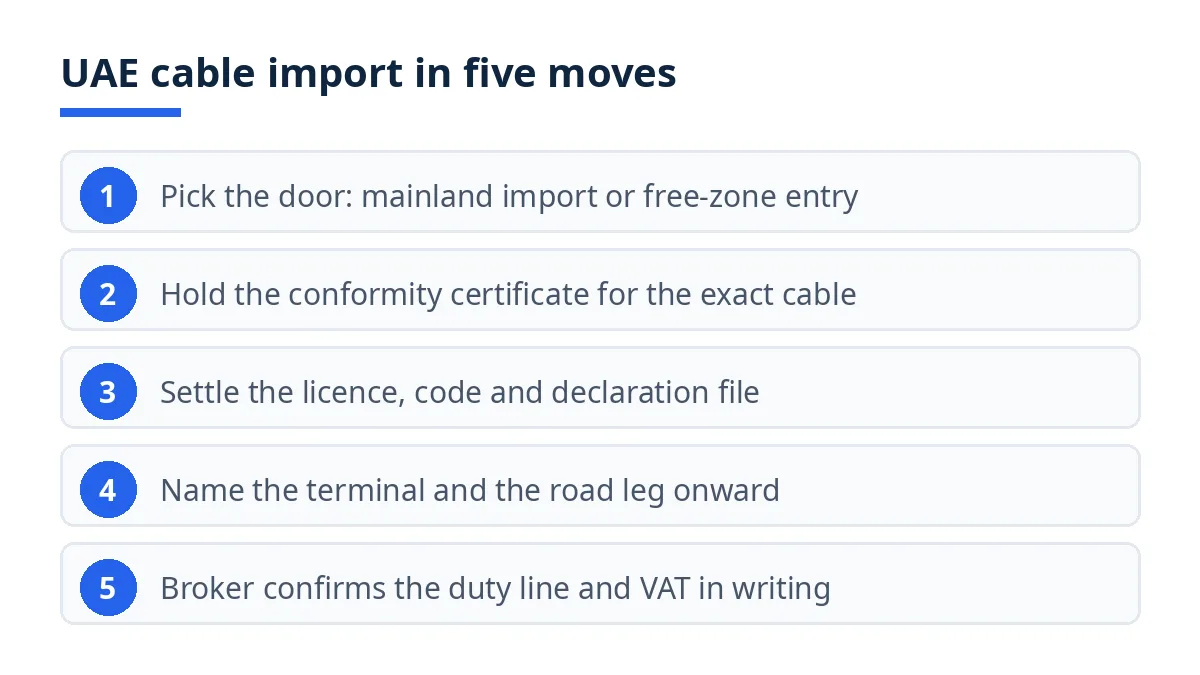
Take the steps in order, and record any change that reopens an earlier step. First, fix the entry door and the emirate of entry, and name who holds the goods after release. Second, settle the conformity file for the precise construction: certificate route, test reports, GCC marking position, substances scope, and label proof. Third, judge suppliers against the UAE file, approve a sample length on paper, and check the company file across quotation, invoice, and bank account. Fourth, fix quantity, drum, length, and unloading terms, with the project team agreeing the drum sequence. Fifth, pick the gateway and its terminal, and have the forwarder confirm terminal, storage terms, and onward road service on paper. Sixth, pick the delivery rule, naming its places, and confirm who files the declaration and who holds each part of the border file. Seventh, rebuild the landed-cost table from live quotations and the broker's numbers, and price from the rebuilt total. Working in this order keeps most trouble on paper, where a correction costs a message rather than a container delay.
Questions UAE buyers ask before ordering
Which UAE entry route should a cable shipment take: mainland import or free-zone entry?
Choose the mainland route where the cable is for sale or use inside the UAE, for project delivery, or for direct warehouse stock: duty and VAT are assessed on the import declaration and the goods release to the buyer.1 Choose the free-zone route at Jebel Ali for storage, consolidation, and regional redistribution or re-export, with duty suspended while goods stay in the zone.1 The deciding facts are where the cable will be sold or used, who releases goods to the mainland afterwards, and who files the second movement. A shipment headed for a named project site is a mainland import, whatever the freight quotation calls it.
What conformity certificate must a cable hold before it can be sold in the UAE?
A valid certificate of conformity for the precise product, demonstrating compliance with MoIAT technical regulations, guidelines, and standards, held by the trader, importer, or manufacturer before the product trades on the UAE market.3 Regulated products carry either an ECAS certificate, lasting one year with annual renewal, or an EQM certificate, lasting three years.3 Cables and telecommunication cables sit in the electrical safety categories, and the certificate rests on test reports and certificates against MoIAT-approved standards from an accredited laboratory, with labels and an Arabic and English manual.3 4 Hold the certificate before treating production as complete.
How does a UAE buyer get a duty figure the budget can rely on?
From the broker, on paper, read from the tariff schedule current on the import date. The broker confirms the full 12-digit code for the precise construction, the duty payable on that line, any preference or agreement position with the origin evidence behind it, and every other measure in force.6 The tariff list spans bands from 0% to 100%, and the 12-digit change expanded the tariff from 7,800 lines to more than 13,400, so a rate quoted for another construction or an old code is no figure here.6 Carry the broker's figure into the landed-cost table ahead of pricing, and price nothing from a band, a headline rate, or a supplier's promise.
What supplier evidence must reach the UAE buyer before production starts?
The certificate of conformity naming the precise construction, test reports from an accredited laboratory against MoIAT-approved standards, a label and marking proof, conductor evidence citing the IEC 60228 edition and completed-cable checking, and a company file placing quotation, invoice, and bank account under one legal entity.3 5 Add the certifier's written answers on GCC marking and substances scope, plus a sample length approved on paper.4 A supplier unwilling to produce the certificate file, or whose documents name another construction, has failed the check. Move to the next supplier before any payment locks the buyer in.
What arrival date should a UAE buyer promise the project?
None, until the carrier or forwarder supplies the sailing date, the terminal arrival estimate, and the onward road booking for the actual shipment week, plus days added for inspection and conformity checks. Sailing changes, transshipment, congestion, and the road leg can all push arrival later. Give the project the resulting date, buffer included, and update it on paper whenever a shipment-week fact moves.
What minimum quantity applies to a first cable order from Bangladesh?
No typical figure appears in this guide, because the sources opened for it carry no such number for cables from Bangladesh. The supplier minimum must be recorded on paper with its basis — metres, kilograms, or per drum — and measured against the installation lengths plus an allowance for cutting, waste, and spares. Record what would shift it — another drum size, a shared run, or a split delivery — as a number. Ordering against an assumed minimum is how a buyer ends with cable the project cannot use, or a shortfall it cannot cover.
Next steps on Exportain
Read the Bangladesh import sequence in full for the wider steps sitting around the UAE file, rework the figures with the landed-cost arithmetic for Bangladesh shipments before accepting a quotation, and carry the heading 8544 classification notes into the code discussion with the broker: the Bangladesh import sequence in full, the landed-cost arithmetic for Bangladesh shipments, the heading 8544 classification notes.
Post a free RFQ on Exportain and get quotes from verified Bangladeshi suppliers
Sources
- Customs Clearance in Dubai & JAFZA: What Importers Need to Know. Delman Shipping, (accessed )
- Jafza is part of DP World, a global trade enabler. Jebel Ali Free Zone (DP World) (accessed )
- Navigating UAE Product Conformity: Understanding ECAS and EQM Certification. SGS, (accessed )
- United Arab Emirates. TÜV SÜD (accessed )
- IEC 60228:2023 - Conductors of insulated cables. International Electrotechnical Commission, (accessed )
- UAE Customs & International Trade: Dubai and Abu Dhabi announce the implementation of the 12-digit Integrated Tariff. PwC (accessed )
- Khalifa Port - Features, Services and Terminals. AD Ports Group (accessed )
- Place of delivery & risk transfer in trade contracts. ICC Academy (accessed )
- Classification Detail — HS 2017 Code 8544: Insulated wire, cable and other electric conductors. United Nations Statistics Division (UNSD) (accessed )
- Guides, References & Public Clarifications. Federal Tax Authority (UAE) (accessed )
About the author
Sourcing from Bangladesh?
Post a request for quotation and suppliers on Exportain can send you their quotes directly.
Post an RFQ