FCA vs CIP: Key Differences, Costs and Which One to Choose
CIP pays carriage and Clause A insurance to Lyon, but risk passes at the first carrier in Bangladesh. This comparison prices one lantern load from Savar both ways and shows when the seller-bought bundle earns its price.
Short answer
Under CIP, the seller pays carriage to the named destination and buys Clause A insurance cover for the buyer, at no less than 110% of the contract price, while risk passes at handover to the first carrier. Under FCA, the buyer names the carrier, pays carriage from the handover onward, and buys its own cover. CIP fits buyers wanting seller-arranged carriage and broad cover to an inland destination; FCA fits buyers holding freight rates and an insurance arrangement they trust.
On this page
Key takeaways
CIP names a destination, but delivery and risk pass earlier, at handover to the first carrier the seller contracted, so the Lyon name fixes how far the seller's carriage and insurance money runs, not who bears transit risk.
The CIP policy must use Clause A maximum cover at no less than 110% of the contract price, in favour of the buyer, running from the delivery point to at least the named destination, while CIF's minimum stays at Clause C.
Clause A is broad but not unlimited: war, strike, and wilful-damage risks are not necessarily included, and a buyer wanting them covered bears the extra cost, agreed in the contract before the load moves.
In the worked example the FCA buyer total is 17,496 dollars and the CIP buyer total is 17,677 dollars before duty, a gap of 181 dollars driven by a 225-dollar freight-rate gap against 44 dollars saved on the seller-bought premium.
Two quotations for the same cartons arrive on a buyer's desk in France, and the destination name on the dearer one does the misleading. It reads "CIP Lyon rail terminal", and it looks like the seller will answer for the load until Lyon. The seller will do two things as far as Lyon: pay the freight, and buy a policy. The seller will not carry the risk as far as Lyon. Risk leaves the seller at the first carrier in Bangladesh, days and two borders before the rail terminal, and from that handover the buyer owns every loss the journey produces, with only a policy the seller chose standing behind the claim.
FCA and CIP share the any-mode family, share the customs split, and share an early risk moment. They part on three questions: who engages the main carrier, who engages the insurer, and how wide the insurer's wording must be. FCA leaves all three engagements to the buyer, from a place the buyer names. CIP hands the first two engagements to the seller, to a destination the seller's citation names, and fixes the third by rule: the policy must use Clause A wording, at no less than 110% of the contract price. This comparison follows one load of lanterns and solar lights from Savar to Lyon, opens the policy the CIP figure contains, and tests when the seller's bundle of carriage plus Clause A cover repays its price, and when a buyer is better off engaging carriage and cover itself.
The verdict in one table: who engages whom, and where risk stops
Point the buyer checks | FCA (Free Carrier) | CIP (Carriage and Insurance Paid To) |
|---|---|---|
Named place in the citation | Agreed place of collection, named by the parties | Named place of destination, where paid carriage and cover end |
Risk leaves the seller | On handover to the carrier the buyer engaged, at the agreed place | On handover to the first carrier the seller engaged, at the delivery place |
Main carrier engaged by | Buyer | Seller |
Freight to the destination settled by | Buyer, for every leg past the handover | Seller, for every leg to the named destination |
Policy for the buyer's transit risk engaged by | Buyer, on wording of its own choosing | Seller, on Clause A wording at 110% or more |
Transport modes the rule describes | Any mode, singly or in combination | Any mode, singly or in combination |
Export and import files | Seller exports; buyer imports and pays duty | Seller exports; buyer imports and pays duty |
Load shape it suits | Collections the buyer directs, sealed containers, multi-leg journeys | Sealed containers and pallets, multi-leg journeys, destinations past the port |
A buyer that wants the seller to run the main journey and to stand behind it with a broad policy, and that accepts the seller's carrier, routing, and insurer, will find CIP the easier bargain. A buyer that already holds freight rates and an insurance programme it trusts, and that wants to keep both engagements, will find FCA the cheaper and more controlled one. Neither citation keeps risk with the seller until Lyon. A buyer that wants the seller to answer for the goods at the destination needs a D rule, where delivery itself takes place at the destination, not a C rule that merely names one.
A CIP citation names two places; an FCA citation names one
The destination in a CIP citation answers a money question, and the delivery place answers a risk question, and the two answers point at different towns. The citation carries the named place of destination, the point to which the seller contracts and pays for carriage and insurance. Delivery takes place elsewhere: at the place of delivery, where the seller hands the goods to the carrier it hired, or to the first carrier where several carriers carry the load in turn.1 CIP requires the seller to contract and pay for carriage and insurance up to the place of destination, while delivery and the transfer of risk happen at the handover to the carrier.1 Treat the destination as the end of the seller's spending, and the delivery place as the end of the seller's risk. Reading them as one place turns a shipment term into a delivery promise: all C terms are shipment terms, not delivery terms, and the buyer bears the risk that the goods may not arrive at the destination in sound condition even though the seller paid for the main leg.1
The sea and inland-waterway-only rules are four — FAS, FOB, CFR, CIF. CPT is any-mode. DPU is any-mode. DDP is any-mode (seller clears import customs, pays duty). FCA is any-mode.1 CIP sits in the any-mode group too: it suits any mode of transport, or a combination of modes, and it fits the container and multimodal practice that dominates Bangladesh exports, where a sealed load changes hands at a depot or terminal well before any vessel sails.1 A load that travels by truck to Chattogram, by vessel to Marseille, and by rail to Lyon can be described by CIP across all three legs. A sea-only rule cannot describe the truck leg or the rail leg, and writing one for a multimodal load names a delivery point the seller may not be able to perform.
FCA carries a single place because the buyer engages the carrier. The seller delivers to the carrier or person the buyer nominated, at the agreed place and point, and completes export clearance.2 Where that place is the seller's own premises, delivery finishes when the goods sit loaded on the buyer's collecting vehicle. Where it is somewhere else, such as a container terminal, delivery finishes when the goods reach the carrier or the buyer's designated person ready to be unloaded from the seller's vehicle.2 The buyer names the carrier, so the buyer also fixes the handover it will attend, insure, and date. Under CIP the seller names the carrier, and the delivery place is a point the parties are urged to agree apart from the destination, because it decides when risk passes and when cover must already be in force.3 Where the parties leave the delivery place undefined, the seller may settle both points itself, choosing whichever suits its own operations.3 A buyer that signs a CIP order naming only Lyon, with no delivery point written in Bangladesh, has handed the seller that choice of the risk moment, and may discover the answer only when a claim turns on it.
Name both places, in full, in every CIP order: the depot or terminal at Chattogram, its address, the handover window, beside the Lyon rail terminal, its name and address, the point where the seller's paid carriage ends. Give the FCA order the same care for its single place: the premises address or the terminal name, the carrier's name, and the collection window. A country name, or a city name with no terminal, names no point at which a driver, a carrier clerk, or an insurer can act.
Reading the Clause A policy: wording, floor, beneficiary, window, edges
Insurance is the duty that sets CIP apart from its neighbours, and the wording is what decides how much protection the duty really gives. Only two of the eleven rules place the insurance purchase on the seller. CIP is one of them, and its required level is the higher of the pair. The seller must obtain insurance on Institute Cargo Clauses (A) terms — the all-risks, maximum-cover wording — or on equivalent terms, while the CIF minimum stays at Clause C, described as minimum cover.1 The 2020 edition raised the CIP floor: before it, Clause C sufficed for CIP as well, and the revision lifted CIP to Clause A while leaving CIF at Clause C.4 A contract or quotation that still prices CIP on the old Clause C basis prices a bargain the current edition no longer describes. Check the edition cited in the order, and check the clause letter on the certificate, before treating any CIP figure as Clause A cover.
Clause A earns its maximum-cover label from the way it is written. Clause C covers a selection of expressly named risks, such as stranding or capsizing, seaquake, fire, and general average, and losses outside the named list, including theft and goods washed overboard, fall outside it.4 Clause A covers a wide range of risks, and the all-risks label still misleads if it is read as covering everything: protection against the consequences of war, strikes, or wilful damage is not necessarily included, and a buyer that wants those risks covered pays for the extra cover itself.4 The same limit applies at the CIF end: a buyer seeking stronger protection — against war or strikes, say, or for fragile, valuable, or theft-prone goods — carries the extra cost, and any cover above the standard must be agreed in advance.5 For lanterns and solar lights, which are theft-attractive, boxed, and easy to resell, the Clause A wording matters in a way it would not for bulk cargo: handling damage, water entry, and pilferage are the losses such cartons actually suffer, and the minimum Clause C wording answers only the perils it names.
Three further tests are applied to the document, not to the quotation: the sum, the beneficiary, and the window. Röhlig states the floor as 110% of the price of the goods named in the contract, in the contract's currency, with proof of placement owed to the buyer.4 Under the ICC Academy comparison, the cover must reach at least 110% of the contract price, the policy or certificate must name the buyer — or a party the buyer designates that holds an insurable interest — as the party entitled to claim, and the cover must extend from the point of delivery to at least the named destination.3 The direct-claim route follows from the beneficiary line: the certificate must entitle the buyer, or any other holder of an insurable interest, to claim straight from the insurer, and the seller must hand the buyer the document that makes that route usable.6 3 A certificate that names only the seller, or a sum below the 110% floor, or a window that stops short of Lyon, leaves the buyer holding a policy it cannot use, or a claim that falls short, whatever the CIP letters promised.
Two edges of the Clause A policy still need the buyer's attention, because neither is cured by the clause letter alone. The first is the seam at the handover. The CIP policy deals with the stretch from handover to the first carrier onward, while the seller naturally has an interest in cover up to that handover, and damage at the exact moment risk transfers can leave each insurer disputing whose stretch the loss belongs to.4 Each party can insure its own stretch separately, but the seam is where disputes breed, and a single comprehensive policy, with the cost share agreed between buyer and seller, avoids the argument.4 The second edge is the destination country's own insurance rules. A destination country may require the cover to be taken out within its borders, or may prohibit cover from non-admitted insurers, and a seller caught by that rule may be unable to place the policy the CIP term demands; in case of doubt, CPT with buyer-bought cover is the safer citation.4 Ask, before ordering, whether the destination market imposes any such requirement, and record the answer with the order.
Under FCA, the buyer engages the whole policy itself, and that freedom cuts both ways. The buyer chooses the insurer, the wording, and the sum, and can buy Clause A cover from the handover at Savar, spanning the truck leg, the terminal wait, the voyage, and the rail leg in one document. The buyer also carries the whole task: finding an insurer that will write Bangladesh-origin cargo, agreeing the wording and the start date, and paying the premium. A buyer with an open cargo programme it can extend to a new load will usually buy that cover more cheaply, and with fewer seams, than the seller buys it inside a CIP figure. A buyer with no insurer at all will usually get moving faster on CIP, provided the Clause A policy is checked line by line before payment, and provided the destination country raises no admission obstacle.
Money and risk, leg by leg, from Savar to Lyon
Charge or task | Who settles it under FCA | Who settles it under CIP |
|---|---|---|
Goods, export packing, loading at the seller's premises | Seller | Seller |
Export file and its charges | Seller | Seller |
Truck, vessel, and rail carriage | Buyer, through its own carrier | Seller, through its own carrier |
Premium for the buyer's transit risk | Buyer, on its own policy | Seller, on the Clause A policy |
Security for the carriage each side engaged | Each side for the carriage it engaged | Seller, for the carriage it engaged |
Unloading and terminal handling at Lyon | Buyer, unless the carriage contract assigns it to the seller | Seller only where the carriage contract assigns it to the seller; otherwise buyer |
Import file, transit customs, duty | Buyer | Buyer |
Carriage past the Lyon terminal | Buyer | Buyer |
The table hides the point that matters most in practice: under CIP, spending and exposure part company for the whole main journey. The seller goes on paying for carriage and insurance after delivery, while the buyer shoulders loss or damage from the first-carrier handover onward, across each leg the seller funded.3 Under FCA there is no such parting to misunderstand, because spending and risk move together at the handover the buyer chose: the buyer funds carriage from that point and shoulders risk from the same point. In either column the buyer needs cover in force from the handover, not from arrival. CIP alone leaves the buyer needing cover while the seller's name still heads the freight bill and the policy — the certificate is easy to overlook and the claim route easy to leave unchecked.
Notice duties sharpen the difference. The C rules ask the seller to tell the buyer delivery has happened, so the buyer can collect the goods at the destination. That message changes nothing about timing: delivery and the risk transfer stand whether or not the notice has arrived.6 A CIP buyer may therefore own the risk for days before hearing the handover date, and a policy examined only after the message arrives may already be late for the first leg. Settle when ordering how delivery news travels: one named person, sending the carrier's name, the handover date, and the transport document reference on the handover day itself, to someone able to examine the certificate that day. Destination charges need the same written precision. Whether the seller's freight bill covers unloading at Lyon turns on the carriage contract: the seller settles those charges only when that contract puts them on the seller's side, and the buyer settles them in every other case.6 A CIP quotation naming Lyon does not, on its own, decide who pays to unload at the Lyon terminal, who pays terminal handling, or who pays the last leg to the warehouse. Get the seller's written word on which Lyon charges its freight already absorbs, file it beside the transport document, and add whatever is left to the buyer total before ranking either quotation.
Priced both ways: lanterns and solar lights from Savar to Lyon
Read every figure in this section as an illustration for this single load. Before any real order, ask a forwarder, a broker, and an insurer to re-price each leg on live terms. A buyer in France orders one consignment of rechargeable LED lanterns and solar lights in cartons from a maker in Savar, for a rail terminal at Lyon. The cartons travel by truck to Chattogram, by vessel to Marseille, and by rail to Lyon. On the FCA side, collection happens at the maker's Savar premises, where the carrier the buyer nominated picks the cartons up. Under CIP, the named place of destination is the Lyon rail terminal, the delivery place is the first carrier's depot at Chattogram where the seller hands the cartons over, and the seller contracts the truck, vessel, and rail legs and buys Clause A cover. Two seller figures attach to the same cartons: the CIP figure already contains the inland movement, the ocean and rail freight, and the premium, while the FCA figure leaves those for the buyer to settle, and the two sides book freight at different rates.
Price element | FCA at Savar | CIP to Lyon |
|---|---|---|
Goods and export packing | 13,640 | 13,640 |
Loading at the maker's premises | 110 | 110 |
Export papers | 215 | 215 |
Inland carriage, Savar to Chattogram | Buyer pays 410 | 410 |
Port handling at Chattogram | Buyer pays 175 | 175 |
Ocean freight, Chattogram to Marseille | Buyer pays 2,260 | 2,430 |
Rail freight, Marseille to Lyon | Buyer pays 340 | 395 |
Transit premium, Clause A wording | Buyer pays 196 | 152 |
Terminal handling at Lyon | Buyer pays 150 | Buyer pays 150 |
Seller's quoted price | 13,965 | 17,527 |
Buyer-paid legs after the price | 3,531 | 150 |
Buyer total before duty | 17,496 | 17,677 |
The chart below sets each seller figure beside the balance its buyer still pays.
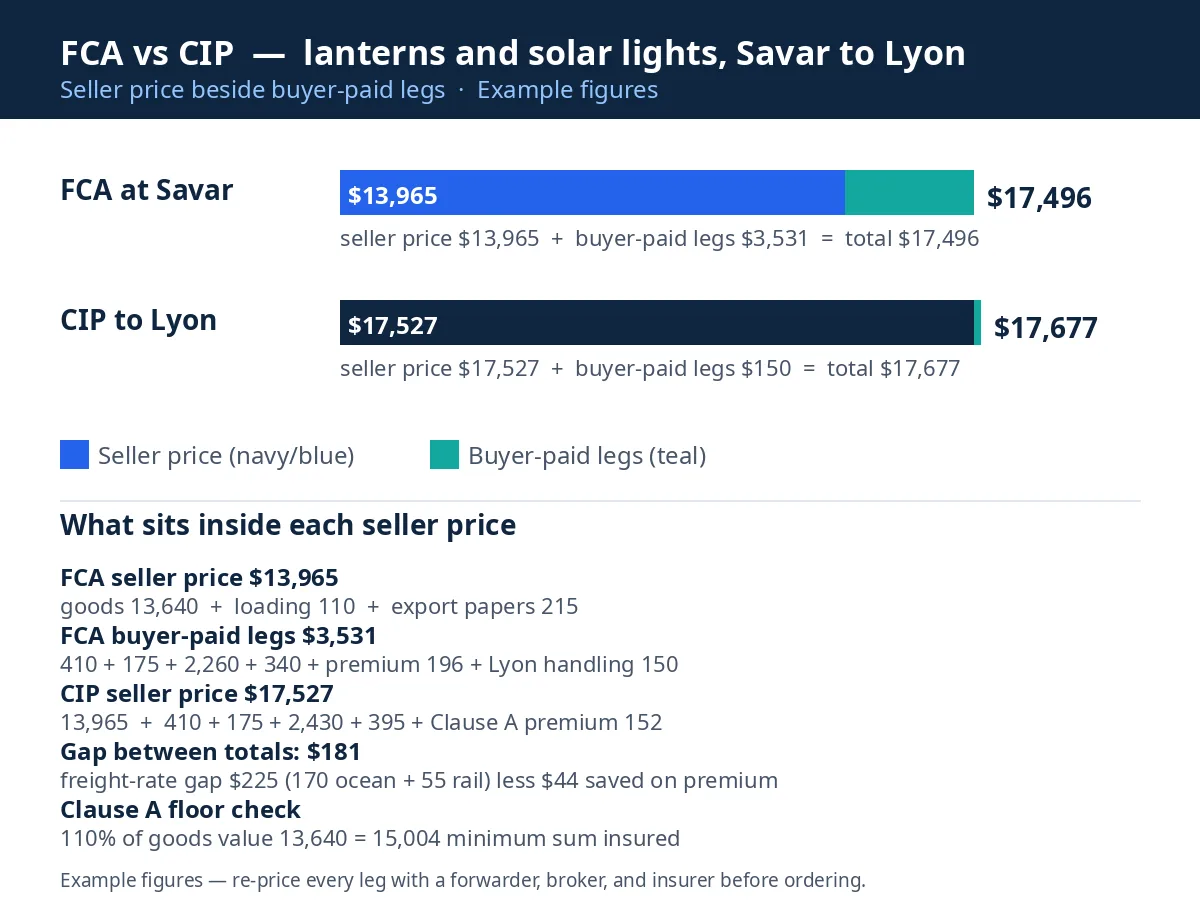
FCA reaches 17,496 from a seller figure of 13,965, built as 13,640 plus 110 plus 215, together with buyer-paid legs of 3,531, built as 410 plus 175 plus 2,260 plus 340 plus 196 plus 150. CIP reaches 17,677 from a seller figure of 17,527, built as the same 13,965 plus 410, 175, 2,430, 395, and a 152 premium, together with buyer-paid legs of 150. Put the two columns side by side and the arithmetic reads: seller figures differ by 3,562, buyer totals by 181. The freight bills explain most of it — the seller's ocean leg is priced 170 above the buyer's and its rail leg 55 above — while the premium line pulls 44 the other way, the seller-bought Clause A policy costing 152 against the buyer's own 196. Another pair of freight rates could reverse the gap, and a buyer holding stronger ocean rates than the seller's would widen the FCA advantage further. Rank the two quotations by their buyer totals, once the Lyon handling position is confirmed in writing for each column, and once the premium lines are compared as wordings, not just as figures: the 152 buys the seller's Clause A policy, chosen by the seller, while the 196 buys the wording, insurer, and start date the buyer chose.
The 110% floor illustrates the same check in miniature. On the goods value shown here, 13,640, the minimum sum insured is 15,004, which is 110% of 13,640.4 That floor is measured against the contract price in the real order, so check the certificate's sum against the contract price as written, in the contract currency, and confirm the window runs from the Chattogram handover to at least the Lyon terminal.3 Duty, import clearance, and carriage from the Lyon terminal to the buyer's warehouse sit outside both totals. No duty percentage is stated, because no tariff schedule for France was opened for this article. Ask a broker for the duty figure, then build both columns out with duty, the clearance charge, and the final leg before deciding which quotation costs less. Both columns carry Clause A wording, but the cover starts at different moments in the journey's paperwork: at the Savar collection under FCA, and at the first-carrier handover under CIP. Ask the insurer to confirm each policy starts on the day risk moves in its own column, and that the CIP certificate sits in the buyer's file before the cartons leave Savar, not after the vessel sails.
Three tests for paying the seller's bundle
First, test the destination. CIP repays its price where the destination sits inland, past the port, and the buyer wants one seller figure to carry the load there: a rail terminal at Lyon, a depot, an airport cargo terminal, or any named point inside the buyer's country that the seller's carriage contract can reach.1 FCA leaves every leg past the handover to the buyer, so a buyer ordering to an inland point on FCA must buy the ocean leg, the rail leg, and the cover separately, and must coordinate three bookings against one handover date. Where the load sails port to port and the buyer collects at the port itself, that inland advantage disappears, and the choice turns on freight rates and cover alone.
Second, test the cover the buyer already holds against the cover the seller must buy. A buyer with an open cargo programme, a broker that writes Bangladesh-origin loads routinely, and wording it has already tested on a claim should price on FCA and keep the policy: the buyer chooses the insurer, the start date, and the exclusions, and pays one premium for the whole journey from Savar. A buyer with no policy, no broker, and no insurer relationship should price on CIP and read the certificate as the price of admission: clause letter, sum against the 110% floor, currency, beneficiary line, destination, and insurer standing, all confirmed before payment. A buyer in between — holding a policy, but one that starts at the port and leaves the truck leg and the depot wait bare — should fix the start date before choosing either term, because the gap sits in the buyer's own wording, not in the Incoterm letters.
Third, test freight control against freight convenience, with the rates in hand. Under CIP the seller chooses the carrier, the route, and the sailing or departure, and the buyer receives the goods on the seller's timetable.3 Under FCA the buyer picks its own carrier and route, merges loads from several sellers onto a shared booking when that helps, and bargains rates directly. A buyer with negotiated ocean and rail rates, or a forwarder consolidating several Bangladesh orders, should price on FCA and keep the routing decisions. A buyer placing one consignment only, without carrier relationships on the route, should price on CIP and judge the seller's timetable, transshipment plan, and Lyon handling position before signing. The premium line rarely decides the comparison on its own: in the illustration above it moves the gap by 44, while the freight-rate gap moves it by 225.
CIP fits badly in two cases that buyers often miss. A buyer that expects the seller to stand behind the cartons all the way to Lyon will find neither FCA nor CIP fits, and a D rule answers that bargain. Where the buyer wants war, strike, or wilful-damage risks covered, neither standard policy fits on its own, and the extra cover must be agreed in the contract with the payer of the extra premium recorded.5 And where the buyer has no carrier, forwarder, broker, or insurer engaged at all, neither term on its own carries the order: the carriage, cover, and clearance support must be put in place first.
Before the truck is booked: places, certificate, destination money
Work through four checks, in this order, before the cartons move.
Write both CIP places, and the FCA place, so a stranger could run them. Name the delivery place and point in full — the depot or terminal at Chattogram, its address, the handover window — and name the destination in full — the Lyon rail terminal, its name and address, the point where the seller's paid carriage ends — with the edition cited beside both.3 A CIP order that names only Lyon hands the seller that choice of the handover point, and the buyer may discover when risk passed, and when cover should have begun, only when a claim turns on it.3 An FCA order needs the same precision in its single place: the Savar premises address, the carrier's name and phone details, plus the collection window, sent to the seller ahead of the carrier's arrival. Keep one spelling of each place on every document: quotation, invoice, packing list, insurance certificate, and transport document alike.
Read the certificate before paying the invoice, and read it as a checklist, not as a formality. Read five lines on the certificate: the clause letter, and whether it reads A or equivalent; the sum, tested against the 110% floor; the currency, tested against the contract; the beneficiary line, and whether it entitles the buyer to claim directly; the window, and whether it reaches at least the named destination; and the insurer's standing.3 4 Ask for the document with the shipping documents, and file it alongside the order, so a claim opens from the papers instead of a hunt for them. Where the destination country requires cover placed locally, or bars non-admitted insurers, settle that point before the seller places the policy, since the seller may otherwise be unable to buy the cover the term demands.4 Where the buyer wants war, strike, or wilful-damage risks covered, agree that extra cover in the contract and note in writing which side funds the extra premium: cover above the standard falls to the buyer.5
Check the export file against the goods as packed. Export clearance sits with the seller in either column. The buyer's job is to line the seller's documents up against the packed cartons, checking that term and place read identically on each one.2 Settle in advance how delivery news travels under CIP: one named person who sends the carrier's name, the handover date, and the transport document reference on the handover day itself, so the buyer hears the same day both when risk moved and when the Clause A window opened, since delivery and the risk transfer stand whether or not the notice has arrived.6
Settle the destination money before the vessel sails. Sort the Lyon money before the vessel sails: which charges the seller's freight already absorbs, which fall to the buyer, and duty funds in hand — import clearance and duty remain the buyer's in either column, and unloading at destination follows the carriage contract.6 Book onward carriage from the Lyon terminal early, so the cartons do not wait at the buyer's expense while the last leg is arranged.
Questions buyers ask about FCA and CIP
Does the Clause A policy in a CIP price cover theft and water damage on the way to Lyon?
Clause A cover reaches far wider than the minimum Clause C wording, and it is the right starting point for cartons that suffer handling, water, and pilferage losses. Clause C covers only a selection of expressly named risks, such as stranding, fire, and general average, and theft and goods washed overboard fall outside it, while Clause A covers a wide range of risks.4 Read the certificate itself before relying on the label: the all-risks wording still carries exclusions, and protection against war, strikes, or wilful damage is not necessarily included, so a buyer that needs those risks covered must agree the extra cover and pay for it.4 Check the window as well: the policy must run from the delivery point to at least the named destination, and a certificate that starts at the port leaves the truck leg and the depot wait outside the cover.3
For the lantern load priced above, which total lands lower, FCA or CIP, and what flips it?
FCA finishes 181 dollars ahead at 17,496 against 17,677: the buyer's own ocean and rail bookings come in 225 below the seller's, while the premium line gives 44 back. The gap reverses wherever the seller's freight pricing undercuts the buyer's by a margin larger than the premium difference, or wherever the buyer must pay a broker or insurer separately to arrange cover the CIP figure already contains. Build each total on the same footing: seller figure, plus every leg left for the buyer, plus duty, clearance, any Lyon handling outside the freight, and the final leg, with the duty figure from a broker. A headline that leaves freight, premium, or destination handling unbought is not lower. It is incomplete.
Can a buyer move a CIP order to FCA after the purchase order is signed?
Yes, while the cartons are still with the seller and the first carrier has not yet taken them. The change needs three things: written agreement from both sides, a fresh price, and documents reissued so each one names the new term — order, quotation, invoice, packing list, insurance document, and transport document, checked in that sequence. Moving from CIP to FCA pulls delivery back to the place the parties agreed, returns carrier nomination and freight booking to the buyer, and removes the carriage and the Clause A premium from the seller's price, so the buyer must have its own carrier and its own policy ready from the new handover date. The move the other way adds those two items to the seller's price and requires the certificate to be placed and checked before the load moves. Any letter of credit naming the old term must be amended separately: the bank tests presented documents against the credit as written. Agree the new price, the delivery place, the destination, and the date cover begins before the load is dispatched, because risk that already passed at a first-carrier handover stays passed.
Why does a CIP contract name a destination in France when the risk passes in Bangladesh?
Because the destination name in a CIP citation fixes money, not risk. The seller contracts and pays for carriage and insurance to the named destination, while delivery and the transfer of risk happen at the handover to the carrier, typically in the seller's country.6 The C rules keep those two points apart on purpose: the place of delivery is where the seller hands the goods to the carrier, and the place of destination is where the goods are to be received and to which the seller must arrange transport.6 Naming Lyon therefore tells the buyer how far the seller's freight bill and policy run, and tells the buyer nothing about who answers for a loss on the voyage. That answer comes from the delivery place, which is why the contract should name both places, and why a buyer that wants risk to stay with the seller until Lyon needs a D rule instead.
Next steps on Exportain
Place the pair in context with the full eleven-rule chart that puts CIP beside the other any-mode rules, then test any sea-freight quotation against the CIF page that sets Clause C minimum cover beside the Clause A level CIP requires. When term, delivery place, destination, and cover are settled, work through the eight buying steps, from catalogue search to freight and inspection.
Sources
- CIF & CIP Incoterms 2020 explained: Key differences. ICC Academy, (accessed )
- FCA & EXW Incoterms® 2020 explained: Key differences. ICC Academy (accessed )
- CPT & CIP Incoterms 2020 explained: Key differences. ICC Academy (accessed )
- CIP Incoterm | Carriage and Insurance Paid To. Röhlig Logistics (accessed )
- CIF (Cost Insurance and Freight) | Incoterms 2020. Röhlig Logistics (accessed )
- Incoterms® 2020 C rules vs D rules: Risk transfer explained. ICC Academy (accessed )
About the author
Sourcing from Bangladesh?
Post a request for quotation and suppliers on Exportain can send you their quotes directly.
Post an RFQ