Saudi Arabia Electrical Cable Imports From Bangladesh: SABER, Ports, Duty
Jeddah, Dammam, or the Riyadh dry port, the SABER and G-Mark route, and the broker-confirmed duty and VAT position decide a Saudi cable import before price does. This guide works through each in decision order, with a worked landed-cost example in Saudi riyals.
Short answer
Importing electrical cables from Bangladesh to Saudi Arabia works when the entry point, the conformity route, and the border file are settled before price is discussed. Pick Jeddah, Dammam, or the Riyadh dry port by delivery address, settle the SABER and G-Mark answers for the exact cable with the assessment body, and have a broker confirm the heading 8544 code, duty, and VAT in writing before pricing.
On this page
Key takeaways
Choose the entry point by delivery address: Jeddah Islamic Port for the west, King Abdulaziz Port in Dammam for the east, and the Riyadh Dry Port by rail from Dammam for the centre; confirm the terminal, storage terms, and onward service before comparing freight.
Settle the SABER scope answer for the exact cable first: the importer initiates the Product Certificate of Conformity through a conformity assessment body, and a Shipment Certificate of Conformity follows for each shipment; check separately whether a G-Mark certificate is also needed.
No duty rate is stated in this guide: the broker must confirm the full Saudi tariff code for heading 8544 and the duty rate beside it in the ZATCA tariff, in writing, before pricing; VAT uses the 15% standard rate on declaration amounts including duty.
Name the construction, standard, and edition on the order, with conductor size measured on the finished cable under IEC 60228:2023, and have the assessment body confirm which Saudi standard and edition is currently in force, including any national modifications.
Price from the worked landed-cost table in Saudi riyals, with duty as a separate line to be inserted from the broker's written figure and VAT shown at 15% of the pre-duty subtotal, and compare suppliers leg by leg on the same delivery basis.
A cable order bound for Saudi Arabia is decided in a different order than the quotation suggests. The entry point comes first, because Jeddah, Dammam, and the Riyadh dry port serve different delivery addresses. The conformity route comes second, because a cable that has not been through the Saudi system cannot clear even when the shipment is ready. The importer file comes third, and the customs file last, with duty and tax confirmed in writing rather than estimated from another market. This guide works through those four decisions in that sequence, with a worked landed-cost example in Saudi riyals.
Pick the Saudi entry point from the delivery address, not from the freight quote
Start with the warehouse or project address and work back to the entry point that serves it. A quotation that names only "Saudi Arabia" has not answered the gateway question, because the Kingdom has two seaboards and an inland rail terminal, and the wrong choice adds an inland leg across the country. The forwarder should name the port, the terminal inside the port, and the onward service for the shipment week, in writing, before freight rates are compared.
For the western region and the Red Sea coast, Jeddah Islamic Port is the entry point. Its flagship container terminal is operated by Red Sea Gateway Terminal (RSGT) and accounts for nearly 40% of Saudi Arabia's container throughput.1 A further terminal is being built under a joint RSGT and CMA CGM agreement signed in August 2026, adding up to 2.6 million TEU of annual handling capacity with new deep-water berths and 10 new ship-to-shore cranes.1 A Jeddah buyer should ask which terminal receives the vessel, the stripping point if the container is opened at the port rather than travelling on sealed, and the storage terms that apply while the conformity and customs files are checked.
For the Eastern Province and the Gulf coast, King Abdulaziz Port in Dammam is the entry point. Saudi Global Ports operates two container terminals there: Terminal 1 covers 138 hectares with 1,680 meters of berth, 14 meters of quay depth, handling capacity of about 2.08 million TEU, 11 quay cranes and 35 rubber-tyred gantry cranes, while Terminal 2 covers 64 hectares with 925 meters of berth, 16 meters of quay depth, handling capacity of about 1.77 million TEU, 9 quay cranes and 30 rubber-tyred gantry cranes.2 Together the terminals connect to more than 40 international trade routes.2 A Dammam buyer should ask which terminal receives the vessel and which onward road service runs to the delivery address, since the two terminals differ in berth length, depth, and equipment.
For Riyadh and the central region, the Riyadh Dry Port changes the route rather than merely shortening it. Saudi Global Ports runs up to 7 daily rail services between King Abdulaziz Port in Dammam and the Riyadh Dry Port, in collaboration with the Saudi Railway Company, under a single operator managing both the seaport and the inland nodes.3 The Riyadh Dry Port is the only inland customs clearance point for containers moved by rail from King Abdulaziz Port in Dammam, and it also operates a bonded zone.4 A Riyadh buyer should therefore ask whether the container clears at the dry port or at Dammam, who holds the bonded-zone position if the drums wait, and how the final road leg to the warehouse is booked.
Drums that travel loose, or containers unpacked at the port so drums can be checked, raise a separate question at any of the three entry points. The buyer should ask the forwarder to name the unpacking point, the storage place for heavy reels, and the daily charge while drums wait for release, and settle that arrangement before loading in Chattogram, not at discharge.
Entry point | Serves | Onward question to settle | First answer to get in writing |
|---|---|---|---|
Jeddah Islamic Port | Western region, Red Sea coast, Western region and the Red Sea coast | Road onward from the named terminal | Which terminal takes the vessel, and where drums are unloaded |
King Abdulaziz Port, Dammam | Eastern Province, Gulf coast, the Eastern Province | Road onward from Terminal 1 or Terminal 2 | Which terminal receives the vessel, and the storage terms there |
Riyadh Dry Port, by rail from Dammam | Riyadh and the central region | Rail to the dry port, then road to the warehouse | Whether clearance happens at the dry port, and the bonded-zone position |
Work out the SABER route and the G-Mark question for the exact cable
Saudi conformity runs through a platform, not through a paper certificate attached at the factory gate. SABER is the electronic system introduced by SASO, the Saudi Standards, Metrology and Quality Organization, to register products and issue certificates of conformity for goods imported into Saudi Arabia, replacing the older paper-based system.5 The platform was launched on 1 January 2019,6 products are registered on SABER and linked to their HS code,6 and in July 2020 SASO and Saudi Customs linked SABER with FASAH, the customs single window.6 The practical consequence is that the conformity file and the customs file are connected: a mismatch between the registered product, the code, and the shipment documents surfaces at clearance.
Two certificates sit at the centre of the route, and they do different jobs. The Product Certificate of Conformity (PCoC) covers the product type and is valid for one year, while the Shipment Certificate of Conformity (SCoC) is issued per shipment and is required for customs clearance.5 The PCoC request must be initiated by the importer, who then selects a conformity assessment body, and the SCoC follows for each shipment after the PCoC, also requested by the importer.6 Both the importer and the manufacturer or supplier must hold SABER accounts.5 The buyer should therefore confirm, before ordering, who the Saudi importer is, that the importer holds a SABER account, and which assessment body will assess the cable. A supplier promise to "handle SABER" without naming the importer, the assessment body, and the registration behind it is not a route.
Whether the cable is regulated at all is the first question the assessment body must answer in writing. SABER registration covers regulated and non-regulated products, and goods outside the regulated scope may need only a self-declaration on SABER.5 Low-voltage electric devices were brought under mandatory electronic certification through SABER from 1 April 2019.6 That date does not settle the position of a particular construction today. The buyer should ask the assessment body to state, for the exact construction and its HS code, which Saudi technical regulation applies, whether the cable falls inside the regulated scope, and which route follows. Record the answer with the construction name, the standard and edition, and the code, so a later shipment of a different construction is not treated as covered by the first answer.
The Gulf Conformity Mark, the G-Mark, is a separate question that can sit alongside SABER. The G-Mark is required by GSO Technical Regulations before low-voltage electrical equipment can be placed on the market in any GCC state, it must be issued by a GSO-approved Notified Body, and affected products cannot legally enter or be sold in Saudi Arabia and the other GCC states without it.7 Low-voltage electrical equipment means equipment rated between 50 and 1,000 volts AC, or 75 and 1,500 volts DC, and the category expressly covers cables, switches, and accessories.7 Certified products must carry the G-Mark with the GSO Conformity Tracking Symbol, a QR code linking the product to its certificate record.7 The scheme is separate from SABER, and a product can need both.7 Ask the assessment body and the Notified Body, in writing, whether the exact cable needs a G-Mark certificate, a SABER certificate, or both, and which body issues each.
The construction standards underneath the route need the same precision. SASO adopted IEC 60227-1:2007, on polyvinyl chloride insulated cables of rated voltages up to and including 450/750 V, as a Saudi standard with national modifications varied to take account of conditions in the Kingdom.8 The document recording that adoption is a final draft circulated for comment, which states that it may not be referred to as a Saudi standard until approved by the board of directors.8 Never quote the draft as the current rule. Instead, ask the assessment body which Saudi standard and edition is currently in force for the construction, what national modifications apply, and where the marking and test requirements are stated.
The conductor itself is governed by its own international standard, which the buyer should cite on the order. IEC 60228:2023 sets nominal areas from 0.5 to 3,500 square millimeters for conductors in electric power cables and cords, pairs each area with wire numbers, wire sizes, and resistance values, and takes in solid, stranded, and Milliken conductors in copper, aluminum, and aluminum alloy, measuring the conductor as it sits in the completed cable rather than as it was made or supplied for inclusion.9 Have the quotation and the test evidence record the conductor material and class, the nominal area, the standard, and the edition, and confirm that resistance was checked on the completed cable. A bare trade size, or a standard cited without its edition, will not line up with a test report. A special cable type governed by its own standard should be ordered under that standard, with the assessment body confirming the technical regulation calls for it.
Name the Saudi importer, then test suppliers against the Saudi file
The importer is the party the Saudi system holds responsible, so name that party before any supplier is scored. The importer initiates the PCoC request and the SCoC request on SABER,6 and the customs declaration is filed through FASAH with the importer's details behind it. If the buyer is not itself the Saudi importer, the buyer needs a written agreement with the importer covering who holds the SABER account, who instructs the assessment body, who files the declaration, who pays duty and VAT, and who receives the goods at the entry point. A quotation that leaves the importer unnamed leaves the conformity route and the customs file unnamed with it.
Supplier papers are checked against the same file. Ask for the exporter's registered legal name and address as they will read on invoices and shipping papers, the trade licence, the tax identification number and VAT registration where they apply, and the Export Registration Certificate (ERC) issued through the Office of the Chief Controller of Imports and Exports, the registration an exporter needs to ship from Bangladesh.10 Match names, addresses, and validity periods from document to document, and confirm one legal name runs through quotation, proforma invoice, bank account, and shipping papers, with any mismatch explained in writing.10 On Exportain, check the scope of each trust badge before treating it as assurance: the badge shows which document and profile reviews were carried out; it is not a factory audit, not an inspection of the goods, and not a promise about capacity, quality, or delivery, and joining alone does not earn one.10
Send every shortlisted supplier one identical written brief, and rank the replies against the Saudi file rather than against headline price. The brief should carry the delivery address and entry point, the construction, standard, and edition, the SABER and G-Mark scope answers already received, the quantities with the drum plan, the delivery rule and the places it names, and the warehouse delivery date the cable must meet. Score the replies on three points, taken in this order. First, does the technical evidence pin down the exact construction, standard, and edition requested, alongside readable test reports and a scope answer the assessment body has accepted? Second, are scope and standard questions answered head-on, including the constructions the supplier will not cover and what changes outside the low-voltage band? Third, do drum, length, and remainder terms, plus the delivery rule and the places it names, come back as figures and places instead of vague assurances? A supplier failing the first point while quoting keenly will end up the dearest on the list, since retesting, relabeling, or a held delivery costs more than the deposit saved. Treat silence on a scope question, or paperwork that names another construction, as a failed check.
Samples test whether the file matches the cable. Approve a sample length in a signed note against the specification, keep a marked cut piece with the approval date, and hold every production drum to that piece for construction, marking, and labeling. When a test report arrives, line up report, approved piece, and drums by name, and turn the file back if any one of the three names something else. On a first order, budget a trial length so the installer handles the actual cable on site ahead of the bulk drums. Ask the assessment body and the broker what language the marking, labels, and documents must carry, and get the answer in writing before production.
Set drum, length, and price-part terms before the quotation is ranked
Plan from the pulls the installer will make, not from the drums the supplier prefers. List each run and the length it needs, add an allowance for offcuts, waste, and spares, and turn the result into a drum schedule: total meters, meters per drum, tolerance on each drum, short lengths and remainders, drum ownership and return, and the site time a short or damaged drum costs. Write the unloading sequence onto the packing list, so warehouse releases follow the order the site draws the drums.
Ask what the minimum is counted on before you accept it. The minimum may attach to one construction, one standard, or one run, and each basis changes the quantity that arrives. Put the supplier's stated basis next to the installer's run lengths, offcut, waste, and spares allowance included, and judge whether the order still fits. If the minimum overshoots the job, test what brings it down: smaller drums, a shared run, or delivery split over two dates, and put the agreed number in writing in meters. This guide states no typical minimum; the supplier's stated basis for that exact construction is the only number to plan from.
Timber drums carry a plant-health file of their own. ISPM 15 describes phytosanitary measures that reduce the risk of introduction and spread of quarantine pests associated with wood packaging material made from raw wood, and the material it covers includes dunnage but excludes wood packaging made from processed wood free from pests, such as plywood.11 Ask the supplier to state the drum material, the treatment applied to each drum, and the mark evidence the shipment will carry, before loading, and have the broker confirm the Saudi position on wood packaging.
Restate all quotations on a single delivery basis before any ranking. Each quotation should break out the goods price, the freight and insurance treatment under its delivery rule, and the buyer-side charges at the port, in customs, and on the inland haul to the warehouse. One lump sum with no delivery rule named leaves the split between seller-paid and buyer-paid costs invisible, so two such sums cannot be ranked against each other. If a supplier moves the delivery basis during negotiation, start the comparison again instead of patching the old ranking. The landed-cost section near the end shows the split to use.
Choose the delivery rule for drums in containers
The delivery rule answers three questions: who books the carriage, who carries the risk while the drums move, and who clears the goods at the border. The sea and inland-waterway-only rules are four — FAS, FOB, CFR, CIF. CPT is any-mode. DPU is any-mode. DDP is any-mode (seller clears import customs, pays duty). FCA is any-mode. Put the delivery place, in full, into the contract wording. The ICC Academy summary warns that a vague port name lets the seller settle on a terminal the buyer never planned for, leaving the inland bill with the buyer, and it notes FCA usually suits container cargo better than FOB, even on a sea leg.12
FCA suits the Saudi container leg better than FOB even when the ocean crossing is the main movement. Under FOB the seller delivers, and risk passes, once the goods are on board the vessel at the named port of shipment, yet container drums wait at the terminal ahead of loading, and handling damage tends to happen in that wait.12 Under FCA, delivery and risk pass on handover to the carrier at the named place: at the seller's premises once the goods are on the buyer's vehicle, or at another named place once the goods are ready there to be unloaded, at the carrier's or the buyer's nominee's disposal.12 Where the purchase runs on FOB terms, ask the forwarder in writing who carries the risk through terminal handling, and put the reply into the contract.
The C rules split cost from risk, and buyers misread the split often. In the C rules the seller arranges and pays for transport to the named destination, but the buyer bears the risk of that transport, with risk passing on handover to the carrier under CPT and CIP, and on loading on board under CFR and CIF, while CIP and CIF add a seller obligation to insure against the buyer's risk.12 The D rules run delivery and risk transfer through to the named place: DAP delivers the goods ready for unloading, DPU adds unloading by the seller, and DDP adds import clearance by the seller.12 DAP to a named warehouse, or to the Riyadh Dry Port where the container clears there, suits many first Saudi orders, since the seller runs the move while the buyer holds the customs file. Before agreeing DDP, confirm in writing that the seller can act as the Saudi importer, hold the SABER account, instruct the assessment body, and file through FASAH. Settle the VAT evidence in the contract under DDP, since the buyer loses direct control of the declaration supporting any VAT recovery.
No sailing time is given here. Arrival moves with the sailing schedule, transshipment, terminal congestion, and the rail or road leg onward, so figures lifted from another route or season would have the installer waiting on site on the wrong day. Get three shipment-week facts from the carrier or forwarder — the sailing, the expected terminal arrival, and the onward booking — and fix the site date from those, with days added for inspection and conformity checks. Have the goods description name the construction in full rather than a generic label, since vague wording invites questions and holds.
Build the Saudi border file around the declaration, the tariff line, and VAT
Four holders each carry one part of the border file. The importer holds the SABER account, the certificates, and the VAT position. The broker holds the declaration, the classification, and the duty and VAT calculation. The carrier holds cargo reporting and the advance data. The supplier holds the origin evidence and the commercial documents. Leaving the whole file with "the forwarder" fails at the first customs question, because no forwarder can supply a certificate or a VAT position the importer has not given.
The customs declaration is the document the file turns on. A customs declaration contains comprehensive information about imported goods, including origin, type, value, quantity, and weight, with payment documents and shipping invoices that help determine the applicable duties.13 The steps described for Saudi imports are: register on the FASAH portal of the Zakat, Tax and Customs Authority, enter the goods details with supporting documents, pay the duties calculated on type and value through FASAH, and wait for customs review, after which the declaration is issued if the information is correct.13 A declaration can be amended before all procedures are completed, but not after clearance is complete.13 Have the broker draft the declaration from settled papers before loading, and treat any later change to the construction, code, or value as a change to the declaration itself.
Start classification at heading 8544, and treat it as indicative until the broker confirms the full Saudi code. The heading takes in insulated wire, cable, and other electric conductors, with or without connectors, and optical fiber cables whose fibers are individually sheathed.14 The six-digit lines split the family by winding-wire material, pick out coaxial cable and vehicle wiring sets, divide other conductors by the 1,000-volt threshold and by whether connectors are fitted, and close with optical fiber cables.14 The subheading follows the construction's type and voltage; the code is then built out to its full Saudi tariff form, which sets the duty line. The code must match across the SABER registration, which links the product to its HS code,6 the invoice, and the declaration. No duty rate appears in this guide, and no duty-free outcome is claimed: before pricing, the broker confirms the full Saudi code, the duty rate beside that code in the ZATCA tariff, and every measure in force on the arrival date, in writing.
VAT sits on top of duty, with a base of its own. The standard VAT rate in Saudi Arabia is 15%.15 VAT is applied to all amounts calculated in the customs declaration, including customs duties, on the value of the goods, shipping costs, insurance, customs fees, and customs declaration fees.16 In the worked example below, VAT is shown at 15% of the pre-duty CIF subtotal, with a further 15% of the duty figure added once the broker confirms the duty. Whether the VAT is recoverable through the importer's return, or stands as a final cost, is a question for the accountant, to be settled before pricing. Keep the declaration, the SCoC, the duty and VAT calculation, and the payment evidence with the order file.
The SCoC travels with the shipment documents to clearance. The shipment certificate must be obtained through SABER for each shipment entering Saudi Arabia, and it is presented with the shipping documents at Saudi customs.5 Because SABER and FASAH are linked,6 the broker should check before loading that the SCoC, the product registration, and the declaration all name the same product, code, and quantity. A certificate naming a different construction is a file defect, cheaper to fix before sailing than at the terminal.
Border file item | Holder | Settle by |
|---|---|---|
SABER account, PCoC, SCoC, and scope answer | Importer with the assessment body | Before the order is placed |
G-Mark certificate and tracking symbol, where required | Notified Body, through the importer | Before production |
Customs declaration through FASAH, classification, customs value | Broker | Before loading in Chattogram |
Duty rate beside the confirmed Saudi code, in the ZATCA tariff | Broker | Before pricing |
VAT calculation and recovery position | Broker and accountant | Before pricing |
Cargo reporting, advance data, construction description | Carrier, using buyer data | Vessel departure from Chattogram |
Origin evidence and commercial documents | Supplier | Loading in Chattogram |
Timber and packaging statement, ISPM 15 evidence | Importer, with supplier | Loading in Chattogram |
Worked example in Saudi riyals, duty left to the broker
Read the table as arithmetic illustrated, not as a quotation: all figures are examples, and the duty row waits for the broker's written confirmation of the code and the rate in the ZATCA tariff. The example runs on FCA Chattogram, Incoterms 2020, for 9,600 meters of a single construction, discharged at Dammam, moved by rail to the Riyadh Dry Port, and delivered by road to a Riyadh warehouse, with VAT shown as its own cash-flow line at 15% of the pre-duty CIF subtotal. Rebuild it from real quotations and broker-confirmed figures before pricing.
Line | Example figures (SAR) |
|---|---|
Product cost: 9,600 meters at 9.75 per meter, FCA Chattogram | 93,600.00 |
Ocean freight, Chattogram to Dammam | 8,900.00 |
Cargo insurance | 640.00 |
Subtotal before duty (CIF value for this example) | 103,140.00 |
Import duty: rate the broker reads off the tariff line | Your figure |
VAT before duty: 15% of the subtotal above | 15,471.00 |
Customs broker fee | 1,150.00 |
Destination port and terminal charges at Dammam | 1,420.00 |
Rail to the Riyadh Dry Port and road delivery to the warehouse | 1,975.00 |
Inspection and testing | 1,340.00 |
Bank and currency costs | 425.00 |
Total cash outlay before duty, including VAT | 124,921.00 |
Landed cost per meter before duty, excluding VAT | 11.40 |
Add the lines in two groups: 93,600.00 + 8,900.00 + 640.00 = 103,140.00; 15% of 103,140.00 = 15,471.00; 1,150.00 + 1,420.00 + 1,975.00 + 1,340.00 + 425.00 = 6,310.00; 103,140.00 + 15,471.00 + 6,310.00 = 124,921.00. Before duty and excluding VAT, each meter already costs 109,450.00 / 9,600 = 11.40 against a quoted 9.75, about 17% higher. Add the duty figure divided by 9,600 to reach the final landed cost per meter, and add a further 15% of the duty figure to the VAT line, because VAT is calculated on amounts in the declaration including customs duties.16 A price built only from the quoted 9.75 leaves freight, inspection, brokerage, and delivery, plus duty and the VAT cash flow, to be paid out of margin. Compare suppliers against this table, leg against leg, on one delivery basis, and turn down any comparison that mixes delivery rules or hides an empty duty line. The method behind the table, including the treatment of reclaimable import tax as cash flow, is set out in the landed-cost method for Bangladesh imports.
Saudi first-order sequence
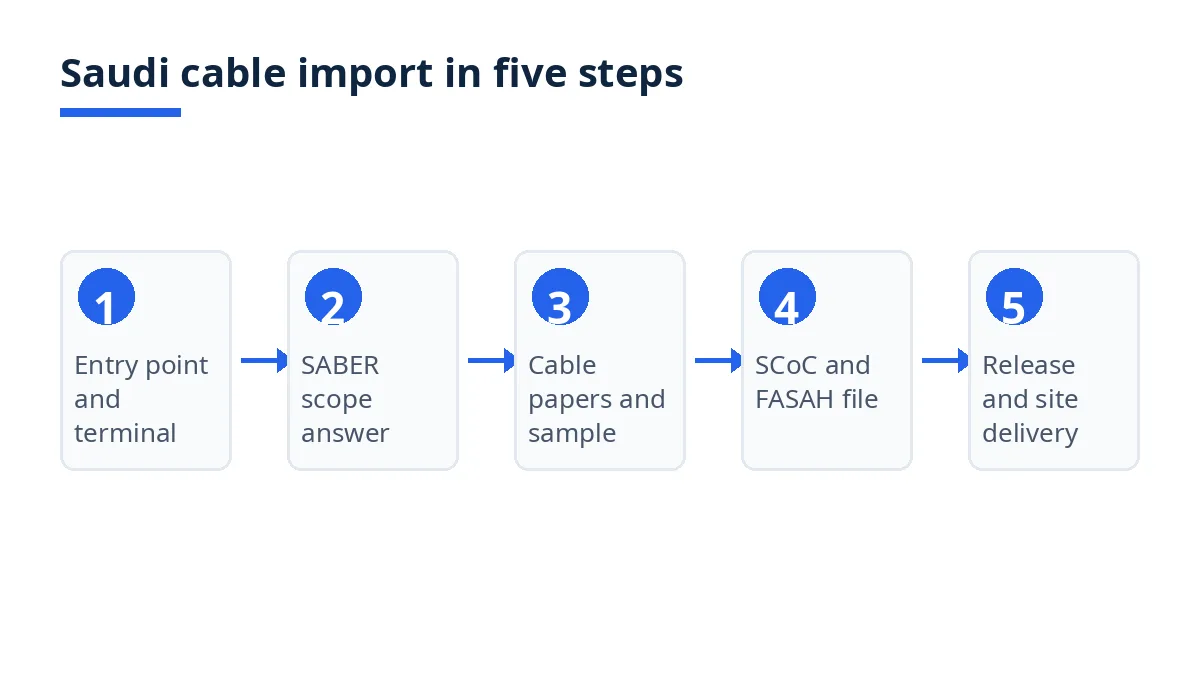
Take the steps in this order, and note any change that sends an earlier step back for revision. First, fix the delivery address, the entry point and terminal, and the onward rail or road leg, and get written confirmation from the forwarder on terminal, storage terms, and onward service. Second, name the Saudi importer and the broker, and get the written SABER and G-Mark scope answers for the exact cable, including the technical regulation, the assessment body, and the Notified Body where one is needed. Third, fix the construction standard and edition, the completed-cable conductor check, and test evidence that names the construction. Fourth, score suppliers on the Saudi file, sign off a sample length in writing, and keep a cut piece against it. Fifth, fix quantity and drum terms, with the drum material and treatment evidence agreed and the unloading order on the packing list. Sixth, fix the delivery rule and its named places, and assign the advance-data filing and each border-file part to a named holder. Seventh, have the broker confirm classification, the duty line from the ZATCA tariff, and the VAT calculation in writing, obtain the SCoC for the shipment, then rebuild the landed-cost table from those numbers before any price is set.
Questions Saudi Arabia buyers ask before ordering
Does a cable shipment to Saudi Arabia need SABER registration before it sails?
Get the scope answer before the order, not at the port. Regulated products must be registered on SABER before they can clear Saudi customs, with a Product Certificate of Conformity covering the product type and a Shipment Certificate of Conformity issued for each consignment,5 while goods outside the regulated scope may need only a self-declaration on SABER.5 Low-voltage electric devices were brought under mandatory electronic certification through SABER from 1 April 2019,6 but the scope answer for the exact construction, standard, and code is what decides the route for a given shipment. Ask the assessment body to state the technical regulation and the route in writing, confirm the importer holds the SABER account that initiates the certificates,6 and do not load until the SCoC route for the shipment is clear.
How does a buyer pick between Jeddah, Dammam, and the Riyadh dry port?
Pick from the delivery address, then confirm the terminal and the onward leg. Jeddah serves the western region through the RSGT terminal, which accounts for nearly 40% of Saudi container throughput,1 Dammam serves the Eastern Province through two SGP container terminals with different berth lengths, depths, and capacities,2 and Riyadh is served by rail from Dammam to the dry port, with up to 7 daily rail services and inland customs clearance at the dry port itself.3 4 The deciding answers are the terminal that takes the vessel, the storage terms there, whether clearance happens at the seaport or at the dry port, and the road or rail service for the shipment week.
How are duty and VAT worked out on a cable shipment into Saudi Arabia?
The broker works both out from the confirmed file, and neither figure is stated in this guide. Duty follows the full Saudi tariff code for the exact construction, read beside that code in the ZATCA tariff with every measure applying on the arrival date, and the broker confirms the code and the rate in writing before pricing. VAT uses the standard rate of 15%,15 applied to all amounts calculated in the customs declaration, including customs duties, on the value of the goods, shipping costs, insurance, customs fees, and customs declaration fees.16 Enter the broker's duty figure in the landed-cost table, add 15% of that figure to the VAT line, and have the accountant confirm whether the VAT is recoverable or a final cost before the price is set.
Which supplier answers decide a first Saudi cable order?
Three answers decide it, and all three must arrive in writing. The first is the conformity answer: the technical regulation, the assessment body, and the G-Mark position for the exact construction, with test reports naming that construction, standard, and edition. The second is the construction answer: conductor material and class, nominal cross-sectional area, and resistance measured on the finished cable under IEC 60228:2023.9 The third is the commercial answer: drum and length terms as figures, a delivery rule with named places, and business papers whose names match across the quotation, invoice, bank account, and shipping documents.10 Sign off the sample length in writing, keep a cut piece, and move to the next supplier while exit is still free if any of the three answers is refused or names a different construction.
When should the installer expect cable shipped from Bangladesh to reach a Saudi site?
No sailing time is given in this guide, and a figure taken from another route or season must not set the site date. Sailing schedules, transshipment, terminal congestion, and the rail leg to the Riyadh Dry Port or the road leg from Jeddah or Dammam all move the arrival date. Get the sailing, the expected terminal arrival for the shipment week, and the onward booking from the carrier or forwarder, then set the site date from those three facts with a buffer for inspection, conformity, and customs checks.
Next steps on Exportain
Read the step-by-step Bangladesh import sequence for the wider steps around the Saudi file, shortlist cable suppliers in the supplier directory on Exportain, and check the code discussion with your broker against the heading 8544 classification notes before filing. The ordering route is explained in buying on Exportain.
Post a free RFQ on Exportain and get quotes from verified Bangladeshi suppliers
Sources
- RSGT and CMA CGM announce USD 434 million initial investment (SAR 1.6 billion) to develop Terminal 4 and add up to 2.6 million TEUs of capacity at Jeddah Islamic Port. Red Sea Gateway Terminal (RSGT), (accessed )
- SGP Container Terminals - Dammam. Saudi Global Ports (accessed )
- Intermodal at Saudi Global Ports. Saudi Global Ports (accessed )
- SGP Intermodal. PSA International (accessed )
- What Is a SASO Certificate? SABER Certification Guide. Tetra Inspection (accessed )
- Saber Registration Saudi Arabia Services. Tabseer (accessed )
- G-Mark Certification. ITMAD (accessed )
- SASO/FDS/IEC 60227-1:2020 - Polyvinyl chloride insulated cables of rated voltages up to and including 450/750 V, Part 1: General requirements (final draft). Saudi Standards, Metrology and Quality Organization (SASO) (accessed )
- IEC 60228:2023 - Conductors of insulated cables. International Electrotechnical Commission, (accessed )
- How to Import from Bangladesh. Exportain (accessed )
- Regulation of wood packaging material in international trade (ISPM 15). International Plant Protection Convention (IPPC), (accessed )
- Place of delivery & risk transfer in trade contracts. ICC Academy (accessed )
- Importance of the customs declaration in import and export. Cargo.sa (accessed )
- Classification Detail — HS 2017 Code 8544: Insulated wire, cable and other electric conductors. United Nations Statistics Division (UNSD) (accessed )
- VAT Guideline For the Retail Sector. Zakat, Tax and Customs Authority (accessed )
- E-Store Customers. Zakat, Tax and Customs Authority (ZATCA) (accessed )
About the author
Sourcing from Bangladesh?
Post a request for quotation and suppliers on Exportain can send you their quotes directly.
Post an RFQ