FCA vs DAP: Key Differences, Costs and Which One to Choose
One load of enamelled steel cookware, priced from Savar to a Trafford Park terminal under FCA and under DAP, shows the destination bargain plainly: FCA ends at the carrier handover, DAP ends at arrival ready for unloading, and the buyer still unloads and clears import under DAP.
Short answer
FCA hands goods to the carrier the buyer names at an agreed place near the start of the journey, and the buyer pays carriage and carries risk from that handover. DAP keeps carriage and risk with the seller until the goods stand at a named destination ready for unloading, where the buyer unloads, clears import, and pays duty. Neither term obliges the seller to insure the buyer.
On this page
Key takeaways
FCA delivers at handover to the carrier the buyer named at the agreed place, and the buyer pays carriage and carries risk from there; DAP delivers at the named destination ready for unloading, with carriage and transit risk on the seller until arrival.
The DAP named place must be a point a driver can reach, a warehouse door or a terminal gate with an address and window, because a city name alone lets the seller choose the cheapest point.
Under DAP the buyer unloads at its own risk, clears import, and pays duty, and bears the risk while clearance runs; the unloading charge follows the carriage contract and must be settled in writing.
In the worked example the FCA buyer total is 20,930 dollars and the DAP buyer total is 20,975 dollars before duty, a 45 gap set entirely by the difference between the two sides' freight rates.
A buyer in Manchester holds two prices for one load of enamelled steel cookware from Bangladesh. The lower price ends at a maker's yard in Savar, where a carrier the buyer hired must collect the pallets. The higher price ends at a freight terminal in Trafford Park, with the pallets still on the arriving truck and the import file still the buyer's to finish. Between those two endings sits the whole journey: the road to Chattogram, the ocean leg to Liverpool, the last road leg inland, and every day of risk along the way.
FCA and DAP divide that journey at opposite ends. FCA hands the load to the buyer's carrier early, at a place near the start, and the buyer runs the rest. DAP keeps the load in the seller's hands until a named place near the end, and the buyer takes over only for unloading, import clearance, and the final move onward. This comparison follows the cookware load from Savar to Trafford Park, prices it under each term, and tests the one question that decides the choice: whether a single seller-managed leg to the destination is worth more to this buyer than control of each leg separately.
The destination bargain in one table
Point of comparison | FCA (Free Carrier) | DAP (Delivered at Place) |
|---|---|---|
Where the seller's delivery ends | Handover to the carrier or person the buyer named, at the agreed place | Arrival at the named place of destination, goods still loaded and ready for unloading |
When risk moves to the buyer | At that early handover | On arrival at the named destination |
Who arranges the main carriage | The buyer, from the handover onward | The seller, for the whole run to the named destination |
Who pays the carriage | The buyer pays each leg after handover | The seller pays carriage to the named destination |
Modes the rule covers | All modes, single or mixed | All modes, single or mixed |
Export and transit customs | Seller clears export | Seller clears export and transit customs |
Import clearance and duty | Buyer | Buyer, at the buyer's cost and risk |
Unloading at the destination | Buyer, where the handover is at a place other than the seller's premises | Buyer, at the buyer's risk; the charge follows the carriage contract |
Policy bought for the buyer | None | None; the seller still carries the transit risk itself |
What the buyer still runs | Carriage, cover, import clearance, unloading, onward carriage | Unloading, import clearance, duty, onward carriage from the named place |
DAP suits a buyer who wants the goods brought to a named destination at the seller's risk and can still handle the arrival work: the lift off the vehicle, the import file, and the duty payment. FCA suits a buyer who already holds carrier contracts and wants to run the journey leg by leg from the handover. Neither term asks the seller to buy a policy for the buyer, and neither term finishes the job at the buyer's warehouse unless the named place is the warehouse itself and the arrival work is done.
What the two terms ask of each side
Under FCA, the seller's part is short and exact. The seller delivers the goods and transfers the risk at the agreed place and point, on handing them to the carrier or the buyer's designated person, and in either case the seller completes the export formalities.1 Where the agreed place is the seller's own premises, the seller loads the goods onto the buyer's collecting vehicle. Where the agreed place lies elsewhere, such as a port container terminal, the seller delivers the goods to the carrier or designated person ready to be unloaded from the vehicle that brought them there.1 From that handover, the buyer arranges transport and handles import formalities.1 The seller's price under FCA covers the goods, their packing, the loading where delivery happens at its own premises, and export formalities; transport beyond the delivery point belongs to the buyer.1
Under DAP, the seller's part runs the full length of the journey. DAP requires the seller to deliver the goods and transfer the risk at the designated place and point of destination, by making the goods available to the buyer ready for unloading from the arriving mode of transport, and the agreed place of destination is typically in the buyer's country.2 The seller arranges and pays for transportation to that place, completes export formalities and any customs procedures in transit, while the buyer handles import formalities.2 The buyer takes responsibility for the goods, including the transfer of risk and the associated costs, once the seller has given notice enabling the buyer to collect them at the designated place.2 Delivery and destination mean the same thing under DAP: the named place is where the goods arrive, where they are handed over, and where risk moves, which contrasts with the C rules, where delivery happens at origin while paid carriage runs on to the destination.2 3
The sea and inland-waterway-only rules are four — FAS, FOB, CFR, CIF. CPT is any-mode. DPU is any-mode. DDP is any-mode (seller clears import customs, pays duty). FCA is any-mode.4 DAP belongs in the same any-mode group: it is suitable for any mode of transportation, including multimodal shipments that involve at least two different modes.5 Seven rules cover any mode and four cover sea and inland waterway only, so a load that travels by truck, vessel, and truck again can be described by either term in this comparison, and the choice turns on where delivery sits rather than on the modes used.4
The practical difference is who absorbs a bad day in transit. Under FCA, a delay, a damaged pallet, or a missed sailing after the handover is the buyer's problem to solve with its own carrier and its own cover. Under DAP, the seller must still get the goods to the named place: if the goods do not arrive there, or do not arrive in sound condition, the seller bears the transport risk and must provide the buyer a remedy, such as reshipment, or stand in default.3 That remedy is the value inside the higher DAP price, and it only has value if the buyer cannot manage the transit problem itself.
A warehouse door, a terminal gate, or a city name: naming the DAP place
The named place under DAP is not a label. It fixes where the seller's carriage ends, where risk moves, and where the buyer must be ready with a crew, a broker, and duty money. Three wordings name three different bargains, and only one of them tells a driver where to stop.
A warehouse door names the tightest bargain. The contract might read DAP followed by the buyer's warehouse address, with a delivery bay and a window. The seller's carrier drives to that door, the buyer unloads there, and onward carriage disappears because the goods have already arrived where they will be stored. Import clearance still belongs to the buyer, and where clearance must finish before the last leg to the warehouse, the buyer finishes it, tells the seller, and the seller's carrier continues to the premises, with the buyer bearing the risk of loss or damage during the clearance process.5 A buyer that cannot clear quickly should not name its own door without that sequence written down, since the load will sit uncleared while the seller waits to complete delivery.
A terminal gate names a middle bargain. The contract might read DAP followed by a named freight terminal at Trafford Park, with a bay number. The seller's duty ends when the truck stands at that gate with the pallets ready for unloading, and the buyer then unloads, clears import, and books the short move to its warehouse. The buyer keeps its own warehouse routine and its own onward carrier, and the seller never has to find a warehouse door it has never visited. The worked example in this article uses a terminal gate, so the onward leg stays visible as a buyer cost rather than vanishing inside the seller's price.
A city name names no bargain a driver can use. The contract might read DAP followed by "Manchester" alone. If the exact location is not specified, the seller can select the point that best suits its purpose, which will usually be the cheapest option, such as a cargo terminal.6 The buyer that meant its warehouse door may find the load standing at a terminal across the city, with unloading, clearance, and onward carriage all still to arrange, and no breach to point to. A common mistake with DAP and DDP is the belief that the destination will always be the buyer's premises, when the buyer could nominate anywhere it chooses, including a building site, a container terminal, or another place entirely.6 Precision is the protection: the place, the point within it, the address, and the window, spelled the same way on the order, the invoice, the packing list, and the transport document.
The FCA side needs the same precision, in miniature. The FCA place is one point near the start of the journey, but a vague point strands the buyer's carrier just as surely. Name the yard or terminal, the gate or bay, and the collection window, and pass the carrier's name and contact details to the seller before the carrier arrives. A buyer that names a city under FCA leaves the seller unsure where the handover happens and the carrier unsure where to collect, and the risk moment follows the handover, so the argument starts with the place, not with the price.
Arrival day: unloading, import clearance, and the pause in between
Arrival under DAP is a handover with work still attached. The goods stand at the named place, still loaded, at the buyer's disposal, and the buyer takes them off the vehicle. The risk of unloading the goods from the aircraft, truck, or vessel at the named place is the buyer's responsibility, and the cost of unloading may or may not be included in the transportation contract the seller arranged with the carrier; if it is not included, the buyer must bear the cost, so the parties should clarify the cost explicitly in the sales contract.2 The same split appears in the D rules generally: under DAP and DDP the seller pays unloading charges at the destination only if the carriage contract stipulates that they are the seller's responsibility, and otherwise they are the buyer's.3 Ask the seller, in writing, whether the unloading charge sits inside its freight deal. A carrier that holds cargo until an excluded unloading fee is paid does not care which side thought the other side was paying.
Import clearance is the second arrival job, and it belongs entirely to the buyer under DAP. The buyer must carry out and pay for all formalities required by the country of import, including licences and permits, import clearance, security clearance, pre-shipment inspection, and any other official authorisations.6 The seller has no obligation to arrange import clearance, although the seller must assist, at the buyer's risk and cost, in obtaining documents or information relating to import formalities if the buyer requests it.6 Under FCA the split is identical at the border: the buyer handles import formalities from the handover onward.1 The difference is timing. An FCA buyer clears import after running the whole journey itself, with days to prepare the file while the load is at sea. A DAP buyer meets the import file at the moment the load arrives, with the seller's delivery complete and the truck waiting.
The pause between arrival and clearance is where DAP orders most often stall. Where a shipment travels by air and requires import clearance in the destination country, the buyer carries out those formalities while the goods sit at the airport, and once cleared, the seller's carrier must be given whatever paperwork it requires to move the cargo from the airport to its final destination.6 The same pause applies at a terminal gate: the load stands ready for unloading, the buyer clears, and only then does the onward move happen. If the buyer fails to inform the seller exactly where delivery is required, or fails to import-clear the goods, the buyer bears the risk of loss or damage from the agreed date or agreed period for delivery.6 If goods are held indefinitely by the importing country's authorities because the buyer failed to obtain a necessary import permit, the buyer bears the risk.6 And if the buyer cannot import-clear the goods expeditiously, it might find that it bears the risk while the goods sit in customs control and is itself in breach if the seller cannot deliver as contracted.6 The seller's arrival notice is the trigger for all of this: the seller must give the buyer any notice the buyer needs to receive the goods, and the buyer should agree, in the contract, how much notice of the delivery point and timing it must give the seller in return.6
For the Manchester load, arrival readiness means four items settled before the vessel sails: a broker holding the import file, duty money confirmed, a crew and gear booked for the delivery window at the terminal gate, and onward carriage booked from the gate to the warehouse. A DAP buyer that meets the arrival notice with none of those ready has accepted delivery on paper while the pallets wait in practice, at its own risk, with storage charges building. The same four items matter under FCA, but the FCA buyer settles them while it still controls the sailing, rather than against a truck already standing at the gate.
Who carries the long haul, and who insures it
Under DAP the seller carries the risk for the entire transportation journey up to the designated place and point of destination, and the seller arranges and bears the cost of transporting the goods there.2 The seller has no obligation to arrange insurance for the buyer, and the seller assumes the risk of transportation up to the agreed destination.5 That combination surprises buyers who equate a seller-carried risk with a seller-bought policy. There is no policy owed. The seller may insure its own interest, since a loss on the journey is the seller's loss until delivery, and under the D terms generally, arranging insurance to protect the seller's own interest is the seller's decision.3 The buyer cannot claim on a policy it has never seen, and should not assume one exists.
The buyer's cover under DAP therefore starts late and covers little: the unloading lift, and the onward leg from the named place to the warehouse. Buy cover dated from arrival at the named place, with the lift and the short road leg named in the wording, and confirm with the insurer that the policy answers for damage during unloading, since that risk is the buyer's from the moment the goods stand ready for unloading.2 A policy that starts only when the pallets reach the warehouse leaves the lift and the terminal-to-warehouse leg bare, which are the two moments the buyer actually owns under DAP.
Under FCA the buyer's cover starts early and covers everything. The buyer carries the risk from the carrier handover at Savar, so the policy must run from that handover through the road leg, the port wait, the ocean leg, the Liverpool arrival, and the road leg to Trafford Park. The seller owes no policy under FCA either. The buyer selects its own insurer, wording, and start date, with the handover as day one of the policy. A policy dated from sailing leaves the Savar road leg and the Chattogram wait outside the cover, and a policy that names only the ocean leg leaves the two road legs bare. The FCA buyer's premium in the worked example is higher than the DAP buyer's short cover precisely because it spans the whole journey rather than the last few miles.
Freight buying follows the same split. Under DAP the seller engages the carriers, fixes the route and the sailing, and the buyer receives the goods when the seller's timetable allows. Under FCA the buyer engages its own carriers and can put this load together with other Bangladesh orders on one booking. A buyer that already moves several loads on shared bookings, or that needs a particular sailing for stock reasons, gains by holding the freight in its own hands. A buyer ordering once, with no freight relationships of its own, gains by letting the seller run the carriage, provided the seller's sailing dates, transshipment plan, and unloading position are checked before signing. Either way, notices must be disciplined: under DAP, the arrival notice that lets the buyer receive the goods; under FCA, the carrier details passed in good time so the handover happens at the right place on the right day.
Priced both ways: enamelled steel cookware from Savar to Trafford Park
The figures below are invented illustrations for this single load, to show how the arithmetic works. They are not quotations, and each leg needs fresh pricing from a forwarder and a broker before any real order. A buyer in Manchester orders one consignment of enamelled steel cookware sets, palletised, from a maker in Savar, for a named freight terminal in Trafford Park, Manchester. The pallets travel by truck to Chattogram, by vessel to Liverpool, and by truck to the terminal. Under FCA, the agreed place is the maker's yard at Savar, and the carrier the buyer named collects the pallets there. Under DAP, the named place of destination is the Trafford Park terminal, and the seller books the truck, the vessel, and the final road leg. The same pallets carry two seller prices, because the DAP price includes the carriage the FCA price leaves to the buyer, and because the two sides book ocean and inland carriage at different rates.
Price element | FCA at the Savar yard | DAP at Trafford Park terminal |
|---|---|---|
Goods and export packing | 16,400 | 16,400 |
Palletising and export crating | 180 | 180 |
Export papers | 240 | 240 |
Loading at the maker's yard | 90 | 90 |
Inland carriage, Savar to Chattogram | Buyer pays 420 | 420 |
Port handling at Chattogram | Buyer pays 195 | 195 |
Loading on board at Chattogram | Buyer pays 155 | 155 |
Ocean freight, Chattogram to Liverpool | Buyer pays 2,540 | 2,680 |
Inland carriage, Liverpool to Trafford Park | Buyer pays 285 | 310 |
Transit premium, whole journey | Buyer pays 165 | No transit premium: seller carries the risk |
Unloading at the Trafford Park terminal | Buyer pays 140 | Buyer pays 140 |
Cover for the lift and onward leg | Not needed separately | Buyer pays 45 |
Onward carriage, terminal to warehouse | Buyer pays 120 | Buyer pays 120 |
Seller's quoted price | 16,910 | 20,670 |
Buyer-paid legs after the price | 4,020 | 305 |
Buyer total before duty | 20,930 | 20,975 |
The chart below puts the two seller prices next to the sums each buyer still owes, with the illustration label on it.
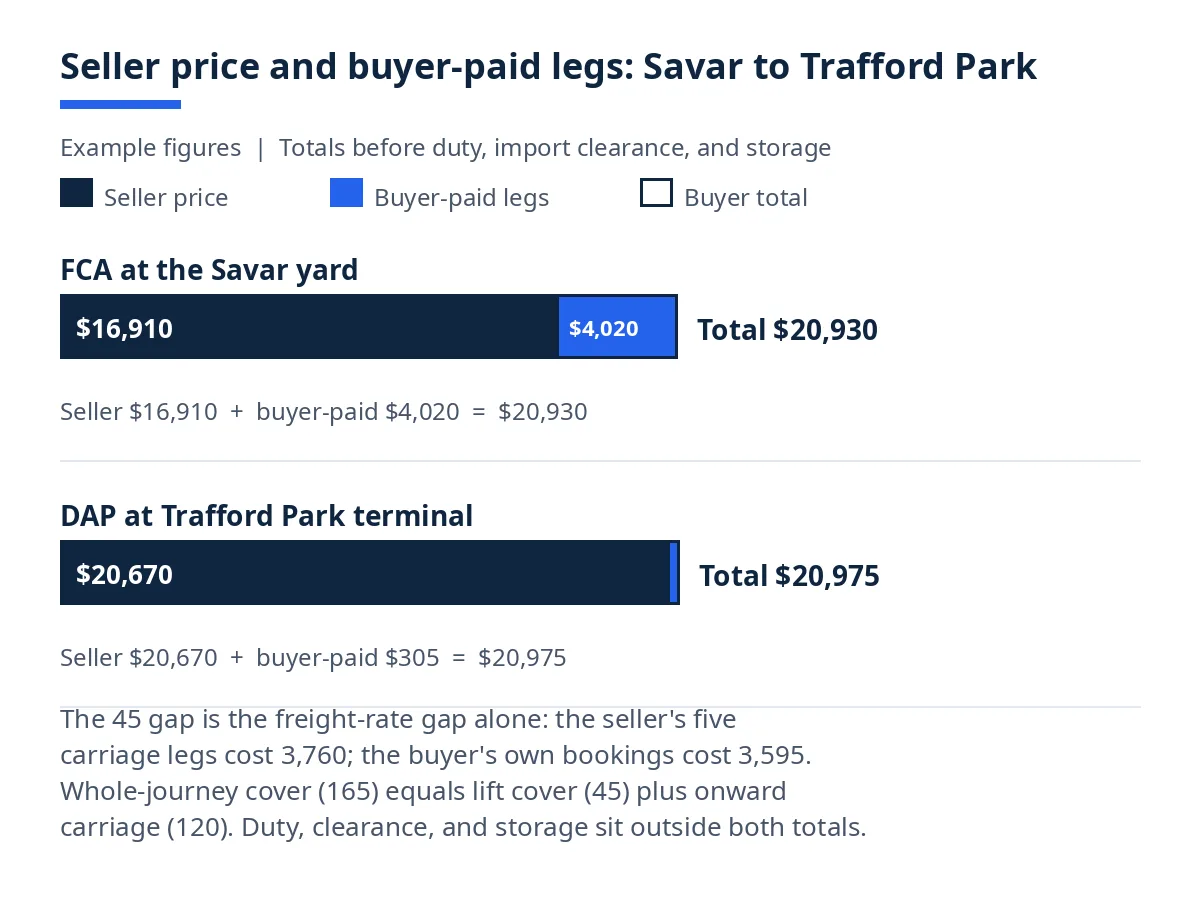
The buyer totals sit 45 apart, with DAP the higher total on these figures: 20,975 against 20,930. The seller prices sit 3,760 apart, which is the carriage the DAP seller has already bought: 420 plus 195 plus 155 plus 2,680 plus 310. The buyer's own bookings for those same five legs cost 3,595, which is 165 less, because the buyer's ocean rate runs 140 below the seller's rate and the buyer's inland rate runs 25 below the seller's. That 165 rate advantage is the whole gap between the totals, because the remaining lines cancel: the FCA buyer's 165 premium for whole-journey cover equals the DAP buyer's 45 for lift and onward cover plus 120 for onward carriage. Change any one rate and the ranking can flip, which is why the comparison must be run on buyer totals with both sides' rates in the open, never on seller headlines.
Duty, the import clearance charge, and storage sit outside both totals. The duty line is left blank on purpose: no rate is quoted here, and the broker who clears the load must supply the figure before either total is judged. Both columns charge unloading of 140 to the buyer, on the stated assumption that the seller's carriage contract excludes it; if a real carriage contract includes unloading, move the 140 into the DAP seller's price and add both columns again. Get the unloading position confirmed in writing for each column, since the charge matches in both columns here only because the assumption matches.
When the single seller-managed leg earns its price
The DAP price earns its keep where the buyer values arrival over control. A buyer ordering a single consignment, with no carrier contracts in Bangladesh, no consolidation to protect, and no appetite for chasing a carrier across three legs, buys one accountable seller for the whole run to the terminal gate, with a remedy if the load never arrives in sound condition.3 The seller's timetable governs, and the buyer trades carrier choice for a single point of answer. That trade favours DAP where the seller runs regular sailings on the route and the buyer's stock plan can absorb the seller's sailing dates.
The FCA price earns its keep where the buyer values control over arrival. A buyer with cheaper ocean rates of its own, a forwarder putting several Bangladesh orders onto one booking, or a carrier it wants to keep using should hold the booking, choose the sailing, and carry the risk from the Savar handover with a policy it chose. The saving in the worked example comes entirely from the buyer's cheaper freight rates, not from any difference in the goods, and a buyer whose rates beat the seller's by more than the DAP convenience is worth will keep that saving on every order. FCA also fits a buyer that wants the load collected at a point it controls, such as the maker's yard, rather than waiting for a seller-managed arrival at a terminal gate.
Two neighbouring rules mark the edges of the DAP bargain, and neither should be confused with it. DPU differs from DAP only on unloading: under DPU the seller unloads the goods at the named place at the seller's risk and expense, while under DAP the buyer unloads at its own risk.2 Where the buyer has no crew, no forklift, or no yard gear at the terminal gate, DPU moves the lift and its risk to the seller, and the seller should assess carefully whether unloading can be ensured at the agreed place before offering it.2 DDP goes further: the seller also carries out and pays for import clearance, including duty, and takes on maximum responsibility, while the buyer is left with unloading.5 DDP is open only where the seller is able to complete import clearance lawfully in the destination country. Where the rules insist the local importer clears the goods, DDP is closed and DAP is the term to use.5 A buyer that wants the seller to clear import should ask how the seller will do it, who acts as importer of record, and what happens if the destination authority refuses a foreign declarant, before accepting a DDP price from a Bangladeshi seller.
Situation | Term that fits |
|---|---|
Buyer wants one seller answerable for the load until it reaches a named terminal gate | DAP |
Buyer holds its own freight rates and wants the carrier and sailing choice | FCA |
Buyer consolidates loads from several sellers onto shared bookings | FCA |
Buyer has no carrier, forwarder, or broker arranged at the origin | DAP, with a broker appointed before the load moves |
Buyer has no unloading crew or gear at the destination | Neither alone; ask for DPU, or arrange the lift before arrival |
Buyer wants the seller to clear import and pay duty as well | Neither; DDP, only if the seller can clear import in the destination country |
Buyer wants delivery and risk to run to the warehouse door itself | DAP at the warehouse address, with the clearance sequence written in |
Buyer cannot clear import quickly and has no broker | Neither term alone; appoint a broker first, then DAP |
Bangladesh ordering checks: the place, the notice, and the clearance file
Write the term the way the people who must act on it will read it. A DAP order needs the named place in full: the terminal name and address, the bay or gate, and the delivery window the truck can meet, with the edition cited beside the term. An FCA order needs the agreed place in full: the yard address, the collection point, and the window, with the carrier's name and contact details passed to the seller before collection. A quotation that says only "FCA Bangladesh" or "DAP Manchester" names no usable place, and no carrier, terminal crew, or broker can act on it. Use identical place wording in the quotation, on the invoice, in the packing list, and on the transport document, so the broker's file matches the carrier's instruction.
Settle the notice route before the truck is booked. Under DAP, agree the channel by which the seller tells the buyer the load has arrived and can be collected: a named contact who answers on arrival days, with the vehicle details, the arrival time, and the transport document reference sent the same day. Under FCA, agree the channel by which the buyer tells the seller the carrier's details and the collection window, so the handover happens at the agreed place and the risk moment is dated by a carrier receipt rather than by argument. Keep the notice, the receipt, and the transport document in the same file as the order.
Before the truck leaves Savar, match the seller's export papers to the pallets as packed, checking that the term and the place wording agree on every document.2 1 For the destination side, appoint the broker, confirm duty funds, and book the unloading crew and the onward carrier before the vessel sails, since import clearance, duty, unloading, and onward carriage stay with the buyer under either term.2 1 Where the DAP place is the buyer's own warehouse and clearance must finish first, spell the handover order into the contract: the buyer clears, the buyer notifies the seller, and the seller's carrier continues to the warehouse, so the two sides never disagree about which stop ended the carriage.
Questions buyers ask about FCA and DAP
Which total is lower for the same cookware load, FCA or DAP?
In the illustration above, FCA lands 45 dollars below DAP, at 20,930 against 20,975, because the buyer's ocean and inland rates run 165 below the seller's rates while the cover and onward lines cancel exactly. Another consignment may land the other way, where the seller's freight rates beat the buyer's by more than the cover difference. Total each column from the seller price upward, adding the legs the buyer still owes, the duty figure supplied by a broker, the clearance charge, unloading where the carriage contract excludes it, and the onward leg. A headline that leaves carriage, cover, or unloading out of the sum is unfinished, not cheaper.
Is DAP the safer choice for a first shipment when the buyer has never cleared import?
DAP is safer on the voyage and harder on arrival, and the arrival half decides it for a first shipment. The seller carries the goods and the risk to the named place, finishes export formalities and any transit customs, and buys the carriage, taking on the long-haul work that trips up a newcomer.2 The buyer still unloads at its own risk, clears import, pays duty, and carries the risk while clearance runs, including the risk where clearance fails because a permit was never obtained.6 For a first order, DAP works only alongside a broker appointed before shipment, duty money confirmed, the unloading charge settled in writing, and the clearance sequence agreed, so the load does not stand at the gate while the file is built. FCA fits a first order only where the buyer's Bangladesh-side team, carrier, forwarder, and broker, is already in place, with a policy whose start date is the carrier handover.1
Can the contract move from FCA to DAP after the order is placed?
Yes, while the pallets are still with the seller and both sides agree the change in writing. The amendment re-prices the deal and remakes every paper so all of them name the new term: the order, the quotation, and the invoice first, then the packing list and the transport document. Moving from FCA to DAP pulls delivery forward to the named destination, moves the risk moment from the carrier handover to arrival ready for unloading, and adds the seller's carriage, export file, and transit risk to the seller's price, while the buyer keeps unloading, import clearance, and duty. The move the other way strips the carriage out of the seller's price and returns carrier nomination, freight booking, and transit risk to the buyer. Any credit that still names the old term must be changed separately through the bank, which checks the documents against the credit. Agree the new price, the named place and point, the unloading charge, and the cover start date before the pallets move, since a handover that has already happened cannot be undone.
What do Bangladeshi suppliers usually quote, FCA or DAP, and how should the request for quotation settle it?
No survey supports a general claim, so the answer has to come from each seller's own setup. A seller that books its own vessels week after week, and whose forwarder can run a load to a named terminal, will usually quote DAP without extra effort and stand behind the promised arrival itself. A workshop that ships through a consolidator and books no carriage of its own will usually quote FCA only, leaving the buyer to name the carrier and the place. The request for quotation must pin the point down: name the term wanted, spell out the FCA place or the DAP named place and point in full, and request freight, papers, handling, unloading, and cover as separate lines, with the unloading charge marked as inside or outside the carriage contract. Quotations rank against each other only when they price the same set of legs, and a headline missing several legs can look lower while the buyer total runs higher.
Next steps on Exportain
Set the pair inside the full eleven-rule chart for Bangladesh shipments, with the sea-only rules beside the any-mode rules, then weigh the seller-bought cover question against the CIF price that folds a Clause C policy into the freight before deciding who should insure the voyage. When the term and the named place or point are settled, ask suppliers to quote on them through the buying steps that cover requesting a quotation on a chosen term.
Sources
- FCA & EXW Incoterms® 2020 explained: Key differences. ICC Academy (accessed )
- DAP & DPU Incoterms 2020 explained: Key differences. ICC Academy, (accessed )
- Incoterms® 2020 C rules vs D rules: Risk transfer explained. ICC Academy (accessed )
- Incoterms 2020 Explained: All 11 Rules. Blue Ocean Academy (accessed )
- DAP & DDP Incoterms 2020 explained: Key differences. ICC Academy (accessed )
- Delivered at Place (DAP) – Incoterms® 2020 Rules. Trade Finance Global (accessed )
About the author
Sourcing from Bangladesh?
Post a request for quotation and suppliers on Exportain can send you their quotes directly.
Post an RFQ