HS Code for Electrical Cables: Classification Guide for Importers
Insulated electrical cables sit in heading 8544, split by cable type, rated voltage and connectors, with national codes running to 8-10 digits in the US, EU and UK.
Short answer
Insulated electrical cables are classified in heading 8544, which covers insulated wire, cable and other insulated electric conductors, whether or not fitted with connectors, and optical fiber cables. The six-digit subheading turns on cable type and rated voltage: winding wire, coaxial cable and wiring sets take named lines, other conductors split at 1,000 volts and on connectors, and national codes run to eight or ten digits.
On this page
Key takeaways
Heading 8544 covers insulated wire, cable and other insulated electric conductors, whether or not fitted with connectors, plus optical fiber cables of individually sheathed fibers.
Winding wire takes 8544.11 for copper and 8544.19 for other materials, coaxial cable takes 8544.20, wiring sets for vehicles, aircraft or ships take 8544.30, and optical fiber cables take 8544.70.
Other conductors split on rated voltage and connectors: 8544.42 fitted with connectors and 8544.49 not fitted, both for voltage not exceeding 1,000 V, and 8544.60 for voltage exceeding 1,000 V.
Insulators take heading 8546 and insulating fittings take heading 8547, other than insulators of 8546: neither product conducts, and neither belongs in heading 8544.
Only the first six digits are shared worldwide: the EU extends to eight digits in the Combined Nomenclature and the United States and United Kingdom to ten, so confirm the full national code.
If you import electrical cables, the hs code for electrical cables is the line your customs entry, duty calculation and origin claim depend on. The Harmonized System is a multipurpose international product nomenclature developed by the World Customs Organization (WCO), used by more than 200 countries and economies as a basis for their Customs tariffs and for the collection of international trade statistics.1 The Convention came into force in 1988, and as of June 2025 it had 162 Contracting Parties, with the system incorporated in the tariff schedules of 212 economies.2 For cables, the code turns on construction and rated voltage, not on the trade name in a supplier listing. This guide covers classification only; the ordering steps are in how to import electrical cables from Bangladesh and the inspection points in the electrical cables quality control checklist.
Quick answer: indicative HS heading (with verify note)
Insulated electrical cables sit in heading 8544. The heading text in the United States schedule reads: insulated (including enameled or anodized) wire, cable (including coaxial cable) and other insulated electric conductors, whether or not fitted with connectors; optical fiber cables, made up of individually sheathed fibers, whether or not assembled with electric conductors or fitted with connectors.3 The path runs Chapter 85, heading 8544, then a six-digit subheading set by cable type and voltage.
Cable type | Indicative subheading | Why |
|---|---|---|
Winding wire of copper | 8544.11 | Winding wire split by conductor material |
Winding wire, other | 8544.19 | Other winding wire line |
Coaxial cable and other coaxial conductors | 8544.20 | Coaxial construction line |
Ignition wiring sets and other wiring sets for vehicles, aircraft or ships | 8544.30 | Wiring sets for vehicles, aircraft or ships |
Other conductors, voltage not exceeding 1,000 V, fitted with connectors | 8544.42 | Connector line in the 1,000 V block |
Other conductors, voltage not exceeding 1,000 V, not fitted with connectors | 8544.49 | Residual line in the 1,000 V block |
Other electric conductors, voltage exceeding 1,000 V | 8544.60 | Voltage exceeding 1,000 V |
Optical fiber cables | 8544.70 | Individually sheathed fibers |
Each line in the table comes from the heading 8544 text and subheading list in the United States Chapter 85 schedule.3 Treat heading 8544 as indicative and confirm the full national code for your exact cable before filing.
How HS codes are structured (2-4-6 digits)
The Harmonised System is a comprehensive classification system of approximately 5,000 six-digit product categories organised by sections, chapters (2 digits), headings (4 digits) and sub-headings (6 digits), with 21 sections, 97 chapters and more than 1,200 headings.4 The current version is HS 2022.4
Each pair of digits narrows the category: chapter 85 for electrical machinery and equipment, heading 8544 for insulated wire and cable, then a six-digit subheading such as 8544.49 for other conductors not fitted with connectors in the 1,000 V block, and a national extension of 8 to 10 digits.4 3
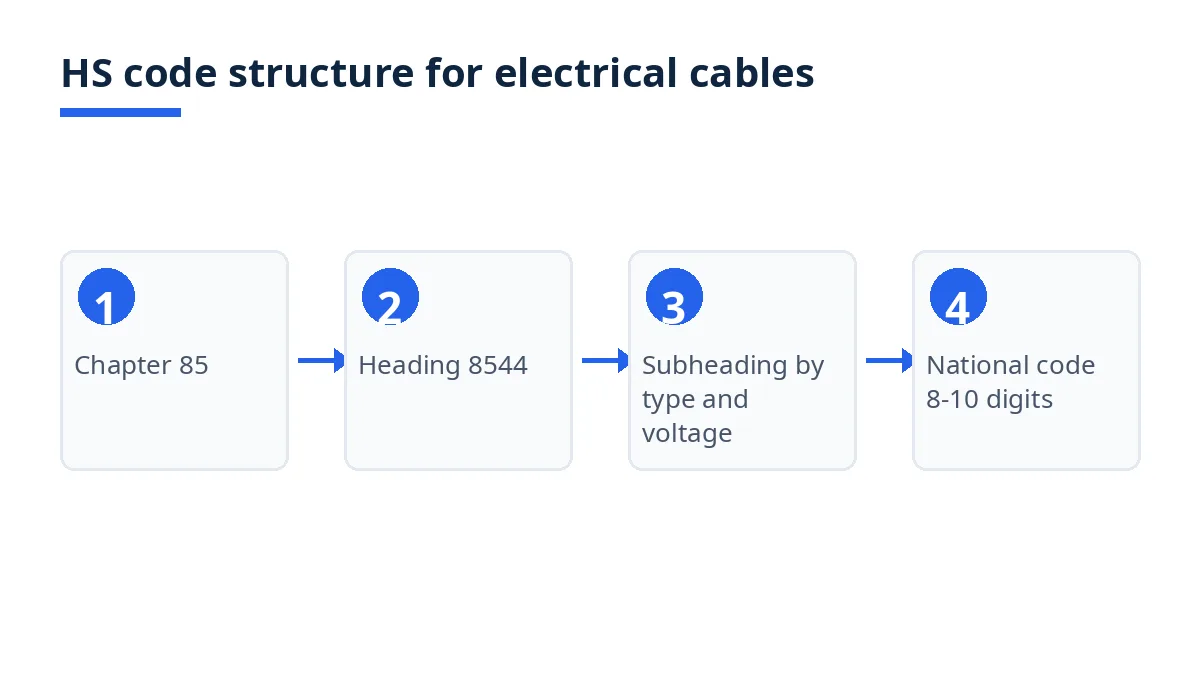
Countries subdivide the six-digit categories into national subheadings.4 The structure is supported by general rules for interpretation and explanatory notes,4 and the General Interpretative Rules and the four-digit heading structure are core elements of the system.2 See the 6-digit HS code guide and HS code and the harmonized system.
Factors that decide the code for electrical cables
Insulation is the entry test. Heading 8544 covers insulated wire, cable and other insulated electric conductors, including enameled or anodized wire.3 A bare, uninsulated conductor does not meet the heading text, so record the insulation or enamel covering for every product before you classify it.
Cable type comes before voltage for the named lines. Winding wire takes 8544.11 for copper and 8544.19 for other materials, coaxial cable takes 8544.20, and ignition wiring sets and other wiring sets of a kind used in vehicles, aircraft or ships take 8544.30.3 Optical fiber cables take 8544.70, covering cables made up of individually sheathed fibers, whether or not assembled with electric conductors or fitted with connectors.3
Rated voltage decides the residual blocks. The schedule groups the remaining conductors as other electric conductors for a voltage not exceeding 1,000 V, and other electric conductors for a voltage exceeding 1,000 V at 8544.60.3 Inside the 1,000 V block, 8544.49 separates conductors for a voltage not exceeding 80 V, with 8544.49.10 for conductors of a kind used for telecommunications.3 Use the rated voltage on the product specification, not the voltage of the installation.
Connectors fitted or not. Inside the 1,000 V block, conductors fitted with connectors take 8544.42 and other conductors take 8544.49.3 The heading itself applies whether or not the conductor is fitted with connectors, so the connector question moves the subheading, not the heading.3 Inside 8544.42, the schedule separates conductors fitted with modular telephone connectors at 8544.42.10 and conductors of a kind used for telecommunications at 8544.42.20.3 Record whether connectors are fitted at shipment.
Heading 8544 is not heading 8546 or 8547. Heading 8546 covers electrical insulators of any material, split at 8546.10 for glass, 8546.20 for ceramics and 8546.90 for other materials.3 An insulator carries no conductor, so it never takes a cable code. Heading 8547 covers insulating fittings wholly of insulating material apart from minor metal components incorporated during molding solely for assembly, other than insulators of heading 8546, plus electrical conduit tubing and joints of base metal lined with insulating material.3 The United Kingdom tariff states the same boundary.5 A cable is a conductor with insulation; a fitting has no conduction function. Keep mixed consignments as separate invoice lines. The general method is set out in how to classify your product with HS codes.
National codes: US HTS, EU CN/TARIC, UK commodity code
Only the first six digits are shared. Countries further subdivide the six-digit HS product categories into regional or national subheadings for greater specificity, and the Combined Nomenclature of the European Union uses eight-digit codes.4
United States: HTS, ten digits. The United States schedule keeps the six-digit lines and adds statistical suffixes. Under 8544.42, the lines separate modular telephone connectors, telecommunications use and other conductors, and under 8544.60 the schedule separates conductors fitted with connectors, conductors of copper and other conductors.3 Read the full ten-digit line for your cable construction and entry date.
European Union: CN at eight digits, TARIC for measures. The Combined Nomenclature is an eight-digit coding system comprising the HS codes with further EU subdivisions and legal notes.4 Read the confirmed eight-digit line in TARIC for the entry date and origin Bangladesh, and check the origin rules behind any preference claim.
United Kingdom: commodity code, ten digits. The United Kingdom builds its commodity code on the same first six digits with its own extension after them. The UK tariff page for subheading 8544.42 lists 8544 4210 00 for conductors of a kind used for telecommunications and 8544 4290 for other conductors fitted with connectors.6 Take the full code from the UK Trade Tariff for your cable and entry date.
How to confirm the code officially
Write a precise description: conductor material, insulation material, cable type (winding wire, coaxial, wiring set or general conductor), rated voltage, whether connectors are fitted, and whether the cable is an optical fiber cable.
Start from the official tariff for the destination: the USITC HTS, TARIC or the UK Trade Tariff, and read the heading 8544 text and the Chapter 85 notes.
Check published rulings for similar cables. For the United States, the USITC advises traders to use the Customs Rulings Online Search Service (CROSS), because the correct classification of many items can be found there.7
For a borderline cable, apply for a binding decision before you ship. In the EU, a Binding Tariff Information decision is issued by national customs authorities, is generally valid for 3 years throughout the EU, and is binding on all EU customs administrations and on the holder.8 In the United Kingdom, a legally binding decision is generally valid for 3 years, through an Advance Tariff Ruling.9 In the United States, if the merchandise is not described in any ruling on CROSS, you may request a binding ruling from U.S. Customs and Border Protection.7
Give your broker the description and the confirmed code for each cable type, and use the same codes on the invoice, the packing list and the entry.
Common classification mistakes
Filing every cable under one residual line. The named lines come first: winding wire, coaxial cable, wiring sets and optical fiber cables each take their own subheading before the voltage blocks are reached.3
Ignoring the 1,000 V threshold. A conductor for a voltage exceeding 1,000 V takes 8544.60, not a line inside the 1,000 V block.3 A wrong voltage statement on the specification sheet moves the whole consignment.
Ignoring the 80 V line inside 8544.49. Conductors for a voltage not exceeding 80 V are separated inside 8544.49, with a telecommunications line at 8544.49.10.3
Treating a terminated assembly as bulk cable. Conductors fitted with connectors take 8544.42; the same cable without connectors takes 8544.49.3 Classify the goods as presented at shipment.
Filing insulators or fittings as cables. Electrical insulators of any material take heading 8546, and insulating fittings wholly of insulating material take heading 8547, other than insulators of heading 8546.3 5 Neither product conducts, and neither belongs in heading 8544.
Copying a code from another country. The EU extends the six digits to eight,4 and the United States and the United Kingdom split the 8544 lines further in their own schedules.3 6
Related duties and documents
This guide states no duty rates: the code decides which duty line customs applies. The rate that must be paid, and any related requirements such as import or export certificates, depends on the tariff classification applicable to the product.8 Read the rate beside your confirmed code for your origin and entry date. Keep the specification, rated voltage statement, drawings showing connectors, confirmed codes, any binding decision and origin evidence with the shipment file, with each cable type as a separate invoice line.
FAQs
What is the HS code for electrical cables?
Insulated electrical cables are classified in heading 8544, which covers insulated wire, cable and other insulated electric conductors, whether or not fitted with connectors, and optical fiber cables made up of individually sheathed fibers.3 The six-digit subheading depends on cable type and voltage: winding wire at 8544.11 or 8544.19, coaxial cable at 8544.20, conductors not exceeding 1,000 V at 8544.42 or 8544.49, conductors exceeding 1,000 V at 8544.60, and optical fiber cables at 8544.70.3
Is the HS code the same in every country?
Only the first six digits are harmonised. Beyond six digits, each system adds its own lines: eight digits in the EU Combined Nomenclature,4 and ten digits in the United States and the United Kingdom.3 6
How do I confirm the correct code?
Describe the cable precisely, read the heading 8544 text and Chapter 85 notes in the destination tariff, and check published rulings, such as CROSS for the United States.7 For a borderline cable, apply for a binding decision before shipping: a Binding Tariff Information decision in the EU,8 an Advance Tariff Ruling in the United Kingdom,9 or a CBP binding ruling in the United States.7
What happens if I use the wrong code?
Duty, licensing and quota treatment are worked out from the code on the declaration, so a wrong code brings the wrong treatment. A legally binding decision helps calculate customs duties, licensing requirements, quotas or other restrictions in advance.9
Next steps on Exportain
Browse Bangladeshi suppliers on Exportain and post a free RFQ at Exportain RFQs with the confirmed code stated per cable type. The harmonized system tariff code explainer is the background read. Exportain is not a party to the goods contract and does not inspect goods, book freight or clear customs.
Sources
- What is the Harmonized System (HS)?. World Customs Organization (accessed )
- WCO Council endorses project proposal aimed at enhancing the Harmonized System framework. World Customs Organization (accessed )
- Harmonized Tariff Schedule of the United States, Chapter 85: Electrical machinery and equipment and parts thereof (Revision 15, 2026). United States International Trade Commission (accessed )
- Harmonised System. European Commission (accessed )
- Insulating fittings for electrical machines, appliances or equipment: UK Online Tariff, heading 8547. GOV.UK, HM Revenue and Customs (accessed )
- Fitted with connectors - UK Integrated Online Tariff, Subheading 854442. GOV.UK (accessed )
- MTB 2019: Get Out Ahead of the Pack with a Binding Ruling from CBP. U.S. International Trade Commission (accessed )
- European Binding Tariff Information (EBTI). European Commission, Taxation and Customs Union, (accessed )
- Check what you'll need to get a legally binding decision on a commodity code. GOV.UK, HM Revenue and Customs (accessed )
- HS Codes
- Customs Classification
- importing from Bangladesh
- tariff codes
- Electrical cables
- Electrical conductors
About the author
Sourcing from Bangladesh?
Post a request for quotation and suppliers on Exportain can send you their quotes directly.
Post an RFQ