What Is a 6-Digit HS Code? Chapters, Headings and Subheadings
Definition
A 6-digit HS code is the international product code of the Harmonized System maintained by the World Customs Organization. The first two digits give the chapter, the first four the heading, and all six the subheading. Every country using the system applies the same six digits, then adds national digits for its own duty rates and statistics.
Published 7 min read
On this page
Key takeaways
A 6-digit HS code is built in three layers: chapter (digits 1-2), heading (digits 1-4) and subheading (all six digits).
The six digits are identical in every country using the Harmonized System; national codes such as the US HTS and EU CN add digits after position six.
Classification follows the product's material, construction and use, read with the section and chapter notes, not the trade name.
Example: knitted cotton T-shirts are 6109.10 - chapter 61, heading 6109, subheading 10, of cotton.
Every product that crosses a border needs a name that customs officers in Dhaka, Rotterdam and New York all read the same way. That name is a number. A 6 digit hs code is the international part of that number: six digits that identify what a product is, built in three layers — chapter, heading and subheading.
What does HS code mean in plain English?
HS stands for Harmonized System, formally the Harmonized Commodity Description and Coding System. In plain English, it is an organized list of traded products — live animals, raw cotton, finished T-shirts, machinery, frozen fish — where each product family has its own number.
The Harmonized System is a multipurpose international product nomenclature developed by the World Customs Organization (WCO).1 It comprises more than 5,000 commodity groups, each identified by a six digit code, arranged in a legal and logical structure supported by well-defined rules for uniform classification.1 More than 200 countries and economies use it as a basis for their customs tariffs and trade statistics, and over 98% of merchandise in international trade is classified in terms of the HS.1
Think of the code as an address for a product: the chapter is the broad district, the heading the street, and the subheading the specific house. A customs officer who sees the six digits needs neither your language nor your brand name to apply the duty rate and checks attached to that product family. See the HS code and the Harmonized System for the full system.
One point matters for buyers: the six digits are only the international core. Countries add their own digits after position six for national duty and statistics, so the full code you declare is longer than six digits in most markets.
How is a 6-digit HS code built, step by step?
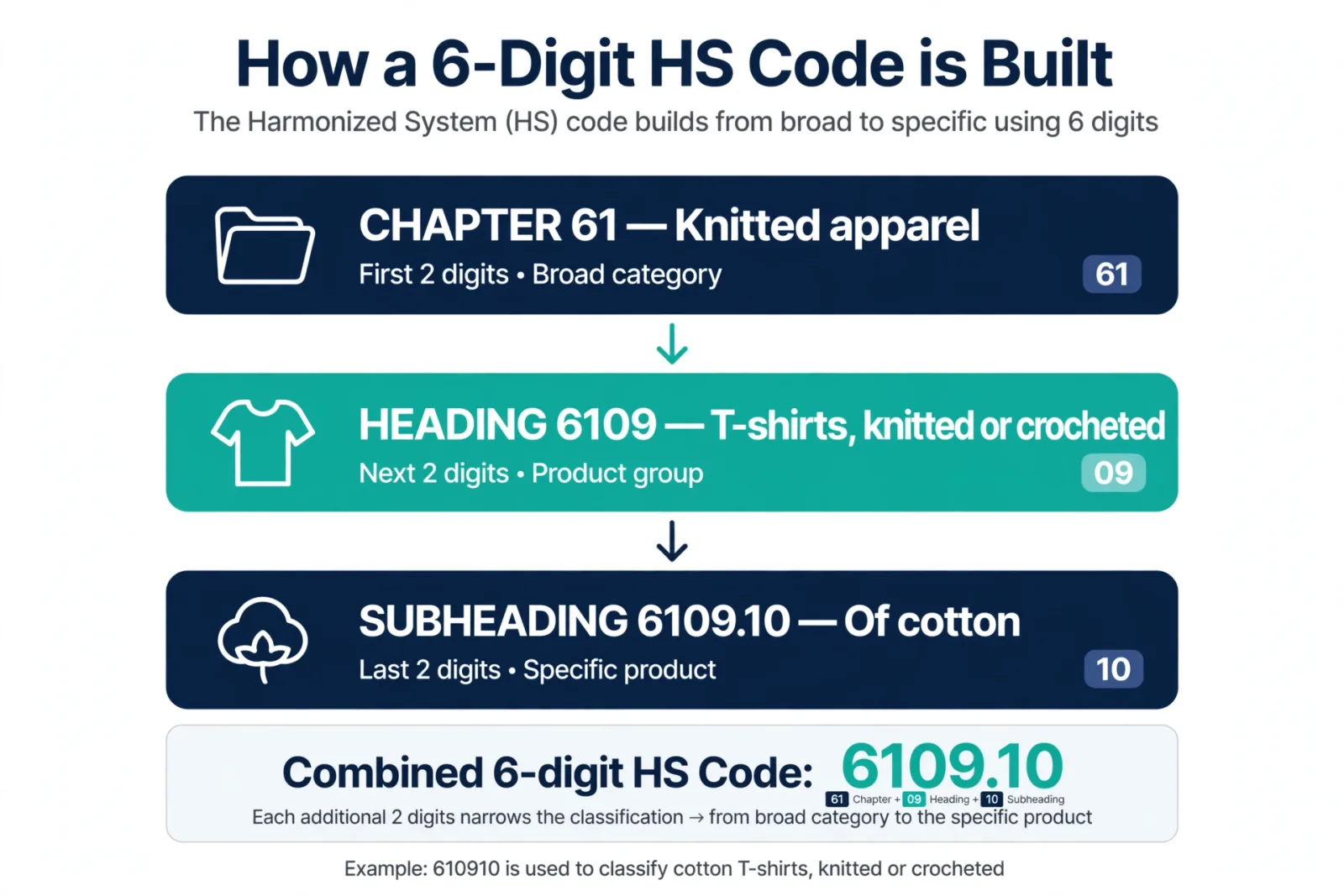
A 6-digit HS code narrows from broad to specific in three pairs of digits:
Digits | Level | What it identifies |
|---|---|---|
1–2 | Chapter | A broad product family, such as knitted apparel |
1–4 | Heading | A product group within the chapter |
1–6 | Subheading | The specific product, the same in every country using the HS |
You classify a product by working through the following steps:
Describe the product exactly. Classification depends on what the product is made of, how it is made, and what it is used for — for a garment, fiber composition, knit or woven construction, and garment type.
Find the chapter (digits 1–2). Knitted apparel falls in Chapter 61. Woven apparel falls in Chapter 62.
Find the heading (digits 3–4). Within Chapter 61, heading 6109 covers T-shirts, singlets and other vests, knitted or crocheted.
Find the subheading (digits 5–6). Under heading 6109, subheading 6109.10 is for cotton, and 6109.90 is for other textile materials.
Read the legal notes, not just the titles. The WCO gives the official interpretation of the HS in its Explanatory Notes, and section and chapter notes decide difficult cases such as mixed materials, sets, and unfinished goods.1
Add the destination's extra digits. Extend the six digits to the full national tariff line your destination requires.
Classification is a legal exercise, not a guess from a product photo. The WCO keeps the HS current through its Harmonized System Committee, which prepares amendments updating the HS every 5 to 6 years, so check a stored code against the current edition before you rely on it.1
Who is responsible for the HS code?
The exporter (seller) proposes the code from the product specification and declares it on the export documentation and commercial invoice, matching the material and construction actually produced.
The importer (buyer) confirms the code before the goods ship. In the United States, only U.S. Customs and Border Protection (CBP) can issue legally binding rulings on the tariff classification of imports; the U.S. International Trade Commission (USITC), which maintains the tariff schedule, cannot confirm a final classification.2 A buyer therefore cannot treat a supplier's code as settled for the destination market.
The customs broker or freight forwarder files declarations using the code supplied and flags descriptions that do not match the goods.
The customs authority verifies the classification, can reclassify the goods, and applies the duty rate, preferences, and controls attached to the final code. The safest arrangement is agreement before shipment: seller, buyer, and broker all working from the same six digits and the same written product description.
Worked example: knitted cotton T-shirts from Bangladesh
Take a Dhaka factory exporting knitted cotton T-shirts to a buyer in the United States. The code is built digit by digit:
Chapter 61: Articles of apparel and clothing accessories, knitted or crocheted.
Heading 6109: T-shirts, singlets and other vests, knitted or crocheted.
Subheading 6109.10: Of cotton.
The shipment's 6 digit hs code is therefore 6109.10, written 610910 without the dot. The first six digits of U.S. import (HTS) and export (Schedule B) numbers are the same because both are built on the HS, but the two systems differ at the 8- and 10-digit level.2 The U.S. importer extends 6109.10 to the full 10-digit HTS line, and duty is assessed on that complete national line. Example figures: a shipment of 24,000 pieces carries the same code as one of 240 pieces — quantity, weight, and value sit alongside the code on the declaration and never change it.
How does an HS code differ from HTS, CN, and TARIC codes?
Term | Digits | Scope |
|---|---|---|
HS code | 6 | International standard set by the WCO |
HTS code | 10 | United States import classification built on the HS |
CN code | 8 | European Union Combined Nomenclature built on the HS |
TARIC code | 10 | EU code: the 8-digit CN code plus two TARIC digits |
Each CN subheading has an 8-digit code: the first six digits are the HS heading and subheading, the seventh and eighth digits are the CN subheadings, and the ninth and tenth digits are TARIC subheadings.3 "Commodity code" is the everyday term many administrations use for the full national code you declare; it contains the HS code but is longer. A stock keeping unit (SKU) is different again: it is your company's internal stock label and has no standing with customs. See also our HS classification guide.
What are the common mistakes to avoid?
Copying a similar product's code. A knitted polo shirt and a woven shirt sit in different chapters, so a copied code misclassifies the goods from the start.
Classifying by trade name. Customs classifies what the product is — its material and construction — not what marketing calls it.
Stopping at four digits. A heading alone is not the declarable code; the full six digits, plus the destination's extension, are required.
Using the exporter's full code as the importer's full code. National extensions differ after digit six.2
Choosing the code with the lowest duty. Classification follows the product and the legal notes; a code picked for its rate risks reclassification, back-duty, and delayed clearance.
Forgetting that codes are revised. The HS is updated every 5 to 6 years, so re-check a stored code against the current edition.1
FAQs
What is a 6 digit HS code?
A 6 digit HS code is the international six-digit product code of the Harmonized System, maintained by the World Customs Organization.1 The first two digits identify the chapter, the first four the heading, and all six the subheading. Countries then add their own national digits.
What is HS code?
An HS code is the number the Harmonized System assigns to a traded product so customs authorities worldwide can identify it, apply the correct duty, and compile trade statistics. The system covers more than 5,000 commodity groups and is used by more than 200 countries and economies.1 Longer codes are national extensions built on the six digits.
How does HS code work in practice?
You describe the product by material, construction, and use, then narrow it through chapter, heading, and subheading using the legal notes and interpretive rules. You then extend the six digits to your destination's full tariff code, which travels on the invoice and customs declaration and determines how the shipment is assessed.
Is HS code used for shipments from Bangladesh?
Yes. Bangladesh Customs works with HS codes in the Bangladesh Customs Tariff, and its guidance directs traders to the tariff's section, chapter, heading, and subheading notes and to the WCO Explanatory Notes when a product is hard to place.4 A Bangladeshi exporter declares the code on export documentation — for example, 6109.10 for knitted cotton T-shirts — and the importing country reads the same six digits on arrival.
What are common mistakes with HS code?
The common mistakes are copying a code from a similar product, classifying by trade name instead of material and construction, declaring only four digits, treating the exporter's national extension as valid at destination, and picking a code for its duty rate rather than its legal fit.
Next steps on Exportain
Classification questions usually surface at the quoting stage, when you need a landed-cost estimate and a supplier must describe the product correctly. On Exportain, you state the product specification — material, construction, and intended use — in your request, so the facts that drive classification are agreed in writing before an order. Post an RFQ, browse suppliers, or read how to buy.
Sources
- What is the Harmonized System (HS)?. World Customs Organization (accessed )
- Definitions and Classifications. U.S. International Trade Commission (accessed )
- Council Regulation (EEC) No 2658/87 on the tariff and statistical nomenclature and the Common Customs Tariff - Summary. EUR-Lex, European Union (accessed )
- Bangladesh Customs & VAT Import Export Hub: Import Requirements. National Board of Revenue, Bangladesh, (accessed )
Reviewed by Naim Islam
About the author
Sourcing from Bangladesh?
Post a request for quotation and suppliers on Exportain can send you their quotes directly.
Post an RFQ