What Does Ex Works Mean in Shipping? A 5-Minute Guide
Definition
Ex works (EXW) is an Incoterms 2020 shipping term. The seller makes the goods available at a named place, usually the factory. Delivery is complete at that point. The seller does not load the goods or clear them for export. The buyer arranges and pays for loading, transport, export and import clearance, freight and delivery, and carries the risk from handover onward.
Published 7 min read
On this page
Key takeaways
Under ex works, the seller only makes the goods available at the named place. Loading and export clearance are not part of the seller job.
Risk passes to the buyer when the goods are placed at the buyer disposal at the named place, before loading and before any transport.
The buyer pays for every step after handover: loading, inland transport, export and import clearance, freight, insurance if wanted, and final delivery.
For cross-border orders, ICC Academy points buyers toward FCA instead of EXW, because the seller then delivers to the carrier and clears the goods for export.
An EXW quote can look cheaper than every other quote on your list, until you add the costs the term leaves with you. This guide gives the ex works shipping meaning in plain language: what the seller does, what lands on the buyer, and where risk changes hands.
Ex works is one of the Incoterms rules published by the International Chamber of Commerce (ICC). The rules are a set of eleven three-letter trade terms used in contracts for the sale of goods, and they clarify the tasks, costs and risks involved in delivery from sellers to buyers.1 The current edition, Incoterms 2020, entered into force on 1 January 2020.1
Quick answer
Under ex works (EXW), the seller delivers by placing the goods at the disposal of the buyer at the seller premises or at another named place, such as a works, factory or warehouse.2 The seller does not need to load the goods on any collecting vehicle, and does not need to clear them for export, where such clearance is applicable.2 From that point, the buyer carries every cost and risk.
What ex works means in plain English
Ex works places the minimum obligation on the seller of any Incoterms rule, in terms of both risks and costs.3 The seller job is short: produce the goods, pack them as the contract requires, and have them ready at the named place on the agreed date or within the agreed period.4 The rule does not ask the seller to arrange a truck, book freight, file an export declaration or buy insurance.
For the buyer, the term works in the opposite direction. Once the goods are placed at your disposal, you pay for loading, transport to the port or airport, export clearance in the seller country, the main carriage, import clearance and duty at destination, and delivery to your warehouse. EXW is listed among the rules for any mode or modes of transport, so the same split applies to road, rail, sea, air and combined movements.2
Write the named place precisely. ICC Academy guidance warns that EXW plus a town name alone leaves the delivery point open to dispute, and advises naming the exact address and point inside that place, followed by Incoterms 2020.4 On a Bangladesh order, that means the full factory address, not only the district.
How ex works works step by step
Agree the contract on EXW terms, with the exact named place and the Incoterms 2020 edition written into the order.
The seller finishes production and places the packed goods at your disposal at that place, ready for loading onto the vehicle you send.4
Your carrier loads the goods at your expense and risk, and moves them to the port or airport.3
Your side handles the export formalities in the seller country, then the main carriage to your country.4
Your side handles import clearance, duty and taxes at destination, plus final delivery.4
You decide whether to insure the goods, because cover after delivery sits at the buyer discretion.4
The flow below shows the handover point. Everything after step 1 belongs to the buyer.
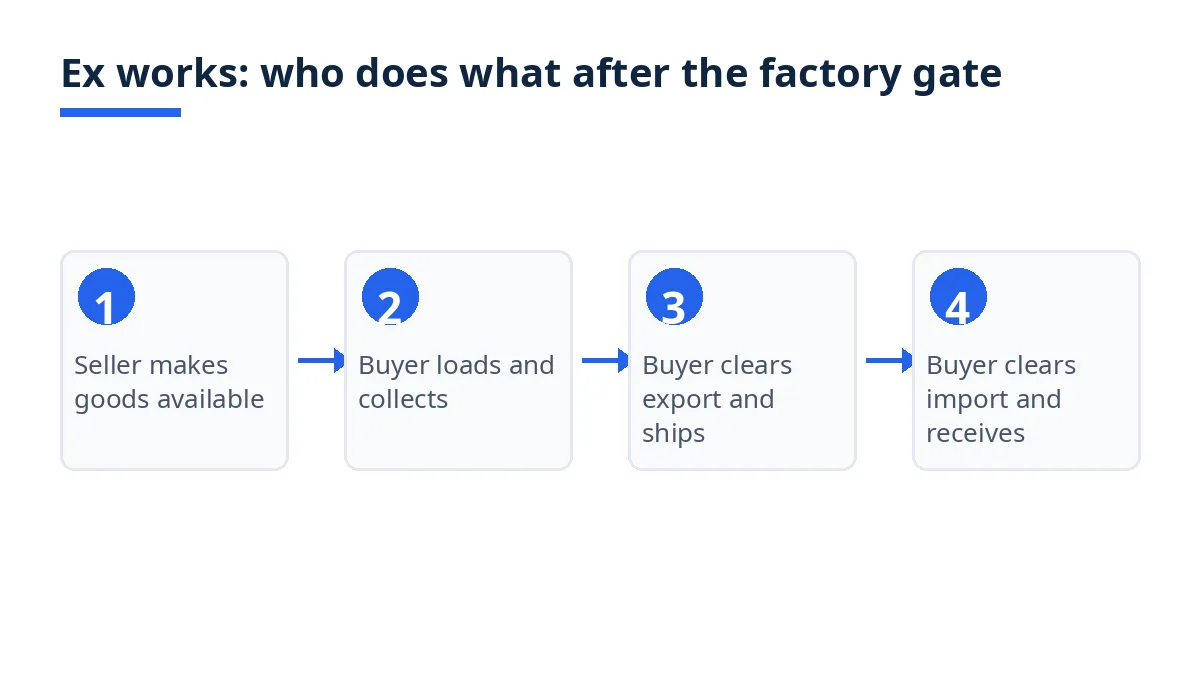
Who is responsible for what under ex works
Task | Seller | Buyer |
|---|---|---|
Make goods available at the named place | Yes | No |
Load goods on the collecting vehicle | No | Yes |
Inland transport to port or airport | No | Yes |
Export clearance in the seller country | No | Yes |
Main carriage (sea, air, road or rail) | No | Yes |
Insurance during carriage | No duty to buy | Buyer choice |
Import clearance, duty and taxes | No | Yes |
Unloading and final delivery | No | Yes |
The table follows the rule itself: the seller does not load the goods or clear them for export,2 and loading onto the buyer vehicle is done at the buyer expense and risk.3 Risk passes at the same early point as delivery, before loading and before the goods travel anywhere.3
Worked example: a garment order from Bangladesh
Example figures. A buyer in the Netherlands orders cotton T-shirts from a factory near Dhaka on the term EXW factory, Incoterms 2020. The EXW price is USD 18,000. The buyer budget then adds loading and trucking to Chattogram port at USD 450, export clearance and port charges arranged through the buyer forwarder at USD 380, ocean freight to Rotterdam at USD 2,900, and optional cargo insurance at USD 180. The goods reach Rotterdam at USD 21,910, before Dutch import duty, taxes, destination handling and onward delivery.
The lesson sits in the gap: the EXW price was only about four fifths of the cost of reaching the destination port, so an EXW quote and an FOB quote for the same shirts are never directly comparable. For the full split of what an EXW price covers, see what an EXW price includes.
Ex works compared with FCA and FOB
EXW vs FCA. Under FCA (Free Carrier), the seller has two main duties that EXW does not impose: deliver the goods to the carrier or person you nominate at the agreed place, and carry out the export clearance.3 ICC Academy notes that EXW is most suitable for domestic trade, and that traders are strongly encouraged to consider FCA instead where goods cross a border, because the export formalities sit with the buyer under EXW.3 The term page for EXW (Ex Works) sets out the rule in more detail.
EXW vs FOB. Under FOB (Free On Board), the seller delivers the goods on board the vessel you nominate at the named port of shipment, and risk passes when the goods are on board.2 The seller under FOB also handles export clearance and the move to the port. FOB applies to sea and inland waterway transport, while EXW works for any mode.2
EXW vs DDP. DDP (Delivered Duty Paid) sits at the opposite end of the scale, with the seller carrying the goods toward the buyer country. The Incoterms guide for shipments from Bangladesh compares all eleven rules side by side.
Common mistakes to avoid
Comparing an EXW price with an FOB price. The two prices buy different amounts of work. Convert every quote to the same delivery point before you rank suppliers.
Leaving the named place vague. A town name is not a delivery point. ICC Academy advises specifying the exact place and point of delivery in the sales contract, because the seller transfers the risk at that location.4
Assuming the seller will load the truck. Under the rule, the seller does not need to load the goods on any collecting vehicle.2 If the factory loads in practice, record that agreement, and who pays, in the contract.
Forgetting the export declaration. The buyer handles any export formalities under EXW, which can lead to complications for both parties when the buyer has no presence in the seller country.3 Agree who files before production, or switch to FCA so the seller clears export.3
Skipping insurance. No part of the EXW rule obliges either side to insure the goods, and the risk is yours from the factory gate. Price the cover into the order.
How Exportain helps with an ex works order
On Exportain, you can post a request for quotation (RFQ) that states the term and named place you want quoted, then compare replies on the same basis instead of mixing EXW and FOB prices. Ask each supplier for an FCA price alongside the EXW price, and keep the agreed term and loading arrangement in the order messages.
FAQs
What does ex works mean in shipping?
Ex works means the seller makes the goods available at a named place, usually the seller premises, and the buyer takes over from there.2 The seller does not load the goods or clear them for export. The buyer pays for transport, clearance, freight and import duty, and carries the risk from handover.2 3
What does EXW stand for?
EXW is the three-letter code for ex works. It is one of the eleven Incoterms 2020 rules, which set out the tasks, costs and risks of delivery between a seller and a buyer in a contract for the sale of goods.1 5
How does ex works work in practice?
The seller readies the packed goods at the named place, your vehicle collects them, and your forwarder runs the shipment from that gate to your warehouse. Delivery must occur on the agreed date or within the timeframe set in the sales contract, with the goods ready for loading onto the vehicle you arranged.4
Is ex works used for shipments from Bangladesh?
Yes, suppliers in Bangladesh quote EXW factory prices, and buyers with strong forwarder arrangements in Bangladesh sometimes accept them. For a cross-border order, ICC Academy encourages traders to think carefully about whether EXW is appropriate, and to consider FCA instead, because the export formalities sit with the buyer under EXW.3
What are common mistakes with ex works?
The recurring mistakes are comparing EXW and FOB prices without adding the missing costs, naming only a town as the delivery place, assuming the seller loads the vehicle, and reaching the shipping date with no agreed filer for the export declaration.
Next steps on Exportain
Browse Bangladeshi suppliers, then post a free RFQ asking for EXW and FCA prices against the same named place. For the rule in full, read the EXW (Ex Works) term page.
Sources
- Incoterms® rules. International Chamber of Commerce (ICC) (accessed )
- Customs valuation: Incoterms. HM Revenue & Customs (GOV.UK) (accessed )
- FCA & EXW Incoterms® 2020 explained: Key differences. ICC Academy (accessed )
- DDP & EXW Incoterms® 2020 explained: Key differences. ICC Academy (accessed )
- Incoterms® 2020. International Chamber of Commerce (accessed )
Reviewed by Naim Islam
About the author
Sourcing from Bangladesh?
Post a request for quotation and suppliers on Exportain can send you their quotes directly.
Post an RFQ