CIF Full Form in Shipping and How It Appears on Invoices
Definition
CIF stands for Cost, Insurance and Freight. It is an Incoterms 2020 rule for sea and inland waterway shipments where the seller pays for the goods, marine insurance and freight to the named destination port. On quotations and invoices, CIF plus the port name shows that those three elements are included in the price, while import duty and onward delivery are not.
Published 7 min read
On this page
Key takeaways
CIF stands for Cost, Insurance and Freight: the seller pays goods, marine insurance and freight to the named destination port.
In documents the term is written as the code, the named port and the edition, for example CIF Felixstowe, Incoterms 2020.
On an invoice the CIF value is goods plus freight plus insurance, shown either as one total or as three separate lines.
Risk passes to the buyer when the goods are loaded on board at origin, and import duty and onward delivery sit outside the CIF price.
If you are searching for the cif full form in shipping, the term has probably appeared on a quotation or invoice, and you want to know what the three letters commit each side to. This page answers that terminology question directly: what CIF stands for, how the full form is written in contracts, and how it shows up on invoices. Deeper explainers on this blog cover the full CIF rule and its insurance in detail.
Quick answer
CIF stands for Cost, Insurance and Freight. It is one of the eleven three-letter Incoterms rules published by the International Chamber of Commerce, and the current edition, Incoterms 2020, entered into force on 1 January 2020.1 Under CIF, the seller pays the cost of the goods, marine insurance and freight to the named destination port. Risk, however, passes to the buyer when the goods are loaded on board at the port of shipment, not when they arrive.
What CIF means in plain English
Read the full form word by word. Cost is the price of the goods themselves. Insurance is the marine cover the seller must arrange for the main carriage. Freight is the sea carriage the seller must contract and pay for to the named port of destination.2 A price written as CIF Felixstowe or CIF Rotterdam therefore bundles those three elements into one figure that runs as far as that named port, and no further.
CIF sits in the group of Incoterms rules for sea and inland waterway transport only, alongside FAS, FOB and CFR.2 It is not an air freight term. The seller delivers the goods on board the vessel, and risk passes when the products are on the ship, even though the seller is still paying the freight to destination.2 The seller also contracts for insurance against the buyer risk of loss or damage during the carriage, but that cover only has to be at the minimum level, so a buyer who wants wider protection must agree it expressly or arrange extra cover.2
That minimum level means cover complying with Institute Cargo Clauses (C) or similar clauses.3 For the full breakdown of duties under the rule itself, see CIF — Cost, Insurance and Freight and CIF Incoterms 2020.
How the full form appears on documents
In the contract and on the quotation, the term is written as the code, the named destination port and the edition, for example CIF Felixstowe, Incoterms 2020. Naming the exact port matters because the seller freight and insurance obligations run only to that port, and stating the edition matters because the rules are updated over time.1
On the commercial invoice, a CIF sale appears in one of two ways. Some sellers show a single total labelled as the CIF value. Others break the total into three lines, for goods, freight and insurance, that add up to the CIF value. The second format is clearer, and it matches how the term is built: under both CIF and CIP, the commercial invoice amount includes the cost of the goods, freight and insurance, as well as export clearance costs.3 Whichever format is used, the invoice wording should match the contract term, the named port and the figures on the transport and insurance documents.
The CIF value also matters after the sale, because customs valuation starts from the price paid. UK guidance treats the customs value as the transaction value, and transport costs up to the place of introduction are included in that value, with no further addition required where the delivery terms are CIF.4 For what sits outside the CIF price at import, see does CIF include import duty.
How it works step by step
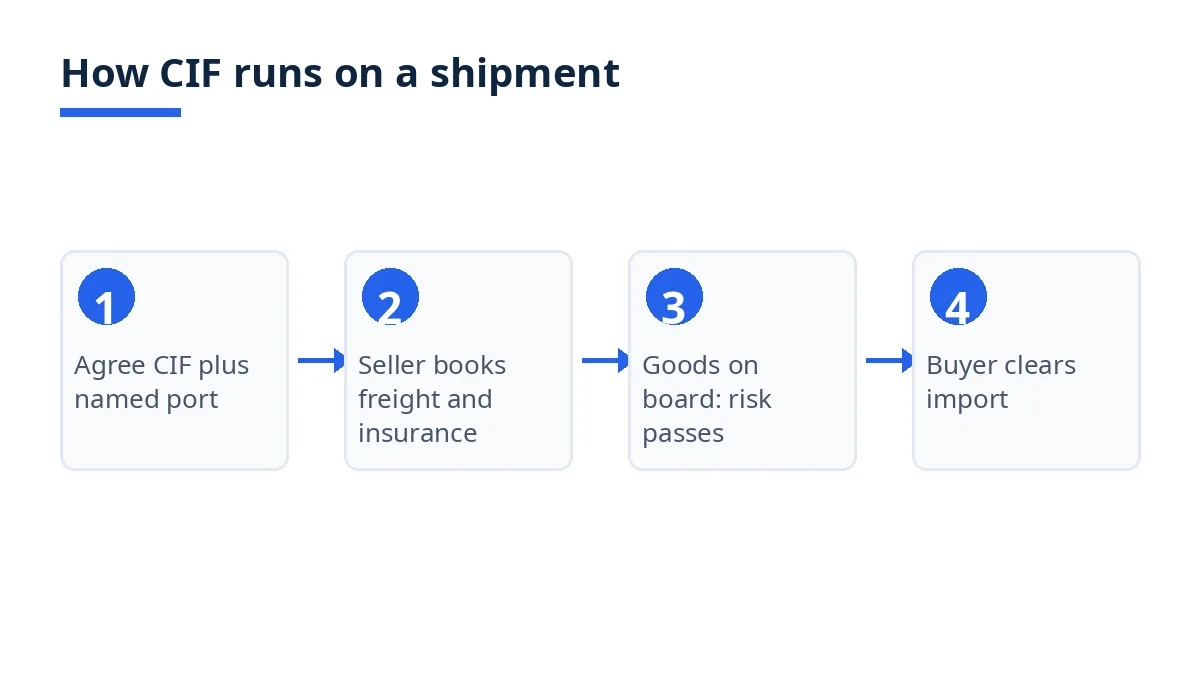
In short form: buyer and seller agree the goods, price basis and named destination port, and record the term in the contract. The seller prepares the goods, completes export formalities, books and pays the sea freight to the named port, and arranges the required insurance. The seller loads the goods on board at the port of shipment, which is the moment risk passes to the buyer.3 At destination, the buyer completes import formalities, pays duty and taxes due, and arranges onward delivery.3
Who is responsible for what
The seller supplies the goods and the commercial invoice, completes export clearance, contracts and pays for carriage to the named destination port, arranges the agreed insurance, and delivers the goods on board at the port of shipment.2
The buyer pays the agreed price, bears risk from the moment the goods are on board, completes import clearance, pays import duty and taxes, and covers destination charges not included in the freight contract, plus onward delivery.3
The point buyers miss most often is the split: the seller pays costs as far as the destination port, but the buyer carries risk from the port of shipment. Paying to destination is not the same as bearing risk to destination.
Worked example with numbers
The figures below are an arithmetic illustration only, not a market price or a rate to expect.
A buyer in the United Kingdom orders garments from Bangladesh on CIF Felixstowe terms. The invoice could show:
Goods value: USD 10,000 International freight to Felixstowe: USD 1,800 Marine insurance for the main carriage: USD 60 CIF value, Felixstowe: USD 11,860
The structure is the lesson. Goods plus freight plus insurance equals the CIF value, the amount payable to the seller under the term, unless the contract states otherwise. Spending does not end there: import duty and taxes where applicable, destination and clearance charges, and delivery from the port sit on top. To turn a CIF figure into a full buying cost, work through landed cost for imports from Bangladesh.
CIF vs related terms
Against FOB (Free On Board): under FOB, the seller also delivers on board at the port of shipment and risk passes there, but the buyer arranges and pays for the main freight and any insurance.2 Under CIF, the seller takes on those two contracts.
Against CFR (Cost and Freight): CFR is CIF without the seller insurance obligation. The seller pays freight to the named destination port, and risk still passes on board at shipment.2
Against CIP (Carriage and Insurance Paid To): CIP is the counterpart for any mode of transport, including container and multimodal shipments, and risk passes when the goods are handed to the first carrier. Its required insurance level is also higher, at Institute Cargo Clauses (A), while CIF stays at Clauses (C).3 The ICC Academy notes that CIF suits port-to-port shipments, while CIP suits container and multimodal movements.3 For the insurance comparison in full, see CIF insurance.
Common mistakes to avoid
Reading CIF as delivered to the warehouse is the most frequent error. Risk passes on board at origin, and import costs belong to the buyer. Accepting the default insurance without checking it is the second: Clauses (C) is minimum cover, so fragile or high value goods may need wider cover agreed in writing before shipment.3
Other avoidable errors include naming the destination port loosely, leaving the edition off the contract, letting the invoice CIF value differ from the freight and insurance documents, and comparing CIF quotations that name different ports or insurance levels as if they were the same offer.
How Exportain helps
Exportain helps importers compare offers from Bangladeshi suppliers on the same price basis. When you post a request, state the term and named port you want quoted, for example CIF with your port and Incoterms 2020, so each supplier prices goods, freight and insurance the same way. Post an RFQ on Exportain to request CIF quotations in that format.
FAQs
What is CIF?
CIF is an Incoterms rule whose full form is Cost, Insurance and Freight. The seller pays for the goods, marine insurance and freight to the named destination port, delivers the goods on board at the port of shipment, and passes risk to the buyer at that loading point.2
How does CIF work in practice?
The seller completes export formalities, books and pays sea freight to the named port, and buys at least the minimum insurance required, then loads the goods on board. The buyer carries risk from loading, and handles import clearance and duty on arrival.3
Is CIF used for shipments from Bangladesh?
Yes, for sea shipments. An export from Bangladesh cannot be loaded until an export declaration, known as a Bill of Export or Shipping Bill, has been submitted to Customs and approved, with documents including the commercial invoice and packing list enclosed.5 A CIF quotation from a Bangladeshi seller builds on that process and adds the seller contracts for freight and insurance to the named port.
What are common mistakes with CIF?
Assuming CIF means delivery to your warehouse, accepting minimum insurance without checking what it excludes, failing to name the exact port and edition in the contract, and letting the invoice CIF value differ from the freight and insurance documents.
Next steps on Exportain
Read the full rule in CIF — Cost, Insurance and Freight, check how the figure is used in CIF value meaning, and compare terms in Incoterms for shipments from Bangladesh before you request quotations.
Sources
- Incoterms® rules. International Chamber of Commerce (ICC) (accessed )
- Customs valuation: Incoterms. HM Revenue & Customs (GOV.UK) (accessed )
- CIF & CIP Incoterms 2020 explained: Key differences. ICC Academy, (accessed )
- Customs valuation: Method 1 - transaction value. HM Revenue & Customs (GOV.UK) (accessed )
- Customs Clearance Procedures for Export. Bangladesh Customs, National Board of Revenue (accessed )
Reviewed by Naim Islam
About the author
Sourcing from Bangladesh?
Post a request for quotation and suppliers on Exportain can send you their quotes directly.
Post an RFQ