Does CIF Include Import Duty? What Buyers Actually Pay at Destination
Definition
No. CIF (Cost, Insurance and Freight) does not include import duty. Under CIF, the seller pays for the goods, marine insurance and freight to the named destination port, and clears the goods for export. You, the buyer, handle import clearance and pay the import duty, import taxes, destination charges not included in the freight, and delivery from the port to your address.
By Naim Islam
Published 8 min read
On this page
Key takeaways
CIF does not include import duty: the buyer handles import clearance and pays duty and import taxes under CIF.
The seller pays for the goods, freight and minimum insurance to the named destination port, and clears export in Bangladesh.
Risk passes to the buyer when the goods are on board at the port of shipment, even though the seller pays freight to destination.
Default CIF insurance is Institute Cargo Clauses (C) at 110 percent of the contract value, so wider cover must be agreed or added.
DDP is the only Incoterms 2020 rule under which the seller pays import duty and completes import clearance.
If you are checking does cif include import duty before you accept a quote from Bangladesh, the answer changes your budget. A CIF price looks complete because it bundles the goods with freight and insurance, but it stops at the destination port. Duty, tax and everything after the port still sit with you.
Incoterms rules are eleven three-letter trade terms published by the International Chamber of Commerce (ICC) that clarify the tasks, costs and risks in delivering goods from sellers to buyers, and Incoterms 2020 entered into force on 1 January 2020.1 In the ICC guidance on tariffs, CIF sits in the group where the seller is responsible for export clearance only, while the buyer handles import duties and tariffs, import customs clearance and transit formalities.2
Quick answer
No. CIF does not include import duty. The seller pays for the goods, marine insurance and freight to the named destination port. You pay import duty, import VAT, GST or sales tax where it applies, clearance costs, destination charges the freight excludes, and transport from the port to your address.
What CIF means in plain English
CIF stands for Cost, Insurance and Freight: the goods, insurance for the main carriage, and freight to a named destination port, as in "CIF Rotterdam, Incoterms 2020." The seller also pays export expenses, including customs clearance, and must organise minimum insurance cover for the benefit of the buyer.3
Two limits define the term. First, CIF is one of four rules, with FAS, FOB and CFR, for sea and inland waterway transport only.4 Second, the named place is a port, not your warehouse. Your import system, with its clearance, duty and tax, sits outside the term.
Cost and risk split at different points. With the C rules, the seller pays freight to the destination, but risk passes to the buyer when the goods are loaded on board at origin.4 A loss at sea is then your loss, which is why the seller buys the insurance for your benefit. Our definition of CIF (Cost, Insurance and Freight) sets out the rule in full.
How CIF works step by step
A CIF shipment from Bangladesh runs through this sequence:
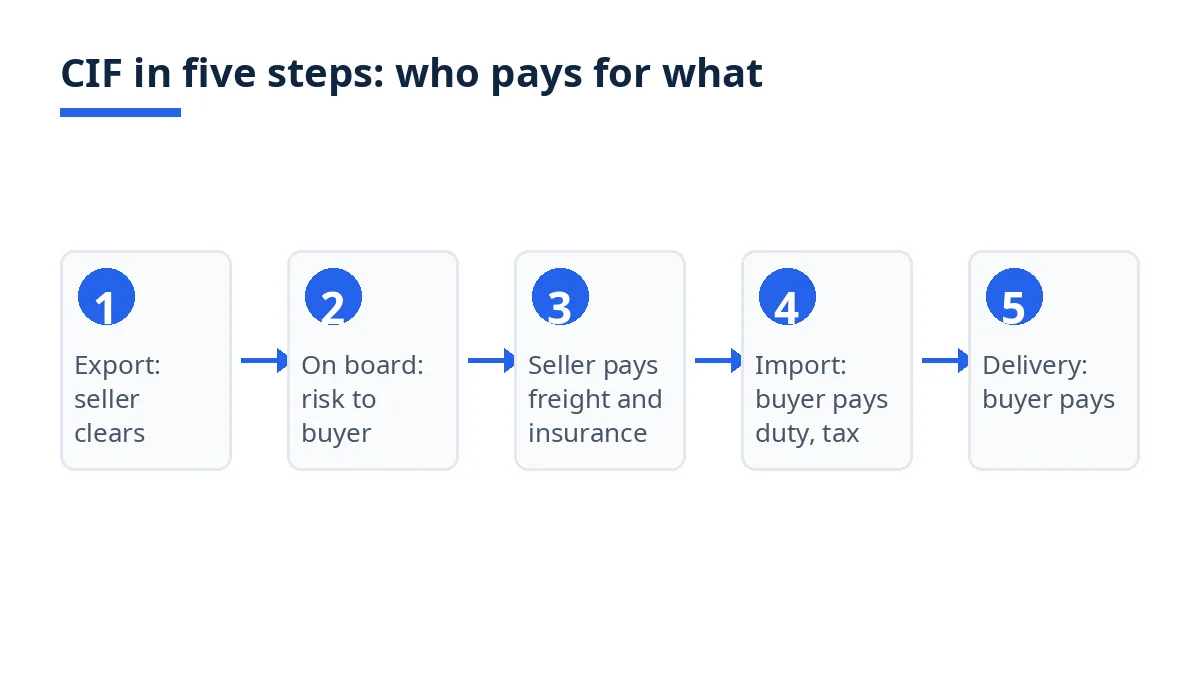
Export clearance. The seller completes export clearance in Bangladesh. Bangladesh Customs requires an export declaration, known as a Bill of Export or Shipping Bill, approved before goods may be loaded, with documents including the export contract or purchase order, the commercial invoice, the packing list, the EXP form and the certificate of origin.5
Loading and risk transfer. The seller delivers the goods on board the vessel at the port of shipment, such as Chattogram. Risk passes to you at that point.
Freight. The seller contracts and pays the carrier to the named port, and provides the transport document, usually a bill of lading, which you need to claim the goods.3
Insurance. The seller obtains insurance complying with Clause C of the Institute Cargo Clauses or comparable clauses, covering 110 percent of the goods sales price in the contract currency, and gives you proof of insurance.3
Arrival and import clearance. You, usually through a customs broker, file the import declaration and pay the duty and taxes assessed.
Onward delivery. After customs release, you arrange and pay for transport to your final address.
Who is responsible for what
Cost or task | Seller | Buyer |
|---|---|---|
Goods, packing and export clearance in Bangladesh | Pays | No |
Loading on board and freight to the destination port | Pays | No |
Minimum marine insurance for the voyage | Pays | No |
Unloading and port charges the freight excludes | No | Pays |
Import clearance, broker fees, duty and import tax | No | Pays |
Storage and demurrage from late clearance | No | Pays |
Delivery from the port to the final address | No | Pays |
Insurance cover beyond the CIF minimum | No | Pays, unless agreed |
Under every Incoterms 2020 rule except DDP, the buyer handles import clearance and pays import duties.4 Duty is set by your own customs authority on arrival, so an overseas seller cannot fold a correct duty figure into a CIF price. For the door-to-door picture, read the guide to landed cost for imports from Bangladesh.
Worked example with numbers: a Bangladesh shipment
Example figures: the amounts below illustrate the arithmetic only and are not a quote. Real duty and tax depend on the goods, their classification and the destination rules at import. Imagine garments shipped from Bangladesh to a European port on CIF terms. The goods cost USD 20,000, the seller's insurance is USD 150, and freight is USD 1,850, so the CIF price you pay the seller is USD 22,000.
None of the arrival costs sit inside that USD 22,000. You still pay import duty as assessed at destination, a broker fee (USD 250 here), port handling and storage (USD 400) and trucking (USD 350). Duty is charged on a base that already includes freight and insurance. In the United Kingdom, for example, Customs Duty is charged on the price paid for the goods plus postage, packaging and insurance, and VAT is charged on the total value including any duty owed.6 The landed total is USD 22,000 plus duty, plus import VAT, plus USD 1,000 of clearance, handling and delivery. CIF is a price to the port, not to your door.
CIF vs related terms
CIF vs CFR. CFR (Cost and Freight) is the same rule without the insurance duty: the seller pays freight to the destination port, and you arrange your own cover.4
CIF vs FOB. Under FOB (Free On Board), the seller delivers the goods on board at the port of shipment and you pay the freight and arrange any insurance.4 See FOB (Free On Board).
CIF vs DAP. Under DAP (Delivered at Place), the seller carries cost and risk to a named place at destination, ready for unloading, but you remain responsible for import tariffs and clearance.2
CIF vs DDP. DDP (Delivered Duty Paid) is the only rule under which the seller pays all export and import tariffs and fulfils the related customs duties.2 If you need a price that includes duty, negotiate DDP, or keep CIF and budget duty yourself. The overview of Incoterms for shipments from Bangladesh compares all eleven rules, and CIF Incoterms 2020 walks through the CIF obligations in sequence.
Common mistakes to avoid
Budgeting the CIF price as the final cost. Add duty, tax, clearance, port charges and delivery to every CIF quote before you set a selling price.
Assuming the seller insurance is broad cover. CIF requires only minimum Clause C cover unless agreed otherwise. Clause C protects against expressly named risks such as fire, stranding and capsizing, and theft is not insured under it.3 For valuable goods, specify wider cover or arrange a top-up policy.
Forgetting where risk passes. Risk transfers on board at the port of shipment, not at destination. Damage at sea is claimed on the insurance.
Using CIF for the wrong shipment. For container shipments handed over at a terminal, and for air or multimodal freight, CIP is the matching rule, with the broader Institute Cargo Clauses (A) as its default cover.4
Naming the port loosely. "CIF USA" is not workable. Name the exact port, and confirm which destination charges, such as unloading and quay dues, the freight includes, because the buyer pays those unless otherwise specified.3
Letting documents drift. Late documents delay clearance and create storage bills that are yours under CIF.
How Exportain helps
Exportain is a marketplace where buyers find Bangladeshi suppliers, post requests for quotation and compare replies in one place. State "CIF" with the exact named port and the Incoterms 2020 edition, and ask each supplier to show the goods, insurance and freight elements separately, so you can add duty, tax and delivery estimates and compare landed costs. Supplier profiles record document and photo checks; those checks are not inspections or guarantees, and Exportain is not a party to your contract for goods. The how to buy guide explains the buyer journey.
FAQs
Does CIF include import duty?
No. Under CIF the seller is responsible for export clearance only, and the buyer handles import duties and tariffs, import customs clearance and transit formalities.2
What is CIF?
CIF stands for Cost, Insurance and Freight. The seller pays for the goods, minimum marine insurance and freight to a named destination port, while risk passes to the buyer when the goods are loaded on board at shipment.3
How does CIF work in practice?
The seller clears export, loads the goods on board, pays freight to the destination port and buys minimum insurance for your benefit. You clear import, pay duty and taxes, cover charges the freight excludes, and arrange onward delivery.
Is CIF used for shipments from Bangladesh?
Yes, for sea shipments. A Bangladeshi seller completes export clearance with an approved Bill of Export and the documents Bangladesh Customs lists, loads the goods on board, and pays freight and insurance to your named port.5 Confirm the exact port and which charges the freight includes before you sign.
What are common mistakes with CIF?
Treating the CIF price as the landed cost, assuming minimum insurance gives broad cover, forgetting that risk passes at shipment, using CIF where CIP fits better, and failing to name the exact port.
Next steps on Exportain
Browse Bangladeshi suppliers for your product, then post an RFQ that names the term, the port and the edition, for example "CIF Rotterdam, Incoterms 2020", so every quote is priced on the same basis. Add duty, tax, clearance and delivery estimates to each CIF price, using the landed cost guide, before you choose a supplier.
Sources
- Incoterms® rules. International Chamber of Commerce (ICC) (accessed )
- Should tariffs be part of Incoterms® training?. ICC Academy (accessed )
- CIF (Cost Insurance and Freight) | Incoterms 2020. Röhlig Logistics (accessed )
- Incoterms 2020 Explained: A Guide for US Exporters. World Trade Center Northern California, (accessed )
- Customs Clearance Procedures for Export. Bangladesh Customs, National Board of Revenue (accessed )
- Tax and customs for goods sent from abroad. GOV.UK (accessed )
Reviewed by Nourin Tabassum
About the author
Sourcing from Bangladesh?
Post a request for quotation and suppliers on Exportain can send you their quotes directly.
Post an RFQ