CIF Shipping Terms Explained for First-Time Importers
Definition
CIF means Cost, Insurance and Freight. Under this Incoterms 2020 rule for sea shipments, the seller pays for the goods, ocean freight and minimum marine insurance to your named destination port. Risk passes to you earlier, when the goods are loaded on board at origin, so you still arrange import clearance and budget for duty and destination charges.
Published 7 min read
On this page
Key takeaways
CIF means Cost, Insurance and Freight: the seller pays goods, freight and minimum insurance to the named destination port.
Risk passes to the buyer when goods are loaded on board at origin, not when they arrive at destination.
CIF default insurance is minimum cover under Institute Cargo Clauses (C); wider cover must be agreed or bought separately.
Duty, destination charges and onward delivery sit outside the CIF price and remain the buyer budget.
If you are importing for the first time, a CIF quote can look simple. One price covers the goods, sea freight and insurance to your port, so it reads like a delivered price. It is not. This guide follows one CIF shipment from order to arrival, so you can see what the seller handles, which documents appear, and what still sits with you.
Quick answer
Under CIF, Cost, Insurance and Freight, the seller pays for the goods, books and pays sea freight to your named destination port, and arranges minimum marine insurance. Risk passes to you much earlier, when the goods are loaded on board at the port of shipment. You still clear import, pay duty and destination charges, and arrange delivery to your premises. For the full definition, see CIF: cost, insurance and freight. CIF is one of the eleven Incoterms rules published by the International Chamber of Commerce (ICC).1 2
What CIF means in plain English
CIF is a port-to-port rule for sea and inland waterway transport only.2 A complete term names the destination port and the version, for example CIF Felixstowe, Incoterms 2020. The latest version entered into force on 1 January 2020, and the rules clarify the tasks, costs and risks in delivery from sellers to buyers.1
Think of CIF as two splits that do not line up. On cost, the seller pays to the destination port. On risk, the seller stops at loading.
Who pays for the ship under CIF?
The seller contracts and pays for the main carriage to the named destination port, and that freight sits inside the single CIF price. GOV.UK states the same point: the seller must contract for and pay the costs and freight necessary to bring the goods to the named port of destination.3
What insurance does CIF include?
CIF includes only minimum insurance by default. The seller must arrange cover that complies with Clause C of the Institute Cargo Clauses, described as minimum cover.2 GOV.UK adds that if you want more protection, you need to agree it expressly with the seller or make your own extra arrangements.3 The amount at that minimum level is 110 percent of the invoice value.4
One CIF shipment, step by step
Follow a single order from a Bangladeshi seller to a buyer overseas.
Step 1: Agree the term in full. Agree the goods, price and term with its named port and version, for example CIF Felixstowe, Incoterms 2020. Ask the seller to show goods, freight and insurance as separate lines.
Step 2: The seller prepares the goods and export papers. The seller packs the goods and prepares the papers for export clearance, including the export contract or letter of credit, the commercial invoice and the packing list.5
Step 3: The seller books the ship and arranges insurance. The seller contracts vessel space, pays freight to your named port, and arranges minimum Clause C insurance for your benefit. You do not book this main leg.
Step 4: Export clearance, then loading. Goods cannot be loaded in Bangladesh unless an export declaration, the Bill of Export or Shipping Bill, has been submitted and approved by Customs.5 Once approved, the goods are loaded on board.5
Step 5: Risk passes to you on board. Risk of loss or damage transfers to you once the goods are loaded on board at the port of shipment.2 The goods now travel at your risk, even though the seller paid freight to destination. The seller sends you the transport and insurance documents.
Step 6: The ship sails to your port. Check the insurance document during this leg. If Clause C does not match the value or fragility of your goods, arrange extra cover before a loss happens.
Step 7: You clear import and collect the goods. On arrival you pay arrival charges outside the freight contract, clear import, pay duties and taxes, and arrange inland transport. A standard CIF summary puts those items with the buyer.4
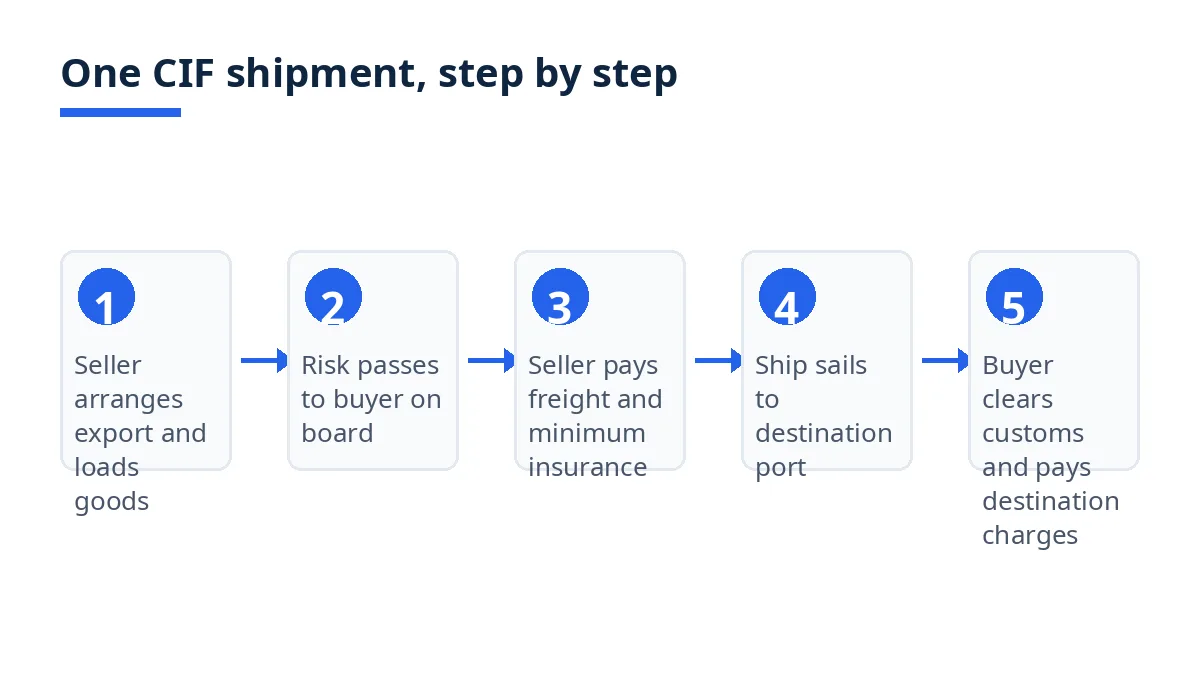
The diagram below shows that journey in five stages.
Who is responsible for what
Task or cost | Seller | Buyer |
|---|---|---|
Packing and export documents | Prepares invoice, packing list and export papers | Checks copies on receipt |
Export clearance in Bangladesh | Responsible, including the Bill of Export | Not responsible |
Booking and paying main sea freight | Books the vessel and pays to the named port | Does not book the main leg |
Marine insurance | Arranges and pays for minimum Clause C cover | Reads the policy, arranges extra cover if needed |
Transit risk | Bears risk until the goods are on board | Bears risk from the on-board point |
Destination charges outside the freight contract | Not responsible | Pays handling and fees |
Import clearance, duty and taxes | Not responsible | Responsible |
Onward delivery from port | Not responsible | Arranges and pays |
To see how buyer-side costs build into a total, read landed cost for imports from Bangladesh.
Worked example with numbers (Bangladesh shipment)
Example figures: a first-time buyer in the United Kingdom orders garments from a Bangladeshi seller, shipped from Chattogram to Felixstowe as CIF Felixstowe, Incoterms 2020. The numbers are illustrative only, not a quotation or current market rates.
Price element | Example figures (USD) | Paid by |
|---|---|---|
Goods and export packing | 40,000 | Seller, inside the CIF price |
Main carriage (ocean freight) | 2,400 | Seller, inside the CIF price |
Marine insurance premium | 180 | Seller, inside the CIF price |
CIF price | 42,580 | Buyer pays the seller |
Destination handling, brokerage, duty and onward delivery | Extra | Buyer, outside the CIF price |
You pay the seller 42,580. If goods are damaged at sea, you claim under the seller-arranged policy, because risk passed at loading. Your final cost is higher once you add the last row.
CIF vs related terms
CIF vs FOB. Under FOB, Free On Board, the seller delivers the goods on board, risk passes at that point, and the buyer bears all costs from that moment onwards.3 The risk point matches CIF. The difference is who books and pays carriage and insurance: under FOB that is you, under CIF that is the seller.
CIF vs CFR. CFR, Cost and Freight, also requires the seller to contract for and pay freight to the named port, with risk passing on board.3 The difference is insurance: CFR has no seller duty to arrange it.
CIF vs CIP. CIP, Carriage and Insurance Paid To, works for any mode and a named place, not only a port. Under CIP the seller must obtain Clause A insurance, broader than the Clause C minimum under CIF.2 Compare options in Incoterms for shipments from Bangladesh.
Common mistakes to avoid
Reading CIF as a delivered price. The price ends at the named port. Duty, destination charges and onward delivery are extra.
Assuming seller risk runs to destination. Risk passes on board at origin, while freight is paid to destination.2
Skipping the insurance document. Clause C is minimum cover. Check it before the ship sails, and agree broader cover or buy extra cover if needed.3
Leaving the port or version out. Write CIF plus the named port plus Incoterms 2020.
Waiting until arrival to plan import clearance. You are responsible for import formalities under CIF.2 Line up your broker before arrival.
Using CIF for a terminal handover without checking fit. Risk transfer happens on board, while containers are often handed over before loading.4
How Exportain helps
Exportain is a B2B export marketplace where buyers find Bangladeshi suppliers, post requests for quotation, receive quotations and place orders. In a CIF request, name your port and ask suppliers to quote goods, freight and insurance separately. Exportain is not a party to the contract for goods, and it does not book freight, arrange insurance or clear customs.
Frequently asked questions
What is CIF?
CIF is Cost, Insurance and Freight, an Incoterms 2020 rule for sea and inland waterway transport. The seller pays for the goods, freight to the named destination port and minimum insurance, while risk passes to the buyer on board at the port of shipment.2
How does CIF work in practice?
In practice, the seller clears export, books and pays the main carriage, arranges minimum insurance and loads the goods on board. You then pay arrival charges outside the freight contract, clear import and arrange onward delivery.4
Is CIF used for shipments from Bangladesh?
Yes. A Bangladeshi seller shipping by sea, normally through Chattogram, can quote CIF to a named port in the USA, UK, EU or UAE. The seller must complete export clearance first, and Bangladesh Customs requires an approved Bill of Export before goods can be loaded.5
What are common mistakes with CIF?
Common mistakes are treating the CIF price as the final cost, assuming seller risk runs to destination, accepting Clause C cover without reading it, and leaving the destination port or version out of the term.
Next steps on Exportain
Read the full definition in CIF: cost, insurance and freight, compare alternatives in Incoterms for shipments from Bangladesh, and check your arrival cost in landed cost for imports from Bangladesh. When your port is set, post a free RFQ on Exportain and ask each supplier to quote CIF with freight and insurance shown separately.
Sources
- Incoterms® rules. International Chamber of Commerce (ICC) (accessed )
- CIF & CIP Incoterms 2020 explained: Key differences. ICC Academy, (accessed )
- Customs valuation: Incoterms. HM Revenue & Customs (GOV.UK) (accessed )
- CIF Incoterms (Cost, Insurance and Freight) Explained. iContainers (accessed )
- Customs Clearance Procedures for Export. Bangladesh Customs, National Board of Revenue (accessed )
Reviewed by Naim Islam
About the author
Sourcing from Bangladesh?
Post a request for quotation and suppliers on Exportain can send you their quotes directly.
Post an RFQ