CIF Freight Term Meaning for Logistics and Procurement Teams
Definition
Under CIF, the freight term means the seller books and pays the main sea carriage to the named destination port, and that freight cost sits inside the single CIF price alongside the goods and minimum insurance. The buyer does not arrange the main leg, but risk passes to the buyer when the goods are loaded on board at the port of shipment.
By Naim Islam
Published 7 min read
On this page
Key takeaways
Under CIF the seller books and pays the main carriage to the named destination port, and the freight cost sits inside the CIF price.
Risk passes to the buyer on board at the port of shipment, even though the seller pays freight to the destination port.
The default CIF insurance is minimum cover under Institute Cargo Clauses (C), so buyers check the policy and arrange extra cover if needed.
Import duties, arrival charges outside the freight contract and onward delivery sit outside the CIF price and stay with the buyer.
For logistics and procurement teams, the cif freight term meaning decides who books the ship, who pays for the main sea leg, and how much of a quoted price is freight rather than goods. A CIF price can look complete because freight is inside it, yet the buyer carries the transit risk and still pays destination costs. This article covers the freight element only. For the general definition, see CIF: cost, insurance and freight.
Quick answer
Under CIF, the seller books and pays the main carriage to the named destination port, and that freight cost sits inside the single CIF price alongside the goods and minimum insurance. The buyer does not arrange the main leg, but risk passes to the buyer on board at the port of shipment. CIF is one of the eleven Incoterms rules published by the International Chamber of Commerce (ICC).1 2
What the CIF freight term means in plain English
CIF stands for Cost, Insurance and Freight. The freight word is a payment and booking duty, not a risk duty. The seller must arrange and pay for the maritime carriage up to the port of destination, and the buyer takes the risk from the moment the goods are loaded on board at the port of shipment.2 GOV.UK states the same split: the seller must contract for and pay the costs and freight to the named port of destination.3
CIF is a port-to-port rule for sea and inland waterway transport only.2 A complete term names the destination port and the version, for example CIF Felixstowe, Incoterms® 2020.
What does the freight part of a CIF price cover?
The freight part covers the main carriage the seller contracts for, from the port of shipment to the named destination port. That main leg sits alongside inland transport to the port of origin, export clearance and departure costs, and the cargo insurance in the seller obligation list for CIF.4
Ask what the freight contract includes at destination. Arrival port charges such as handling and fees are a buyer obligation under CIF, separate from the seller-paid sea freight.4
What does CIF freight not cover?
CIF freight does not cover import clearance, duties and taxes, or inland transport to your warehouse. Those items sit with the buyer.4 It also does not include broad insurance: only minimum cover is required, and a buyer who wants more protection must agree it with the seller or arrange extra cover itself.3
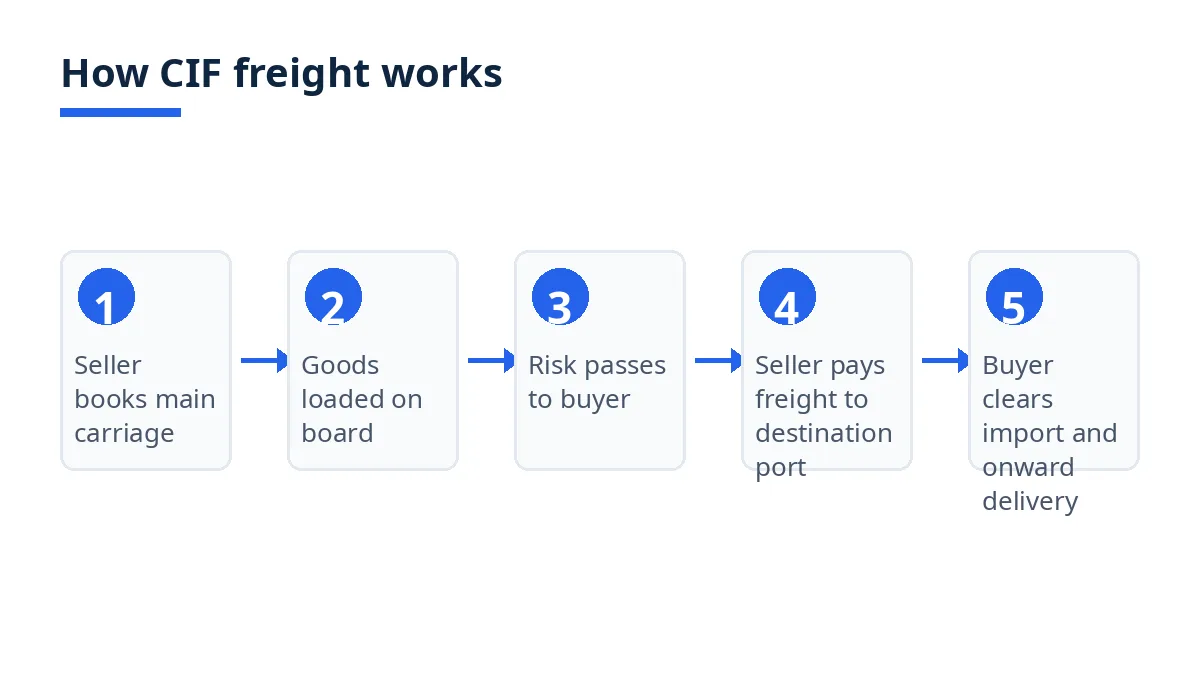
How CIF freight works step by step
Step 1: Agree the term in full. The contract states the goods, the price and the term with its named port and version, for example CIF Rotterdam, Incoterms® 2020.
Step 2: The seller books the main carriage. The seller contracts the vessel space and pays the freight to the named port.
Step 3: The seller clears export and loads the goods. For a Bangladesh shipment, goods cannot be loaded unless an export declaration, the Bill of Export or Shipping Bill, has been submitted and approved by Customs, with the export contract or letter of credit, invoice and packing list.5
Step 4: Risk passes on board. Once the goods are loaded on board, risk passes to the buyer.2 The seller hands over the transport and insurance documents.
Step 5: The buyer completes the arrival side. The buyer pays arrival charges outside the freight contract, clears import, pays duties and taxes, and arranges onward delivery.4
The flow below sums up the freight sequence.
Who is responsible for what
Task or cost | Seller | Buyer |
|---|---|---|
Booking the main carriage | Books the vessel and contracts the carrier | Does not book the main leg |
Freight to the named port | Pays the carrier | Pays nothing for that leg |
Export clearance and loading | Responsible | Not responsible |
Transit risk | Bears risk until the goods are on board | Bears risk from the on-board point |
Marine insurance | Arranges and pays for minimum cover | Checks cover, arranges extra if needed |
Arrival charges outside the freight contract | Not responsible | Pays handling and fees 4 |
Import clearance, duties and taxes | Not responsible | Responsible |
Onward delivery | Not responsible | Arranges and pays |
Worked example with numbers (Bangladesh shipment)
Example figures: a United Kingdom buyer orders garments from a Bangladeshi seller, shipped from Chattogram to Felixstowe as CIF Felixstowe, Incoterms® 2020. The numbers are illustrative only, not a quotation or current market rates.
Price element | Example figures (USD) | Paid by |
|---|---|---|
Goods and export packing | 40,000 | Seller, inside the CIF price |
Main carriage (ocean freight) | 2,400 | Seller, inside the CIF price |
Marine insurance premium | 180 | Seller, inside the CIF price |
CIF price | 42,580 | Buyer pays the seller |
Destination handling, brokerage, duty, onward delivery | Extra | Buyer, outside the CIF price |
The freight line is 2,400 of the 42,580 total. On FOB terms the same goods would normally exclude that freight and the insurance, and the buyer would pay the carrier directly. To reach the full cost, add the buyer-side extras, as set out in landed cost for imports from Bangladesh.
If the goods are damaged at sea, the buyer claims under the seller-arranged insurance, because risk passed at loading. The default CIF cover is Clause C of the Institute Cargo Clauses, described as minimum cover.2 The insurance amount is stated as 110 percent of the invoice value at that minimum level.4
How do you compare two CIF quotes on freight?
Compare two CIF quotes line by line, not by the headline total. Ask each seller to split the price into goods, freight and insurance, name the destination port, and confirm which destination charges its freight contract includes.
CIF vs related terms
CIF vs FOB. Under FOB, Free On Board, the seller delivers the goods on board and risk passes at that point, and the buyer bears all costs from that moment onwards.3 The risk point matches CIF. The freight difference is total: under FOB the buyer books and pays the main carriage, under CIF the seller does.
CIF vs CFR. CFR, Cost and Freight, keeps the seller-paid freight and the on-board risk point, but the seller has no duty to arrange insurance.3 Choose CFR only if your team will arrange its own cover.
CIF vs CIP. CIP, Carriage and Insurance Paid To, is for any mode and a named place, not only a port. Under CIP the seller must obtain insurance complying with Clauses A of the Institute Cargo Clauses, broader than the Clause C minimum under CIF.2 For containers handed to a carrier before loading, terminal handover alone does not transfer risk under CIF, so CIP usually matches the handover more closely.4
Common mistakes to avoid
Comparing a CIF quote with an FOB quote as like for like. One includes freight and insurance to destination, the other does not.
Assuming paid freight means seller risk to destination. The seller pays freight to the named port, but risk passes on board at origin.2
Accepting the minimum insurance without reading it. Clause C is minimum cover. For fragile or high-value goods, agree broader cover or arrange extra cover.3
Leaving the destination port or version out of the term. An unnamed port leaves seller-paid freight undefined.
Budgeting the CIF price as the final cost. Duties, arrival charges and onward delivery are extra.4
Using CIF for a terminal handover. Containers are often handed over before loading, while CIF risk transfer happens on board.4
How Exportain helps
Exportain is a B2B export marketplace where buyers find Bangladeshi suppliers, post requests for quotation, receive quotations and place orders. In CIF requests, name the destination port and ask suppliers to show freight and insurance lines separately. Exportain is not a party to the contract for goods, and it does not book freight, arrange insurance or clear customs.
Frequently asked questions
What is CIF?
CIF is Cost, Insurance and Freight, an Incoterms® 2020 rule for sea and inland waterway transport. The seller pays for the goods, books and pays freight to the named destination port, and arranges minimum insurance, while risk passes to the buyer on board at origin.2
How does CIF work in practice?
In practice, the seller books the main carriage, clears export, loads the goods on board and sends the transport and insurance documents. The buyer pays arrival charges outside the freight contract, clears import and arranges onward delivery.4
Is CIF used for shipments from Bangladesh?
Yes. Bangladeshi sellers shipping by sea, normally through Chattogram, can quote CIF to a named port in the USA, UK, EU or UAE. The seller needs approved export clearance first: Bangladesh Customs requires an approved Bill of Export before loading.5
What are common mistakes with CIF?
Common mistakes are comparing CIF and FOB totals without splitting out freight, assuming the seller carries risk to destination, accepting Clause C cover unread, and forgetting that duties, arrival charges and onward delivery sit outside the CIF price.
Next steps on Exportain
Read the full definition in CIF: cost, insurance and freight, then check the other options in Incoterms for shipments from Bangladesh. When your port is set, post a free RFQ on Exportain and ask each supplier to quote CIF with the freight line shown separately.
Sources
- Incoterms® rules. International Chamber of Commerce (ICC) (accessed )
- CIF & CIP Incoterms 2020 explained: Key differences. ICC Academy, (accessed )
- Customs valuation: Incoterms. HM Revenue & Customs (GOV.UK) (accessed )
- CIF Incoterms (Cost, Insurance and Freight) Explained. iContainers (accessed )
- Customs Clearance Procedures for Export. Bangladesh Customs, National Board of Revenue (accessed )
Reviewed by Nourin Tabassum
About the author
Sourcing from Bangladesh?
Post a request for quotation and suppliers on Exportain can send you their quotes directly.
Post an RFQ