BKMEA Meaning in Trade: Definition and Use Explained
Definition
BKMEA stands for Bangladesh Knitwear Manufacturers and Exporters Association. It is the apex trade body for the knitwear sector of Bangladesh, established in 1996, representing knitwear manufacturers and exporters. BKMEA provides policy advocacy, member services including Utilisation Declaration support for export orders, and work on labour and environmental standards. Membership is an identity reference point only, not an export licence or a quality guarantee.
Published 7 min read
On this page
Key takeaways
BKMEA stands for Bangladesh Knitwear Manufacturers and Exporters Association, the apex trade body for the knitwear sector of Bangladesh.
BKMEA was established in 1996 and currently represents approximately 2,540 knitwear member factories.
Members use BKMEA services including a one-stop point for UD and UP services, and BKMEA issues UD certificates to members against work orders.
BKMEA membership is not an export licence, a customs decision or a quality guarantee, and it does not replace the ERC from CCI&E or buyer due diligence.
If you source knitwear from Bangladesh, the bkmea meaning matters because the name appears on supplier profiles, membership records and export paperwork. Buyers often read it as a government licence or a product certificate. It is neither. This entry explains what BKMEA is, what it does, where its role stops, and how to use a membership claim when you screen a supplier.
Quick answer
BKMEA stands for Bangladesh Knitwear Manufacturers and Exporters Association. BKMEA is an apex trade body that represents the knitwear sector of Bangladesh, established in 1996 by a group of manufacturers and currently representing approximately 2,540 knitwear member factories.1 It is not a ministry, a customs authority or an inspection agency, and membership is not a guarantee that any order will meet your specification.
What BKMEA means in plain English
The full form breaks into parts. Bangladesh is the country it serves. Knitwear Manufacturers and Exporters are its members: factories that make knitted garments, such as T-shirts, polo shirts and sweaters, and the companies that export them. Association means a member-based trade body, not a state department.
BKMEA formulates sector-based policy and advocacy, provides services to its members, addresses environmental and labour standard issues in member factories, and collaborates with government, development partners and agencies.1 In FY25, Bangladesh earned US$21.15 billion from knitwear exports within total apparel exports of US$39.34 billion.2 Read the name as industry representation, not approval of a shipment.
Membership is a useful first identity reference point, but it proves nothing about quality, delivery or compliance. Those need their own checks: samples, references and a written order agreement. A knitwear order also needs the correct tariff classification, covered in the guide to the HS code and the Harmonized System.
How BKMEA works step by step
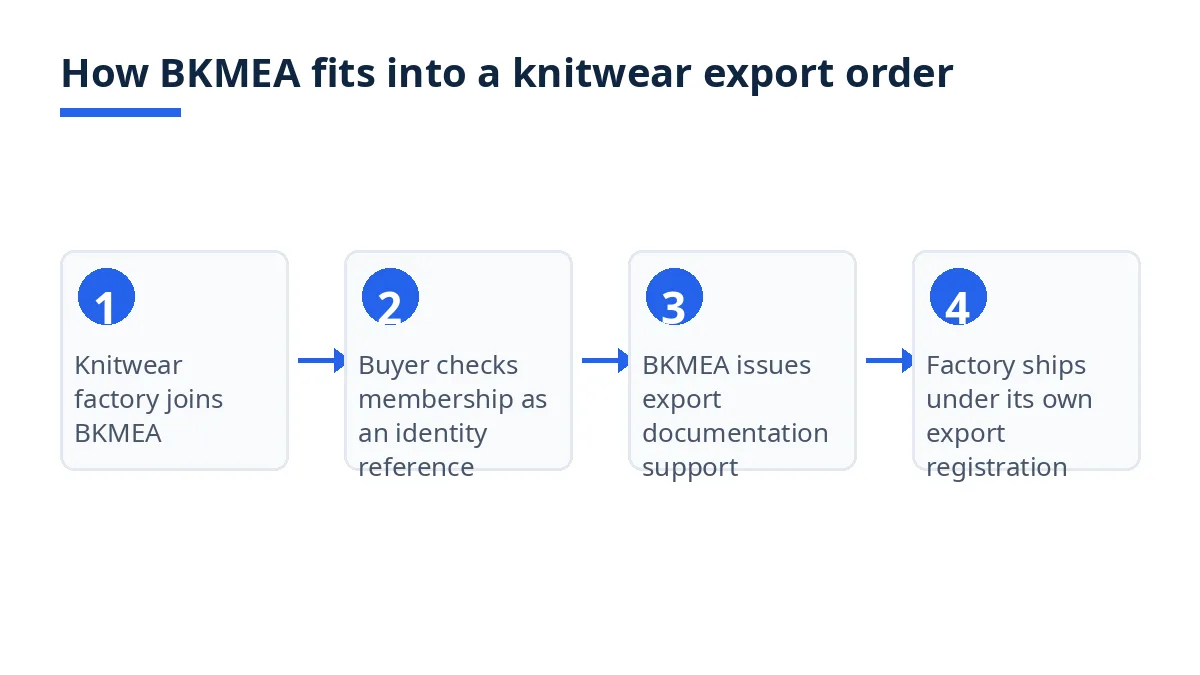
Step 1: A knitwear factory joins BKMEA. A Bangladeshi knitwear manufacturer or exporter becomes a member and is counted among the member factories the association represents.1
Step 2: The member uses association services in its export work. BKMEA lists a one-stop service point for UD and UP services.1 Its UD department handles Utilisation Declaration applications supported by documents that include a consumption report, the export letter of credit or contract copy, a back-to-back letter of credit copy, a proforma invoice for raw material, a bank certificate and a measurement chart.3
Step 3: A UD certificate supports the work order. A UD certificate authorises the use of duty-free imported raw materials for manufacturing export-oriented garments, and both BGMEA and BKMEA issue UD certificates to their members against each work order, detailing exporter, importer and raw material information.2
Step 4: The shipment itself clears through Customs. Bangladesh Customs, under the National Board of Revenue, is responsible for export clearance, and goods may not be loaded until an export declaration, the Bill of Export or Shipping Bill, is submitted and approved by the Customs authority.4 For RMG exports under a bonded warehouse, a Utilisation Declaration is among the additional documents listed.4
Step 5: The buyer checks the claim, then continues with due diligence. Confirm membership is held in the same company name as the quotation and invoice, then check business registration, samples and written terms separately.
The diagram below summarises how BKMEA fits into a knitwear export order.
Who is responsible for what
Party | Responsible for |
|---|---|
BKMEA | Representing member knitwear exporters, policy advocacy, member services including the one-stop UD and UP service point, and sector promotion |
Knitwear manufacturer or exporter | Holding membership in its correct company name, producing the goods, and preparing export documents |
Buyer | Checking the membership claim, verifying the supplier separately, and agreeing terms in writing |
Customs and government authorities | Export clearance, duties and regulatory decisions, which BKMEA does not make |
Inspection or testing providers, if used | Checking goods against the standard the buyer has specified |
A late shipment or failed quality check is a contract matter between buyer and seller. Membership transfers no responsibility to BKMEA, which decides no customs outcomes.4
Worked example with numbers (Bangladesh shipment)
Example figures: a European buyer orders 10,000 knitted polo shirts from a Bangladeshi knitwear exporter, packed into 500 cartons for sea shipment. These numbers are illustrative only.
First, the buyer confirms the exporter lists BKMEA membership in the same company name as on the pro forma invoice. Second, the buyer checks the order documents: 10,000 pieces, agreed sizes and colors, the 500-carton packing plan and the shipment window are all in the purchase order. Third, because the order uses imported inputs, the exporter applies for a UD certificate against the work order.3 2 Fourth, the buyer approves a pre-production sample and arranges its own inspection before loading.
BKMEA appears at the checking and documentation stage. The numbers that decide whether the order succeeds sit in the contract, not in the membership.
BKMEA vs BGMEA
BKMEA and BGMEA are separate associations with overlapping ground. The short table below sets out the difference, and the full comparison is in BGMEA and BKMEA.
Point | BKMEA | BGMEA |
|---|---|---|
Full name | Bangladesh Knitwear Manufacturers and Exporters Association | Bangladesh Garment Manufacturers and Exporters Association |
Sector focus | Knitwear sector of Bangladesh1 | Wider apparel industry, covering woven garments, knitwear and sweaters5 |
Established | 19961 | 19835 |
Membership route | Knitwear manufacturers and exporters join BKMEA as members1 | Factories apply for BGMEA membership online, submit documents, pay online and generate an e-certificate of membership6 |
Around 40 percent of BGMEA member factories are knitwear and sweater manufacturers, and the rest, around 60 percent, are woven garment manufacturers.5 A knitwear factory may therefore appear in connection with either body. Check the actual membership record rather than assuming from the product.
BKMEA membership vs an export licence. Membership is not a trade licence. The Export Policy 2024-27 lists getting an Export Registration Certificate, or ERC, from the Office of the Chief Controller of Imports and Exports (CCI&E) as step one of the export process, and the ERC is a separate approval issued by CCI&E.7 A supplier needs the correct government registrations on top of any membership.
BKMEA vs a certificate of origin. A certificate of origin states where goods were made. Customs lists the certificate of origin for export goods as issued by the Export Promotion Bureau or a Chamber of Commerce and Industry, not by BKMEA.4 Ask for each document by name when your order requires it.
Common mistakes to avoid
Treating membership as certification. Membership shows a supplier belongs to the organised knitwear trade. It certifies no order, fabric or audit result, and it is not a guarantee of quality or reliability.
Confusing BKMEA with a government department. Customs clearance and export registration belong to the authorities.4
Mixing up BKMEA and BGMEA. The two bodies serve overlapping but different memberships. Record the full name of the body your supplier belongs to.
Checking the name but not the company. Membership, invoice and bank account names should all match. A mismatch is a reason to pause and ask questions.
Skipping normal due diligence. Samples, written specifications, inspection and clear payment terms remain your responsibility.
Assuming BKMEA covers every Bangladeshi product. BKMEA is specific to knitwear. Other sectors belong to different trade bodies, or to none relevant to your check.
How Exportain helps
Exportain is a B2B export marketplace where buyers find Bangladeshi suppliers, post requests for quotation, receive quotations, message suppliers and place orders. A supplier profile can state trade association memberships, and buyers can review the verification information recorded for a supplier before they enquire. Those checks are reviews of documents and photos, not factory inspections or guarantees. Exportain is not a party to the contract for goods, and it does not inspect goods, book freight or clear customs.
Frequently asked questions
What is BKMEA?
BKMEA is the Bangladesh Knitwear Manufacturers and Exporters Association, the apex trade body for the knitwear sector of Bangladesh, established in 1996 and currently representing approximately 2,540 knitwear member factories.1
How does BKMEA work in practice?
In practice, a knitwear exporter joins BKMEA as a member and uses its services, including the one-stop service point for UD and UP services.1 For a UD, the member submits documents such as the export letter of credit or contract, a consumption report and a raw material proforma invoice.3 For a buyer, BKMEA is a membership claim to check during supplier screening, then to follow with samples and written terms.
Is BKMEA used for shipments from Bangladesh?
Yes, indirectly. BKMEA services sit behind knitwear shipments, because a Utilisation Declaration is listed by Customs among the additional documents for RMG exports under a bonded warehouse.4 BKMEA is not a shipping line or a freight term, so it does not move goods or clear a shipment itself.
What are common mistakes with BKMEA?
Common mistakes include treating membership as a certification or quality guarantee, confusing BKMEA with a government authority or with BGMEA, and failing to check that the membership name matches the invoice company. Skipping samples, specifications and inspection is another frequent error.
Next steps on Exportain
Start by learning how to find suppliers in Bangladesh, then read the overview of the knitwear industry in Bangladesh before your first inquiry. When your specification is ready, return to the Exportain home page to post a request for quotation, and ask each shortlisted knitwear supplier for its BKMEA membership record and its export registration.
Sources
- BKMEA at a Glance. BKMEA (accessed )
- BGMEA makes unit price declaration mandatory for UD certificates. The Financial Express, (accessed )
- Utilization Declaration (UD) Department services. Bangladesh Knitwear Manufacturers and Exporters Association (accessed )
- Customs Clearance Procedures for Export. Bangladesh Customs, National Board of Revenue (accessed )
- Bangladesh Garment Manufacturers and Exporters Association (BGMEA). Sidley Austin LLP (accessed )
- BGMEA launches Membership Management System to provide faster and simpler services. BGMEA (accessed )
- Start an Export Business in Bangladesh (2026 Guide). Entrepreneurs.bd (accessed )
Reviewed by Naim Islam
About the author
Sourcing from Bangladesh?
Post a request for quotation and suppliers on Exportain can send you their quotes directly.
Post an RFQ