BGMEA and BKMEA Full Meaning, Role and Membership
BGMEA covers Bangladesh ready-made garments broadly and BKMEA covers knitwear only. This guide compares their roles and membership, and shows buyers how to verify a factory claim directly.
Short answer
BGMEA is the Bangladesh Garment Manufacturers and Exporters Association, the trade body for ready-made garments broadly. BKMEA is the Bangladesh Knitwear Manufacturers and Exporters Association, the trade body for knitwear only. Both represent exporters to government, support members with export services including Utilisation Declarations, and run compliance and training work. Buyers use membership as a starting check, then verify it directly.
On this page
Key takeaways
BGMEA, founded in 1983, covers woven garments, knitwear and sweaters, with around 4,500 member factories.
BKMEA, established in 1996, covers knitwear only, with approximately 2,540 member factories.
Both associations issue Utilisation Declaration (UD) certificates to members against each work order.
Membership does not guarantee quality, delivery or day-to-day compliance.
Buyers should confirm membership directly with the association, not from a logo or a scanned certificate alone.
BGMEA means Bangladesh Garment Manufacturers and Exporters Association, and BKMEA means Bangladesh Knitwear Manufacturers and Exporters Association. BGMEA represents the ready-made garment industry, particularly woven garments, knitwear and sweater sub-sectors.1 BKMEA represents the knitwear sector of Bangladesh.2 If you source apparel from Bangladesh, you will see these names on factory profiles, membership certificates and export documents. Understanding what each body covers and how to verify membership helps you judge whether a supplier is a genuine exporting factory.
This guide gives you a side-by-side comparison, what each association does, who can become a member, and a step-by-step method to verify membership. For the wider buying process, see how to import from Bangladesh.
What does BGMEA mean?
BGMEA is the short form of Bangladesh Garment Manufacturers and Exporters Association. It started its journey in 1983 and works through policy advocacy to the government, services to members, and ensuring workers' rights and social compliance at factories.1 Its headquarters is the BGMEA Complex in Dhaka.3
BGMEA covers woven garments, knitwear and sweaters, although buyers most often meet it through woven and general apparel factories.1 It reports around 4,500 member factories, about 40 percent knitwear and sweater manufacturers and 60 percent woven garment manufacturers.1 It also owns the BGMEA University of Fashion and Technology and has a research wing.3
For a buyer, the point is simple. A factory that lists BGMEA membership claims to be part of Bangladesh's formal, export-oriented garment sector. That claim is worth checking, not just accepting.
What does BKMEA mean?
BKMEA is the short form of Bangladesh Knitwear Manufacturers and Exporters Association. BKMEA was established in 1996 by a group of manufacturers and currently represents approximately 2,540 knitwear member factories.2 BKMEA lists its headquarters in Dhaka, Bangladesh.4 BKMEA also has its own research unit.4
Where BGMEA covers the garment sector broadly, BKMEA gives knitwear its own voice. Knitwear here means T-shirts, polo shirts, sweatshirts, underwear and other knitted apparel, which uses different machinery, yarn supply chains and lead times from woven garments.
BKMEA states that it works on sector-based policy and advocacy, provides services to members, addresses environmental and labor standard issues in member factories, and collaborates with government and other stakeholders.2 For buyers sourcing knit products, BKMEA membership is often the more relevant signal. As with BGMEA, it is a starting point for due diligence, not the end of it.
BGMEA vs BKMEA: comparison table
The two associations are sister bodies, not rivals. Some factories hold membership of both. The table below summarizes the differences buyers most often need.
Feature | BGMEA | BKMEA |
|---|---|---|
Full form | Bangladesh Garment Manufacturers and Exporters Association | Bangladesh Knitwear Manufacturers and Exporters Association |
Founded | 19831 | 19962 |
Main focus | Ready-made garments broadly, including woven garments, knitwear and sweaters1 | Knitwear only2 |
Typical products covered | Shirts, trousers, jackets, denim and general apparel, plus some knit and sweater production | T-shirts, polo shirts, hoodies, sweatshirts, underwear and other knitted garments |
Head office | BGMEA Complex, Dhaka3 | Dhaka4 |
Member factories stated by the body | Around 4,500 member factories1 | Approximately 2,540 knitwear member factories2 |
Who joins | Garment manufacturers and exporters, mainly woven and general ready-made garment factories, with a large knit and sweater minority1 | Knitwear manufacturers and exporters2 |
Key export service | Issues Utilisation Declarations (UDs) to members5 | Issues Utilisation Declarations (UDs) to members, with a one-stop service point for UD and UP services2 |
Role with government | Policy advocacy to the government for the wider ready-made garment sector1 | Sector-based policy making and advocacy for knitwear2 |
Dual membership | Possible where a factory makes both woven and knit products | Possible where a factory makes both woven and knit products |
In short: for woven shirts or trousers, expect BGMEA; for T-shirts or fleece, expect BKMEA; for both, verify each membership separately.
What does BGMEA do?
BGMEA's role falls into four areas that matter to buyers, even though buyers are not its members.
First, representation. BGMEA carries out policy advocacy to the government for the apparel industry.1
Second, export facilitation. Both BGMEA and BKMEA issue UD certificates to members against each work order, detailing exporter, importer and raw material information.5 A UD certificate authorizes the use of duty-free imported raw materials for manufacturing export-oriented garments, and is required for customs clearance, export processes, trade preferences and cash incentives.5 BGMEA has moved this work online: its Membership Management System lets factories apply, submit documents, pay, update information and generate an e-certificate, and BGMEA describes UD automation as one of its digital services.6
Third, compliance. BGMEA states that ensuring workers' rights and social compliance at factories has been part of its work since its inception.1 Its membership criteria are also linked to safety and operational standards, covered below.
Fourth, industry development. BGMEA has a research wing and owns a university of fashion and technology.3
What does BKMEA do?
BKMEA performs a similar set of functions, focused on knitwear. It says it promotes the Bangladesh knitwear sector in the global apparel market, formulates sector-based policy and advocacy, and provides services to members.2 Its listed activities include work on knitwear, export, import, textile, industrial and labor policy, plus market expansion, research and productivity work.2
On export services, BKMEA lists a one-stop service point for UD and UP services.2 That matches the shared UD role: both associations issue UD certificates to members against each work order.5
On compliance and skills, BKMEA lists consultancy for social and environmental compliance and green industry development, research, training for workers and managers, and assistance on structural and fire safety.2 It also has its own research unit.4
For buyers, membership connects a factory to the UD process it needs for duty-free inputs. That is why it is worth verifying, and why a false claim is a serious warning sign.
Who can become a member and how does membership work?
Membership is for businesses, not individuals. A member must be a garment or knitwear manufacturer and exporter in Bangladesh, with the registrations a formal exporter needs.
What are BGMEA's current membership criteria?
BGMEA has introduced criteria for granting membership that include minimum factory space and machinery requirements, aiming to ensure basic operational and safety standards.7 A woven or knit factory must have at least 100 machines, a sweater factory at least 60 machines, and a factory must have at least 15,000 square feet of floor space to qualify.7 BGMEA said it will not register a factory in a shared building housing other establishments such as banks, insurance offices or markets, although a building with only garment units may be approved.7 Criteria change, so treat any threshold as a prompt to ask for current evidence.
BGMEA's membership system is online: factories apply, submit documents and pay online, and members can update information and generate an e-certificate.6 For reinstatement, factories must submit updated trade licenses, tax certificates and factory licenses and clear all outstanding dues.7
For export registration itself, see the Export Registration Certificate (ERC) guide. Association membership and export registration are different checks.
Can a factory be a member of both BGMEA and BKMEA?
Yes, a factory can hold membership of both associations, most commonly where it produces both woven and knit garments or a group has separate woven and knit units. Overlap is normal: about 40 percent of BGMEA member factories are knitwear and sweater manufacturers.1 A dual member may obtain its UDs mainly from one association, so verify each membership separately and ask which body issued the UD for orders like yours.
What about subcontracting factories?
Subcontracting adds another layer. The Bangladesh commerce ministry's subcontracting guidelines made BGMEA or BKMEA membership mandatory for subcontracting factories.8 Only compliant factories are eligible, a written agreement between the exporter and the factory is mandatory, and the guidelines also require the government-set minimum wage, approved structural designs and group insurance for workers.8 Exporters must monitor compliance in subcontracting factories and inform the trade bodies about any nonconformity.8
If your order involves subcontracting, ask the exporter to name the subcontractor and provide its membership evidence. Rule out undisclosed subcontracting in writing.
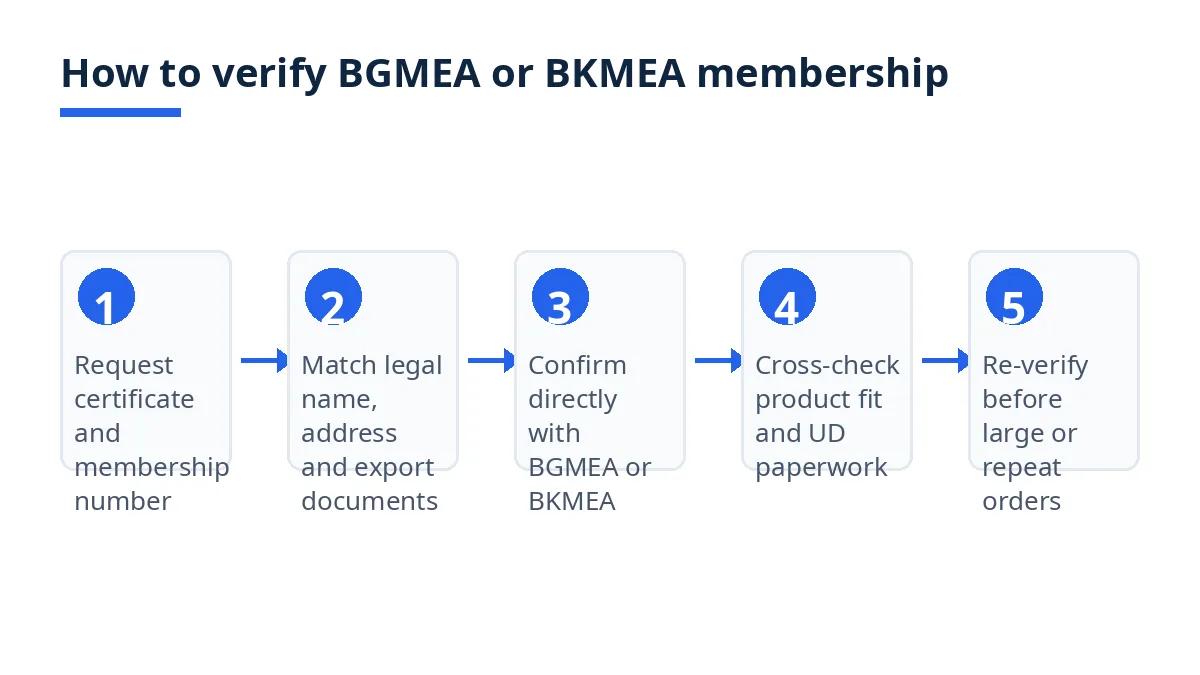
How can buyers verify BGMEA and BKMEA membership?
Verification must go beyond a logo on a website or a scanned certificate in a sales presentation. Follow these steps for every new supplier.
Ask for the membership certificate and number. Request a clear copy of the current certificate, the membership number, the exact legal company name and the factory address, and note the validity period. For BGMEA members, an e-certificate generated through the Membership Management System is part of how membership is now managed.6 An expired certificate, or a name or address that does not match the company quoting you, is a reason to pause.
Match the legal identity. Compare the certificate name with the trade license, export registration, bank details, pro forma invoice and contract. A different name may mean you are dealing with a trading intermediary rather than the factory itself. That is not automatically disqualifying, but you should know which model you are buying through.
Check with the association directly. Contact BGMEA or BKMEA through its official site and ask it to confirm whether the company is a current member in good standing. Provide the legal name, membership number and factory address exactly as shown, use contact details from the official site only, and keep the confirmation in your supplier file.
Cross-check product fit. A knitwear order placed with a factory whose only verifiable membership and machinery are for woven production deserves extra questions. Visit the factory or use an inspection partner to confirm that machines match the claimed category. A pre-shipment inspection helps you check the goods later.
Verify supporting export documents. Check export registration, any bonded warehouse license where it applies, and UD paperwork for comparable orders. The UD paperwork should detail the exporter, importer and raw material information for the work order.5 Consistency across documents, with the same name, address and ownership, is the signal you want. See also export documents from Bangladesh.
Re-verify before large or repeat orders. Membership can lapse. Before a large order, a new season or a change of factory unit, repeat the direct check and record the date and who confirmed it.
If a supplier refuses to share a membership number or provides a certificate you cannot confirm, treat that as a material risk and do not pay a deposit until the identity check is complete.
Why membership matters, and what it does not guarantee
Verified membership indicates that a factory is part of the formal export system, has been assessed by its trade body against that body's criteria, and has access to the UD process for duty-free inputs.
Membership does not guarantee product quality, on-time delivery, labor conditions on a given day or financial stability. It is not a substitute for inspections, audits, buyer references, trial orders and a clear contract. Think of verification as an identity check: it confirms a real, registered participant in Bangladesh's garment export industry. Quality and delivery still depend on how you specify, monitor and manage the order.
Common mistakes buyers make with BGMEA and BKMEA claims
The first mistake is accepting a logo as proof. Only a direct check with the association turns a claim into a verified fact.
The second mistake is checking the wrong association for the product. Match the check to the product, and check both memberships where a supplier claims both.
The third mistake is treating membership as a quality result. Quality is answered by samples, inspections, agreed acceptance limits and buyer references.
The fourth mistake is verifying once and never again. Membership, licenses and factory units change, so an old check does not cover a new unit or a lapsed renewal.
Frequently asked questions
What is the full form of BGMEA?
BGMEA stands for Bangladesh Garment Manufacturers and Exporters Association. It is the trade association for garment manufacturers and exporters in Bangladesh, founded in 1983 and headquartered at the BGMEA Complex in Dhaka.1 3
What is the full form of BKMEA?
BKMEA stands for Bangladesh Knitwear Manufacturers and Exporters Association. It is the trade association for knitwear manufacturers and exporters in Bangladesh, established in 1996 and based in Dhaka.2 4
What is the main difference between BGMEA and BKMEA?
The main difference is product focus. BGMEA covers the ready-made garment sector broadly, including woven garments, knitwear and sweaters, while BKMEA covers knitwear only.1 2 Both represent exporters, issue Utilisation Declarations to members and work with the government on trade policy.5
Can a factory be a member of both BGMEA and BKMEA?
Yes, a factory or group that produces both woven and knit garments may hold dual membership. Buyers should verify each membership separately with the relevant association and ask which body issues the factory's Utilisation Declarations for orders like theirs.
How can a buyer verify a factory's BGMEA or BKMEA membership?
Ask for the current membership certificate and number, match the legal name and factory address against the trade license and export documents, then contact the association directly through its official site to confirm current membership. Re-verify before large or repeat orders.
Does BGMEA or BKMEA membership guarantee quality?
No, membership does not guarantee quality. It confirms that a factory is part of the formal export system and has access to export facilitation such as the UD process.5 Buyers should still run their own audits, inspections, trial orders and reference checks.
Why do BGMEA and BKMEA issue UD certificates?
BGMEA and BKMEA issue UD certificates so member factories can use duty-free imported raw materials for specific export orders. A UD authorizes that use for manufacturing export-oriented garments and is required for customs clearance and related export processes.5 Each UD is issued against a work order and details the exporter, importer and raw material information.5
Next steps on Exportain
On Exportain you can browse Bangladeshi suppliers, compare profiles and post a structured request for quotation that sets out your product, quantity and destination. Exportain is a marketplace for finding and contacting suppliers; it is not a party to your contract for goods, and it does not inspect goods, book freight or clear customs. Read how to buy on Exportain before you order, ask for the BGMEA or BKMEA membership number early, and confirm it with the association before you confirm the order.
Sources
- Bangladesh Garment Manufacturers and Exporters Association (BGMEA). Devex (accessed )
- BKMEA at a Glance. BKMEA (accessed )
- Bangladesh Garment Manufacturers and Exporters Association. Wikipedia (accessed )
- Bangladesh Knitwear Manufacturers and Exporters Association. Wikipedia (accessed )
- BGMEA makes unit price declaration mandatory for UD certificates. The Financial Express, (accessed )
- BGMEA launches Membership Management System to provide faster and simpler services. BGMEA (accessed )
- BGMEA sets new membership criteria to ensure factory safety, operational standards. The Financial Express, (accessed )
- BGMEA, BKMEA membership must for Bangla subcontractors. Fibre2Fashion (accessed )
About the author
Sourcing from Bangladesh?
Post a request for quotation and suppliers on Exportain can send you their quotes directly.
Post an RFQ