CIF Incoterms 2020 Explained: Seller and Buyer Obligations Step by Step
Definition
CIF (Cost, Insurance and Freight) is an Incoterms 2020 rule for sea and inland waterway transport only. The seller delivers on board at the port of shipment, clears export, and pays for carriage and minimum Clauses (C) insurance to the named destination port. Risk passes to the buyer on board, so cost and risk transfer at different points.
By Naim Islam
Published 7 min read
On this page
Key takeaways
Under CIF, the seller pays freight and minimum insurance to the named destination port, but risk passes to the buyer on board at the port of shipment.
The default CIF insurance is Institute Cargo Clauses (C) for 110% of the contract price in the contract currency.
The seller clears export and the buyer clears import; the buyer also pays destination charges not included in the freight.
CIP, not CIF, is the any-mode rule, and its default insurance level is Institute Cargo Clauses (A).
Under CIF Incoterms 2020, the seller pays for carriage and marine insurance to a named destination port, but the buyer carries the risk from when the goods are placed on board the vessel at the port of shipment. This article sets out the ten obligation pairs, a worked example for a shipment from Bangladesh, and the mistakes that create disputes.
What CIF means in plain English
CIF stands for Cost, Insurance and Freight. It is an Incoterms 2020 rule published by the International Chamber of Commerce (ICC), and it is always used with a named port of destination, for example "CIF Rotterdam, Incoterms 2020." The ICC states that the CIF rule is reserved for use in maritime trade.1 The seller delivers the goods on board the vessel, clears them for export, and contracts and pays for carriage and insurance to the named destination port.
The central point is a split: the destination, to which the seller arranges transport, and the place of delivery, where risk passes, are different places.2 The insurance protects the buyer on a leg where the buyer already bears the risk. See also CIF: cost, insurance and freight.
How CIF works step by step
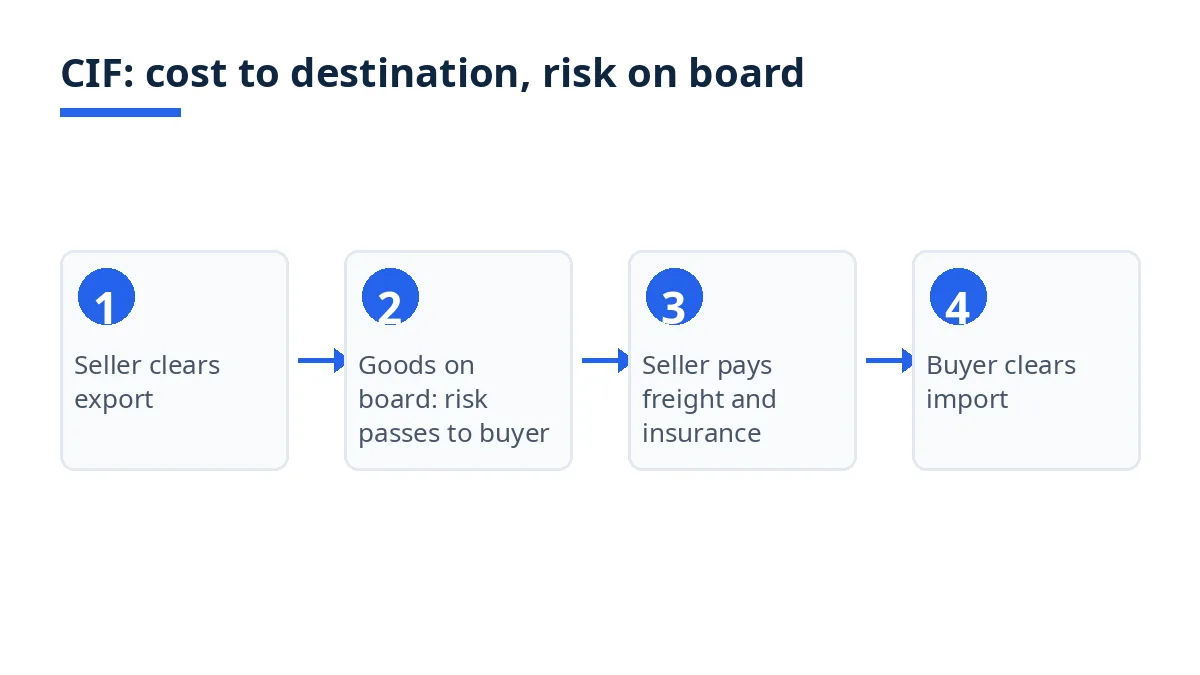
Agree the term in full. Write the rule, the named port and the version, for example "CIF Rotterdam, Incoterms 2020."
The seller prepares the goods. The seller supplies the goods and invoice, and checks, packs and marks them as the contract requires.
The seller clears export. Under the "C" rules, the seller must complete export formalities.2
The seller contracts carriage and insurance. The seller arranges carriage to the named port and must obtain cargo insurance covering the goods up to that port.2
The seller delivers on board. Delivery and risk transfer occur when the goods are loaded on board at the port of shipment.2
The seller sends the documents. The seller provides the transport and insurance documents, so the buyer can claim the goods and claim under the insurance if needed.
The buyer takes over. The buyer pays the price, completes import formalities, and pays import duties and onward costs.2
Who is responsible for what under CIF?
Incoterms 2020 sets out ten matched articles, A1 to A10 for the seller and B1 to B10 for the buyer. In the 2020 edition all costs for a rule are also listed together in A9/B9.1 Under CIF, the pairs divide as follows.
Article | Seller (A) | Buyer (B) |
|---|---|---|
A1/B1 General | Provides the goods and invoice as agreed in the contract | Pays the price as agreed in the contract |
A2/B2 Delivery | Delivers the goods on board the vessel at the port of shipment | Takes delivery of the goods at the named destination port |
A3/B3 Risk | Bears risk until the goods are on board at the port of shipment | Bears risk from the moment the goods are on board |
A4/B4 Carriage | Contracts and pays for carriage to the named destination port | Has no duty to contract for the main carriage |
A5/B5 Insurance | Obtains cargo insurance at the seller's cost, for the buyer's benefit | Has no duty to insure, but may arrange extra cover |
A6/B6 Document | Provides the transport document covering carriage to destination | Accepts the transport document when it is issued as agreed |
A7/B7 Clearance | Completes export clearance | Completes import and transit clearance and pays import duties |
A8/B8 Checking and packing | Pays for checking and packs and marks the goods for the agreed carriage | Has no checking or packing duty under this article |
A9/B9 Costs | Pays costs to delivery on board, plus freight, insurance and export clearance | Pays other costs from delivery on board, including import duties |
A10/B10 Notices | Notifies the buyer that the goods have been delivered on board | Gives any notice the seller needs to arrange carriage and insurance |
On A5/B5, the default insurance is Institute Cargo Clauses (C), and the parties may agree a higher level.1 On A9/B9, the buyer pays unloading at destination unless the contract of carriage places those costs on the seller.2
How much insurance must the seller buy under CIF?
The seller must insure the transport with cover that complies with Clause C of the Institute Cargo Clauses or comparable clauses, for 110% of the goods' sales price in the contract currency, extending from the point of delivery to the port of destination, and must provide proof of insurance to the buyer.3 Clauses (C) cover a list of named risks, such as fire and explosion, stranding, capsizing and general average.3 CIF is one of only two Incoterms 2020 rules that require a party to purchase insurance, and in both CIF and CIP the cover must be at least 110% of the value of the goods in the sales contract.4
That default is minimum cover, not full cover. If wider protection is needed, agree it before shipment. A buyer who wants higher cover bears the additional cost unless the contract states otherwise.3
Worked example with numbers for a Bangladesh shipment
Example figures only. The numbers below illustrate the arithmetic and are not market quotes.
A buyer in Europe orders garments from a seller in Bangladesh on the term "CIF Rotterdam, Incoterms 2020."
Goods, ex-works value of the order: USD 20,000
Export packing, checking, delivery to the vessel at Chattogram and export clearance, arranged and paid by the seller: USD 600
Ocean freight from Chattogram to Rotterdam, contracted and paid by the seller: USD 1,800
Marine insurance premium arranged by the seller: USD 150
CIF price invoiced to the buyer: USD 22,550
At a contract price of USD 20,000, cover at 110% means an insured amount of USD 22,000 at the Clauses (C) minimum, in the contract currency.3
Once the goods are on board at Chattogram, the buyer bears the voyage risk, even though the seller paid the freight and premium. On arrival, the buyer pays import clearance, duties, unloading not included in the freight, and onward transport. See landed cost for imports from Bangladesh.
How does CIF compare with FOB, CFR and CIP?
Rule | Who pays main freight | Seller must insure | Risk passes |
|---|---|---|---|
FOB | Buyer | No | On board the vessel at the port of shipment |
CFR | Seller | No | On board the vessel at the port of shipment |
CIF | Seller | Yes, Clauses (C) minimum | On board the vessel at the port of shipment |
CIP | Seller | Yes, Clauses (A) | When goods are handed to the first carrier |
Under FOB, delivery and risk work as under CIF, but the buyer arranges the main carriage. See FOB (Free On Board). CFR is CIF without the seller's insurance duty. CIP is the any-mode counterpart: the ICC raised the CIP default to Clauses (A), while CIF kept Clauses (C).1 CIF suits port-to-port, bulk or non-containerized goods, and CIP usually fits containerized goods better.4 See Incoterms for shipments from Bangladesh.
Common mistakes to avoid
Using CIF for air freight or a terminal handover. CIF is for sea and inland waterway transport only.4 Where containers are handed over at a terminal before loading, CIP may fit better.3
Assuming the seller carries risk to destination. Risk passes on board at shipment, even though the seller pays to destination.
Accepting minimum insurance without checking it. Clauses (C) cover named risks only. Check the list before signing.
Omitting the port or the version. "CIF" with no named port and no Incoterms 2020 reference leaves the cost endpoint open.
Ignoring destination charges. Unloading and handling not included in the freight fall on the buyer.
Not checking the insurance document. Confirm it covers your shipment, lets you claim, and runs at least from loading to destination.
FAQs
What is CIF?
CIF is an Incoterms 2020 rule meaning Cost, Insurance and Freight, used only for sea and inland waterway transport. The seller delivers on board at the port of shipment and pays for carriage and minimum insurance to the named destination port, while risk passes to the buyer on board.
How does CIF work in practice?
The seller export-clears the goods, books carriage and insurance, loads them on board, and sends the transport and insurance documents. The buyer pays the price, import-clears on arrival, and pays duties and onward delivery.
Is CIF used for shipments from Bangladesh?
CIF can be used for a sea shipment from Bangladesh when the seller arranges freight and insurance to a named port, for example from Chattogram to a European port. Check whether Clauses (C) minimum cover is sufficient for the goods.
What are common mistakes with CIF?
Common mistakes are using CIF for non-sea transport, assuming the seller bears risk to destination, accepting Clauses (C) cover without checking it, and leaving out the named port, the Incoterms 2020 reference, or destination charges.
Next steps on Exportain
Before you agree a CIF price, set the named port, insurance level and destination charges in writing. Browse suppliers on Exportain, read how to buy on Exportain, or post an RFQ stating "CIF [your port], Incoterms 2020" so quotes use the same basis.
Sources
- Incoterms® 2020. International Chamber of Commerce (accessed )
- Incoterms® 2020 C rules vs D rules: Risk transfer explained. ICC Academy (accessed )
- CIF (Cost Insurance and Freight) | Incoterms 2020. Röhlig Logistics (accessed )
- Incoterms 2020 CIF: Spotlight on Cost, Insurance and Freight. Shipping Solutions, (accessed )
Reviewed by Nourin Tabassum
About the author
Sourcing from Bangladesh?
Post a request for quotation and suppliers on Exportain can send you their quotes directly.
Post an RFQ