CIF Value Meaning: How Customs Uses CIF Value to Calculate Duty
Definition
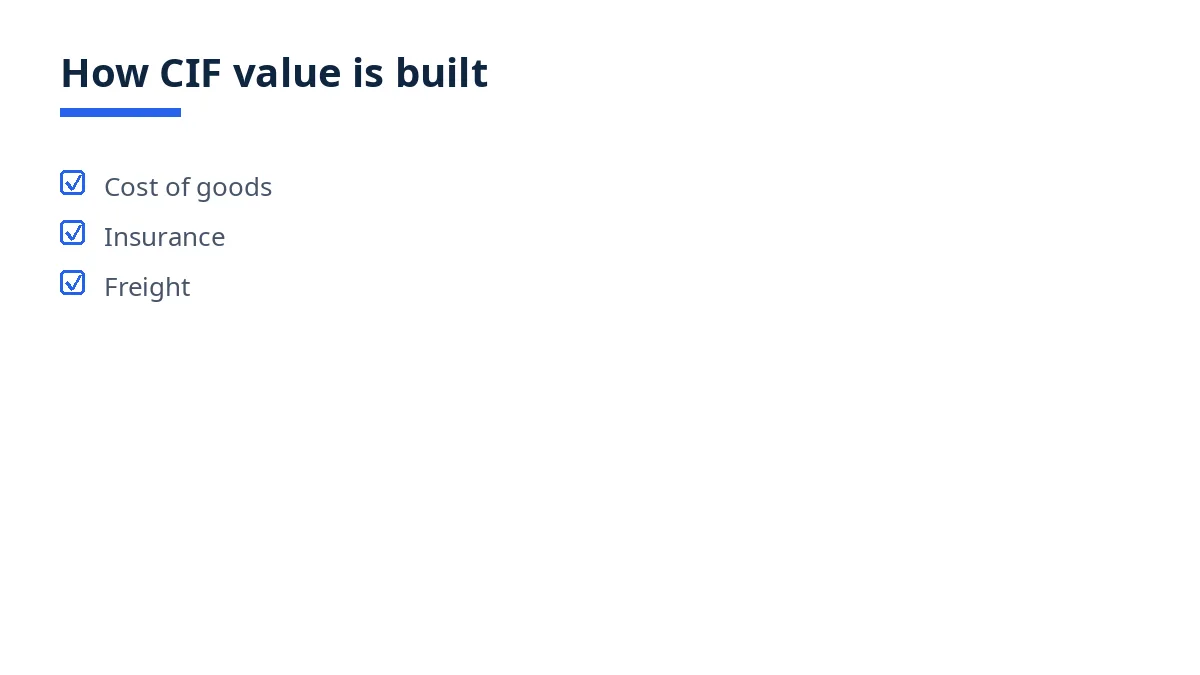
The CIF value is the cost of the goods plus insurance plus freight to the port of importation. In territories that value goods on a CIF basis, customs calculates import duty on that combined figure rather than on the goods price alone. The United States is an exception, because its law excludes international transport and insurance from the dutiable price when they are shown separately.
By Naim Islam
Published 7 min read
On this page
Key takeaways
CIF value is the cost of the goods plus insurance plus freight to the port of importation.
The majority of WTO members include transport and insurance in the customs value, the CIF basis, so duty falls on the combined figure.
The United States excludes international transport and insurance from the dutiable price when they are shown separately.
Under CIF the seller pays freight and insurance to the destination port, but risk passes to the buyer once the goods are on board.
The CIF value stops at the destination port and excludes duty, taxes and onward delivery, which belong to landed cost.
If you import goods by sea, the cif value meaning matters twice: when you compare a seller's price, and when customs works out your duty. The customs value is the value of goods for the purpose of levying ad valorem duties, which are duties calculated on value.1 This article explains what the CIF value includes, how customs uses it, and where the main exception sits.
Under the WTO Agreement on Customs Valuation, the customs value is based primarily on the transaction value, the price actually paid or payable when sold for export to the country of importation, plus certain adjustments.2 Whether transport and insurance sit inside that value depends on the importing country's law.1
Quick answer
The CIF value is the cost of the goods plus insurance plus freight to the port of importation. The majority of WTO members include those transport, loading and insurance elements in the customs value, a basis known as the CIF (cost, insurance, freight) basis, while the few that exclude them use an FOB (free on board) basis.3 In a CIF-basis territory, duty is calculated on the combined figure, not on the goods price alone.
What the cif value meaning covers in plain English
CIF stands for Cost, Insurance and Freight. It is one of the Incoterms rules published by the International Chamber of Commerce (ICC), which allocate costs and risks between buyer and seller.4 In the Incoterms 2020 list, CIF sits among the rules for sea and inland waterway transport.5
A CIF price always names a destination port, such as CIF Rotterdam or CIF Felixstowe, because the freight element has no end point without one. The price bundles three elements:
Cost is the goods, including export packing and delivery on board.
Insurance is the marine cover the seller arranges for the buyer's benefit. Incoterms 2020 sets different levels of insurance coverage for CIF and for CIP,4 and under CIF the seller's obligation is minimum cover, so a buyer who needs more should agree it in the contract or arrange a top-up.
Freight is the sea carriage the seller pays to the named destination port.
Risk and cost split at different points. The seller pays freight and insurance to the destination port, but risk passes to the buyer once the goods are on board. For the related price term, see CIF price meaning, and for the full rule, see CIF — Cost, Insurance and Freight.
How it works step by step
Agree the term and the port. Buyer and seller record the CIF port, currency and price in the purchase order and invoice.
The seller prepares and ships the goods. The seller packs for export, completes export clearance and delivers the goods on board. Risk passes to the buyer here, although the seller still pays freight and insurance to the destination.
Freight and insurance are arranged. The seller contracts the carrier, pays ocean freight to the named port and obtains the insurance document. Both amounts form part of the CIF value.
Documents move to the buyer. The buyer receives the invoice, packing list, bill of lading and insurance document, and checks them.
Customs values the shipment. The buyer's broker declares the shipment. Where the territory includes delivery costs, transport, insurance, loading and handling costs to the border must be included in the customs value.6 Duty is a percentage of that value, at the rate set by the goods' classification.
The buyer completes the landed picture. The buyer pays duty, import VAT or sales tax, plus destination charges, and arranges onward delivery.
The United States exception
The United Kingdom determines the customs value on a cost, insurance, freight (CIF) basis under its customs legislation.7 Not every territory does the same. United States law defines the price actually paid or payable as the total payment for imported merchandise, exclusive of any costs incurred for transportation, insurance and related services incident to the international shipment.8 A US-bound CIF invoice should show freight and insurance separately, so they stay out of the dutiable value. Confirm your destination's basis with your broker. See also Incoterms for shipments from Bangladesh.
Who is responsible for what
Cost or task | Seller | Buyer |
|---|---|---|
Goods and export packing | Yes | — |
Export customs clearance | Yes | — |
Delivery on board | Yes | — |
Ocean freight to destination port | Yes | — |
Marine insurance to destination port | Yes | — |
Risk after goods are on board | — | Yes |
Import clearance and declaration | — | Yes |
Import duty on the customs value | — | Yes |
Import VAT or sales tax | — | Yes |
Confirm in writing which destination charges the freight includes, and check the insurance scope.
Worked example with numbers (Bangladesh shipment)
Example figures. The amounts below are illustrative only, not a quotation, a market price or a duty rate.
Element | Example figures |
|---|---|
Goods, including export packing | 10,000 (contract currency) |
Ocean freight, Bangladesh port to destination port | 1,200 |
Marine insurance arranged by the seller | 80 |
CIF value at the destination port | 11,280 |
In a CIF-basis territory, duty is calculated on 11,280, the CIF value times the rate for the goods' classification. Purely as arithmetic, at an illustrative 10 percent the duty would be 1,128, and import VAT on the duty-inclusive value would be calculated on 12,408. The real rate depends on classification and tariff, so check the tariff or ask your broker.
For a US-bound shipment, the dutiable value would generally start from the goods amount rather than 11,280, because international transport and insurance sit outside the price actually paid or payable when identified separately.8 Either way, the CIF value is not your final total: add handling, broker fees, storage and haulage. See landed cost for imports from Bangladesh.
CIF vs related terms
CIF vs FOB. Under FOB (Free On Board), the price covers the goods and delivery on board at the port of shipment, and the buyer arranges freight and insurance. A CIF-basis customs system adds the actual freight and insurance to a FOB price to reach the customs value.
CIF vs CFR. CFR (Cost and Freight) bundles goods and freight but not insurance, and sits with CIF in the sea and inland waterway rules.5 If you insure a CFR shipment yourself, your broker applies your destination's rules to the figures.
CIF vs CIP. CIP (Carriage and Insurance Paid To) sits in the rules for any mode of transport,5 and names a place rather than a port. Risk passes when the goods are handed to the first carrier, not on board.
CIF value vs landed cost. The CIF value stops at the destination port. Landed cost adds duty, taxes, port charges and delivery to your door, so calculate both.
Common mistakes to avoid
Budgeting duty on the goods price alone. In CIF-basis territories, freight and insurance sit inside the taxable value, so a goods-only budget understates it.
Accepting a CIF price with no named port. Without the destination port, the freight element, and therefore the CIF value, is undefined, and quotes cannot be compared.
Failing to break out freight and insurance. Where customs needs the elements separately, the United States being the main example, a lump-sum invoice can mean excess duty or delays.
Assuming the seller's price and the customs value are always the same number. Customs may test and adjust the declared value, so let your broker apply your destination's rules to the invoice figures.
Assuming the seller's insurance is wide cover. The seller's obligation is minimum cover. Check the insured value, the risks covered and who can claim, and top up if needed.
Using CIF for air or courier shipments. CIF is a sea and inland waterway rule. For other modes, use a term such as CIP.
FAQs
What is CIF?
CIF is an Incoterms rule meaning Cost, Insurance and Freight, published by the ICC for sea and inland waterway transport.5 The seller pays for the goods, arranges insurance and pays freight to a named port. Risk passes to the buyer once the goods are on board.
How does CIF work in practice?
The seller export-clears the goods, loads them on board, pays freight to the named port and arranges insurance, then sends the documents to the buyer. The buyer declares the shipment and pays duty, calculated on the CIF-based customs value in CIF-basis territories,3 plus import taxes and charges.
Is CIF used for shipments from Bangladesh?
Yes. CIF is a standard offer for sea shipments from Bangladesh where the buyer wants the supplier to arrange freight and insurance. Confirm the named port, the documents, the insurance scope, and that freight and insurance are identifiable before agreeing the price.
What are common mistakes with CIF?
The most common mistakes are budgeting duty on the goods price alone, accepting a CIF price with no named port, failing to separate freight and insurance where customs requires it, and treating minimum insurance as full cover.
Next steps on Exportain
On Exportain, buyers find Bangladeshi suppliers, post a request for quotation and receive quotations they can compare on the same terms, with port, specification and quantity stated. Browse suppliers, post your requirement at post an RFQ, or read how to buy.
Sources
- Customs Valuation — Frequently Asked Questions. World Customs Organization (accessed )
- Technical information on Customs Valuation. World Trade Organization (accessed )
- WCO Guide to Customs Valuation and Transfer Pricing. World Customs Organization, (accessed )
- ICC releases Incoterms® 2020. International Chamber of Commerce, (accessed )
- Incoterms 2020 app | ICC Knowledge 2 Go. International Chamber of Commerce (accessed )
- Valuing imported goods using Method 1 (transaction value). HM Revenue and Customs (accessed )
- Customs valuation - Additional case studies of interest. HM Revenue and Customs (accessed )
- Field Service Advice 200036015 (quoting 19 U.S.C. § 1401a). Internal Revenue Service, (accessed )
Reviewed by Nourin Tabassum
About the author
Sourcing from Bangladesh?
Post a request for quotation and suppliers on Exportain can send you their quotes directly.
Post an RFQ