What Does an EXW Price Include? Cost Breakdown With a Real Example
Definition
An EXW price covers only the goods themselves, packed for export and made available at the named place, usually the seller's factory. The seller does not load the goods or clear them for export. The buyer pays for loading, transport, export clearance, freight, insurance if wanted, and import duties and taxes.
Published 7 min read
On this page
Key takeaways
An EXW price covers only the goods, export-packed and made available at the named place. Loading is not included.
The buyer pays for loading, inland transport, export clearance, freight, import clearance, duties and taxes on top of the EXW price.
Risk passes to the buyer at handover at the named place, before the goods move, and neither party must insure under EXW.
Compare suppliers on the same Incoterm and named place, and convert every quote to full landed cost before deciding.
If a Bangladeshi supplier quotes you an EXW price, understanding the exw price meaning before you compare quotes will save you from a costly misunderstanding. EXW places the least responsibility on the seller and the most on the buyer, so an EXW quote is almost never the full cost of getting goods to your warehouse.
Quick answer
An EXW price covers only the goods themselves, made available at the seller's premises, usually the factory, in export packing and ready for collection. It excludes loading, inland transport, export clearance, international freight, insurance, and destination duties and charges. The buyer arranges and pays for each of those items separately, on top of the EXW price.
What EXW means in plain English: the exw price meaning explained
EXW stands for Ex Works. It is one of the Incoterms® rules published by the International Chamber of Commerce (ICC), a set of eleven three-letter trade terms first published in 1936, with the Incoterms® 2020 edition in force from 1 January 2020.1 EXW can be used for any mode of transport.
Ex Works is always followed by a named place, for example EXW Gazipur factory, Bangladesh, Incoterms® 2020, because the price only makes sense once the handover place is known. In plain English: the goods are ready at our door at the agreed price, and everything from our door onward is yours to arrange and pay for.
Under Incoterms® 2020, delivery and risk transfer occur when the seller places the goods at the buyer's disposal at a named place, such as a factory or warehouse, not loaded on any collecting vehicle.2 The seller does not need to load the vehicle or clear the goods for export, unless agreed otherwise. Risk passes at handover, before the goods move. For the rule in full, see EXW — Ex Works.
An EXW quote therefore often looks lower than a Free On Board (FOB) or Cost, Insurance and Freight (CIF) quote for identical goods. More of the journey is simply left unpaid.
How it works step by step
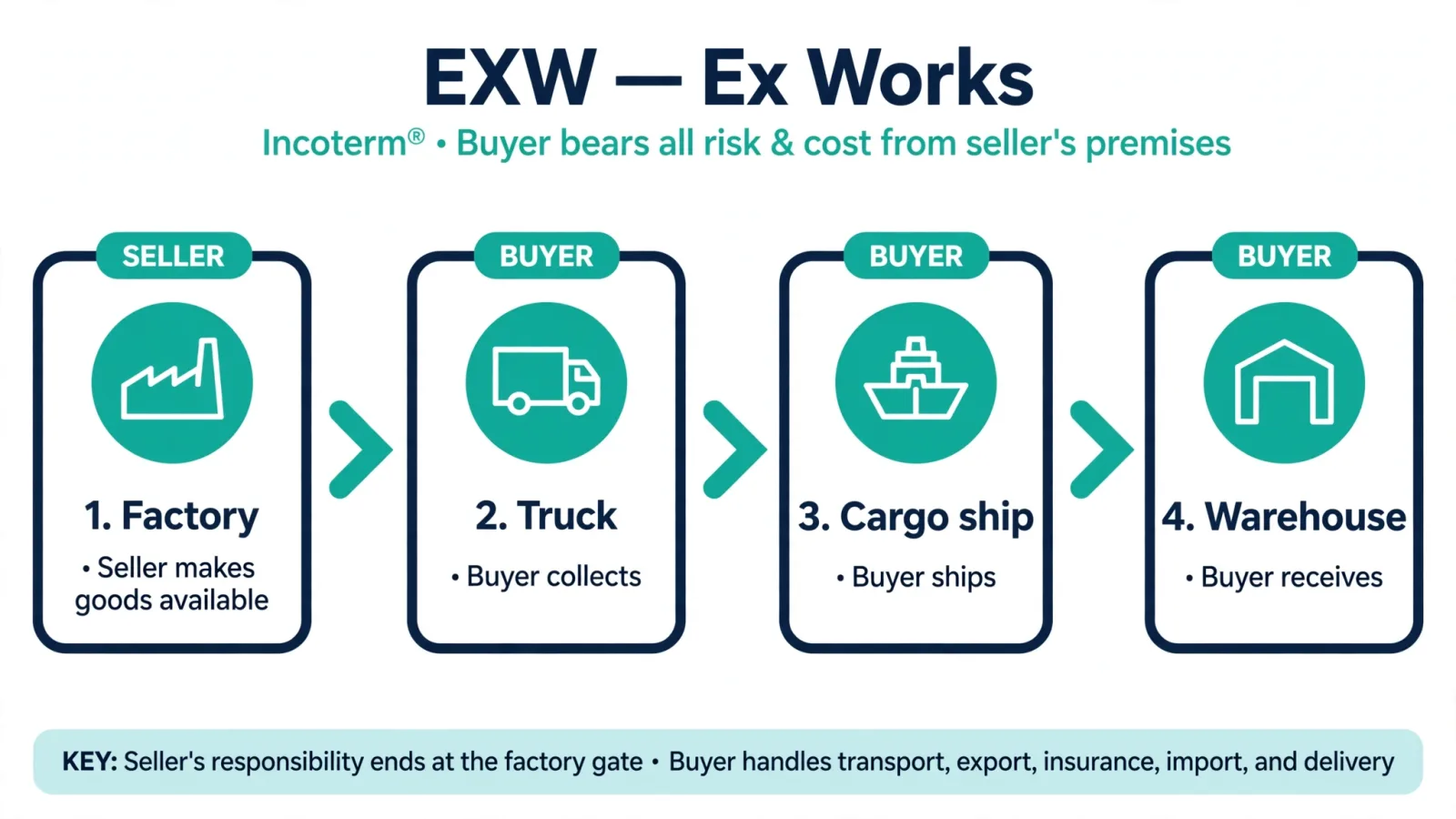
Agree the term, the place and the price. Buyer and seller agree the goods, quantity, packing and price, and record the named place in the pro forma invoice and purchase order, with the exact address and the words Incoterms® 2020.
The seller prepares the goods. The seller makes the goods, packs them for export, and notifies the buyer when they are ready for collection at the named place.
The buyer collects. The buyer, or its forwarder or agent, sends a vehicle to the factory. Loading is the buyer's cost and risk under EXW, unless the seller agrees in writing to load.3
The buyer handles export and the whole journey. The buyer arranges inland transport to the port and completes export clearance in Bangladesh. The seller assists only at the buyer's request, risk and cost.3 The buyer then books and pays for the main carriage and any insurance. See Incoterms for shipments from Bangladesh.
The buyer clears import and receives the goods. On arrival, the buyer handles import clearance, pays destination duties and taxes, and arranges final delivery.
Who is responsible for what
Task | Seller | Buyer |
|---|---|---|
Goods available, export-packed, at the named place | Yes | No |
Notice that the goods are ready | Yes | No |
Loading onto the collecting vehicle | No | Yes, unless the seller agrees in writing to load |
Inland transport, factory to port | No | Yes |
Export clearance in Bangladesh | Assists only, at buyer's risk and cost | Yes |
International freight | No | Yes |
Cargo insurance | No obligation | Buyer's choice, as neither party must insure |
Import clearance, duties and taxes | No | Yes |
Risk after handover at the named place | No | Yes |
Two points surprise first-time buyers. On insurance, EXW requires neither party to take out cover, so arrange your own policy if you want protection from handover. On export clearance, the buyer must handle export formalities, which can be difficult with no presence in the seller's country.3
Worked example with numbers (Bangladesh shipment)
Example figures. The figures below are illustrative round numbers, not quotations or market rates. Confirm each line with your forwarder before you order.
Imagine a consignment of garments from a factory in Gazipur:
Cost line | Who pays | Amount (USD) |
|---|---|---|
Goods at the factory, the EXW price | Buyer pays the seller | 12,000 |
Loading and inland transport to Chattogram port | Buyer | 450 |
Export clearance via the buyer's agent | Buyer | 150 |
Ocean freight to destination port | Buyer | 1,800 |
Cargo insurance arranged by the buyer | Buyer | 120 |
Subtotal at destination port, before import duty and taxes | 14,520 |
The gap is the lesson. The EXW price of USD 12,000 is about 83 percent of the USD 14,520 needed to land the same goods at the destination port, and duty, destination taxes, port charges and final delivery still sit on top. Under EXW, pricing includes only the value of the goods and the packaging needed for the journey.4 See landed cost of imports from Bangladesh for how to build the full figure.
EXW vs related terms
EXW vs FCA. Under Free Carrier (FCA), the seller delivers the goods, cleared for export, to the buyer's carrier at the named place, and loads the goods if delivery is at the seller's premises.3 Because the seller handles export clearance under FCA, ICC guidance notes that EXW can cause problems where goods are intended to be exported and that FCA is preferred in that case.2
EXW vs FOB. Under FOB, the seller delivers the goods on board the vessel at the named port of shipment, and risk passes on board.2 FOB is sea-only, and its price is normally higher than EXW because inland delivery and loading are included. See FOB — Free On Board.
EXW vs CIF. Under CIF, the seller pays for freight and insurance to the named destination port, while risk still passes when the goods are on board at shipment.2 CIF is also sea-only. See CIF price meaning.
EXW vs DDP. Delivered Duty Paid (DDP) is the opposite extreme. The seller delivers to the buyer's destination, cleared for import with duties paid. Always compare suppliers on the same Incoterm, specification and named place.
Common mistakes to avoid
Comparing EXW and FOB quotes as if they were the same price. They cover different parts of the journey. Convert every quote to full landed cost first.
Assuming loading is included. Under EXW it is not. If the factory loads your vehicle as a favor, agree who bears the risk of damage during loading.
Assuming the seller clears the goods for export. Export clearance is the buyer's responsibility. Without a Bangladeshi agent or forwarder in place before collection day, the shipment can stall at the gate.
Leaving the named place vague. EXW Bangladesh is not workable. Name the exact factory address and add Incoterms® 2020.
Forgetting insurance and risk. Risk is yours from handover, yet neither party must insure. Arrange cover yourself if the value warrants it.
Budgeting from the EXW price alone. Build the full landed cost first, as the worked example shows.
How Exportain helps
Exportain is a B2B marketplace that connects international buyers with Bangladeshi suppliers. Exportain is not a party to the contract for goods and does not inspect goods, book freight or clear customs. When you request quotations, state the Incoterm and named place you want priced, such as EXW factory or FOB Chattogram, so every supplier answers on the same basis. If a supplier quotes EXW and you have no agent in Bangladesh, ask for an FCA or FOB price as well.
FAQs
What is EXW?
EXW, or Ex Works, is an Incoterms® 2020 rule under which the seller makes the goods available, packed for export, at a named place such as its factory. The seller's obligations end there. The buyer collects the goods and pays for loading, transport, export clearance, freight and import formalities.
How does EXW work in practice?
The seller notifies the buyer that the goods are ready, and the buyer's vehicle or forwarder collects them. From then on the buyer carries the risk and every onward cost, including export and import clearance. Most overseas buyers appoint a forwarder or local agent in Bangladesh.
Is EXW used for shipments from Bangladesh?
Yes. Bangladeshi suppliers quote EXW, in particular to buyers with their own forwarder in Bangladesh. Buyers without a local presence often prefer FCA or FOB, because the seller then completes export clearance.
What are common mistakes with EXW?
Common mistakes are comparing EXW directly with FOB or CIF quotes, assuming loading and export clearance are included, leaving the named place imprecise, forgetting that risk passes at the factory, and budgeting only the EXW price instead of the full landed cost.
Next steps on Exportain
Browse suppliers to find Bangladeshi suppliers for your product, then post your requirement at post an RFQ with one Incoterm and one named place so quotations arrive on the same basis. Read how to buy for the full buying process on Exportain.
Sources
- Incoterms® rules. International Chamber of Commerce (ICC) (accessed )
- Place of delivery & risk transfer in trade contracts. ICC Academy (accessed )
- FCA & EXW Incoterms® 2020 explained: Key differences. ICC Academy (accessed )
- DDP & EXW Incoterms® 2020 explained: Key differences. ICC Academy (accessed )
Reviewed by Naim Islam
About the author
Sourcing from Bangladesh?
Post a request for quotation and suppliers on Exportain can send you their quotes directly.
Post an RFQ