How to Import Leather Wallets From Bangladesh in 2026: Complete Buyer Guide
Step-by-step buyer guide to importing leather wallets from Bangladesh: fold styles and edge finishing, HS 4202.31 duties for the US, UK and EU, chrome VI and LWG checks, RFID-blocking tests, AQL sampling and a worked 6,000-wallet order for a US promo buyer.
Short answer
To import leather wallets from Bangladesh, specify the wallet in numbers: fold style, closed size, leather type and thickness, card-slot count, stitching and edge finish. Leather wallets classify under HS subheading 4202.31; the United States charges 8 per cent duty, the United Kingdom 2 per cent and the EU 3 per cent. Check chrome VI test results for EU orders, approve a pre-production sample, set the AQL plan, and clear customs with the code and the export file.
On this page
Key takeaways
Leather wallets classify under HS 4202.31: the United States charges 8% duty, the United Kingdom 2% and the EU 3%.
Leather articles that touch the skin must test below 3 mg/kg of chromium VI under EU REACH, tested by EN ISO 17075.
A 6,000-wallet lot inspected at General Inspection Level II takes a 200-piece sample: accept 10, reject 11 major defects at AQL 2.5.
Example figures put 6,000 bifold wallets landed in the United States at $31,630 all in, or $5.27 per wallet.
A wallet is small, flat and easy to ship, which is exactly why buyers get careless with it. A bifold a millimetre too thick will not close, and a slot cut a fraction narrow will not take its card. This guide works through the import in that order, ending with a worked example for 6,000 bifolds going to a US promo-products buyer.
Bangladesh is a sensible place to buy them. Leather and leather goods earned $1.23 billion in the 2025-26 financial year, up 7.07 per cent on the year before, and leather goods alone contributed $400.4 million, up 16.13 per cent.1 Wallets sit in the small-leather-goods end of that trade: low weight, low freight per piece, and orders in the thousands.
What the border charges: code and duty for leather wallets
A leather wallet is a pocket article with a leather outer surface. That description is the classification. Under the United States Harmonized Tariff Schedule, such wallets fall under subheading 4202.31.60, and the general rate of duty is 8 per cent ad valorem.2
The rate changes with the destination. The United Kingdom charges 2 per cent third-country duty on leather wallets under commodity code 4202 3100, plus 20 per cent VAT.3 The European Union charges 3 per cent under the common tariff.4
Destination | Code | Duty |
|---|---|---|
United States | 4202.31.60 | 8% of the customs value |
United Kingdom | 4202 3100 | 2% of the customs value, plus 20% VAT |
European Union | 4202.31 | 3% of the customs value |
Ask your broker to confirm the full national code before the goods ship. The HS lines for leather wallets list the codes.
Chrome VI: the EU rule that stops wallets at the border
A wallet spends its life against skin, in a pocket or a hand, so the EU treats its chemistry as a safety matter. Under EU REACH, skin-contact leather goods are barred from the market once their chromium VI reaches 3 mg/kg, or 0.0003 per cent of the leather's total dry weight.5 The regulation names EN ISO 17075 as the test method.5
Tanners use chromium III, and chromium VI can form during or after processing when process control slips, so a test result on one batch says nothing about the next. Ask for a test report on the production leather, and name EN ISO 17075 in the order.
Reading the tannery: LWG ratings and what they do not prove
The Leather Working Group (LWG) audits tanneries on environmental performance. Its audit standard has run since 2005 and scores tanneries across 17 areas, from water and power consumption and chemical handling to waste and discharge treatment and workplace safety.6 Tanners are rated Gold at 85 per cent, Silver at 75 per cent, Bronze at 65 per cent, or Audited at 50 per cent, and certification is valid for 24 months.6
Ask which tannery supplied the leather and check it against the LWG directory. In Bangladesh the check matters more than most places: only seven companies in the country hold LWG certification, and most tanneries at the Savar estate have yet to qualify.1
Do not over-read the medal: LWG certification does not guarantee that a finished wallet will pass a restricted-substance test.6 Treat the medal as evidence about the tannery, and the EN ISO 17075 report as evidence about your leather.
Wallet anatomy: folds, edges, hardware and RFID claims
Start with the fold. A bifold folds once and holds six to eight cards; a trifold folds twice and holds more; a card holder is a flat sleeve with two to four slots; a long wallet holds banknotes flat and usually closes with a zip. Name the fold, the closed size, the card slots and the note layout.
Name the leather type, the animal, the thickness and the finish. Full-grain keeps the hide surface intact; top-grain is sanded and finished; corrected-grain is heavily finished; bonded leather is reconstituted fibre.
Edges and stitching decide how long the wallet lasts. A burnished edge is smoothed and sealed; a painted edge is coated and can crack and peel; a turned edge is folded inside and stitched. Name the edge treatment, the stitch count per inch and the thread type. Name the zip, snap or clasp by type and metal, and require a pull test on the zip and a snap test on every press stud.
RFID blocking is the claim buyers ask about most and verify least. A wallet blocks radio signals when a continuous conductive layer, usually aluminium or copper, surrounds the cards and forms a Faraday cage.7 Contactless cards use 13.56 MHz, and a wallet that blocks that frequency covers the cards a buyer cares about.7 There is no single body that certifies a wallet as RFID blocking, so the label is only as good as the maker behind it.7 Test it: put a contactless card inside the closed wallet and hold a reader against it; if the reader cannot detect the card, the shielding works.7 Test with cards in different slots, since some wallets shield the main compartment and leave an outer pocket exposed.7
Wallets also sell as gifts, and the gift segment runs on different terms. Corporate and promo buyers order mixed colours in one run, deboss the company logo on the outer panel, and pack each wallet in a gift box. Name the deboss position and depth and whether the gift box is packed flat or assembled, since assembled boxes take far more carton space.
Samples, inspection and the AQL numbers
Take the sample through three rounds: first a cutting of the production leather with the colour and finish approved. Then a proto sample, to settle the fold, slots, edge and hardware. Then a pre-production sample in the bulk materials, measured and flexed, with the card slots checked against real cards.
Write the inspection plan into the order before production starts. Under ISO 2859-1, the lot size and the inspection level fix the sample: at General Inspection Level II, a 6,000-wallet lot takes code letter L and a 200-piece sample, accepting 10 and rejecting 11 major defects at AQL 2.5, and accepting 14 and rejecting 15 minor defects at AQL 4.0.8 Settle the defect classes in writing before the inspector arrives: a broken zip is major, a loose thread end is minor, and a chrome VI failure is critical.
Ask each maker for the minimum per style and per colour, since a 6,000-piece order in three colours is three minimums, not one. As a guide, one manufacturer puts simple leather RFID wallet runs from 300 units, with higher minimums where new tooling is needed.7 Our leather wallets price guide shows how the FOB lines are built.
The Bangladesh export file
Nothing loads until Bangladesh Customs has approved the export. The exporter needs an Export Registration Certificate from the Chief Controller of Imports and Exports, an EXP form certified by an authorised dealer bank, a Bill of Export, and an origin certificate from the Export Promotion Bureau or a chamber of commerce.9 The EXP form is the bank's declaration that the exporter has arranged for the proceeds to be realised, and the proceeds must normally be repatriated within four months of shipment.9
Polybag each wallet, sort cartons by style and colour, and label each carton with the style, colour, quantity and carton number. Count the cartons against the bill of lading before the container is sealed.
Delivery terms: FOB, CIF or DAP
The ICC's Incoterms 2020 set has eleven rules that split cost, risk and customs duties between the two sides of a sale.10 For wallets shipped by sea, three rules do most of the work. With FOB Chattogram, the seller loads the wallets onto the vessel and you take over the sea leg and the insurance. With CIF, the seller pays the freight and the insurance to your port, yet the risk moves to you as soon as the wallets are on board, and the cover is the minimum level unless you agree a higher one.10 With DAP, the seller carries the wallets to the place you name, and import clearance and the duty stay with you.10
State one Incoterms rule and one named place on every quotation: a CIF price already holds the sea freight and insurance, while an FOB price ends at the ship's rail. Our Incoterms guide explains each of the eleven rules.
Worked example: 6,000 bifolds for a US promo-products buyer
Example figures: a US promo-products buyer orders 6,000 bifolds in three colours, debossed with a client logo and packed in gift boxes, FOB Chattogram to New York.
Cost element | USD |
|---|---|
Product price, FOB Chattogram, 6,000 at $4.50 | 27,000 |
Freight and insurance | 1,850 |
US duty at 8% of the $27,000 goods value | 2,160 |
Broker, port handling and delivery | 620 |
Total cash outlay | 31,630 |
Cost per wallet | 5.27 |
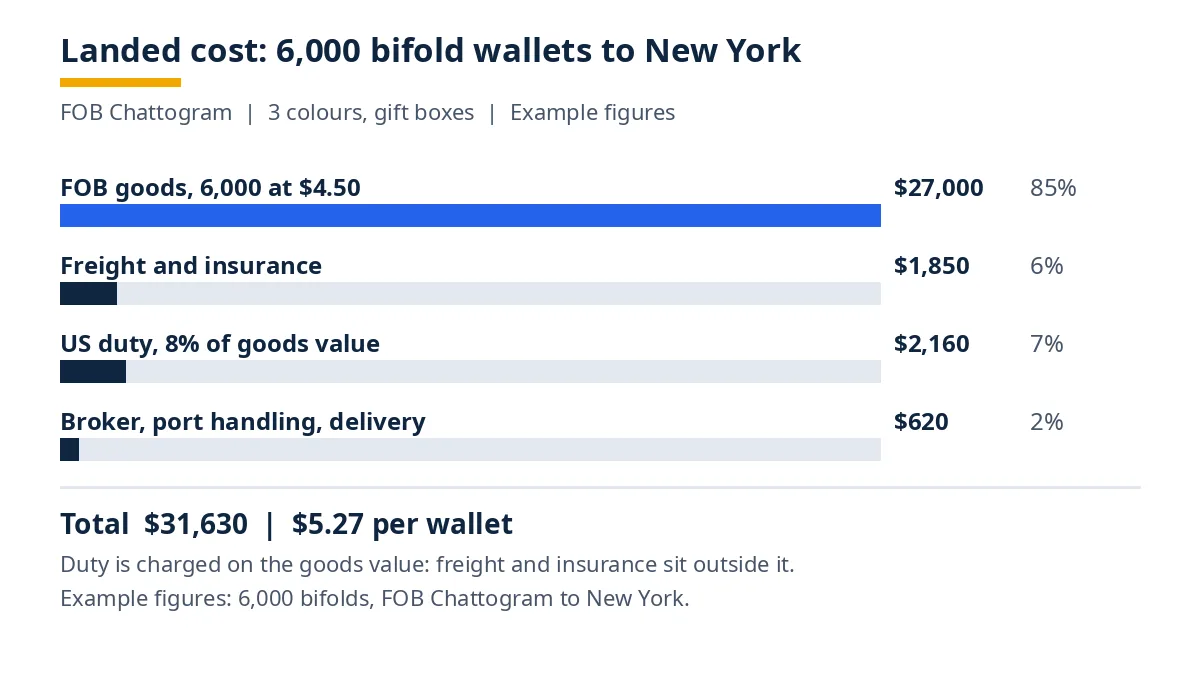
Check it: 8 per cent of $27,000 is $2,160, and the lines add to $31,630, or $5.27 per wallet. The duty is charged on the goods value, so the freight and insurance sit outside the duty calculation.
Five mistakes that cost wallet importers money
Approving the leather on a cutting and the wallet on a photograph. Only a finished wallet proves the fold, the slots and the edge.
Letting the outer surface change the code. A wallet described as leather but made with a plastic outer surface takes a different subheading and a different duty rate.
Trusting an RFID label without a reader test. There is no universal certification for RFID blocking, so a label proves nothing on its own.7 Run the card reader test on the sample and again on the bulk lot.
Paying the balance before the inspection report arrives. Put the sampling plan in the order first — sample size, accept number and reject number — and read the report before the money moves.
Ordering one colour run and receiving three. A mixed-colour order is three production runs: confirm the per-colour minimum and carton labels.
Import checklist
Wallet defined in numbers: fold, size, leather, slot count, edge treatment, hardware.
Code settled: HS 4202.31, duty confirmed.
Chrome VI test report on the production leather, EN ISO 17075.
Tannery named and checked against the LWG directory.
Makers shortlisted: three to five, quotations on one rule and one place.
Samples approved in three rounds, in writing, from bulk materials.
RFID claim tested with a card reader on the sample and the bulk lot.
Inspection plan on file: level, AQL, sample size, accept and reject numbers.
Order placed: specification, quantities per colour, price, payment terms, packing, date.
Export papers ready: ERC, EXP form, Bill of Export, certificate of origin.
Freight and insurance arranged, sailing followed, broker briefed before the vessel arrives.
FAQs
What duty do leather wallets from Bangladesh pay in the United States?
Leather wallets fall under HTS subheading 4202.31.60 at 8 per cent ad valorem.2 Confirm the full 10-digit line with your broker.
What is the chrome VI limit for wallets sold in the EU?
Leather articles that touch the skin must contain less than 3 mg/kg of chromium VI, tested by EN ISO 17075.5
How many wallets does an inspector check in a 6,000-piece order?
At Level II under ISO 2859-1, a 6,000-piece lot takes a 200-piece sample: 10 major defects pass the lot and 11 fail it at AQL 2.5; at AQL 4.0 the numbers are 14 and 15 for minor defects.8
Do RFID-blocking wallets really block card readers?
A wallet with a continuous conductive layer blocks the 13.56 MHz frequency used by contactless cards, but there is no universal certification, so test it with a reader.7
Next steps on Exportain
Start with the code in our classification guide for leather wallets, then read our importing guide. When the specification is ready, post an RFQ with the wallet specification, the fold and leather, the colours and the tariff code.
Sources
- Leather sector spots 'hope' despite old troubles. bdnews24, (accessed )
- Harmonized Tariff Schedule of the United States (2026), Chapter 42. United States International Trade Commission (accessed )
- Articles of a kind normally carried in the pocket or in the handbag - UK Integrated Online Tariff. GOV.UK (accessed )
- Heading 4202: trunks, suitcases, wallets and similar containers - Northern Ireland Online Tariff. GOV.UK (accessed )
- Commission Regulation (EU) No 301/2014 amending Annex XVII to Regulation (EC) No 1907/2006 as regards chromium VI compounds. EUR-Lex, (accessed )
- Certification - Leather Working Group. Leather Working Group (accessed )
- RFID Wallet Meaning: What B2B Buyers Must Know. Gstar Tech (accessed )
- AQL Table Explained: Sample Size and Accept/Reject. Westwood Sourcing, (accessed )
- Procedures to be an Exporter. Bangladesh Trade Portal (accessed )
- Incoterms 2020 Explained | FOB, CIF, EXW & DDP. Transifly (accessed )
About the author
Sourcing from Bangladesh?
Post a request for quotation and suppliers on Exportain can send you their quotes directly.
Post an RFQ