HS Code for Leather Wallets: Classification Guide for Importers
A leather wallet is a pocket article under heading 4202: subheading 4202.31 for a leather or composition leather outer surface, 4202.32 for plastics sheeting or textile materials, with the full national code confirmed per destination.
Short answer
A leather wallet is classified in heading 4202 as a pocket article. The indicative subheading is 4202.31 when the outer surface is leather or composition leather, and 4202.32 when it is sheeting of plastics or textile materials. Card cases, purses and key cases share the same pocket-article group. Confirm the full national code for the destination before filing, and never file one ten-digit code as universal.
On this page
If you import leather wallets the hs code for leather wallets is the line your customs entry and duty treatment turn on. The Harmonized System is a multipurpose international product nomenclature developed by the World Customs Organization (WCO), comprising more than 5,000 commodity groups, each identified by a six-digit code, and used by more than 200 countries and economies as a basis for their customs tariffs.1 A wallet is a small article, but its code still turns on facts you can check: whether it is carried in the pocket or handbag, and what material forms its outer surface. This guide covers classification only and states no duty rates. For background, read the HS code hub and how to classify your product.
Quick answer: indicative HS heading (with verify note)
The indicative heading is 4202. Heading 4202 covers, among other containers, wallets and purses, of leather or of composition leather, of sheeting of plastics, of textile materials, of vulcanised fibre or of paperboard, or wholly or mainly covered with such materials or with paper.2 Inside the heading, wallets sit in the pocket-article group: articles of a kind normally carried in the pocket or in the handbag.2 The split inside the group turns on the outer surface:
Wallet | Indicative six-digit subheading |
|---|---|
Leather wallet, with outer surface of leather or composition leather | 4202.31 |
Wallet with outer surface of plastics sheeting or textile materials | 4202.32 |
Wallet of another pocket-article material | 4202.39 |
Leather purse, card case or key case, pocket-carried | 4202.31 |
In the United States schedule, the leather pocket-article line 4202.31 splits at the statistical level into a reptile leather line and an other line.3 United Kingdom guidance likewise places wallets and purses in subheadings 4202.31, 4202.32 or 4202.39, by outer surface.4
Verify note: heading 4202 and subheading 4202.31 are indicative. Confirm the subheading and the full national extension against the official schedule for the exact wallet type, and never file a single ten-digit code as if it were universal.
How HS codes are structured (2-4-6 digits)
The hierarchy runs from chapter to heading to subheading, and countries subdivide the six-digit categories further.1 At the subheading level, only subheadings at the same level are comparable, so a wallet is compared with other pocket articles first, not with handbags.5 The current version is HS 2022.6
Level | Digits | For a leather wallet |
|---|---|---|
Chapter | 42 | Articles of leather, travel goods, handbags and similar containers |
Heading | 4202 | Trunks, suitcases, handbags, wallets, purses and similar containers |
Subheading | 4202.31 | Pocket articles, leather or composition leather outer surface |
National extension | 8 to 10 digits | Set by the importing country |
The Combined Nomenclature of the European Union uses eight-digit codes, comprising the six-digit HS codes with further EU subdivisions.6 The United States and the United Kingdom work to ten digits, with their own splits after the first six.
Read the first six digits to understand the wallet internationally, and the full code in the tariff of the country where you will declare it.
Factors that decide the code for leather wallets
The pocket-article test comes first. Before the material is considered, ask whether the article is of a kind normally carried in the pocket or in the handbag.2 A bifold fitted with note and card compartments passes that test on its size and its fittings. An article too large for a pocket or handbag, or designed to be carried as a bag in its own right, fails it and is tested against the handbag or other-bag groups instead.
Wallet, card case, purse and key case share one group. The pocket-article group covers wallets, purses, note-cases and key-cases together.4 A slim card case, a coin purse and a key case are all tested in the same group as a wallet, and all take 4202.31 when the outer surface is leather or composition leather.2 The distinction between them matters for the product description, not for the six digits. What changes the six digits is the outer surface, not the number of card slots.
A coin compartment does not create a second article. A wallet with a zipped coin section stays one pocket article at 4202.31, provided the outer surface is leather. A coin purse sold separately is still a pocket article in the same group, so it gets its own invoice line.
The outer surface is what the eye sees. Containers are classified according to the material of their outer surface visible to the naked eye, including where the outer layer is one layer of a combination of materials.4 For this chapter, leather includes chamois, patent, patent laminated and metallised leather.2 A leather wallet coated with a thin layer of plastics or synthetic rubber invisible to the naked eye, usually less than 0.15 mm thick, still takes the leather line, and composition leather, built on a basis of natural leather or leather fibres, also takes the leather line.4
A leather-look wallet is not automatically a leather wallet. A wallet whose visible outer surface is sheeting of plastics or textile materials takes 4202.32, even when it imitates leather.2 For textile fabric coated or laminated with plastics, the United States notes treat the article as having an outer surface of textile material or of sheeting of plastics, depending on which constituent makes up the exterior surface.3
A strap can move the article to the handbag group. Handbags in heading 4202 include handbags with or without a shoulder strap.2 A small wallet with a short wrist strap, still sized and fitted as a pocket article, is tested as a wallet. A larger article carried by its strap or handle as a small bag is tested as a handbag at 4202.21 for a leather outer surface.
The boundaries around the pocket-article group. Leather apparel sits in heading 4203, not heading 4202, and other leather articles that are not containers sit in heading 4205.2 A money belt worn around the waist is tested as a belt. Two exclusions remove further articles from heading 4202: plastics sheeting bags with handles, not designed for prolonged use, go to heading 3923, and articles of plaiting materials go to heading 4602.2
National codes: US HTS, EU CN/TARIC, UK commodity code
United States: HTS, ten digits. The United States schedule keeps the same first six digits and adds national detail. Under 4202.31, the statistical lines separate reptile leather from other leather.3 Under 4202.32, the lines separate sheeting of plastics from textile materials, and the textile lines split further by fibre.3 Read the full ten-digit line for the exact wallet.
European Union: CN at eight digits, TARIC for measures. The Combined Nomenclature uses eight-digit codes, comprising the six-digit HS codes with further EU subdivisions.6 Take the eight-digit CN line for the wallet, then check TARIC for the measures that apply on the entry date.
United Kingdom: commodity code. The United Kingdom builds its commodity code on the same first six digits, with its own extension after them.5 The tariff lists the leather pocket-article line with hand-made and other commodities, so a leather wallet at 4202.31 needs the hand-made question answered before the final digits are chosen.5 Hand-made items may need certification by a recognised authority in the country of production.4
How to confirm the code officially
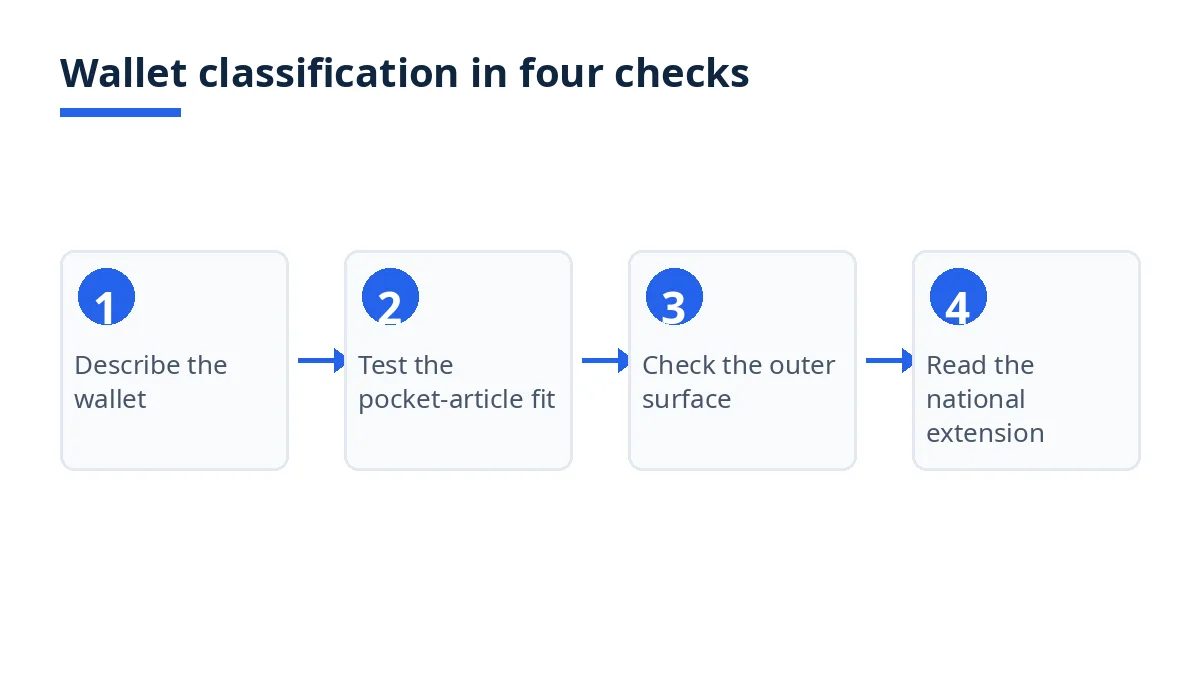
Write a precise description: pocket-article fit, dimensions, compartments including any coin section, visible outer surface material, and any coating.
Start from the official tariff for the destination: the United States schedule, TARIC or the United Kingdom Trade Tariff, and read the heading text and chapter notes.
Check published rulings for similar pocket articles. A ruling on another importer's wallet shows how customs reasons, not a decision about your wallet.
For a borderline wallet, such as a wristlet that could be a small handbag, apply for a binding decision before you ship. In the European Union, a Binding Tariff Information decision needs a separate application for each type of product.7 In the United Kingdom, a legally binding decision is generally valid for 3 years, through an Advance Tariff Ruling.8 Elsewhere, apply for the equivalent ruling from that country's customs authority.8
Give your broker the description and the confirmed code for each wallet style, and use the same codes throughout the entry.
Common classification mistakes
Filing every small leather article as a wallet. Heading 4202 separates handbags, pocket articles and other bags into different groups.2 A handbag belongs at 4202.21 and a travel bag at 4202.91, not at 4202.31.
Filing a plastics or textile wallet on the leather line. A leather-look wallet with a plastics sheeting or textile outer surface belongs at 4202.32, not at 4202.31.2
Filing a card case as a handbag or as an accessory. A pocket-carried card case is a pocket article in the same group as a wallet.4
Treating a wallet with a coin section as two articles. The coin section is a compartment of one wallet, not a second article.
Copying a code from another country. Only the first six digits are shared internationally.6 The reptile leather split in the United States lines and the hand-made split in the United Kingdom lines have no counterpart in each other.3 5
Filing a set under one code without checking the pieces. A handbag set with a matching wallet contains articles in different groups.2 List the pieces separately.
Related duties and documents
This guide states no duty rates: the code decides which duty line customs applies, and a rate on one line does not carry to another line. Read the rate beside your confirmed code for your origin and entry date.
Keep the classification file with the shipment documents: the wallet specification, the pocket-article fit, the visible outer surface material, the confirmed subheading and full national code for each style, any binding decision, and the origin evidence. If the specification changes, for example a new coating or a new strap, re-check the code before the next shipment.
FAQs
What is the HS code for leather wallets?
The indicative subheading is 4202.31, for articles of a kind normally carried in the pocket or in the handbag with an outer surface of leather or of composition leather.2 Confirm the full national extension: the United States schedule splits the line into reptile leather and other leather,3 and the United Kingdom tariff splits it into hand-made and other lines.5
Is the HS code the same in every country?
Only the first six digits are shared internationally. Countries subdivide them into national subheadings, and the European Union uses eight-digit Combined Nomenclature codes.6 The United States and the United Kingdom work to ten digits, with their own splits.3 5
How do I confirm the correct code?
Describe the wallet precisely, read the heading text and chapter notes in the destination tariff, and check published rulings for similar pocket articles. For a borderline wallet, apply for a binding decision before shipping: a Binding Tariff Information decision in the European Union,7 an Advance Tariff Ruling in the United Kingdom,8 or the equivalent ruling elsewhere.8
What happens if I use the wrong code?
Duty, licensing and quota treatment are worked out from the code on the declaration, so a wrong code brings the wrong treatment. A binding decision taken in advance helps you work out the duties and restrictions that will apply.8
Next steps on Exportain
Browse Bangladeshi suppliers on Exportain, then post a free RFQ with the pocket-article fit and outer surface stated for each wallet style. The HS code hub is the background read. Exportain is not a party to the goods contract and does not inspect goods, book freight or clear customs, so keep your broker and any binding decision central.
Sources
- What is the Harmonized System (HS)?. World Customs Organization (accessed )
- HS Nomenclature 2022, Chapter 42. World Customs Organization (accessed )
- Harmonized Tariff Schedule of the United States, Chapter 42 (2026 Revision 18). U.S. International Trade Commission (accessed )
- Classifying leather for import and export. GOV.UK, HM Revenue and Customs (accessed )
- Articles of a kind normally carried in the pocket or in the handbag: subheading 420231. GOV.UK, UK Trade Tariff (accessed )
- Harmonised System. European Commission (accessed )
- European Binding Tariff Information (EBTI). European Commission, Taxation and Customs Union, (accessed )
- Check what you'll need to get a legally binding decision on a commodity code. GOV.UK, HM Revenue and Customs (accessed )
About the author
Sourcing from Bangladesh?
Post a request for quotation and suppliers on Exportain can send you their quotes directly.
Post an RFQ