Quality Control Checklist for Electrical Cables From Bangladesh
A numbered QC checklist for electrical cables from Bangladesh: conductor and resistance, insulation and sheath thickness, diameter and ovality, voltage tests, print legend and CPR data, drum length and packing, with fixes for common failures.
Short answer
Use this electrical cables quality control checklist to check conductor material and cross-section, conductor resistance, insulation and sheath thickness, diameter and ovality, voltage test results, print legend and CPR data, and drum length and packing on cables from Bangladesh before shipment. Agree test methods, limits and acceptance numbers in the purchase order.
On this page
Key takeaways
Agree the construction specification, test methods, limits and acceptance numbers before inspection, and draw the sample randomly across constructions, cross-sections and drums.
Measure conductor resistance on sampled lengths and compare it with the limit in the named standard and purchase order: IEC 60228:2023 covers cross-sections from 0.5 mm2 to 3,500 mm2 and includes resistance values for conductors in the finished cable.
For EU construction use, reaction-to-fire classes for electric cables run from Aca to Fca under Table 4 of Commission Decision 2006/751/EC, class Eca is tested to EN 60332-1-2 with flame spread H at or below 425 mm, and EN 50575 covers reaction to fire only.
Check the drum as carefully as the cable: print legend and drum labels, declared length verified by the plan method, drum condition and end seals, because a sound cable on a short or damaged drum still fails the buyer.
Use this electrical cables quality control checklist to check a shipment before it leaves Bangladesh. A cable is judged on the drum and on the test bench: a conductor that reads high on resistance, thin insulation, or a fading print legend fails in service or at market surveillance. ISO 2859-1:2026 defines a system of acceptance sampling plans for inspection by attributes, using the acceptance quality limit (AQL) to determine sample sizes and acceptance and rejection thresholds.1
Why this checklist matters
Electrical cables concentrate risk in a long, layered product: the conductor decides current capacity and voltage drop, the insulation and sheath decide safety and life, and the marking decides whether the drum can be traced and sold. A buried fault, such as a short strand count or thin insulation, does not show on the drum face.
A written checklist removes interpretation. Each point is checked against the approved sample, the specification and the test file, and recorded as pass, fail or not applicable. Sampling and acceptance are set in the purchase order and inspection plan, not in this checklist: ISO 2859-1:2026 indexes its schemes by AQL for lot-by-lot inspection.1 See the AQL acceptance quality limit explainer.
Before you start
Do not begin until the references are complete: an approved pre-production sample length of each construction, made with the production materials, the purchase order, the specification and the test reports for the exact constructions. The specification names each construction separately: conductor material and class, nominal cross-section, core count, insulation material, rated voltage, armour status, sheath material and the cable standard the order is bought to. Agree the sampling plan in advance,1 and draw the sample randomly across drums.
Fix the conductor reference first. IEC 60228:2023 specifies nominal cross-sectional areas in the range 0.5 mm2 to 3,500 mm2 for conductors in electric power cables and cords, with requirements for wire numbers and sizes and resistance values, relating to conductors in the finished cable.2 IEC 60502-1:2021 specifies construction, dimensions and test requirements for extruded-insulation power cables of rated voltages 1 kV (Um = 1.2 kV) and 3 kV (Um = 3.6 kV) for fixed installations.3
Fix the market file before inspection. The Construction Products Regulation (CPR) lays down harmonised rules for the marketing of construction products in the European Union and provides a common technical language to assess performance.4 Confirm the BSTI Certification Marks position for each construction with the exporter before shipment. Read how to import electrical cables from Bangladesh alongside this checklist.
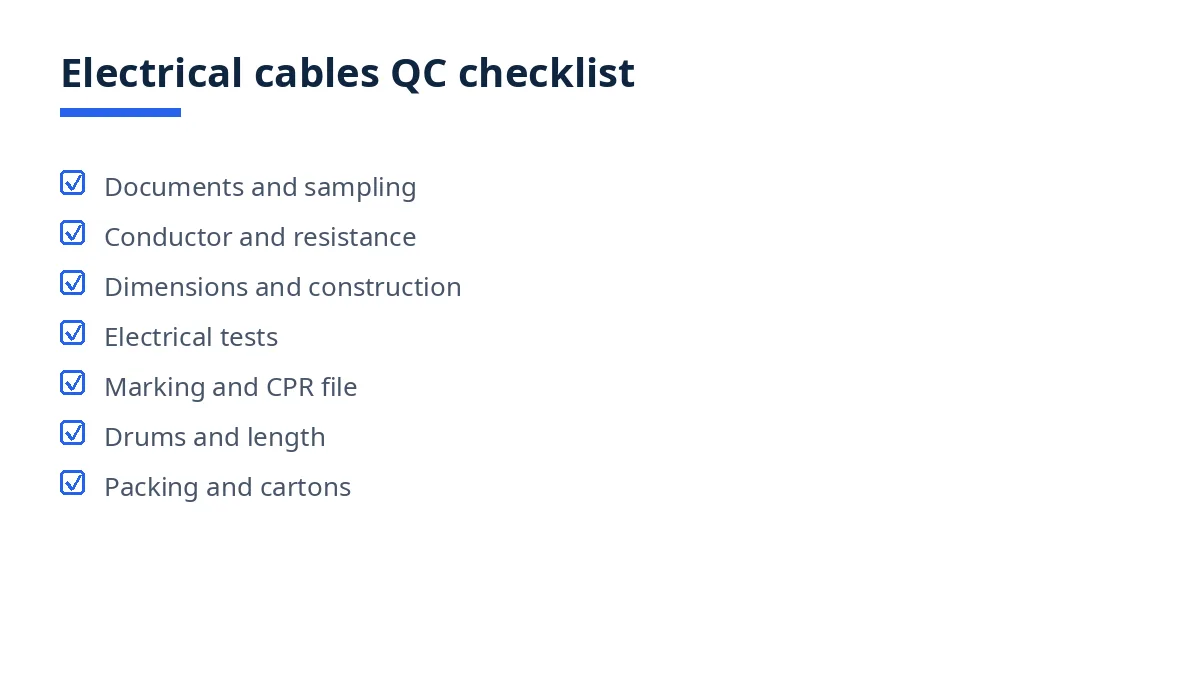
The full checklist (numbered, printable)
Specification, documents and sampling
Draw the sample randomly across constructions, cross-sections and drums under the agreed plan, recording the drums opened and lengths sampled.
Check each sampled length against the specification and approved sample: conductor material and class, cross-section, core count, insulation, rated voltage and armour status must agree.
Check the test file for the exact construction: report identifiers, construction, cross-section and rated voltage must match the cable in hand, not another construction.
Confirm the BSTI Certification Marks document position for each construction with the exporter, and file the copy before shipment.
Conductor checks
Expose the conductor on sampled cut ends and check the material: copper, aluminium or aluminium alloy as ordered, with no substituted metal.
Count and check the wires against the conductor class in the specification. IEC 60228:2023 covers solid, stranded and Milliken conductors and flexible copper conductors.2
Measure the conductor and compare the result with the nominal cross-section in the order, recording actual readings per drum.
Measure conductor resistance on sampled lengths by the method in the inspection plan, and compare each reading with the limit in the named standard and purchase order. IEC 60228:2023 includes resistance values and information on temperature correction factors for resistance measurement.2
Check core identification along the sampled lengths: colours or numbers as specified, consistent end to end.
Dimensions: insulation, sheath and diameter
Cut ring samples and measure insulation thickness at points around the circumference, recording the thinnest reading against the named standard and specification.
Measure sheath thickness the same way, checking for thin spots over armour or core edges.
Measure the overall diameter at several points along each sampled length and across each drum, against the specification.
Check ovality by measuring the diameter in two directions at the same point, and record any length where the readings diverge beyond the specification.
For armoured constructions, check armour coverage on exposed sections: wires or tape as specified, evenly applied, with no gaps or rust. IEC 60502-1:2021 specifies construction and dimensions within its scope.3
Electrical tests
Confirm continuity on every core of each sampled length, end to end, with no open circuit.
Carry out the voltage test, called the hi-pot test, at the voltage and duration set in the purchase order and the named standard, recording the result per drum.
Where the plan requires it, measure insulation resistance by the named method against the purchase order limit, recording the instrument and conditions.
Check that every routine test report names the construction, cross-section, drum number and length tested, and matches the drums in the consignment.
Re-check resistance and dimensions on a fresh sample from any drum where a result sits close to the limit, before that drum is accepted.
Construction and appearance
Check the sheath surface along sampled lengths for cuts, blisters, pinholes and repairs, marking any defect by drum and metre position.
Check that insulation and sheath compounds match the approved sample in type and colour, recording any substitution as a failure.
Check handling on a sampled length: the cable uncoils and bends as the construction should, with no sheath cracking or armour springing open.
Check cut ends are sealed against moisture as specified, with no water inside the cable or corrosion on the conductor.
Marking, CPR file and labels
Read the print legend along several sampled lengths: maker, construction, cross-section, rated voltage and standard as specified, legible, and still readable after a rub by hand.
Check drum labels against the purchase order and packing list: construction, cross-section, length, gross weight and drum number must agree.
For European Union construction use, check the declared reaction-to-fire class against the order. Table 4 of Commission Decision 2006/751/EC sets classes for electric cables from Aca to Fca, with additional classification for smoke, flaming droplets and acidity, and class Eca is tested to EN 60332-1-2 with flame spread H at or below 425 mm.5
For European Union construction use, check the Declaration of Performance (DoP) reference and CE marking against the drum documents. Europacable guidance states that EN 50575 covers reaction to fire only, the CPR makes no distinction based on rated voltage, and cables with connectors fitted sit outside the CPR scope.6
Confirm the class required for the building or use was set by the destination market, not assumed by the factory, and that the DoP and test evidence cover the construction shipped.
Drums, length and packing
Verify the length on sampled drums by the counter or re-measure method in the plan, and compare the result with the drum label and ordered length.
Check drum condition: flanges and lagging sound, no crushed timber, cable protected from damage, and the trailing end secured and accessible for testing.
Check moisture protection as specified: end seals fitted, wrapping complete, and no drum stored standing in water or with damaged covering.
Weigh and measure sample drums, and check drum count and total metres against the packing list.
Common failures and how to fix them
The most frequent failure is conductor resistance above the limit, usually from an undersized conductor, a short strand count or a material substitution after sample approval. Stop, cut and measure lengths built with the production conductor, and hold the lot until the build matches the sample. Thin insulation at one point traces to extrusion centring: re-centre the line and re-sample the affected window as its own group.
Diameter and ovality drift point to extrusion or laying-up settings: correct the setting and re-measure across drums. A fading or incorrect print legend points to the marking setup or the wrong label file: correct both and re-check every drum in that run. Length shortfalls and damaged drums point to the winding stage: re-verify lengths drum by drum and replace damaged lagging.
Above the agreed acceptance level, options are re-inspection after sorting, documented partial acceptance, or rejection.
Downloadable template and summary table
Copy the checklist into your inspection sheet, add the construction specification and the test voltages and limits from the purchase order, and record a result per construction.
Section | Checks | Evidence |
|---|---|---|
Documents and sampling | Sample, construction, test file | Plan, reports |
Conductor | Material, wires, resistance | Cut ends, readings |
Dimensions | Insulation, sheath, diameter, ovality | Ring samples, readings |
Electrical tests | Continuity, voltage test, reports | Test log per drum |
Construction | Sheath surface, compounds, ends | Visual check, photos |
Marking and CPR | Print legend, class, DoP | Label file, DoP copy |
Drums and packing | Length, drum condition, seals | Packing list |
How Exportain helps
Exportain is a B2B marketplace connecting buyers with Bangladeshi suppliers of electrical cables, so the specification behind this checklist can be agreed at the enquiry stage. Browse suppliers, use inspection services when you plan the check, and plan the final check with the pre-shipment inspection guide. Supplier profiles show which document and photo checks have been recorded, not factory inspections. Exportain is not a party to the contract and does not inspect goods.
FAQs
When should this checklist be used?
Use it at final inspection, when cables are finished, tested and drummed. For larger and first orders, also use the conductor, dimension and marking points during production.
Who should complete it?
The buyer, a local agent or an independent inspector can complete it, using the approved sample lengths, the specification and the test file.
What are the most common failures?
Conductor resistance above the limit, thin insulation, diameter drift, a fading or incorrect print legend and short drum lengths are the failures buyers find most often.
Can a third party do it?
Yes, if you share the approved references, declared values and acceptance levels first, and the inspector reports measured values per construction.
Next steps on Exportain
Before production starts, agree your specification and inspection plan, then read how to import electrical cables from Bangladesh and the pre-shipment inspection guide, and plan the check with inspection services. You can also post a free RFQ via RFQs.
Sources
- ISO 2859-1:2026 - Sampling procedures for inspection by attributes — Part 1: Sampling schemes indexed by acceptance quality limit (AQL) for lot-by-lot inspection. International Organization for Standardization (accessed )
- IEC 60228:2023 - Conductors of Insulated Cables. GlobalSpec (accessed )
- IEC 60502-1:2021 - Power cables with extruded insulation and their accessories for rated voltages from 1 kV (Um = 1,2 kV) up to 30 kV (Um = 36 kV) - Part 1: Cables for rated voltages of 1 kV (Um = 1,2 kV) and 3 kV (Um = 3,6 kV). International Electrotechnical Commission, (accessed )
- Construction Products Regulation (CPR). European Commission (accessed )
- Commission Decision 2006/751/EC, Annex Table 4: Classes of reaction-to-fire performance for electric cables. legislation.gov.uk (accessed )
- CPR – FAQ. Europacable (accessed )
About the author
Sourcing from Bangladesh?
Post a request for quotation and suppliers on Exportain can send you their quotes directly.
Post an RFQ