Private Label Kids' Shoes Manufacturing in Bangladesh: A Brand Owner's Guide
Your brand, a Bangladeshi factory's capacity: the commercial process, the compliance file, and the cost lines of private label kids' shoes.
Short answer
Private label kids' shoes from Bangladesh means the factory builds your brand's shoes to your specification: your lasts, materials, colours, labels, and retail packaging, under your name. You supply the design and brand assets, approve samples, and carry the compliance file for the target market, including lead testing and a Children's Product Certificate for the United States. The factory supplies manufacturing capacity and usually material sourcing. Agree specification, testing, and packaging in writing before production.
On this page
Key takeaways
Private label splits the work: the brand owner owns design, brand assets, and the compliance file; the factory owns manufacturing.
US children's products need lead testing by a CPSC-accepted laboratory and a Children's Product Certificate that accompanies distribution.
Retail packaging, labels, and barcodes are priced separately from the shoes; confirm who supplies artwork and who prints.
Approve the specification, the sample, and the packaging in writing before bulk production starts.
Private label is the fastest route to selling kids' shoes under your own brand, and the easiest route to a compliance problem you did not expect. The factory makes the shoes; the brand owner owns everything the shoes say, show, and claim. When a label is wrong, a material is untested, or a size curve does not fit, the brand owner's name is on the product, not the factory's.
This guide sets out the commercial process for private label children's shoes from Bangladesh: what you supply, what the factory supplies, what the compliance file must contain for the United States and the European Union, and how the costs add up. It is written for brand owners and retailers creating their first own-brand kids' range.
What private label means, and what it does not
Private label means the factory manufactures shoes to your specification and branding: your design, your materials selection, your colours, your labels, and your retail packaging, sold under your brand name. The factory may suggest materials and constructions from its existing range, but the finished product is yours. That is the difference from wholesale: a wholesale kids' shoes order buys the factory's existing product, while a private label order buys manufacturing capacity applied to your product.
Private label does not transfer the compliance duty. In the United States, the importer of a children's product must generate a Children's Product Certificate certifying compliance with the applicable safety rules, supported by testing from a CPSC-accepted third-party laboratory.1 The factory can arrange the testing; the certificate and the duty to hold it sit with the importer. In the European Union, the importer is likewise responsible for ensuring the products it places on the market comply with the applicable restrictions. Whoever's brand is on the box carries the reputational risk either way, so the brand owner must hold the file even when the factory did the work.
What you supply, and what the factory supplies
You supply: the design and specification (styles, size range and size curve, colours, materials, construction, and closure type); brand assets (logo artwork, label designs, hang tag designs, retail box artwork, and barcodes); the target-market compliance requirements; and the packaging specification. Supply artwork in print-ready files with the exact colours and dimensions, and confirm who owns each asset in writing.
The factory supplies: manufacturing capacity, material sourcing (or purchasing to your nominated suppliers), lasting and moulding for the agreed sizes, production, and usually export packing. Some factories also offer design help, material libraries, and sample rooms. Use those services, but keep the final specification in your document, not in a conversation.
You agree together: the specification sheet, the sample approval process, the testing plan, the packaging, the price build-up, the production schedule, and the inspection plan. Every item agreed verbally should appear in the purchase order or the specification sheet attached to it. A private label order with an unwritten specification is a dispute with a delivery date.
The compliance file for the United States
For the US market, build the file around the CPSC requirements for children's products. Children's products must not bear paint or similar surface coatings containing more than 90 ppm lead, and must not contain more than 100 ppm total lead in any accessible component part.1 They must be tested by a CPSC-accepted third-party laboratory, and the importer must generate a Children's Product Certificate that accompanies distribution.1 Children's products must also bear distinguishing, permanent marks on the product and packaging (tracking labels) that let consumers identify required information.1
In practice, your file for each style should contain: the material and component list; the test reports from the CPSC-accepted laboratory, naming the style, sizes, and materials tested; the Children's Product Certificate; the tracking label artwork as applied; and the factory's material declarations for coatings, adhesives, and plasticised parts. Ask the factory which laboratory it uses, confirm the laboratory is CPSC-accepted for the applicable rules, and keep the reports for the exact style and materials shipped. A report for a different style does not cover your shoes.
The compliance file for the European Union
For the EU market, the chemical rules that most often affect children's shoes are the REACH restrictions on phthalates. It is prohibited in the EU to manufacture, import, or sell toys and childcare articles for children aged 0 to 14 containing DEHP, DBP, BBP, or DIBP at 0.1 percent by weight or more, individually or in any combination, and the same limit applies to DINP, DIDP, and DNOP in products that could be placed in the mouth.2 Note the scope carefully: the restriction as written covers toys and childcare articles, not footwear as such. Children's shoes are not toys, so the restriction does not apply to shoes directly; but shoes with soft PVC parts that a small child could mouth, and any toy-like or childcare element attached to the shoe, can fall inside it, and many EU buyers apply the same 0.1 percent limit to plasticised shoe parts as a purchasing requirement regardless.2 State the position in your specification: name the limit you require, the materials it applies to, and the test evidence you will accept, rather than assuming the factory applies the toy rules to shoes.
Denmark adds a national rule worth knowing if Denmark is a target market: a Danish ban on phthalates in toys and childcare articles for children aged 0 to 3 applies at 0.05 percent, and it does not apply generally within the EU.2 Confirm the position for each target market with your compliance adviser; do not apply one country's rule to the whole Union, or the Union's rule to a national exception.
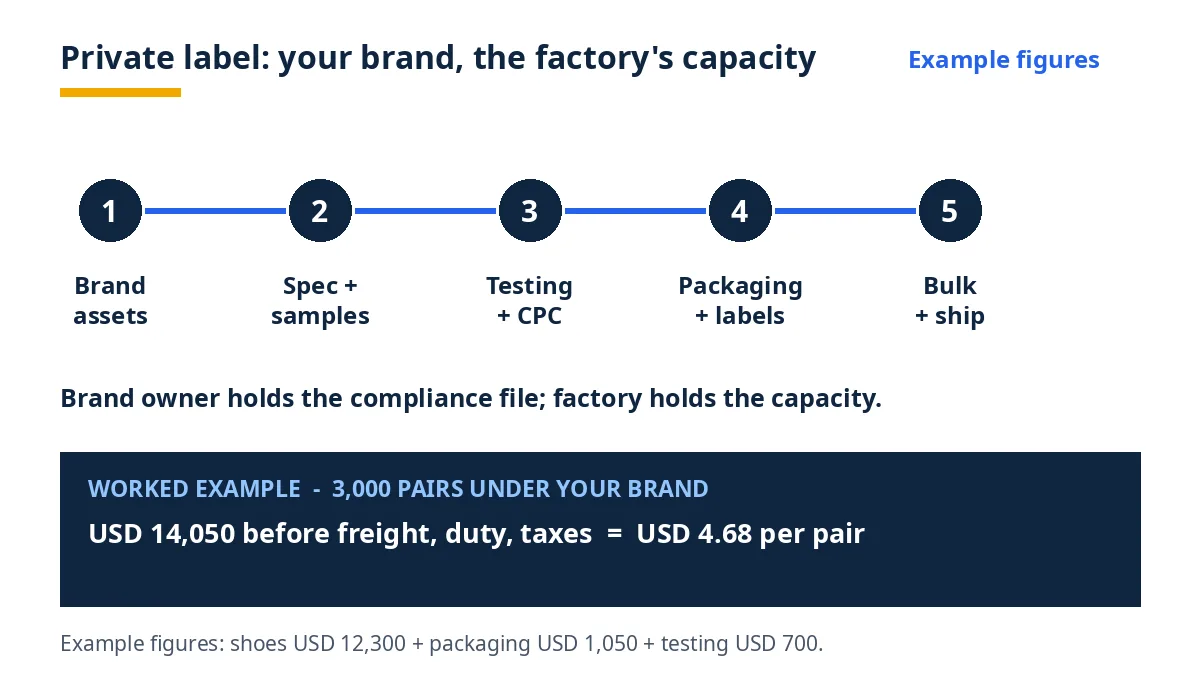
Worked example: 3,000 pairs under your brand
The figures below are example figures for 3,000 pairs of private label children's canvas shoes, one style, three colours, with custom retail boxes and hang tags. They show the cost structure, not a factory quotation.
Cost line | Example figures |
|---|---|
Shoes, 3,000 pairs at USD 4.10 | USD 12,300 |
Custom retail boxes and hang tags, 3,000 at USD 0.35 | USD 1,050 |
Testing allocation (one batch, CPSC-accepted laboratory) | USD 700 |
Total before freight, duty, and taxes | USD 14,050 |
Unit cost before freight, duty, and taxes | USD 4.68 per pair |
The arithmetic is 12,300 + 1,050 + 700 = 14,050, and 14,050 divided by 3,000 pairs is USD 4.68 per pair. Packaging adds USD 0.35 per pair and testing adds USD 0.23 per pair at this volume. Neither line appears in a factory's headline shoe price, which is why private label quotes must be compared on the full build-up: shoes plus packaging plus testing, on the same basis.
Own-brand programmes at this scale have a deep supply base to draw on. Export Promotion Bureau data reported by World Footwear put leather footwear exports at USD 620.17 million between July 2024 and May 2025, up 28.96 percent year on year, with other footwear at USD 494.28 million, up 30.25 percent.3 Choice of factory is plentiful; the duty to specify, sample, and test stays with the brand owner.
Samples: approve in writing, in stages
Run samples in stages and approve each stage in writing. First, a design and material sample confirming the specification. Second, a fit sample in the full size range, checked on the lasts the factory will use for bulk. Third, a pre-production sample in final materials, colours, labels, and retail packaging, exactly as bulk will ship. Photograph each approved sample, keep one set yourself, and reference the approval date and sample identity in the purchase order.
The most expensive sample mistake is approving a sample in one colour and one size and assuming the rest of the range matches. Colour, material, and size variations are where bulk production drifts. Check the full size curve at the pre-production stage, including the ends of the size range, where fit and closure problems show first.
Packaging, labels, and barcodes
Retail packaging is part of the product, not an extra. Confirm in the specification: box dimensions and board grade; print colours and finish; hang tag size, content, and attachment method; barcode type and placement; and the language and content of every label, including size, material, care, and origin statements. Confirm who supplies the artwork, who prints, and who checks the printed proof. A barcode that does not scan, a size label that does not match the shoes inside, or a care label in the wrong language is a retail problem discovered after the container lands.
For the US market, remember the tracking label requirement: children's products must bear distinguishing, permanent marks on the product and packaging.1 Put the tracking information on both the shoe and the box, and check it on the pre-production sample.
Minimums, and how private label changes them
Private label usually carries higher minimums than wholesale, because custom materials, colours, labels, and packaging are ordered for your product alone. Confirm the minimum per style, per colour, and per size. Also confirm what happens to leftover custom materials and packaging: who owns them, who stores them, and whether they can be used on a repeat order. Minimums interact with order size in ways the typical MOQ guide sets out, and the FOB cost breakdown shows how fixed costs like testing spread across the order.
Next steps on Exportain
Write the specification before you request quotations: styles, size curve, materials, brand assets, testing, and packaging, each on its own line. You can post an RFQ with the specification attached, browse Bangladeshi suppliers, and check how to buy for how quotations and orders work. For inspection planning, see the quality control checklist for kids' shoes.
Sources
- Business Guidance FAQ. U.S. Consumer Product Safety Commission (accessed )
- Fact-sheet: Phthalates in toys and childcare articles. Danish Environmental Protection Agency (accessed )
- Bangladesh: leather and non-leather footwear exports on the rise in 2024-2025. World Footwear, (accessed )
About the author
Sourcing from Bangladesh?
Post a request for quotation and suppliers on Exportain can send you their quotes directly.
Post an RFQ