Wholesale Kids' Shoes From Bangladesh: Prices, MOQ and Reliable Suppliers
Wholesale kids' shoes from Bangladesh, bought on assortment, size curve and landed cost: price drivers, MOQ counting, duty preferences and supplier checks, with a worked landed-cost example.
Short answer
Wholesale kids' shoes from Bangladesh are bought as ready styles in bulk, priced by material, size mix, colour count, volume tier and delivery basis, with no standard minimum quantity. Compare quotations on the same counting basis and delivery basis, budget duty on a broker-confirmed preference position, and check the supplier's children's styles, size chart, chemical reports and samples across the size range before paying a bulk deposit.
On this page
Key takeaways
Wholesale means buying ready styles in bulk; a custom design is a different purchase with different checks.
Specify sizes by foot length in millimetres and sample the smallest, middle and top-end sizes before bulk.
There is no standard MOQ; a 1,000-pair minimum can mean per order, per style, per colour or per size group.
In the worked example, duty at 8 percent adds 0.63 dollars per pair, and the preference column must be broker-confirmed before pricing.
Exportain badges record a document and photo review, not a factory inspection or a guarantee.
A wholesale order for children's shoes succeeds or fails on the assortment, not on a single unit price. The buyer who orders the right styles, in the right size curve, with the right file for the destination market, can sell through the shipment. The buyer who orders on a catalogue photograph and a headline price can hold stock in sizes that do not move, while the sizes customers want run out.
Bangladesh ships footwear at scale. Between July 2024 and May 2025, leather footwear exports reached 620.17 million US dollars, up 28.96 percent year on year, and other footwear reached 494.28 million US dollars, up 30.25 percent, on Export Promotion Bureau data reported by World Footwear.1 In 2024-25 the sector exported about 1.67 billion US dollars, with footwear at about 1.19 billion US dollars, or 72 percent of the total, from production of about 423 million pairs across more than 3,600 units, including roughly 90 large export-oriented factories.2
What does wholesale mean for kids' shoes from Bangladesh?
Wholesale buying means buying finished styles in bulk for resale, rather than commissioning a new design. The supplier offers styles it already produces, in set materials, colours and size ranges. A custom or OEM order is a different purchase: the buyer supplies the design and the factory builds to it. This guide covers the wholesale purchase only.
Three routes are common. A factory supplier makes the shoes it sells you. A trading supplier buys from a factory and sells under its own name. A buying house arranges the order with a factory on your behalf. None is wrong by itself. A trading supplier must name the factory, fix it for your order and show the factory's papers, while a factory supplier must show that the styles, size range and test reports belong to its own production.
Which styles and size ranges should a wholesale order cover?
Start from the age band you sell to, because age decides the size range, the fastening and the checks that matter. Toddlers need light, flexible shoes with fastenings an adult can close quickly. Pre-school children need shoes that stay on during active play. School-age children need harder-wearing styles in a wider size run. Do not spread a first order across every age band.
Children outgrow shoes quickly. Retail fit guidance puts the interval between sizes at two to three months for toddlers, three to four months for pre-school children, and four to six months for school-age children.3 Small sizes therefore turn over faster, and reorders need shorter intervals than adult footwear.
Age band | Growth pace reported | Buying consequence |
|---|---|---|
Toddler | New size every 2 to 3 months | Weight the curve to small and middle sizes; plan frequent repeats |
Pre-school | New size every 3 to 4 months | Weight the curve to middle sizes; check fastenings on every size |
School-age | New size every 4 to 6 months | Run the full size range; check sole wear on top-end sizes |
Specify sizes by foot length in millimetres for every size, from the supplier's own chart for the last in use. Generic conversion charts do not convert exactly between systems, so local size numbers go in as a second column only. The fit allowance is about a thumb's width, about 1.3 cm, between the longest toe and the tip of the shoe. Check it with the child standing, measuring both feet while wearing the socks the shoe will be worn with.3 Ask for samples at the smallest, middle and top-end sizes, not one middle-size sample, and require the width fitting for each size.
What sets the wholesale price per pair?
No single wholesale price exists for children's shoes from Bangladesh. Any figure quoted without a style, material, size mix and delivery basis cannot be compared with another. Put these questions to every supplier: material, sole and construction, size mix and colour count, volume tier, testing and packaging, and delivery basis.
LightCastle Partners reports an average export price of about 15 US dollars per pair across all Bangladeshi footwear exports, against about 7 dollars for basic rubber and plastic footwear and about 31 dollars for premium leather footwear.2 That average describes the whole export mix. It is not a wholesale price for children's shoes, and it must not be used as one. The same analysis reports that an estimated 80 to 90 percent of key synthetic inputs are imported, mainly from China, Taiwan and South Korea.2 Volume changes price in steps: ask for the tier table in writing, and check both sides of each price break.
How much should you budget beyond the unit price?
Budget the landed cost: the unit price plus freight and insurance, duty, and clearance and delivery costs, each on the basis your broker confirms for the exact classification and entry date.
For one leather-upper line, the United Kingdom tariff shows a third-country duty of 8.00 percent.4 That is the rate before any preference. Whether a lower rate applies depends on the origin rules for Bangladesh and the proof of origin held, and the broker confirms that before pricing. Bangladesh exports to the European Union duty-free and quota-free under Everything But Arms as a least developed country, and after graduation it keeps that access for a three-year transition.5 On 29 October 2026 the United Nations General Assembly granted a three-year extension of the preparatory period, moving graduation from 24 November 2026 to 24 November 2029, so the transition period now runs from the later date.6 For the United Kingdom, the same briefing reports tariff-free access for 99.8 percent of goods under the Developing Countries Trading Scheme, continuing for three years after graduation, after which 92 percent of goods remain duty-free under Enhanced Preferences.5 Treat every preference as a question for the broker.
The worked example below shows how the elements combine. Example figures. All numbers are illustrative, not market prices.
Landed-cost element | Duty paid (example) | Preference applied (example) |
|---|---|---|
Goods, 4,800 pairs at 7.20 dollars FOB | 34,560 dollars | 34,560 dollars |
Freight and insurance to the destination port | 2,850 dollars | 2,850 dollars |
Duty at 8 percent of 37,410 dollars | 2,993 dollars | 0 dollars |
Landed cost before VAT and local delivery | 40,403 dollars | 37,410 dollars |
Landed cost per pair | 8.42 dollars | 7.79 dollars |
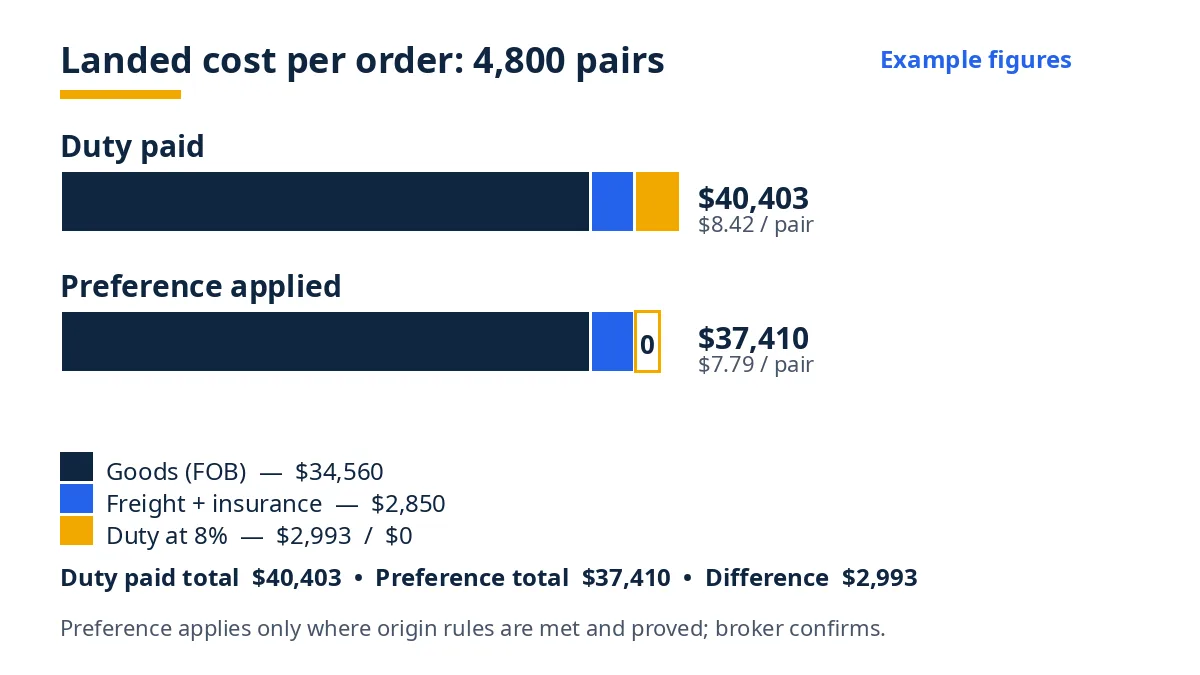
The difference is 0.63 dollars per pair, or 2,993 dollars on the order, and it turns entirely on whether the preference is qualified for and proved. The example excludes VAT, clearance charges and inland delivery.
What MOQ will you meet, and how is it counted?
The minimum order quantity is the smallest quantity a supplier will accept on its normal terms, and there is no standard minimum for Bangladesh or for children's shoes that a buyer can safely assume.7 The number matters less than the unit it is counted in. A minimum of 1,000 pairs can mean 1,000 pairs in total, per style, per colour or per size group.
Counting basis | Smallest order for a 1,000-pair minimum | Question to ask in writing |
|---|---|---|
Per order | 1,000 pairs in total, split across styles | Is there also a minimum per style or colour |
Per style | 1,000 pairs for each style | Can two styles sharing a material count together |
Per colour | 1,000 pairs for each colour of each style | Can a stock colour replace a custom colour |
Per size group | 1,000 pairs for each size group | What size breakdown is accepted within the group |
Minimum order value | A money floor, alone or with a piece count | Is the floor on an FOB basis, and must both floors be met |
Stock styles are usually more flexible than custom colours or materials, because the supplier already carries the material and the tooling. Custom labels, printed packaging and custom-dyed materials each bring a supplier minimum of their own, and those minima can drive the order size even when the shoe quantity looks acceptable.7 Read the MOQ guide at MOQ meaning before you fix colours and packaging, and ask every supplier to state the counting basis, tier and validity period in the quotation.
How do you check a wholesale supplier before you pay?
Check in the order a wholesale buyer loses money: assortment evidence first, papers second, samples and inspection third. Ask for the style list with age bands, size ranges in millimetres, materials by name and markets supplied, and ask which styles are stock and available for repeat orders.
Read the profile badges for what they actually record. Exportain quotations state unit price, minimum order quantity, lead time, Incoterm, payment terms and validity, and suppliers can complete verification checks covering identity, business registration, export registration and factory or office photos, with staff reviewing each submission.8 A badge records that review. It is a document and photo review, not a factory inspection, and it is not a guarantee of capacity, quality or delivery.8 The supplier verification guide sets out the meanings: Exportain Verified covers identity, phone, email and business registration; Export Verified covers the Export Registration Certificate; Factory Verified or Trading Company Verified covers reviewed facility photos; Trusted Trader records completed orders on Exportain with no disputes.9 Membership never grants a badge.9
Match the names: the legal name on the export papers, quotation, invoice and bank account must agree character for character. Ask a trading supplier to name the factory and state that it is fixed for the order; a refusal ends the check. Ask for three shipment references from the last two years, and the proof behind one of them. Require the children's file for the exact styles ordered, and do not pay a bulk deposit before the samples and the file are approved.
Which market rules change the order?
The destination market decides the labeling, chemical and certificate file, and the file must belong to the exact shoe, material and colour in the order. For the United Kingdom, footwear material labeling applies as retained in UK law and the broker confirms the preference position; for the UAE, the broker confirms tariff and labeling before pricing.
In the European Union, labeling must give the composition of the three main parts: the upper, the lining and sock, and the outersole, using pictograms or written indications for leather, coated leather, textiles and other materials.10 Only materials covering at least 80 percent of the surface area, or 80 percent of the volume of the outersole, need to be labeled.10 Confirm the artwork against the production materials, because a material change changes the label. Entry 47 of Annex XVII to the REACH Regulation caps chromium VI below 3 mg/kg in leather that touches the skin, measured under EN ISO 17075-1 and EN ISO 17075-2.11 Ask for the report on the production leather, by colour.
For the United States, testing must come from a laboratory the CPSC accepts, and the importer issues the Children's Product Certificate on that testing.12 The CPSC business guidance caps lead in paint and similar coatings at 90 ppm, total lead in any accessible component part at 100 ppm, and any regulated phthalate at 0.1 percent in an accessible plasticized part of a children's toy or child care article as defined in 16 CFR 1307.2.12 A product for a child under 3 must have no small parts, and no part may separate during use and abuse testing.12
How do you place and control a wholesale order?
Place the order as a written record, and control it against that record at each stage.
Write the specification sheet: age band, size range in millimetres, width fittings, materials by name and colour, fastening types, chemical limits, labeling, packaging and carton quantities.
Post the requirement with the specification attached, stating quantity per style, per colour and per size group, destination, delivery basis and deadline.
Compare quotations on the same basis: unit price, tier, counting basis, separate charges, lead time, delivery basis, payment terms and validity.
Approve samples across the size range: smallest, middle and top-end sizes, in each width fitting, with foot length marked on each.
Put the purchase order in writing: specification version, quantities by size and colour, unit price and tier, delivery basis, lead time from the approval date, payment schedule, inspection plan and shipment documents.
Inspect before shipment. Sampling inspection under ISO 2859-1 uses General Inspection Level II, with Critical 0, Major 2.5 and Minor 4.0 as the garment industry standard limits.13 For a lot of 3,201 to 10,000 pairs, that plan gives code letter L and a sample of 200 pairs, with 10 or fewer major defects accepted and 11 or more rejected; any critical defect rejects the lot.13
Check the shipment documents before release: commercial invoice, packing list, certificate of origin where a preference is claimed, and bill of lading, all in the same legal name as the quotation. Exportain holds money for a goods order only when both parties agree to a funds hold, and without a hold payment is settled directly between buyer and supplier on the accepted terms.8 Do not pay in full before the inspection result is known.
Questions wholesale buyers ask about kids' shoes from Bangladesh
What is a realistic first wholesale order size?
There is no standard first-order size. The realistic size is the supplier's minimum on its stated counting basis, for the styles and colours you can sell, at a tier price you can retail against.
How do I compare two wholesale quotations?
Compare them only when the style, material, colour count, size mix, tier, delivery basis, currency and validity match. Read the unit price with the tier table, the testing and labeling included, and the duty position the broker has confirmed.
Do stock styles still need a chemical and certificate file?
Yes. The market rules apply to the shoe sold, not to the route by which it was bought. A stock style still needs the chemical reports for its production materials and colours, the labeling for the destination market, and, for the United States, the Children's Product Certificate supported by third-party testing.12
Can I order below the MOQ for a first trial?
Ask, and expect a trade-off. A supplier may accept a smaller run on stock materials, with fewer colours, standard trims and packaging, or with a small-order surcharge.7
Next steps on Exportain
Write the specification sheet before you contact any supplier: age band, foot lengths in millimetres, materials by name and colour, chemical limits and the size curve you will order. Browse suppliers for children's footwear sellers, read how to buy for the quotation and order record, and post the specification with the size range and the market file included through requests for quotation.
Sources
- Bangladesh: leather and non-leather footwear exports on the rise in 2024-2025. World Footwear, (accessed )
- Leather & Footwear as The Next Export Frontier of Bangladesh. LightCastle Partners (accessed )
- Kids Shoe Fit Guide | How to measure kids' feet. Primark, (accessed )
- Commodity code 6403993300: Footwear which cannot be identified as men's or women's footwear - UK Integrated Online Tariff. GOV.UK (accessed )
- LDC Graduation Bangladesh: Critical 2026 Changes for Exporters. TRW (accessed )
- What delaying LDC graduation means for Bangladesh. Dhaka Tribune (accessed )
- MOQ Meaning (Minimum Order Quantity). Exportain (accessed )
- About Exportain. Exportain (accessed )
- How Supplier Verification Works on Exportain. Exportain, (accessed )
- Footwear industry - Internal Market, Industry, Entrepreneurship and SMEs. European Commission, (accessed )
- Chromium VI in leather. SATRA (accessed )
- Business Guidance FAQ. U.S. Consumer Product Safety Commission (accessed )
- AQL Calculator — Free ISO 2859-1 Sample Size Tool. SDF Clothing (accessed )
About the author
Sourcing from Bangladesh?
Post a request for quotation and suppliers on Exportain can send you their quotes directly.
Post an RFQ