Typical MOQ for Kids' Shoes in Bangladesh (and How to Negotiate It Down)
Kids'-shoe MOQs in Bangladesh usually run 300 to 1,000 pairs per style, set per style, color, and size. This guide gives planning bands, explains moulds and material batches, and shows levers that cut the floor.
Short answer
For kids' shoes from Bangladesh, expect a minimum order of about 300 to 1,000 pairs per style, set by the size range, color count, moulds and material batches. A ready-made style sits at the low end and a new mould sits at the high end, and the levers in this guide cut the total without dropping the checks a children's shoe needs.
On this page
Key takeaways
Ask for the MOQ per style, per color, per size, and per width; a single total cannot be compared with another quotation.
Each children's size needs its own last and cutting dies, so a wide size curve and two widths raise the floor.
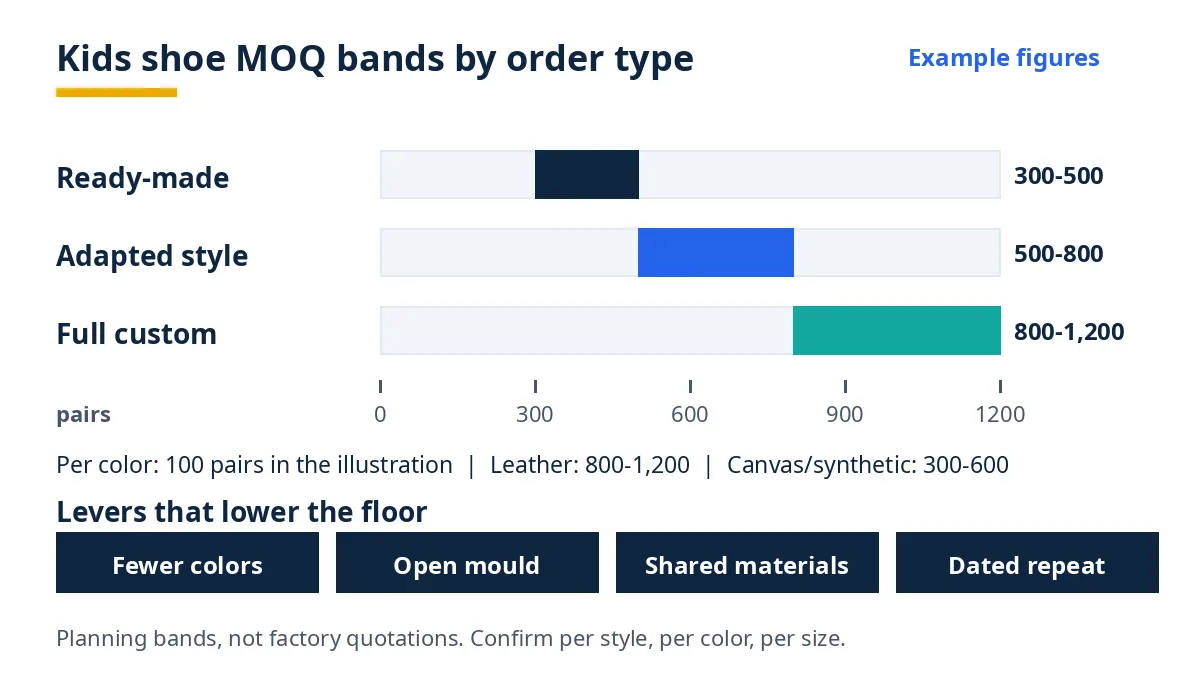
Planning bands run 300 to 500 pairs for a ready-made style and 800 to 1,200 pairs for a full custom style with a new mould.
Tooling, material batches, and a chemical report for each color set the floor; cutting colors and sharing materials lower it.
A dated repeat option, an open mould, and tooling paid outright with ownership stated are the levers that move a factory.
A quotation for kids' shoes often gives one number for the minimum order and leaves the buyer to discover what it covers. That figure may count pairs per style, per color, or per size range, and each reading changes the order by hundreds of pairs. This guide separates those readings and sets out the moves that bring a factory minimum down without removing a safety or fit check.
What does a kids'-shoe MOQ actually count?
A minimum order quantity (MOQ) is the smallest number of pairs a factory will put into production. In footwear, that floor is rarely one flat number. One footwear manufacturer guide lists three common structures: pairs per model, pairs per color, and pairs per size range, with an illustration of 300 pairs per model and 100 pairs per color.1 Learn which structure a quotation uses before comparing two prices.
Ask for the MOQ in writing at four levels: per style, per color, per size, and per shipment. A factory may accept 300 pairs of one style while still requiring 100 pairs in each color. Ask also whether the floor falls on a repeat of the same style, color, and materials, and do not assume it does until the factory confirms it.
Why do children's sizes push the MOQ up?
Children's shoes need more sizes across a short span of foot growth than adult shoes, and every extra size adds pattern work, lasts, cutting work, and a separate setup. One tooling guide explains that a full adult size grade can run to 14 sizes, with about 750 lasts to support mass production at 1,500 pairs a day.2 Each children's size still needs its own last and cutting dies.
The size curve is the split of the total across sizes. Middle sizes usually sell fastest, so a flat split leaves unsold pairs at both ends. State the curve size by size, in foot length in millimeters, and ask the factory to confirm it against the MOQ at each level. Width fittings add a second split: ask whether the floor is per width or per style.
What are the typical MOQ bands by order type?
No single Bangladesh-wide MOQ exists for kids' shoes. Published footwear guidance puts the typical range at 100 to 500 pairs per model, depending on materials, complexity, and the manufacturer.1 Another footwear maker states that most factories demand 1,000 pairs or more, while its own floor is 300 pairs per style, covering multiple sizes and two or three colors.3 The band depends on the order type, not on the product name alone.
The table below gives planning bands to test against quotations. Example figures. These bands are not quotations from any Bangladesh factory. Use them to spot a quotation far outside the usual range, then ask why.
Order type | Planning band, pairs per style | What usually drives the floor |
|---|---|---|
Ready-made style, factory materials and open mould | 300 to 500 | Size curve and color count, with little new tooling |
Adapted style, changed upper, print, or fastening | 500 to 800 | Pattern changes, material batches, and a new cutting setup |
Full custom style, new sole mould and new last | 800 to 1,200 | Moulds, lasts, cutting dies, and material batches for one style |
Leather upper in a named tannage and color | 800 to 1,200 | Leather batch size and a report for each material and color |
Synthetic or canvas upper, stock materials | 300 to 600 | Sole and component batches, with less waste than leather |
A ready-made style gives the lowest floor because the factory already holds the mould, the last, and the pattern. Leather sits higher than canvas or synthetic cloth because leather is bought in hides, so batch size and offcuts set a floor that cloth does not impose in the same way. If a leather supplier requires material for 500 pairs, a factory cannot make 100 pairs from it in an efficient way.1
Bangladesh has a large footwear base to draw on. Footwear exports reached a record 1.23 billion dollars in the financial year ended June 30, up 2.35 percent on the prior year on Export Promotion Bureau data.4 For sector background, see this sector overview.
How do moulds, lasts, and cutting dies change the maths?
Tooling is the fixed cost a small order must carry alone. One tooling guide puts a full set of midsoles, outsoles, cutting dies, shanks, and logo moulds for a modern athletic shoe at about 85,000 dollars before production starts, not counting lasts, with lasts at 3 to 7 dollars each across about 750 pieces.2
A set of cutting dies may cost 3,000 to 5,000 dollars, and the same guide states that a factory will generally fold that charge into the shoe price on a sizeable order, while an order under 5,000 pairs will likely carry a separate bill for lasts and cutting dies.2 Show tooling as a separate line, with ownership and repeat treatment stated.
Open moulds change the maths in the other direction. Many factories hold sole moulds any customer may use, often with a removable logo plate, and the tooling guide notes the designs may not be cutting edge but the price cannot be beaten.2 New mould work also sets the calendar: sampling with an existing mould takes 7 days, while new mould development takes 45 days.5
How do materials and colors multiply the minimum?
Every color is a separate material batch. Leather in one color needs its own hide batch, dye lot, and chemical report. A plasticised sole or trim in one color needs its own compound batch. The MOQ per color exists because the factory cannot buy, dye, or compound a fraction of a batch for a handful of pairs.
The chemical file multiplies with the same logic. Under REACH, chromium VI compounds are capped at 3 mg/kg or less in leather parts that come into contact with skin, and phthalates including DEHP, DBP, BBP, and DIBP are capped at under 0.1 percent in plasticised materials in toys and childcare articles, per the SGS summary of the REACH Annex XVII entries.6 A report belongs to a named material in a named color. Freeze colors before the factory buys materials.
Consolidation is the direct answer. Use one upper material across colors, one sole compound across the style, and one lining across sizes. A factory guide lists limiting color variations and consolidating materials among the main ways a brand can manage a footwear MOQ.1 Use one box design across colors for a first order, with a sticker to separate pairs.
Which negotiation levers actually move a factory?
A factory lowers a floor when the buyer lowers its cost or risk. Asking for a lower number without changing anything rarely works, because setup, tooling, and material batches stay the same. The levers below change something real.
Cut the color count first. Drop from four colors to two for the first order, and hold the others for a reorder once sales show which colors move. Next, take a ready-made or open-mould sole and last. One maker notes that 300 pairs can cover multiple sizes and two or three colors on a ready-made basis.3
Consolidate styles onto shared materials, and ask the factory to quote two styles together, with the shared material shown as one batch. Commit to a repeat in writing: a dated option for a second run within a stated period, at a stated price basis, subject to the first run passing inspection.
Pay a larger deposit, or pay for tooling outright, with ownership stated, and tie the deposit to sample approval, material purchase, and bulk start. Accept a longer lead time or a shared slot if the buyer can wait, and simplify construction where a part adds setup without adding function. Pressure alone does not move a factory: one that agrees to a floor it cannot run will recover the cost elsewhere.
What should the quotation state before you agree?
A quotation that can be compared states the MOQ at each level, the tooling lines, the size curve, and the validity period. Ask for each item below, and treat a missing item as a question to answer before the order.
MOQ per style, per color, per size, and per width, each as a number of pairs.
Tooling charges shown separately, with ownership and repeat-order treatment stated.
Size curve, size by size, in foot length in millimeters, with the factory's own chart for the last in use.
Materials by name, color by color, with the chemical report named for each material and color.
Unit price at the quoted quantity, and the price if the quantity rises or falls.
Lead time from sample approval, with the mould step shown separately where needed.
Delivery term, payment terms, deposit stages, and validity period.
Sample plan: fit sample, chemical sample, and pre-production sample, each approved in writing before the next stage.
Exportain quotations already carry the commercial frame for this check: price, MOQ, lead time, delivery term, payment terms, and validity, with the RFQ and every quotation version kept on the platform for both sides to see.7 Badges record a review of documents and photographs, not a factory inspection, and do not assure capacity, quality, or delivery.7
Worked example: cutting a 1,200-pair floor to 600 pairs
Example figures. A buyer wants a children's canvas shoe for ages 4 to 7, in four colors, across nine sizes, with a new sole mould and a printed box in each color. The first quotation sets the floor at 1,200 pairs: 300 pairs per color, with a new mould, four dye lots, four box prints, and a separate tooling charge. The buyer needs 600 pairs for a first season.
The buyer changes the order, not only the number. Colors drop from four to two, both on the same canvas and sole compound. The new sole mould is replaced with an open mould. The box becomes one design with a color sticker. The buyer commits to a dated repeat option within four months, subject to inspection, and pays for the cutting dies outright, with ownership stated. The revised floor is 600 pairs: 300 per color across nine sizes.
Item | First quotation | Revised order |
|---|---|---|
Colors | 4 | 2 |
Pairs per color | 300 | 300 |
Total pairs | 1,200 | 600 |
Sole mould | New, 45-day step | Open mould, no new mould step |
Material batches | 4 dye lots, 4 box prints | 1 canvas batch, 1 box design |
Tooling | New mould plus dies, charged in full | Dies paid outright, ownership stated |
Repeat | None stated | Dated option, same colors, within 4 months |
The saving comes from the color count, the open mould, and the shared material batch. The checks stay: fit samples across the smallest, middle, and largest sizes, chemical reports for each color, and a pre-production sample approved in writing before bulk. A lower floor that drops a check is not a saving.
Mistakes that lock in a high MOQ
The most common mistake is approving a style before the MOQ levels are known. Learn the four levels before the sample round. The second mistake is adding colors after materials are bought: freeze colors at sample approval, and treat any later color as a new order.
The third mistake is splitting a small quantity across too many styles, since each style carries its own setup, tooling, and material batch. The fourth is accepting a low headline MOQ without asking what was removed to reach it. Ask what changed, and write the materials, reports, and sample plan into the order.
How do you write the RFQ so factories quote a comparable MOQ?
Write the RFQ as a specification. State the age range, size range in foot length in millimeters, width fittings, materials by name, color count, sole and last basis, size curve, and chemical limits. Ask each factory to quote its floor at the four levels in the same format.
Ask three questions in every RFQ. First, what is the floor per style, per color, per size, and per width. Second, what tooling is new, what is open, and what does each new tool cost, with ownership stated. Third, what happens to the floor on a repeat within a stated period. General MOQ rules are covered in the MOQ guide. What a badge does and does not prove is explained in this badge-check guide.
Frequently asked questions
Can I order 100 pairs of kids' shoes from Bangladesh?
A 100-pair order is below the usual floor for a custom children's style, which published guidance places in the 100 to 500 pair band per model, with most factories asking for 1,000 pairs or more on a new design.1 3 A 100-pair run may be possible on a ready-made style with stock materials, one color, and a narrow size range.
Does the MOQ apply per color or per style?
It can apply at both levels, and the quotation must state each one. One footwear guide gives the illustration of 300 pairs per model with 100 pairs per color, so a three-color order needs 300 pairs only if each color reaches 100 pairs.1 Cut the color count first when the total must fall.
Can the MOQ fall on a repeat order?
It can, where the repeat uses the same style, color, materials, mould, and last, because tooling and pattern work are already done. Ask the factory to state the repeat floor in the first quotation, and put the repeat in as a dated option. A repeat that changes a color or material is a new order, with a new batch and report.
What if I need many sizes but only a few pairs in each?
A wide range with thin quantities at each size is the hardest shape for a factory to run, because each size needs its own setup. Narrow the range to sizes the buyer will sell, and ask whether the factory will accept a lower floor at the end sizes. If end sizes cannot reach a floor, drop them from the first order and add them on the repeat.
Should I pay for the mould to get a lower MOQ?
Paying for a mould outright can lower the floor, because the factory no longer carries the tooling cost on a small run. Do it only with ownership stated in writing, charges shown separately, and repeat treatment agreed. A mould the buyer paid for but cannot reuse has bought a lower first floor at the price of a second charge later.
Next steps on Exportain
Write the four MOQ levels into the RFQ before contacting a factory: per style, per color, per size, and per width, with the size curve, color count, and sole and last basis stated. Browse suppliers, compare quotations through requests for quotation, and read the kids' shoes manufacturer guide for the fit and chemical checks. Approve samples and reports in writing before bulk starts.
Sources
- Footwear MOQ: minimum order quantity in shoe manufacturing. LG Shoes (accessed )
- Shoe Tooling for Mass Production. Shoemakers Academy, (accessed )
- Low MOQ Shoe Manufacturer: Start with 300 Pairs. BONA Shoes, (accessed )
- Bangladesh eyes $5bn footwear boom as China loses US ground. bdnews24 (accessed )
- Shoe Sample Development Process: From Tech Pack to Bulk. BONA Shoes, (accessed )
- REACH Application for Juvenile Products in the EU. SGS (accessed )
- About Exportain. Exportain (accessed )
About the author
Sourcing from Bangladesh?
Post a request for quotation and suppliers on Exportain can send you their quotes directly.
Post an RFQ