

The Footwear Industry in Bangladesh: Capacity, Clusters and Key Players
Leather and footwear exports reached USD 1.67 billion in FY2024-25, with footwear at about USD 1.19 billion. This pillar guide covers products, clusters, supplier checks, MOQ, pricing, compliance, Incoterms and duties.
Short answer
The footwear industry in Bangladesh produces leather, synthetic and textile footwear for export and a large domestic market, across more than 3,600 production units. Leather and footwear exports reached USD 1.67 billion in fiscal year 2024-25, with footwear at about USD 1.19 billion. Buyers source it by specifying each style, verifying the factory and its material sources, approving tested samples, and agreeing MOQ, price, Incoterm and lead time per order.
On this page
Key takeaways
Leather and footwear exports reached USD 1.67 billion in fiscal year 2024-25, with footwear at about USD 1.19 billion and leather footwear at about USD 672 million, per LightCastle Partners research.
EPB data reported by The Financial Express put leather footwear receipts at USD 545.35 million in July to April of FY2024-25, up 26.08 percent.
Production is about 423 million pairs a year across more than 3,600 units, but only about 90 factories are large and export-oriented, so export capability is selected factory by factory.
There is no industry-wide MOQ, price or lead time; all three are quoted per factory and per style against a written specification.
For the EU, footwear must meet Directive 94/11/EC material labelling and the REACH chromium VI limit of less than 3 mg/kg in skin-contact leather.
The footwear industry in Bangladesh makes leather shoes, synthetic and textile trainers, sandals, espadrilles and safety footwear for export and for a large home market. This pillar guide is for importers, brands and sourcing agents in the United States, the United Kingdom, the European Union and the United Arab Emirates weighing Bangladesh against other footwear origins. It covers the latest export data, products and clusters, supplier checks, MOQ, pricing and lead times, compliance, shipping, Incoterms and duties, and a step-by-step buying process.
Market overview with latest data on the footwear industry in Bangladesh
Bangladesh's leather and footwear sector is the country's largest non-ready-made-garment manufacturing export category, and footwear is the part of it that is growing. Research by LightCastle Partners puts total leather goods and footwear exports at USD 1.67 billion in fiscal year 2024-25, with footwear alone accounting for about 72 percent of that figure, at approximately USD 1.19 billion.1 Within footwear, leather footwear remained the largest export category at approximately USD 672 million in FY2024-25, while non-leather footwear, at approximately 31 percent of sector revenues, was the fastest-growing segment.1 Keep the series separate when you compare figures: these are full fiscal-year figures for the leather and footwear sector as compiled in that research, not calendar-year totals.
The Export Promotion Bureau (EPB) fiscal-year series, reported by The Financial Express, tells the same growth story part-way through the year. Earnings from leather and leather products grew by 10.08 percent to USD 932.53 million in the first ten months of FY2024-25 (July to April), and export receipts from leather footwear stood at USD 545.35 million in the same ten-month period, a rise of 26.08 percent.2 A ten-month EPB figure and a full-year research figure measure different periods, so use each one on its own terms and check the current EPB release before you quote a number to your board.
Scale is not the constraint. Annual footwear production stands at approximately 423 million pairs across more than 3,600 production units, comprising over 3,500 micro, small and medium enterprises and roughly 90 large export-oriented factories, and the value chain employs an estimated 850,000 workers.1 Domestic consumption of about 355 million pairs a year keeps capacity utilised, and approximately 85 million pairs are exported annually, about 20 percent of production.1 Most capacity serves the home market, so export capability has to be selected factory by factory, not assumed from the size of the industry.
Two structural features shape what you can buy. First, the raw material base. Bangladesh's domestic livestock population represents approximately 2.4 percent of the global total, enabling annual processing of around 35 million square feet of leather, almost entirely sourced domestically.1 Leather footwear therefore starts from a local hide supply that competing origins such as Vietnam, which rely heavily on imported hides, do not have.1 Second, the input position reverses for non-leather footwear: an estimated 80 to 90 percent of key synthetic inputs, including EVA and PU compounds, rubber soles and adhesives, are imported, primarily from China, Taiwan and South Korea.1 A synthetic trainer programme is therefore exposed to imported-input lead times in a way a leather shoe programme is not.
Price positioning sits in the middle of the market. The average export price is about USD 15 per pair, above basic rubber and plastic footwear at about USD 7 per pair and below the premium leather footwear average of about USD 31 per pair.1 The top five markets, the United States, Germany, France, Poland and the Netherlands, absorb most export receipts, while Japan, South Korea, Canada and Australia together account for less than 10 percent of sector exports.1
Main products and production clusters
Footwear is classified for customs in Chapter 64 of the Harmonized System, which covers footwear, gaiters and the like and parts of such articles. The chapter notes set the two classification tests you will use on every style: the material of the upper is the constituent material with the greatest external surface area, ignoring accessories and reinforcements, and the material of the outer sole is the material with the greatest surface area in contact with the ground.3 The main headings are:
HS heading | What it covers | Typical Bangladesh products |
|---|---|---|
6401 | Waterproof footwear with outer soles and uppers of rubber or plastics, uppers neither fixed to the sole nor assembled by stitching or similar processes | Wellington-type boots and waterproof work boots |
6402 | Other footwear with outer soles and uppers of rubber or plastics | Synthetic sandals, slippers and moulded casual shoes |
6403 | Footwear with outer soles of rubber, plastics, leather or composition leather and uppers of leather | Leather dress shoes, casual shoes, boots and leather sandals |
6404 | Footwear with outer soles of rubber, plastics, leather or composition leather and uppers of textile materials | Textile trainers and sports footwear, including 6404.11 sports footwear |
6405 | Other footwear | Espadrilles and styles outside the headings above |
6406 | Parts of footwear, gaiters and similar articles | Uppers, soles, heels and removable insoles |
Chapter 64 does not cover worn footwear, which sits in heading 6309, orthopaedic footwear, which sits in heading 9021, or toy footwear and skating boots with skates attached, which sit in Chapter 95.3 Agree the six-digit subheading with your supplier and broker for each style before you place the order, because the heading decides which duty line and which product rules customs applies.
The product offer follows the headings. Leather footwear under 6403 is the established export line, built on domestic hides. Textile and synthetic footwear under 6402 and 6404, including trainers and athleisure styles, is the growth line, built on imported compounds and soles.1 Safety footwear is a distinct sub-offer under 6401 and 6403, sold on protective performance rather than fashion, and espadrilles, sandals and slippers fill the 6402 and 6405 ranges.
Production clusters in four areas, and the cluster tells you what a factory is set up to make:
Gazipur, north of Dhaka. The largest cluster for export footwear, including leather shoe factories around Kaliakoir. Apex Footwear's production facility in Kaliakair, Gazipur employs around 10,000 workers and produces more than 50,000 pairs of shoes each day, and the company exports to more than 130 retailers across Europe, North America and Japan.4
Savar and Ashulia, west of Dhaka. Footwear factories sit alongside the Savar Tannery Industrial Estate, where the country's tanneries were relocated from Hazaribagh in 2017.1 Proximity to tanneries suits leather shoe and leather goods production, and the estate's effluent treatment position, covered in the compliance section below, is part of due diligence for any leather programme.
Narayanganj, south-east of Dhaka. A smaller cluster with a history in espadrilles and canvas footwear, using the same labour and logistics base as its knitwear and garment factories.
Chattogram and the export processing zones. Factories in and around Chattogram, including in the Cumilla and Karnaphuli export processing zones, sit closest to the port of Chattogram, which shortens the factory-to-vessel leg for export orders.
Key players fall into three groups. The first is a small set of large, export-oriented factories, roughly 90 across the sector, with in-house lasting, finishing and testing lines.1 The second is the membership of the Leathergoods and Footwear Manufacturers and Exporters Association of Bangladesh (LFMEAB), the sector's trade association, whose members cover footwear and leather goods and which represents the sector in pre-budget consultations with the National Board of Revenue.5 The third is the long tail of more than 3,500 smaller units that mainly serve the domestic market of about 355 million pairs a year.1 A buyer sourcing for export should start with the first two groups and treat domestic-market capacity as background, not as a shortlist.
How to find and verify suppliers
Find suppliers through more than one channel so you can cross-check what a factory tells you. Start with the LFMEAB member list for leather footwear and leather goods factories,5 add Bangladesh export data and Exportain trade intelligence for market context, then work Bangladeshi suppliers listings by product and ask each candidate for its current export markets and reference styles in your heading, whether 6403 leather shoes or 6404 textile trainers.
Verification is a document exercise first and a visit exercise second. Ask for, and read, the following before you discuss price in detail:
Trade licence and export registration, in the factory's own name.
LFMEAB or other trade association membership, where claimed.5
Export history: anonymised bills of lading or shipment summaries for your target market, showing heading, volume and recency.
The tannery or material source for each material in your specification, because EU chemical compliance, covered below, is decided at material level.
Test reports for the exact construction you plan to buy, not for a similar shoe from a previous season.
Factory profile evidence: production lines, lasting and stitching capacity per day, and the quality-check points the factory itself runs.
On Exportain, read badges for what they are. Supplier profiles carry document and photo review badges: the badge records that documents and photos were reviewed, and membership never grants a badge.6 A badge is not a factory inspection, a certification or a guarantee. Exportain is a B2B marketplace and is not a party to the contract for goods between buyer and seller; it does not inspect goods, book freight or clear customs.6 Use the badge as a first filter, then run the document checks above yourself or through an inspection firm you appoint.
Two red flags end a conversation early: a factory that quotes a firm price and lead time before it has seen a full specification is not pricing your shoe, and a supplier that cannot name the tannery or compound source for an upper leaves you with no material to test and no compliance file to build.
MOQ, pricing and lead times
There is no industry-wide MOQ, standard price or standard lead time for footwear from Bangladesh, and no official body publishes one. All three are quoted per factory, per style and per order, against a written specification. Any single figure quoted without a specification is a sales opening, not a commitment. What follows is how each of the three is built, so you can compare quotes on equal terms.
MOQ. The minimum order quantity is set by material and component minimums, not by the shoe alone. A leather style carries the tannery's minimum for the specified hide and colour; a synthetic style carries the compound, mesh and sole minimums for that construction; both carry size-run and colourway splits. Expect the MOQ to be stated per style and per colour, with a separate, smaller minimum per size inside the run. When you request a quote, state your target quantity per style, per colour and per size range, and ask the factory to quote its MOQ on the same basis, so two factories answer the same question.
Pricing. The sector's average export price of about USD 15 per pair is a mix average across leather, synthetic and textile footwear, not a price for your style.1 Your unit price is built from upper material, sole and components, labour for cutting, stitching, lasting and finishing, packing, and export costs to the agreed Incoterm point. Compare quotes only at the same Incoterm and specification, and ask each factory to itemise material, making and packing separately, so a lower quote shows you where the money came out.
Example figures. For illustration only: a buyer's specification for 3,000 pairs of a leather casual shoe is quoted by two factories at the same Incoterm, FOB Chattogram. Factory A quotes USD 14.80 per pair itemised as materials USD 8.60, making USD 4.70 and packing and export costs USD 1.50. Factory B quotes USD 13.90 per pair with no itemisation. The worked example totals are USD 44,400 from Factory A and USD 41,700 from Factory B for the goods at FOB. The example shows the method, not a market price: the buyer asks Factory B for the same itemisation before treating the USD 2,700 gap as a saving, because an unitemised gap is usually a material or component difference that will appear at inspection.
Lead times. A lead time is a chain, not a single number: material production or import, sampling and approval, bulk production, inspection and booking, then transit. The chain differs by product. A leather style waits on tannery production from domestic hides; a synthetic style waits on imported EVA, PU, soles and adhesives, which account for an estimated 80 to 90 percent of key synthetic inputs.1 Ask for the lead time broken into those stages, with the material stage stated separately, and agree what starts the clock, normally written order confirmation plus approved counter-sample, not the first enquiry. Put the agreed dates, and what happens if a stage slips, in the purchase order.
Quality, certifications and compliance
Quality in footwear is decided by three layers: the destination market's product law, your own specification and testing, and the factory's process control. Market law is not optional and it is not replaced by a buyer's private standard.
EU material labelling. Directive 94/11/EC requires labelling of the materials used in the main components of footwear sold to consumers in the EU. The label must give information on three components, the upper, the lining and sock, and the outer sole, in written form or as a pictogram.7 Only materials covering 80 percent or more of the surface area of the upper, the lining and sock, and 80 percent or more of the volume of the outer sole need to be labelled; where no single material reaches 80 percent, the label gives the two main materials.7 The label must be visible, securely attached and accessible, and must appear on at least one item of the pair, and where footwear is imported, the person who first places it on the EU market is responsible for supplying the label and for its accuracy.7 Agree the label artwork, in the destination language set, at sampling stage, not at packing.
EU chemical limits for leather. Under REACH Annex XVII, as amended by Commission Regulation (EU) No 301/2014, leather articles coming into contact with the skin shall not be placed on the EU market where they contain chromium VI in concentrations equal to or greater than 3 mg/kg of the total dry weight of the leather, and the same limit applies to any leather part of an article that contains leather parts.8 The restriction has applied since 1 May 2015, and the EN ISO 17075 method named in the regulation is the reference method for detecting chromium VI in leather.8 For a leather shoe, that means the test unit is each leather in the shoe, upper, lining and sock, from the named tannery batch in your specification. A test report for a different leather, colour or tannery does not clear your shoe.
Tannery and environmental compliance. Leather compliance starts one step before the shoe factory. Finished leather exports declined sharply following the relocation of tanneries from Hazaribagh to the Savar Tannery Industrial Estate in 2017, and the estate's central effluent treatment plant operates below the peak wastewater load, which is why non-compliant tanneries cannot obtain Leather Working Group certification.1 Ask a leather footwear supplier which tannery supplies each leather, whether that tannery holds a current Leather Working Group audit rating or an equivalent buyer-accepted audit, and how effluent compliance is evidenced. If the answer is a certificate for a different tannery, the shoe in front of you is untested for sourcing purposes.
Safety and protective footwear. Protective footwear for workplace use sits outside the consumer footwear labelling directive and under the EU rules on personal protective equipment.7 If you are buying safety footwear, specify the protective features in the purchase specification and require the conformity evidence for the exact model and size range, because a certificate for a similar model does not cover your model. Keep PPE conformity and chemical compliance as separate files.
Your own quality system. Write the specification so an inspector can measure it: materials by name, size range and sizing system, colour standards, packing and carton marking, and the labelling set from the rules above. Approve a pre-production sample and a counter-sample, set the inspection point before packing closes, and test production-representative pairs, not showroom pairs, for the chemical limits above and for physical performance such as sole bond strength and flexing, through a laboratory accredited for those methods.
Shipping, Incoterms and duties
Footwear from Bangladesh normally leaves by sea from Chattogram, the country's main seaport, in full or shared containers; small sample orders move by air from Dhaka. Cartons are bulky relative to weight, so confirm carton dimensions and pairs per carton in the specification, because those two numbers set your freight cost per pair under any Incoterm.
Incoterms® 2020 is the current edition of the ICC rules, in force since 1 January 2020. The Incoterms® rules are eleven three-letter trade terms that clarify the tasks, costs and risks involved in the delivery of goods from sellers to buyers, and they are recognised as the global standard for interpreting the most common terms in foreign trade.9 In your own words, the four rules you will meet most often on footwear orders work as follows:
Rule | Who arranges and pays main freight | Where risk passes to the buyer | Practical note for footwear |
|---|---|---|---|
EXW (Ex Works) | Buyer | At the seller's premises | Buyer carries export clearance workload; rarely suitable for a first order |
FOB (Free On Board) | Buyer | When goods are on board the vessel at the named loading port | The common Bangladesh footwear term; name the port, for example FOB Chattogram, Incoterms® 2020 |
CIF (Cost, Insurance and Freight) | Seller, plus minimum insurance | When goods are on board at the loading port | Seller's freight is convenient, but risk still passes at loading, not at arrival |
DAP (Delivered at Place) | Seller | At the named destination place, ready for unloading | Buyer still clears import and pays duty unless the contract says otherwise |
Always write the rule with its named place and edition, for example "FOB Chattogram, Incoterms® 2020", and keep the insurance position explicit under FOB, where neither party is obliged by the rule itself to insure. Exportain does not book freight or clear customs, so the freight forwarder and customs broker, yours or the seller's, are separate appointments to name in the order paperwork.6
Duties are decided by the heading from the products table, the origin of the goods and the destination's preference scheme, in that order. As a least developed country, Bangladesh benefits from the Everything But Arms (EBA) arrangement under the EU's Generalised Scheme of Preferences, which grants duty-free, quota-free access to the EU for exports of all products except arms and ammunition, and 91 percent of Bangladesh's exports to the EU enter duty- and quota-free.10 Footwear that meets the EBA rules of origin and is shipped with the required proof of origin therefore enters the EU without customs duty while Bangladesh holds that status. Two cautions apply. First, preference is a property of the consignment, not the country: if the origin evidence fails, the standard third-country duty for the heading applies. Second, the status is time-limited by LDC graduation; LightCastle Partners estimates potential most-favoured-nation tariff exposure of 10 to 17 percent in the EU and 12 to 18 percent in the UK if no replacement arrangement applies after graduation.1 For the United States and the UAE, read the duty beside your confirmed six-digit code in the destination tariff for the entry date; this guide states no US or UAE rate, because footwear rates vary by heading and material and a rate quoted for one heading does not carry to another.
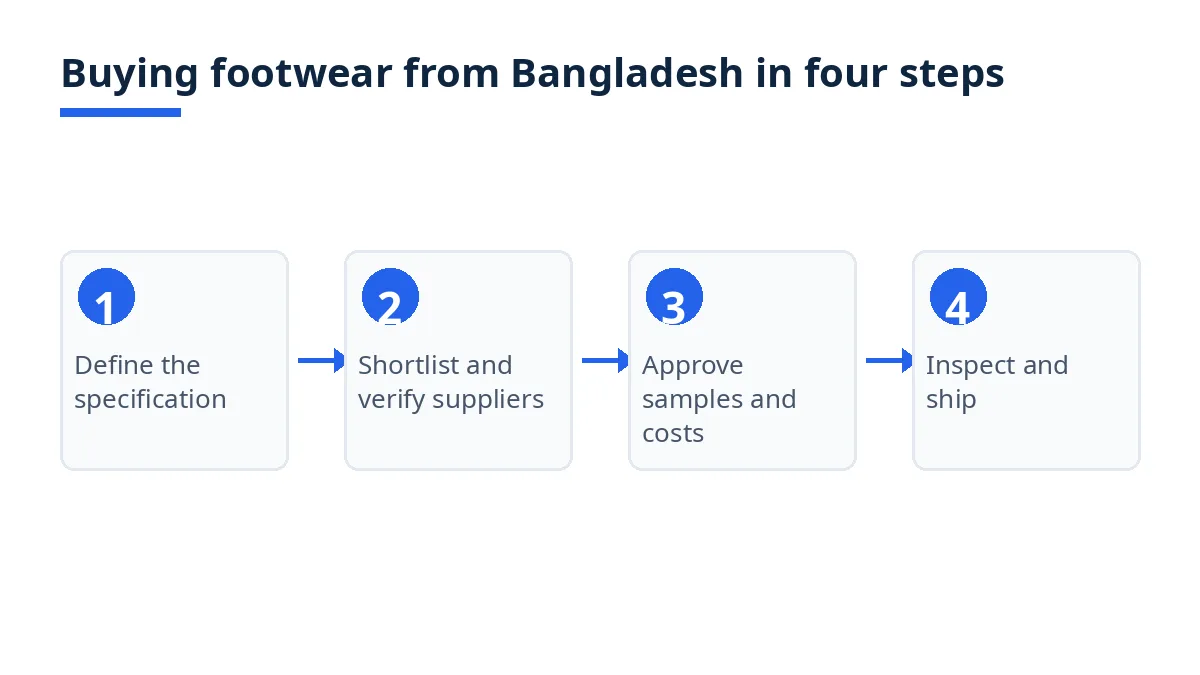
The buying process below pulls these threads together.
Step-by-step buying process
Define the specification. Write the shoe before you shop for it: HS heading, upper and sole materials, size range and sizing system, colours, labelling set, packing and pairs per carton, target quantity per style and colour, and destination market.
Shortlist and verify suppliers. Build a shortlist from association lists and supplier listings, then run the document checks in the verification section, including tannery and material sources for each material.5 6
Sample and approve. Order samples against the specification, test production-representative pairs for the chemical and physical points in the compliance section, and approve a counter-sample in writing.7 8
Agree commercial terms in writing. Fix MOQ per style and colour, itemised unit price, the Incoterm with its named place, the staged lead time and its start point, payment terms and the inspection point, all in the purchase order.9
Produce, inspect and ship. Monitor the material stage first, inspect finished goods before shipment against the approved counter-sample and specification, then ship with the origin evidence your duty position depends on.10
Related guides
Read how to import from Bangladesh for the general import sequence behind the footwear steps above, the leather goods industry in Bangladesh pillar for the neighbouring category, and Bangladesh export data for category scale. The knitwear industry in Bangladesh pillar shows how a garment category handles the same MOQ, compliance and Incoterm questions.
FAQs
Is Bangladesh a good place to source footwear?
Bangladesh is a credible sourcing option for leather footwear and for synthetic and textile footwear where the specification, materials and compliance file are managed actively. The sector exported about USD 1.19 billion of footwear in FY2024-25 within leather and footwear exports of USD 1.67 billion, produces about 423 million pairs a year and holds a domestic hide base for leather uppers.1 The same research records the constraints to price in: productivity below Vietnamese comparators, imported synthetic inputs and tannery effluent compliance that decides access to premium leather programmes.1 Source factory by factory, not on the country label.
What is the typical MOQ?
There is no published typical MOQ for footwear from Bangladesh, and no official body sets one. Each factory quotes its MOQ per style and per colour from its material and component minimums, with a smaller minimum per size inside the run. State your target quantity per style, colour and size range in your enquiry and require the MOQ back on the same basis, so quotes from different factories can be compared directly.
How long is the lead time?
There is no standard lead time: yours is the sum of its stages, material production or import, sampling and approval, bulk production, inspection and booking, and transit. A leather style depends on tannery production from domestic hides, while a synthetic style depends on imported compounds, soles and adhesives.1 Ask for the stages separately, agree in writing what starts the clock, and hold the factory to the stage dates in the purchase order rather than to a single delivery promise.
Which certifications matter?
The certifications that matter are the ones your destination market and your buyers require for the exact shoe. For the EU, the binding requirements are legal, not voluntary: material labelling for the upper, lining and sock and outer sole under Directive 94/11/EC,7 and the chromium VI limit of less than 3 mg/kg in skin-contact leather under REACH Annex XVII.8 Beyond the law, a current Leather Working Group audit rating for the supplying tannery is the leather sourcing credential buyers ask for most often, and protective footwear needs its own conformity evidence for the exact model.1 Management and social audits a buyer names in its own vendor manual sit on top of these; none of them replaces the legal file.
Next steps on Exportain
Browse Bangladeshi suppliers by footwear product, use Exportain trade intelligence to check the market picture behind this guide, and post a free RFQ at Exportain RFQs with your specification, target quantity and destination market so footwear suppliers can quote against the same written brief.
Sources
- Leather & Footwear as The Next Export Frontier of Bangladesh. LightCastle Partners (accessed )
- July-April exports hit $40.20b. The Financial Express, (accessed )
- Harmonized Tariff Schedule of the United States, Chapter 64 (2026 Revision 15). U.S. International Trade Commission (accessed )
- Apex Footwear: From tannery to retail giant. The Business Standard (accessed )
- Allow 'free of cost' raw material imports. The Financial Express (accessed )
- Supplier verification: Earn trust badges buyers can see. Exportain (accessed )
- Footwear labelling. European Commission, EUR-Lex (accessed )
- Commission Regulation (EU) No 301/2014 amending Annex XVII to REACH as regards chromium VI compounds. European Commission, EUR-Lex, (accessed )
- Incoterms® rules. International Chamber of Commerce (ICC) (accessed )
- EU trade relations with Bangladesh. European Commission, (accessed )
- Incoterms
- quality control
- Bangladesh Export Data
- Category Pillars
- Supplier Sourcing
- Leather footwear
- Footwear Bangladesh
About the author
Sourcing from Bangladesh?
Post a request for quotation and suppliers on Exportain can send you their quotes directly.
Post an RFQ


