Bangladesh Export Data: Complete Guide for Exporters
A seller-facing guide to reading Bangladesh export data: where official figures come from, why shipment and receipt totals differ, and how to turn product and destination data into market choices.
Short answer
Bangladesh export data comes mainly from customs declarations compiled by the Export Promotion Bureau and from export receipts reported to Bangladesh Bank by authorized dealer banks. It shows what was shipped or paid for, by product and destination, and in which period. Read by product and market, over at least twelve months, it helps exporters choose markets, time outreach, and check demand before spending on samples or stock.
On this page
Key takeaways
Bangladesh export data comes from customs declarations for goods shipped and from export receipts reported to Bangladesh Bank by authorized dealer banks.
Shipment and receipt totals differ because of timing, valuation, and coverage, per Bangladesh Bank.
In FY2024-25, per Bangladesh Bank, goods export receipts were USD 43,559.3 million and ready-made garments were 85.4 percent of that total.
Read data by product first, then by destination, over at least twelve months, comparing the same source and status.
Data shows past shipments, not future orders. Buyer validation on specification and compliance still decides each sale.
Bangladesh export data is the official record of what Bangladesh sells to the world, and for an exporter it is a planning tool. Used well, bangladesh export data shows which products shipped, to which destinations, in what values, and in which period, so you can choose a market and check demand before you spend on samples or stock. This guide explains where the figures come from, why official totals differ, and how to read them at product and destination level. For the combined picture, see Bangladesh export and import data.
Key takeaways
Bangladesh export data comes from two main official trails: customs declarations for goods shipped, and export receipts reported to Bangladesh Bank by authorized dealer banks when proceeds are received.1
The two trails do not match exactly. Bangladesh Bank notes that shipment records and receipt records differ because of timing, valuation, and coverage, so its receipts data can differ from figures compiled by the Export Promotion Bureau (EPB) and the Bangladesh Bureau of Statistics.1
In FY2024-25, per Bangladesh Bank, export receipts for goods were USD 43,559.3 million, and ready-made garments accounted for USD 37,218.0 million, or 85.4 percent of that total.1 A headline total therefore says more about garments than about most other categories.
Read data by product first, then by destination, over at least twelve months. Compare the same months, the same source, and the same status, provisional or revised.
Data shows past shipments. It does not promise orders. Buyer questions on specification, certification, packing, and order pattern still decide whether a flow becomes your sale.
Why this matters for buyers and sellers
For a seller, export data answers three questions. First, is there proven demand. If Bangladeshi factories already ship your category to a market every month, buyers, freight routes, and compliance expectations already exist there. Entering a proven flow is usually less risky than creating demand from zero.
Second, where should you focus. A category may be large but concentrated in one or two destinations, or smaller but spread across many markets. The first pattern calls for depth in one market. The second calls for breadth, with markets ranked by size, growth, and fit with your capacity.
Third, how should you time your effort. Many categories are seasonal because of retail calendars, weather, harvests, or festivals. Monthly data over more than one year shows those cycles more honestly than a single month.
The structure of the national total shows why product-level reading matters. In FY2024-25, per Bangladesh Bank, ready-made garment receipts of USD 37,218.0 million made up 85.4 percent of goods receipts, while leather and leather manufactures recorded USD 1,197.5 million, jute and jute manufactures USD 845.3 million, home textiles USD 453.8 million, fish, shrimps and prawns USD 354.2 million, and pharmaceutical products USD 215.7 million in the same period.1 A seller of jute goods, seafood, or pharmaceuticals who reads only the national headline is reading a garment story.
For buyers, the same data works in reverse. It shows whether a category has an established export base, whether shipments are steady or sporadic, and whether a supplier claim fits the wider picture. Steady shipments usually point to an ecosystem of factories, input suppliers, inspectors, and forwarders who know the product. Our guide to the knitwear industry in Bangladesh shows that ecosystem inside a major category.
Data also disciplines pricing. A unit value, category value divided by quantity, mixes grades, specifications, and contract terms in one average. Treat it as a prompt for a detailed quotation, never as your price.
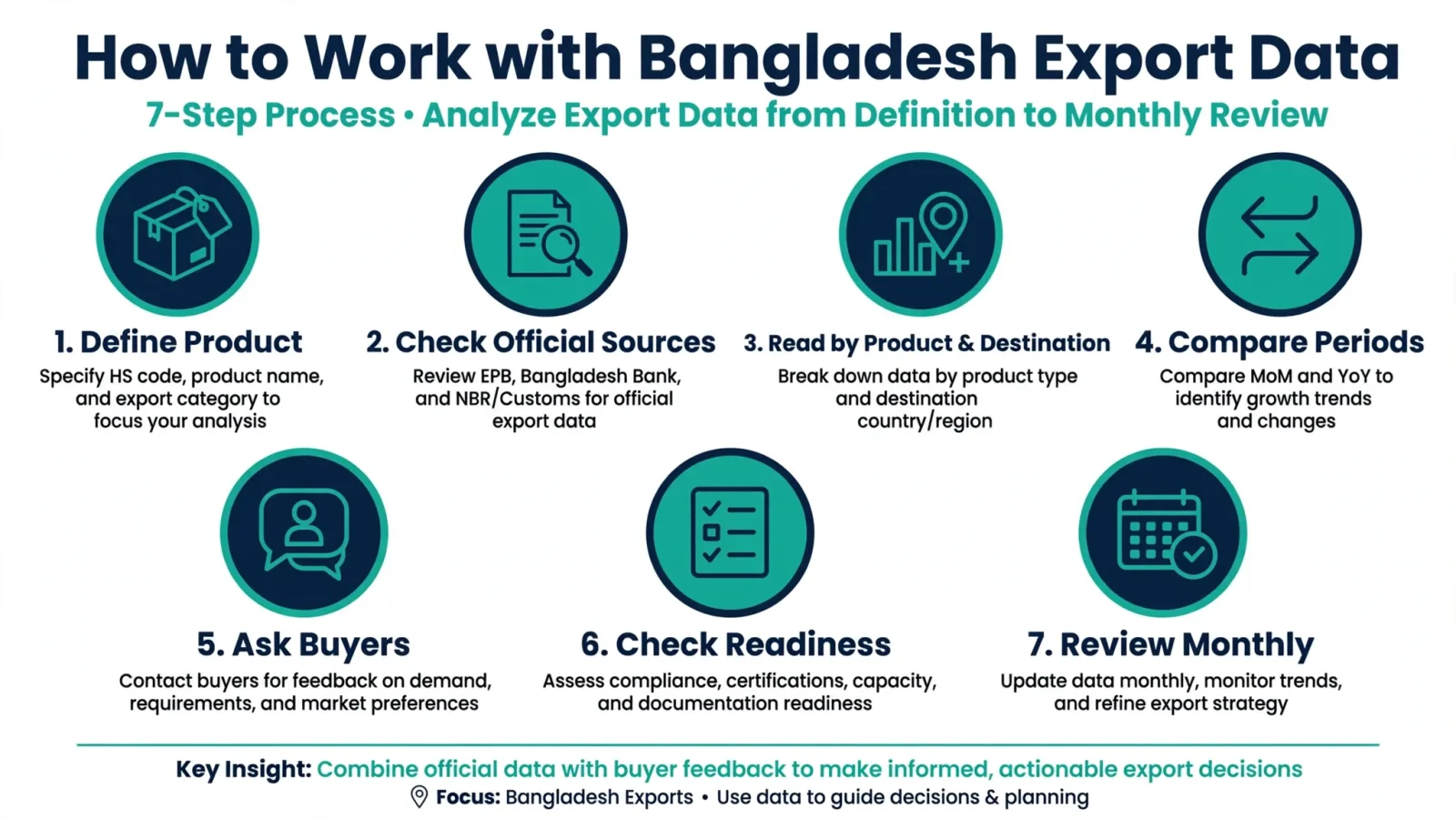
Step-by-step: how it works — bangladesh export data in practice
Step 1. Define your product precisely
Write down what you make: material, construction, intended use, and buyer type. A search for garments will overwhelm you. A search for your specific product type, in the classification language customs uses, will not. Bangladesh Bank classifies receipts using the Harmonized Commodity Description and Coding System, at four-digit heading level, by commodity and by country.1 If you do not know your classification, resolve it with your clearing and forwarding agent or a customs adviser first.
Step 2. Go to the official source first
Start with the Export Promotion Bureau (EPB) for shipment-based export performance, and with Bangladesh Bank for receipts and balance of payments data.1 2 3 Record source, period, and whether the figure is provisional or revised. A figure without source and period is not usable evidence.
Bangladesh Bank compiles annual receipts from foreign exchange returns submitted by authorized dealers, recording an export when proceeds are actually received, which can be before or after shipment.1 Its monthly balance of payments table records exports on a receipts basis and a shipment basis, labelled revised or provisional.2
Step 3. Read by product, then by destination
Look at your category over at least twelve months, then break the same period down by destination. Note the total, the direction, the share held by the top destinations, and any month where shipments stop or spike. Bangladesh Bank presents receipts by commodity and by country, so one release lets you check a product total and then its destination split.1 A spike can reflect one large shipment or a correction, so investigate before you act.
Step 4. Compare periods honestly
Compare the same months year on year, not a peak month against a low month. In July FY2026-27, per Bangladesh Bank, export shipments were USD 4,729 million on a provisional basis, compared with USD 4,779 million in July FY2025-26 on a revised basis, a change of -1.1 percent.2 That month alone tells you almost nothing about your product. Check whether a change came from quantity, value, or both. If two sources differ for the same period, follow their method notes and name the source you used.
Step 5. Turn findings into questions for buyers
Data tells you where to ask, not what to conclude. Frame specific questions: which specifications sell, which certifications buyers require, which packing and labeling rules apply, and what order size is normal. Bring those questions to buyer discussions and to your listing.
Step 6. Check your own readiness against the flow
Before you chase a highlighted market, confirm you can export legally and practically: registrations are current, your bank can handle the process, and your supply chain can meet the specification at buyer volumes. The registration foundation is covered in our guide to the ERC — Export Registration Certificate.
Step 7. Review on a rhythm and keep notes
Set a monthly review. Note what changed, which destination moved, and what you will do differently. Keep a log with four fields: source, period, finding, and action. Over a year, it becomes market intelligence grounded in official records.
Costs, timelines and documents
What does using export data cost?
Headline official data is published for public use, so your core research can start without buying a database. Costs arise around the data. Commercial platforms that resell customs records charge fees that vary by provider, coverage, and licence, so compare what a platform covers for Bangladesh and your product before you pay. You may also pay an agent, consultant, or researcher to extract and interpret records. Agree products, destinations, periods, and format in writing first. Finally, allow for acting on the data: samples, testing where buyers require it, and listing preparation. None has a single standard price, so obtain current quotations.
How long do official figures take to appear?
Official statistics do not appear on the day goods leave. Monthly figures are released after the period closes and records are compiled, and they may be revised later. Bangladesh Bank marks its monthly balance of payments columns as revised or provisional, a signal to treat early figures as direction rather than as a final total.2 Annual figures give cleaner comparisons but arrive later. Never promise a buyer an outcome based on one provisional month.
Your own shipment timeline is separate. Production, inspection, documentation, clearance, and transport each add time, so have your bank and agent confirm the current sequence for your shipment.
Which documents create the data trail?
The documents behind the data are the same documents that make an export legal and traceable. For every shipment, keep together: trade licence and chamber or association membership where applicable, Export Registration Certificate, sales contract or purchase order, commercial invoice, packing list, the EXP form processed through your authorized dealer bank, the customs bill of export, a transport document such as a bill of lading or airway bill, and any certificate of origin or product certificate required. Our guide to export documents from Bangladesh covers the full set. Inconsistent descriptions, quantities, or values can delay a shipment and corrupt the data trail, so check consistency before submission.
Bangladesh-specific rules and tips
Exports operate under the export policy framework and foreign exchange regulations administered through authorized dealer banks. Your bank is part of the compliance chain: authorized dealers report export receipts to Bangladesh Bank, and that reporting is one source of the national receipts data.1 Work with your bank early, especially for a first shipment to a new market, and follow its current EXP instructions rather than copying an old shipment file unchecked.
Registration is the foundation. An exporter normally needs a trade licence, membership of the relevant chamber or trade association, and the Export Registration Certificate issued through the Office of the Chief Controller of Imports and Exports, renewed as required. Keep renewals in a diary. An expired registration at shipment time can stop a ready order.
Read the data with its structure and calendar in mind. Garments dominate national exports, so headline growth often reflects garment performance more than your category, as the FY2024-25 shares per Bangladesh Bank show.1 Always drill down to product and destination. Bangladesh follows a July to June fiscal year, so mixing a fiscal period with a calendar period creates a trend that does not exist. Label every figure with its period and period type.
Mistakes and red flags
Quoting a headline total as your market size. The national total includes every product. Your opportunity is your product and destination segment only.
Trusting unsourced figures. Screenshots and forwarded tables strip away source, period, and revision status. If you cannot trace a number to EPB, Bangladesh Bank, or another primary source, do not use it.
Mixing receipts and shipments. Bangladesh Bank states that receipts and customs-based shipment data differ because proceeds and shipments are recorded on different dates, and valuation and coverage differ.1 State which measure you quote.
Comparing provisional and revised figures without saying so. Mixing the two stages invents growth or decline that never happened.
Reading one month as a trend. Single months move with shipment timing, holidays, and one large order. Use at least one full seasonal cycle first.
Confusing value growth with volume growth. Value can rise because prices or mix changed while quantities stayed flat, or the reverse. Check both where data allows.
Treating a unit value as your price. A category average blends many grades and terms. Use it as orientation only, then quote for your specification.
Letting data replace buyer validation. Past shipments prove a flow exists, not that a buyer will order from you. Samples, specifications, and compliance still win each order.
Checklist
Your product is defined precisely, by material, construction, use, and buyer type, before any data is pulled.
The source of every figure is recorded, with its period, period type, measure, and whether it is provisional or revised.
At least twelve months have been reviewed for your product category, broken down by destination.
Year-on-year comparisons use the same months and the same source.
Value and quantity have both been checked where the data allows, and unit values are treated only as orientation.
The top destinations are listed, with notes on seasonality and any spikes that need investigation.
Buyer questions drawn from the data, on specification, certification, packing, and labeling, are written down.
Your trade licence, chamber or association membership, and Export Registration Certificate are current.
Your bank has confirmed the current EXP and documentation sequence for your next shipment.
Your document set is consistent across invoice, packing list, customs declaration, and transport document.
A monthly review is in the diary, with a log for source, finding, and action.
How Exportain helps
Exportain helps Bangladeshi sellers turn research into buyer contact. Once the data shows which products and markets deserve focus, present that offer to international buyers on Exportain, with your products, capabilities, and export readiness in one place, by following how to sell on Exportain. Buyers browsing suppliers on Exportain can find sellers whose focus matches proven trade flows. Exportain does not replace official statistics, and it is not a party to your contract for goods.
FAQs
What should I know first about Bangladesh Export Data?
Know first what each source counts. Shipment figures come from customs declarations, while Bangladesh Bank receipts come from authorized dealer returns and record exports when proceeds are received, so the two totals differ by timing, valuation, and coverage.1 Define your exact product, read at least twelve months by destination from a named official source, and note whether each figure is provisional or revised.
What are the typical costs and timelines?
Headline official data can be consulted without buying a commercial database. Commercial platforms charge varying fees and professional help is charged by scope, so there is no single standard price. Obtain quotations and agree coverage in writing. Official figures appear after the period closes, and monthly figures marked provisional may later be revised, as Bangladesh Bank labels show.2 Confirm your shipment timeline separately with your bank and agent.
Which documents are needed?
You need the documents that create the export record: trade licence, chamber or association membership where applicable, Export Registration Certificate, sales contract or purchase order, commercial invoice, packing list, the EXP form processed through your authorized dealer bank, the customs bill of export, a transport document such as a bill of lading or airway bill, and any certificate of origin or product certificate the destination or buyer requires. Consistent product descriptions, quantities, and values across all of them keep clearance moving and the data record accurate.
What are the most common mistakes?
The most common mistakes are quoting the headline total as the market for one product, trusting unsourced figures, mixing shipment and receipt measures, comparing provisional with revised figures without saying so, calling one month a trend, and mistaking value growth for volume growth. Past shipments show a flow exists, but specification, samples, and compliance still win each order.
Next steps on Exportain
Use one official release to build your product and destination shortlist, then check trade intelligence on Exportain as you refine it. When the shortlist is ready, follow how to sell on Exportain to present the offer, and keep your monthly review running.
Sources
- Annual Export Receipts of Goods and Services 2024-25. Bangladesh Bank (accessed )
- Balance of Payments (Monthly). Bangladesh Bank (accessed )
- রপ্তানি উন্নয়ন ব্যুরো (Export Promotion Bureau) home page, e-services menu. Export Promotion Bureau, Bangladesh (accessed )
- Bangladesh Export Data
- export statistics
- EPB
- Bangladesh Bank
- export research
- seller guide
- market selection
About the author
Sourcing from Bangladesh?
Post a request for quotation and suppliers on Exportain can send you their quotes directly.
Post an RFQ