

Bangladesh Export Import Data: Complete Guide for Exporters
Practical, current guide for Bangladeshi exporters on Bangladesh Export Import Data, with official sources, fees, timelines and how Exportain helps.
Published 10 min read
Short answer
Bangladesh export import data is the official record of what leaves and enters the country, compiled from customs declarations and published by EPB, Bangladesh Bank, NBR, BBS and CCI&E in different forms. Before using any figure, confirm the product code, period, unit and publishing institution.

On this page
If you sell from Bangladesh, bangladesh export import data is the official record of what leaves and enters the country, which products move, which markets buy them, and how trade changes over time. Used well, it helps an export business bangladesh owners are building make better decisions about products, markets, and pricing, instead of relying on rumours or one buyer's opinion. This guide explains where the data comes from, how to read it, what the underlying registrations and documents involve, and how bangladesh exporters can turn public trade data into real enquiries and orders.
Key takeaways
Bangladesh export import data is compiled from customs declarations and published in different forms by the Export Promotion Bureau (EPB), Bangladesh Bank, the National Board of Revenue (NBR), the Bangladesh Bureau of Statistics (BBS), and the Office of the Chief Controller of Imports and Exports (CCI&E).
No single source tells the whole story. EPB is strongest for export performance by product and destination, Bangladesh Bank for payments and foreign exchange, NBR for tariff and classification detail, and BBS for long-run national statistics.
Always check the product code, period, and unit before comparing figures. Data by fiscal year, calendar year, quantity, and value can look contradictory when definitions differ.
Good data use starts with correct export registration and clean documents. Errors in your declarations become errors in the national data and can delay payment and clearance.
Exportain helps sellers use market insight practically, by presenting verified products to buyers already searching for suppliers from Bangladesh.
Why bangladesh export import data matters for buyers and sellers
Trade data matters because it replaces guesswork with evidence when an exporter must commit money. Before developing a new product, a seller can check whether buyers in a target market already import that category, whether demand is recorded consistently across periods, and which other supplying countries appear in the same market. Before quoting, a seller can sense-check whether a buyer's requested volume is realistic for that market and product.
For buyers, the same data works in reverse. An overseas buyer can confirm that Bangladesh genuinely exports the product they need, see its main destination markets, and shortlist categories where Bangladeshi supply is established rather than experimental. Accurate data therefore supports trust on both sides of a transaction.
The data also reveals concentration risk. If your category depends heavily on a few destination markets, a policy change, demand shift, or logistics problem in one market has an outsized effect. Exporters who follow the data regularly spot that risk earlier and can develop additional markets before they are forced to.
Finally, data shapes credibility. An answer grounded in official trade records sounds very different from one based only on opinion. You do not need to quote figures in every conversation, but you should know where your claims come from and be able to point to the official source behind them.
Step-by-step: how it works
Every recorded export or import begins as a declaration for a real shipment, and published statistics are built up from those declarations.
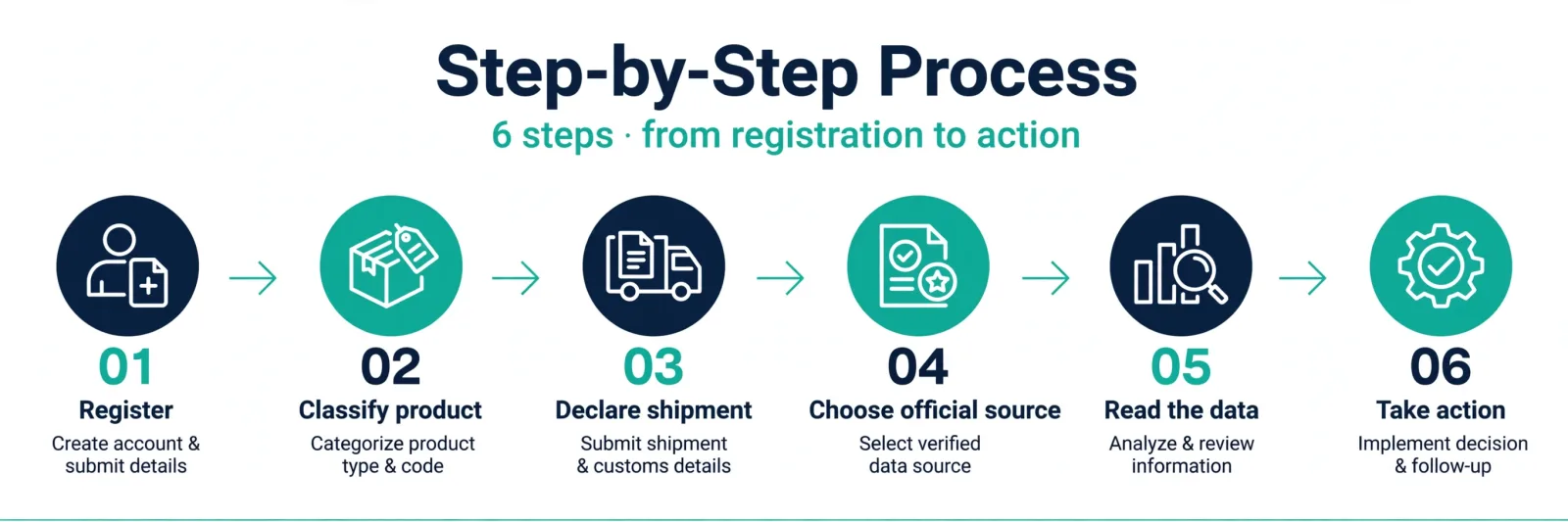
Step 1 – Register correctly before you trade. Registrations must be in place before shipments can be declared properly, starting with the Export Registration Certificate (ERC) issued through CCI&E. Our guide to the ERC export registration certificate (https://exportain.com/blog/erc-export-registration-certificate) explains what it is and why keeping it current matters.
Step 2 – Classify your product correctly. Each shipment is declared under a Harmonized System (HS) code. Trade data is organised by these codes, so a wrong code risks a customs query and places your product in the wrong category in the statistics you later rely on. Describe the product by material, construction, and function, and confirm the code before you declare.
Step 3 – Declare the shipment through customs. Export declarations are processed through Bangladesh Customs systems, including ASYCUDA World, alongside Bangladesh Bank reporting that records the export for foreign-exchange purposes through the EXP procedure. The documents behind the declaration must agree with each other. See our overview of export documents from Bangladesh (https://exportain.com/blog/export-documents-from-bangladesh) for how the core documents fit together.
Step 4 – Choose the right official source. Once declarations are aggregated, different institutions publish different views of the same trade. Use EPB for export performance by commodity and destination, Bangladesh Bank for payments and foreign-exchange reporting, NBR and Bangladesh Customs for tariff lines and classification, BBS for longer-run statistics, and CCI&E for the registration framework.
Step 5 – Read the definitions before the numbers. Note the period covered, the valuation basis where stated, whether quantities are in weight, pieces, or another unit, and which HS revision the table uses. Two exporters can cite the same source and disagree simply because one read a fiscal-year table and the other a calendar-year table.
Step 6 – Turn the finding into one commercial action. Data only pays when it changes a decision, such as selecting one priority market, adjusting a product range toward recorded demand, preparing samples for a market where Bangladesh already trades, or not pursuing a product with no recorded trade in your target market. Record the decision and revisit it at the next release.
Costs, timelines and documents
There is no single fee called a data fee. Separate three kinds of cost. First, official publications from bodies such as EPB, Bangladesh Bank, and BBS are public information products; access arrangements are set by the publishing institution, so always use its official channel. Second, the registrations that allow you to export legally, such as trade licence renewal, chamber membership where applicable, and ERC issuance and renewal through CCI&E, carry official fees set and revised by the authorities. Amounts change and can vary by category, so check the current official fee schedule when you apply rather than relying on a figure in any article, including this one. Third, if you pay a commercial database, consultant, or agent to interpret data for you, that price is a private agreement, not an official charge.
Timelines need the same care. Published statistics always lag the shipments they describe, because declarations must be processed and aggregated before a monthly, quarterly, or annual release can appear. Registration processing also varies with completeness: a correct application with consistent details moves faster than one that must be corrected. Build that lag into your planning, use the most recent release for direction, and never promise a buyer a figure is live to the current week when the series is published in arrears.
The documents that create reliable data, and that buyers and banks rely on, typically include the following, prepared consistently for each shipment as applicable:
Export Registration Certificate (ERC) – Confirms the exporter's registration through CCI&E and underpins legal exporting
Trade licence and chamber membership records – Confirm the business identity behind the exporter name used on declarations
Commercial invoice – States seller, buyer, product description, quantity, and value declared
Packing list – Confirms quantities and packaging that should match the invoice and declaration
Bill of lading or airway bill – Confirms shipment and transport details for the consignment
Certificate of origin, where required – Supports origin claims and any preferential treatment the buyer seeks
EXP-related reporting through the banking channel – Connects the shipment to export proceeds realisation recorded by Bangladesh Bank
If you are preparing to sell internationally, start with how to sell on Exportain (https://exportain.com/how-to-sell), which sets out how a verified seller profile presents your business alongside your formal registrations.
Bangladesh-specific rules and tips
Bangladesh trade data sits inside a specific national system, and a few local points catch out new exporters and foreign buyers alike.
First, know which institution owns which question. CCI&E, under the Ministry of Commerce, is the authority for import and export registration certificates. EPB, also under the Ministry of Commerce, promotes exports and publishes export performance data. Bangladesh Bank regulates the foreign-exchange side of trade and publishes related statistics. NBR oversees customs and taxation, and BBS is the national statistical organisation. Sending a tariff question to a promotion body, or a payments question to a statistics office, wastes weeks.
Second, keep your business identity identical everywhere. The exporter name and address on your trade licence, ERC, bank records, invoices, and Exportain profile should match. Inconsistent spellings create problems in declaration matching, proceeds realisation, and buyer verification.
Third, respect the fiscal-year convention. Much Bangladeshi reporting is organised by fiscal year rather than calendar year. When you compare it with a destination country's calendar-year import statistics, expect a timing difference and say so. Mirror differences between what Bangladesh records as an export and what a partner records as an import are also normal, because of valuation, timing, and routing differences, and do not by themselves prove an error.
Fourth, treat HS classification as a commercial skill, not paperwork. Many Bangladeshi strengths, including apparel, are split by distinctions such as knitted versus woven construction and fibre content. Reading data at heading and subheading level is far more precise than reading broad chapter totals alone.
Fifth, renew before you are asked. Lapsed registration can interrupt declaring and shipping. Diarise renewals for your ERC, trade licence, and any membership your buyers or bank expect, and keep copies together so a due-diligence request can be answered the same day.
Mistakes and red flags
The most damaging mistakes are rarely technical. They are decisions made confidently on numbers that were never checked:
Quoting a figure with no source, period, or product code. If a number cannot be traced to EPB, Bangladesh Bank, NBR, BBS, or another named official publication, do not use it with a buyer.
Mixing periods and units. Comparing a fiscal-year total with a calendar-year total, or kilograms with pieces, produces false growth and false decline.
Reading broad totals instead of your product line. National exports can rise while your specific HS line falls. Decisions belong at product level, not the headline.
Using an unofficial copy without checking the original. Verify any figure you will act on against the publishing institution's release.
Declaring carelessly and then trusting the statistics. Wrong HS codes and mismatched documents distort the record and create compliance risk at the same time.
Treating one buyer enquiry as market proof. One enquiry is an opportunity, not a trend. Check whether wider data supports investing in samples or stock for that market.
Ignoring buyer red flags. A buyer who refuses to discuss specifications, quantities, or destination, or who pressures you to mis-declare value or description, is a risk regardless of the market data. Accurate declaration protects the exporter first.
Checklist
Use this checklist each time you research a market:
I have named the exact product and confirmed its HS classification from material, construction, and function.
I have chosen the source that owns my question: EPB for export performance, Bangladesh Bank for payments and foreign exchange, NBR and Customs for tariff and classification, BBS for long-run statistics, CCI&E for registration.
I have recorded the period, unit, and valuation basis of every figure I plan to use.
I have compared at least two periods instead of relying on a single release.
My ERC, trade licence, and memberships are current, and my business name is identical across all of them.
My invoice, packing list, and declaration details agree for the shipment in question.
I have turned the research into one clear action, such as a priority market or a product adjustment.
My Exportain seller profile is complete, so buyers can verify who they are dealing with.
How Exportain helps
Exportain connects verified Bangladeshi sellers with international buyers actively sourcing from Bangladesh. Data tells you where demand exists; a strong marketplace profile is how that demand finds you. On Exportain you present your products with clear specifications and respond to enquiries with the registrations and documents serious buyers expect.
Start by reviewing how to sell (https://exportain.com/how-to-sell) and compare the seller options on the membership page (https://exportain.com/membership) so your profile fits your export business bangladesh plans, whether you are shipping a first order or supplying several markets. Keep descriptions accurate and HS-relevant details, such as materials and construction, explicit, because buyers filter on exactly those facts.
Become a verified Exportain seller and reach global buyers → https://exportain.com/how-to-sell
FAQs
What should I know first about Bangladesh Export Import Data?
Start with the sources and the definitions. Bangladesh export import data is built from customs declarations and published by EPB, Bangladesh Bank, NBR, BBS, and CCI&E in different forms for different purposes. Before using any figure, confirm the product code, period, unit, and publishing institution. That habit prevents most misreading, including false comparisons between fiscal-year and calendar-year series.
What are the typical costs and timelines?
Access follows the publishing institution's own arrangements, while registrations behind legal exporting, including ERC issuance and renewal through CCI&E and trade licence renewal, carry official fees revised from time to time. Because amounts depend on your category and on application completeness, check the current official schedule when you apply. Published statistics also appear in arrears after declarations are processed, so allow for that lag when you plan research or quote a figure to a buyer.
Which documents are needed?
Keep your ERC, trade licence, and membership records current, and prepare each shipment with a consistent commercial invoice, packing list, transport document such as a bill of lading or airway bill, certificate of origin where required, and banking-channel export reporting connecting the shipment to proceeds realisation. Additional documents depend on the product and destination, so confirm the full set for your HS line before you ship.
What are the most common mistakes?
The most common mistakes are quoting figures without a named official source, mixing fiscal-year and calendar-year data, comparing different units, reading headline totals instead of your own product line, and declaring under the wrong HS code or with inconsistent documents. Checking the source, period, unit, and product code before acting avoids nearly all of these errors.
Sourcing from Bangladesh?
Post a request for quotation and suppliers on Exportain can send you their quotes directly.
Post an RFQ