The Leather & Leather Goods Industry in Bangladesh: Capacity, Clusters and Key Players
EPB data put leather and leather products at USD 1.14 billion in fiscal 2025 and USD 1.23 billion in fiscal 2026. This pillar covers products, the Savar tannery cluster, supplier and tannery checks, MOQ, quality and duties.
Short answer
Bangladesh exports leather, leather goods and leather footwear worth USD 1.14 billion in fiscal 2025 on EPB data, rising to USD 1.23 billion in fiscal 2026, with footwear the largest named segment. Buyers source by fixing leather type and tannery first, because chemical limits and Leather Working Group readiness sit at the tannery, then checking the goods factory against a written specification.
On this page
Key takeaways
EPB data put leather and leather products at USD 1.14 billion in fiscal 2025 and USD 1.23 billion in fiscal 2026, with leather footwear the largest named segment at USD 672.07 million in fiscal 2025.
Bangladesh Bank receipts for leather and leather manufactures were USD 1,197.5 million in 2024-25, a different series from the EPB and shipment figures that must not be added to them.
A May 2026 gap assessment found only three of 20 assessed Savar tanneries scoring above 50 percent on LWG readiness, so the tannery behind the leather must be verified lot by lot.
There is no single typical MOQ, price or lead time in this sector; all three are quoted per supplier, per article, per leather and per colour against a written specification.
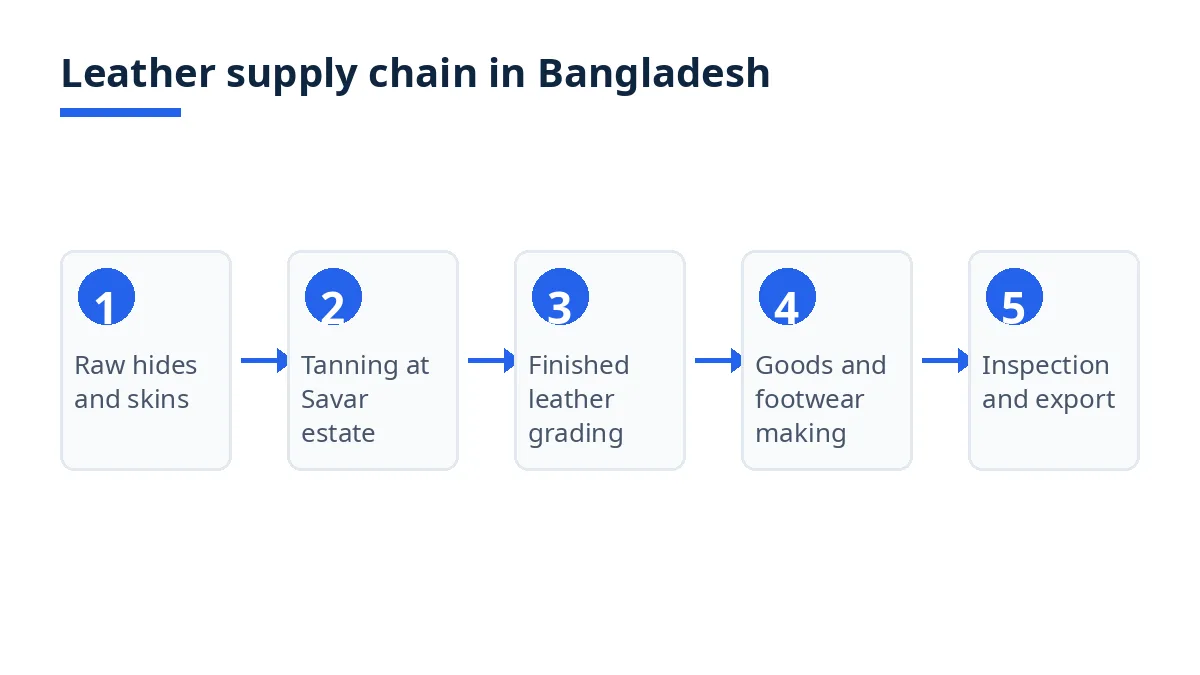
If you buy leather bags, wallets, belts, gloves or leather footwear, Bangladesh offers a full chain in one country: domestic raw hides, a dedicated tannery estate, finished leather, and factories that cut, stitch and finish goods for export. The chain is established, but it is not uniform. The tannery behind your leather decides your chemical and environmental position in the European Union, the United States and the United Kingdom, so this guide treats leather sourcing as two linked purchases: the finished leather, and the goods made from it.
Market overview with latest data
Start with the export figures at the level the Export Promotion Bureau (EPB) reports them. The EPB series covers leather and leather products as one sector line, without a separate monthly line for finished leather, goods and footwear.
On EPB data reported by New Age, export earnings from leather and leather goods rose by 10.19 percent to USD 1.14 billion in fiscal year 2024-25, after USD 1.03 billion in fiscal 2024.1 The same EPB series put the sector at USD 1.17 billion in fiscal 2023, USD 1.24 billion in fiscal 2022 and USD 1.03 billion in fiscal 2021, and leather accounted for approximately 2.36 percent of total export earnings in fiscal 2025.1 Read that history plainly: this sector has moved around the USD 1 billion level for several years rather than growing steadily, so expect capacity and experience, not a rapidly expanding supplier base.
The following year continued the recovery. Provisional EPB data reported by The Financial Express put leather and leather products exports up 7.09 percent in fiscal year 2025-26, reaching USD 1.23 billion, with June 2026 alone up 47.68 percent.2
Inside the fiscal 2025 total, the segment split matters more than the headline. Reporting of the EPB release put leather footwear at USD 672.07 million in fiscal 2025, up 23.54 percent, while leather products excluding footwear recorded USD 344.79 million, down 2.21 percent.3 The segments do not move together: a strong footwear year does not prove that bag capacity grew. Shortlist by segment.
Bangladesh Bank publishes two further series, and each answers a different question. Its annual export receipts publication for 2024-25 records leather and leather manufactures receipts of USD 1,197.5 million, up 9.4 percent, within total export receipts for goods of USD 43,559.3 million.4 Bangladesh Bank records receipts when export proceeds are received through banks, and it states that its figures can differ from customs-based and EPB figures because of differences in valuation, timing and coverage.4 Separately, its shipment table, compiled from National Board of Revenue data, puts leather and leather products at USD 1,145.4 million in 2024-25, revised, and USD 1,236.7 million in 2025-26, provisional, a rise of 8.0 percent.5 The shipment and EPB series sit close together, while receipts sit higher for the same year. Keep the three series separate and never add them together. See Bangladesh export data for how to read EPB releases without mixing series.
Two points sit behind the numbers. First, hides and skins arise from the local livestock sector, but tanning chemicals, hardware, zips and linings are bought in, and imported inputs decide the long pole in the lead time. Second, hide supply is seasonal, with a large share of raw hides collected around Eid-ul-Azha.
Main products and production clusters
The offer groups into four product families. Each uses different machinery, skills and checks, so fix your family first, then look for factories.
Finished leather. Crust and finished bovine, goat and sheep leather sold to goods and footwear makers, specified by animal, substance (thickness), temper, finish, colour, selection grade and the tannery that produced it. The tannery is part of the specification, because the tannery carries the effluent and chemical record your market will test.
Leather goods. Handbags, wallets, purses, card holders, belts, briefcases, travel bags and small accessories, specified by leather type and substance, lining, hardware, edge finishing, stitch density, measurements and packing. Two bags with the same silhouette differ in cost and life because the leather selection, lining and hardware differ.
Leather footwear. Shoes and sandals with leather uppers, specified by upper leather, lining, last, size run, sole type and bonding or stitching method. Footwear is the largest named export segment, at USD 672.07 million in fiscal 2025 on the EPB reporting above.3
Gloves and leather apparel. Work gloves, fashion gloves and leather garments, specified by leather type, cut, lining and size. This family is checked on fit and pair matching as well as on leather quality.
Where the clusters are
Tanning is the concentrated stage. The Leathergoods and Footwear Manufacturers and Exporters Association of Bangladesh (LFMEAB) is the trade body for manufacturers and exporters of leather products, footwear, synthetic and allied products in Bangladesh, and its stated objective is a close and mutually beneficial relationship between local manufacturers and exporters and their buyers.6 Goods and footwear making sits with individual factories, while the tanneries sit in one estate.
The Financial Express recorded that the Ministry of Industries allocated plots to 155 tannery owners through the Bangladesh Small and Cottage Industries Corporation (BSCIC) in the Leather Industrial Park established on 200 acres of land at Savar, after tanneries relocated from Hazaribagh in Dhaka under a Supreme Court order, and that around 115 tanneries had become operational at that time, in early 2019.7 A later workshop report put the position in 2026 as around 140 operational tanneries out of 162 allocated in the Savar Tannery Industrial Estate.8 The two counts are dated snapshots seven years apart, not a single series. Ask whether the tannery named for your leather is operating, and where.
How to read key players
Key players are best read through the sector bodies, not a ranking. LFMEAB covers the goods and footwear makers, the Bangladesh Tanners Association covers the tanneries, and the 2026 gap assessment was organised jointly by the tanners association and the Business Promotion Council.8 This guide names no companies as recommended suppliers, because grades, machinery and order books change by season. A factory that makes a sound wallet from bought-in finished leather has not proved it can control a full-grain handbag programme.
Classification decides the duty line
Classify each product before you negotiate the final price, because the code follows the material and the article type, not the marketing name. In the United Kingdom tariff, the Chapter 42 notes state that the term leather includes chamois, patent, patent laminated and metallised leather, and that heading 4203 covers apparel and clothing accessories including gloves, belts and wrist straps.9
Product family | Indicative heading | What decides the exact line |
|---|---|---|
Finished bovine leather | 4107 | Animal, tanning state, and whether the leather is full grain or split |
Handbags, wallets and cases | 4202 | Article type, and the material of the outer surface |
Leather apparel, gloves and belts | 4203 | Article type, and whether the item is a glove, garment or accessory |
Other articles of leather | 4205 | Use of the article, where no earlier heading covers it |
Footwear with leather uppers | 6403 | Upper material, sole material and footwear type |
Read the table as indicative only. Confirm the full national code in the destination tariff for your exact article and material, because a bag with an outer surface of plastic sheeting sits in a different subheading of 4202 from the same bag in leather.9
How to find and verify suppliers
Start from your specification, not from a supplier list. For goods, the specification states leather animal, type and substance, colour and finish, lining, hardware, edge paint, stitch specification, measurements with tolerances, labelling, packing and the test evidence you require. For finished leather, it states animal, substance, temper, finish, colour, selection grade and the chemical limits your market applies. See how to write an RFQ.
Build a shortlist from the Exportain category directory, LFMEAB membership, trade data and referrals, then run the same verification sequence. LFMEAB membership is the natural first screen for the making stage.6
Identity. Match the legal name, trade licence details and factory address across the supplier documents and its online presence. Resolve any inconsistency in writing before you discuss price.
Producing sites, plural. Record which site tans or supplies the leather, which site cuts and stitches the goods, and which stages are bought in. In this sector the chain has at least two sites by design. An unexplained chain is the problem, not a named bought-in stage.
Tannery position. Ask which tannery produced the leather in your sample, whether that tannery holds a current Leather Working Group audit result, and how its effluent is treated. The 2026 gap assessment reported below shows why this question cannot be skipped.8
Machine and craft capability. For goods, ask which cutting, skiving, splitting, edge-painting and stitching equipment will produce your order. For footwear, ask which lasts, size systems and sole attaching methods the site runs.
Evidence for the exact family. Ask for export history and test reports that name a comparable article, leather type and market. A chemical report for a wallet does not cover a handbag in another leather from another tannery.
Sample in your specification. Order a pre-production sample in your leather, colour and hardware, then check substance, colour against the approved swatch, stitching, edge finish and hardware function. Seal a counter-sample and a leather swatch once approved.
Export readiness. Ask which markets the supplier ships this family to, which documents it prepares as a routine, and its export registration and association position.
Capacity in your window. Ask how much of the line is already booked for your window and what happens if leather delivery or approvals slip.
Independent checks. For larger programmes, use an independent inspection company for a factory audit or a pre-shipment inspection. Use a video walk-through as a first screen only.
Payment discipline. Agree payment terms that match the risk of a new relationship. Confirm bank details through a second channel before paying, and treat any late change of bank details as a reason to pause and re-verify.
Warning signs include a quote far below comparable offers, refusal to name the tannery behind the leather, a sample in a different leather from the one quoted, pressure to pay quickly to a personal account, and certificates naming a different company, site or product.
MOQ, pricing and lead times
Buyers routinely ask for one typical minimum order quantity (MOQ), one typical price and one typical lead time. None of the three exists as a single figure for this sector. Each is quoted per supplier, per article, per leather and per colour.
MOQ is driven by the smallest workable lot at each stage: the tannery lot and selection grade for the leather, dye and finish lots for a colour, hardware and lining lots, and label and carton print runs for private-label goods. A wallet in a running black leather will normally carry a lower minimum than the same wallet in a dyed-to-order colour with your hardware and label. Expect minimums per article, per leather and per colour, not only per order.
Pricing is built from leather, making, lining and hardware, finishing, testing, packing, inland transport and margin, then expressed on the agreed delivery term. Leather is priced and yielded by area, so the cutting yield your pattern achieves is part of the price. Compare quotations only on an identical specification. State substance and selection grade: a cheaper quote at a thinner substance or a lower selection is a different product, not a saving.
Delivery terms decide who pays for which leg, so quotations on different terms are not comparable until you adjust them. Example figures: two suppliers quote for the same handbag, one at USD 18.40 per piece EXW and one at USD 19.10 per piece FOB. Adding inland transport, export handling and loading of USD 0.55 per piece to the EXW quote gives a like-for-like FOB cost of USD 18.95 per piece, so the real gap is USD 0.15 per piece, not USD 0.70. Use the same adjustment with the landed cost for imports from Bangladesh method.
Lead times cover leather tanning or purchase, hardware and lining supply, production, finishing, testing, packing and transport to port, after sample approval. Finished leather availability is the usual long pole: a stock leather in a running colour behaves differently from a dyed-to-order leather that must clear the tannery queue and your chemical approval first. Confirm the leather lot and the production slot in the purchase order.
Quality, certifications and compliance
Leather goods fail in predictable ways: a bag whose colour rubs, whose edges crack, or whose hardware tarnishes; a shoe whose upper splits at the flex point; a batch whose chromium VI result blocks the market. A quality plan names each risk and its check, and attaches the specification to the purchase order so the standard becomes part of the contract.
Specify measurable quality. For leather, define animal, substance with tolerance, colourfastness to rubbing, flex endurance and tear strength where your product needs them. For goods, define stitch density, edge finish, hardware function and measurements. Words such as soft or premium cannot be inspected. Numbers, a test method and an approved swatch can.
Tannery audit: read the scope. The Leather Working Group (LWG) audit standard, first launched in 2005, is an international certification standard for environmentally and socially accountable leather manufacturing, covering 17 sections including water and energy usage, chemical management, and waste management and effluent treatment.10 Ratings run at 85 percent for Gold, 75 percent for Silver, 65 percent for Bronze and 50 percent for Audited, a manufacturer must reach the rating in every category or it is certified at its lowest category, and certification is valid for 24 months for leather manufacturing facilities.10 LWG audits a site, not a company or a hide, and the quality of the final effluent is assessed as part of the audit, so the efficiency of a common effluent treatment plant (CETP) can affect the score of a tannery that uses it, while CETPs themselves are not audited.10 Check that the site that made your leather is the site on the certificate.
The Savar position, stated as the source states it. A gap assessment of 20 tanneries in the Savar Tannery Industrial Estate, presented at a May 2026 workshop organised by the Bangladesh Tanners Association and the Business Promotion Council and reported by The Business Standard, found that only three tanneries scored above 50 percent against LWG protocol readiness, with the highest at 51 percent, and six others above 40 percent.8 The same report flagged the CETP in Savar as only partially functional, noted that 300 of the 1,710 total LWG points relate to CETP and waste management, and recorded that only eight Bangladeshi institutions had so far secured LWG certification.8 It also recorded that most Savar tanneries cannot directly export to European and United States markets for lack of certification and instead sell raw leather to China at lower prices.8 Verify your own tannery and lot, because estate averages settle nothing about your shipment.
Chemical limits are law in the destination market. Guidance on the assimilated REACH regulation states that leather articles coming into contact with the skin must not be placed on the market where they contain chromium VI in concentrations equal to or greater than 3 mg/kg of the total dry weight of the leather.11 The same guidance states that azo dyes which may release listed aromatic amines above 30 mg/kg must not be used in articles that may come into direct and prolonged contact with the skin, including handbags, purses, wallets and briefcases, and that leather products containing dimethyl fumarate above 0.1 mg/kg must not be placed on the market.11 The importer is treated in law as the producer and is expected to have tested the products or to hold supplier test evidence.11 LWG applies the same threshold at the tannery: for Gold and Silver certification, chromium VI must be below 3 mg/kg, and any level above 3 mg/kg is an automatic failure, while certification does not guarantee that no restricted substance failure will occur in a final product.10 Test the finished article from your production lot, not only the tannery sample.
Product certification: check the finished good. Where a buyer requires OEKO-TEX LEATHER STANDARD, the Hohenstein guidance states that certification means a product, material, accessory or other leather good has been tested for substances that could harm human health, that a finished-good claim requires the product and each of its components to be tested, and that a claim covering only an ingredient, such as the suede in a product, is not allowed.12 The same guidance states that the standard is not an eco or sustainability claim, that a certificate is valid for 12 months and renewed annually with testing, and that finished goods need their own certification even where every component is already certified.12 Ask the supplier to submit the valid certificate itself, because a label alone is not sufficient proof for a business buyer.12
Social compliance is buyer-specific. State your audit requirement at enquiry stage, ask which audits the tannery and the goods factory have passed and when, and do not treat a product certificate as evidence of factory social compliance.
Test at the right stages. Approve the leather swatch and the pre-production sample, test the bulk leather lot before cutting, then inspect before shipment against the sealed counter-sample. Agree the sampling method in the order. ISO 2859-1:2026 defines a system of acceptance sampling plans for inspection by attributes, indexed by acceptance quality limit (AQL), for lot-by-lot inspection, and the AQL is the maximum average percentage of defective items considered acceptable during random sampling.13 See AQL acceptance quality limit and pre-shipment inspection.
Shipping, Incoterms and duties
Leather goods ship mainly in cartons by sea, with samples and small accessory orders by air. Bags lose shape if cartons are over-compressed, so agree pieces per carton, carton dimensions, gross weights and any shape protection, such as stuffing or dust bags, before the price is fixed, because carton volume decides the freight basis.
Duties and market access must be checked, not assumed. Duty depends on the HS classification, your destination tariff and any preferential scheme that applies to Bangladesh at the time of import. For the European Union, the Access2Markets guidance describes Everything But Arms (EBA) as a special arrangement for least developed countries, granting full duty-free and quota-free access to the EU Single Market for all products except arms and ammunition.14 That preference depends on origin rules and on the scheme in force at shipment, so confirm eligibility with your broker before you price the order. A duty-free position in one market proves nothing in another.
Choose the delivery term deliberately. Under EXW, you arrange and pay for almost everything from the factory gate. Under FOB, the supplier delivers the goods on board the vessel at the named Bangladeshi port and you control the main freight. Under CIF, the supplier arranges and pays freight and minimum insurance to your destination port, while risk still passes when the goods are loaded. Under DAP, the goods are brought to a named place in your country without import clearance, and under DDP, duties and clearance sit with the seller as well. The Incoterms rules published by the International Chamber of Commerce are eleven three-letter trade terms that clarify the tasks, costs and risks involved in delivering goods from sellers to buyers.15 Incoterms 2020, the current version, entered into force on 1 January 2020.15 Read Incoterms for shipments from Bangladesh.
Documents decide whether goods move. Bangladesh Customs requires an export declaration, known as a Bill of Export or Shipping Bill, to be submitted and approved before goods are loaded for export, with documents enclosed that include the export letter of credit or, where there is none, the export contract or purchase order, a commercial invoice with a detailed description of the goods, a packing list, an EXP form certified by an authorised dealer bank, a certificate of origin issued by the EPB or a chamber of commerce, a VAT registration certificate and a taxpayer identification number.16 Check article names, HS codes, quantities, carton counts and weights across every document as soon as drafts arrive.
Step-by-step buying process
Define the range. Fix product families, leather animal, type and substance, colours, hardware, labelling, packing and destination.
Research the market. Check current EPB and Bangladesh Bank data, and record which series each figure came from.
Classify each article. Confirm the indicative heading by material and article type, then the full national code in your destination tariff.
Shortlist and check suppliers. Run the identity, producing-site, tannery position, capability and evidence checks in this guide.
Request comparable quotations. Send the identical specification to each supplier, and require delivery term, currency, validity, MOQ and lead time.
Sample and test. Approve samples and swatches in your leather and colour, test the leather lot, and seal a counter-sample.
Agree the contract. Issue a purchase order with the full specification, tolerances, label wording, chemical limits, test and document list, inspection rights, payment terms and delivery term.
Control production. Confirm leather lot approval and the production slot, and resolve any substitution in writing before it happens.
Inspect before shipment. Commission an independent inspection against the sealed sample across colours and sizes, and release shipment only on a pass or an agreed corrective action.
Ship, clear and review. Check document drafts early, clear customs with your broker, then review the delivered goods against the counter-sample.
Related guides
Use Bangladesh export data to read the next EPB release for this sector, and finding suppliers in Bangladesh to widen the long list before you narrow it with the checks in this guide.
FAQs
Is Bangladesh a good place to source leather & leather goods?
It can be, when the article, the leather and the tannery are matched. EPB data put the sector at USD 1.14 billion in fiscal 2025 and USD 1.23 billion in fiscal 2026, with leather footwear the largest named segment at USD 672.07 million in fiscal 2025.1 2 3 The counterweight is tannery readiness: a May 2026 gap assessment found only three of 20 assessed Savar tanneries scoring above 50 percent on LWG protocol readiness, so verify the tannery and test the lot rather than buying on the sector headline alone.8
What is the typical MOQ?
There is no single typical MOQ for this sector. Minimums are set by the leather lot and selection grade, by dye and finish lots for a colour, by hardware and lining lots, and by label and carton print runs, and are normally quoted per article, per leather and per colour. Ask each supplier to state its MOQ against your exact specification.
How long is the lead time?
Lead time is article- and input-specific. It covers leather tanning or purchase, hardware and lining supply, production, finishing, testing, packing and transport to the port, after sample approval. A dyed-to-order leather lot and imported hardware are the usual constraints. Require a written lead time for your article and delivery month.
Which certifications matter?
It depends on your market and your product. For skin-contact leather articles, the chromium VI limit of 3 mg/kg of dry leather weight is a market-access rule in the REACH guidance, alongside the azo dye and dimethyl fumarate limits.11 At the tannery, an LWG audit covers 17 sections with medal thresholds from 50 percent for Audited to 85 percent for Gold, and certification is valid for 24 months.10 An OEKO-TEX LEATHER STANDARD certificate covers a finished good only when the product and each component are tested, and it is valid for 12 months.12 Check the holder, site, articles covered and expiry date on every certificate.
Next steps on Exportain
Start with how to import from Bangladesh, then browse suppliers and use trade intelligence to track the sector figures before you post a request for quotation.
Sources
- Leather, leather-goods exports see 10pc growth. New Age (accessed )
- June exports surge by 25.91pc, FY26 earnings hold steady at $48b: EPB. The Financial Express, (accessed )
- Bangladesh's export earnings stood at $48.28b in FY25. BizBD Review (accessed )
- Annual Export Receipts of Goods and Services 2024-25. Bangladesh Bank (accessed )
- Annual export shipment data by commodity, Bangladesh Bank (source: National Board of Revenue). Bangladesh Bank (accessed )
- President's Message - LFMEAB. Leathergoods and Footwear Manufacturers and Exporters Association of Bangladesh (LFMEAB) (accessed )
- Environmental woes weigh on country's leather export. The Financial Express, (accessed )
- Poor compliance in Savar tanneries forcing leather industry out of global markets. The Business Standard, (accessed )
- UK Integrated Online Tariff: subheading 420212 and Chapter 42 notes. GOV.UK (accessed )
- Certification - Leather Working Group. Leather Working Group (accessed )
- Leather goods | Business Companion. Business Companion (accessed )
- OEKO-TEX LEATHER STANDARD FAQ. Hohenstein (accessed )
- ISO 2859-1:2026 - Sampling procedures for inspection by attributes — Part 1: Sampling schemes indexed by acceptance quality limit (AQL) for lot-by-lot inspection. ISO (accessed )
- Trade arrangements. European Commission, Access2Markets (accessed )
- Incoterms® rules. International Chamber of Commerce (ICC) (accessed )
- Customs Clearance Procedures for Export. Bangladesh Customs, National Board of Revenue (accessed )
- Bangladesh Export Data
- Category Pillars
- Supplier Sourcing
- Leather goods
- Leather footwear
- Finished leather
About the author
Sourcing from Bangladesh?
Post a request for quotation and suppliers on Exportain can send you their quotes directly.
Post an RFQ