Top Kids' Shoes Manufacturers in Bangladesh: How to Find and Verify Them
Find a kids shoes manufacturer in Bangladesh by specifying sizes in millimetres, chemical limits and fastening checks first, then checking size charts, laboratory reports and fit samples across the full size range.
Short answer
To find and check a kids shoes manufacturer in Bangladesh, specify foot length in millimetres for every size, the chemical limits for the destination market, and the fastening and small-parts checks for the age group. Then compare manufacturers on children's models already made, size charts built from foot measurements, and laboratory reports naming each material and colour. Approve fit samples across the size range before bulk.
On this page
Key takeaways
Specify foot length in millimetres for every size, from the manufacturer's own chart for the last in use; generic conversion charts do not convert exactly.
Allow about a thumb's width, about 1.3 cm, between the longest toe and the shoe tip, and check fit on the smallest, middle and largest sizes.
Chromium VI in leather touching skin must stay below 3 mg/kg under REACH, and US children's products must meet the 100 ppm lead and 0.1 percent phthalate limits.
Products for children under 3 must not contain or liberate small parts after use and abuse testing; age grading decides which rule applies.
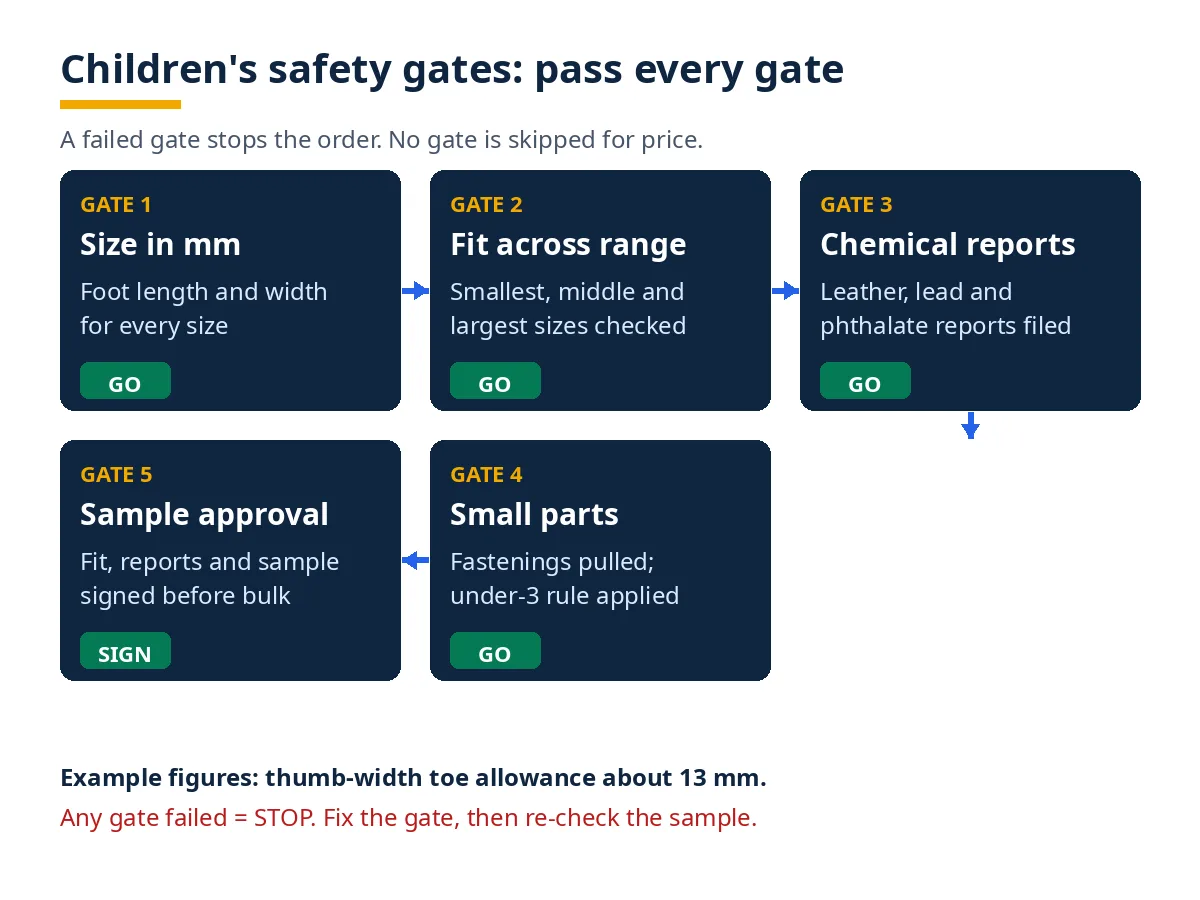
Approve the fit samples, the chemical reports and the pre-production sample in writing before bulk starts, and before any deposit.
A child's shoe is not a small adult shoe. Feet are still growing, the child cannot always say where a shoe pinches, and the rules that govern what may touch a child's skin are stricter than the rules for adult footwear. A buyer who starts with price or a catalogue page will miss the checks that decide whether a children's shoe can be sold in the destination market at all. This guide starts with those checks: sizing and fit, chemical limits, small parts and fastenings, and materials. Only then does it turn to finding and checking a manufacturer in Bangladesh.
Why do children's shoes need a different check from adult shoes?
Children's feet grow fast. Retail fit guidance states that toddlers may need a new shoe size every two to three months, pre-school children every three to four months, and school-aged children every four to six months.1 Size curves need more sizes at the small end, reorders need shorter intervals, and a single fit sample proves far less than it does for an adult shoe.
The second difference is who wears the shoe. A child may chew a strap or pull at a charm. The buyer checks the shoe as a child will use it.
How do sizing systems differ, and what should the order specify?
Shoe sizes do not convert cleanly between systems. The European and American systems use different units, Europe a centimetre-based system of Paris points and the United States barleycorns, so the same foot length takes a different size number in each system.2 A conversion chart is an approximation. The order must specify foot length in millimetres as the controlling measurement.
The controlling system is Mondopoint. ISO 9407:2019 specifies Mondopoint sizing based on defined measurements of the foot the footwear is intended to fit, in millimetres of foot length and, where required, width, and it applies to all types of footwear.2 Put the Mondopoint length and width for every size in the order. Then add local size numbers as a second column, taken from the manufacturer's own chart for that last, not from a generic chart.
How is fit checked on a child's foot?
Fit is checked standing, on both feet, with the socks the child will wear. Place the foot on a chart while standing, heel lined up with the heel mark, and measure heel to longest toe, plus width at the widest part of the outline.1 Measure both feet and buy for the larger foot.
The growth allowance is about a thumb's width, about half an inch or 1.3 cm, between the end of the child's longest toe and the tip of the shoe.1 More than that is not safer: a shoe bought two sizes large will slip at the heel and trip the child. Width matters as much as length. If the length fits and the width does not, change the width fitting, not the length. Ask which width fittings the manufacturer offers, and require fit samples in the narrowest and widest fittings you will sell.
Which chemical limits apply to children's shoes?
Two markets set the limits a buyer must meet. In the European Union, chromium VI is restricted to less than 3 mg/kg in leather articles that come into contact with the skin, under REACH Regulation Annex XVII entry 47, with detection by EN ISO 17075 parts 1 and 2.3 Chromium VI can form when chromium III in tanning salts oxidises, and it is a known skin irritant.3 Ask for the report on the production leather, by colour.
Phthalates need a separate check. Several ortho-phthalates, including DEHP, DBP, DIBP and BBP, are classified as toxic to reproduction and restricted in products including footwear.4 The European Chemicals Agency notes they have been restricted since July 2020 in products including footwear, and that young children are among the groups most exposed to their effects.4 Phthalates are plasticisers that are not chemically bound in the material, so they can leach out or evaporate.4 Ask for a phthalate report on every plasticised part: sole, PVC upper or trim, printed areas and coated fabrics.
In the United States, children's products must meet lead and phthalate limits set out by the Consumer Product Safety Commission. Total lead must not exceed 100 ppm in any accessible component part, lead in paint and similar coatings must not exceed 90 ppm, and regulated phthalates must not exceed 0.1 percent in any accessible plasticised component part of children's toys and child care articles.5 Products must be tested by a third-party, CPSC-accepted laboratory, and the importer must generate a Children's Product Certificate.5 Ask which laboratory will test the production shoe and whether the certificate names your exact model and colour range.
Check | Market rule | Limit the buyer writes into the order |
|---|---|---|
Chromium VI in leather touching skin | REACH Annex XVII entry 47 | Less than 3 mg/kg, EN ISO 17075 parts 1 and 2 |
Phthalates in plasticised parts, EU | REACH restrictions on DEHP, DBP, DIBP and BBP in footwear | Report naming each phthalate and each part tested |
Total lead, accessible parts, US | CPSIA / CPSC | No more than 100 ppm in any accessible component part |
Lead in paint and coatings, US | CPSIA / CPSC | No more than 90 ppm |
Phthalates, US children's toys and child care articles | CPSC, 16 CFR 1307 | No more than 0.1 percent in any accessible plasticised part |
What small-parts and fastening checks does a child's shoe need?
Products intended for children under 3 years of age must not contain small parts or liberate small parts after use and abuse testing.5 That rule decides how charms, decorative studs, rivets, eyelets and detachable parts are treated on shoes for the youngest age group. A part that stays fixed on a table sample may detach when a child pulls it or bends the shoe repeatedly, so the check is done after use and abuse testing. Do not grade a shoe for children aged 3 and over to avoid the under-3 rule if it is made, sized and marketed for younger children.
Fastenings need their own checks. Laces, hook-and-loop straps, buckles and elastic inserts must stay fastened during normal wear and must not create a loop or loose end a child can pull free. Test every fastening on the sample: pull each strap and lace end, open and close each fastening repeatedly, and record any stitching that loosens or buckle that opens under a light pull. Ask where each cord runs, how each end is finished, and what stops it pulling through.
Which materials suit children's shoes, and what must be stated in writing?
Material choice is a specification decision, not a marketing claim. The order should name the upper, lining, insole, sole compound and every coating or print, each by specification. "Good quality leather" is not a specification. The leather type, tannage, thickness and finish are. A chemical report belongs to a named material in a named colour. Change the material or colour, and the report no longer covers the shoe.
Two material questions belong in every children's order. First, what touches the skin. Linings, insoles, straps and collars touch skin directly, so they carry the strictest chemical checks and the clearest material names. Second, how the shoe bends during wear. Ask the manufacturer to state sole flexibility in the specification, and check it on the fit sample by bending the shoe at the ball of the foot.
How do you find manufacturers in Bangladesh?
Start from the product, not from a company list. Write the specification first: age range, size range in millimetres, width fittings, materials by name, chemical limits, fastening types and packaging. Then search for manufacturers that already make children's footwear in that construction and material. A manufacturer that makes adult leather shoes well may never have made a children's shoe, and the size grading, fastening work and chemical file are different skills.
Bangladesh has a large footwear sector, and the footwear industry guide sets out its scale and structure. A shortlist is three to five manufacturers whose children's models, size ranges and material files match your specification closely enough that a sample round can start. Ask each one for the same information: children's models made, size range in millimetres, width fittings, materials, laboratories used, and age grading.
How do you check a manufacturer before a bulk order?
Check the manufacturer in the same order as the children's checks: sizing, chemicals, small parts, then commercial terms. Ask for the size chart for the last your model will use, with foot length in millimetres for every size, and ask how the chart was built. A chart built from a generic conversion is a warning sign. Ask for chemical reports on children's products already made, naming laboratory, method and material. Ask for the small-parts and fastening procedure. Ask for a sample plan: fit sample, chemical sample from production materials, and pre-production sample in the full size range, each approved in writing before the next stage starts.
The commercial check follows the technical check. Ask for an itemised quotation: unit price, tooling or mould charges shown separately, minimum order quantity, size curve, lead time, named delivery term, payment terms and validity period. Ask which parts the manufacturer makes itself and which it buys in, because bought-in components carry their own chemical files. The finished leather manufacturer guide helps when the upper is leather, and the inspection points from the inspection checklist for safety shoes transfer to children's shoes, with the children's chemical and fastening checks added.
Exportain badges do not replace this check. Exportain is a business-to-business marketplace where buyers search supplier profiles, post RFQs and compare quotations, and badges on profiles reflect a review of documents and photographs, not an inspection of a factory.6 A badge is not a guarantee of capacity, quality or delivery, and membership never grants a badge.6 Staff review submissions covering identity, business registration, export registration, and photos of a factory or office.7 The sizing chart, chemical reports and fastening checks are the buyer's own work, done before paying a deposit.
Worked example: a size run that catches the error early
Example figures. A buyer orders 3,000 pairs of children's canvas shoes for ages 4 to 7, foot lengths 155 mm to 195 mm, two width fittings. The manufacturer sends one fit sample in the middle size, with a generic conversion chart and no width fitting stated. The buyer asks instead for three samples, smallest, middle and largest, each in both width fittings, with foot length marked on each. The smallest size arrives with a toe allowance of 4 mm, below the thumb-width allowance of about 13 mm, and the widest fitting is missing. The largest size arrives with a heel that slips. The manufacturer re-grades the last, adds the missing width fitting, and resubmits. The second round passes on all three sizes.
The cost of that round is one extra sample shipment and two weeks. The cost of approving the single middle sample would have been 3,000 pairs in which the smallest size pinched and the largest size slipped. Order the size run, record the measurements, and keep the approved samples as the standard for bulk inspection.
Next steps on Exportain
Write the children's specification before you contact any manufacturer: age range, foot lengths in millimetres, width fittings, materials by name, chemical limits and fastening types. Browse suppliers for children's footwear makers, read the footwear industry guide for the sector structure, and post the specification with the size run and the chemical file included through requests for quotation. Compare the replies on the same size range and the same chemical reports, not on a headline price, and approve the fit samples, the reports and the pre-production sample in writing before bulk starts.
Sources
- Kids Shoe Fit Guide | How to measure kids' feet. Primark, (accessed )
- ISO 9407:2019—Footwear Sizing. ANSI, (accessed )
- Chromium VI in leather. SATRA (accessed )
- Phthalates. European Chemicals Agency (accessed )
- Business Guidance FAQ. U.S. Consumer Product Safety Commission (accessed )
- About Exportain. Exportain (accessed )
- Supplier verification: Earn trust badges buyers can see. Exportain (accessed )
About the author
Sourcing from Bangladesh?
Post a request for quotation and suppliers on Exportain can send you their quotes directly.
Post an RFQ