Safety Shoes Exporters in Bangladesh: Verified Supplier Checklist
Check a safety shoes exporter in Bangladesh on paper first: the ERC, BIN and export file, test reports and certificates naming one model and factory, and the shipment record that separates a trading exporter from its factory.
Short answer
To check a safety shoes exporter in Bangladesh, match the legal name on the ERC, trade licence, TIN and BIN papers, then match the test report, certificate and datasheet to one model, one factory and one protection code. Ask for shipment papers in the same name, and require the exporter to name the factory that will make your model. Do not pay a deposit until the whole file agrees.
On this page
Key takeaways
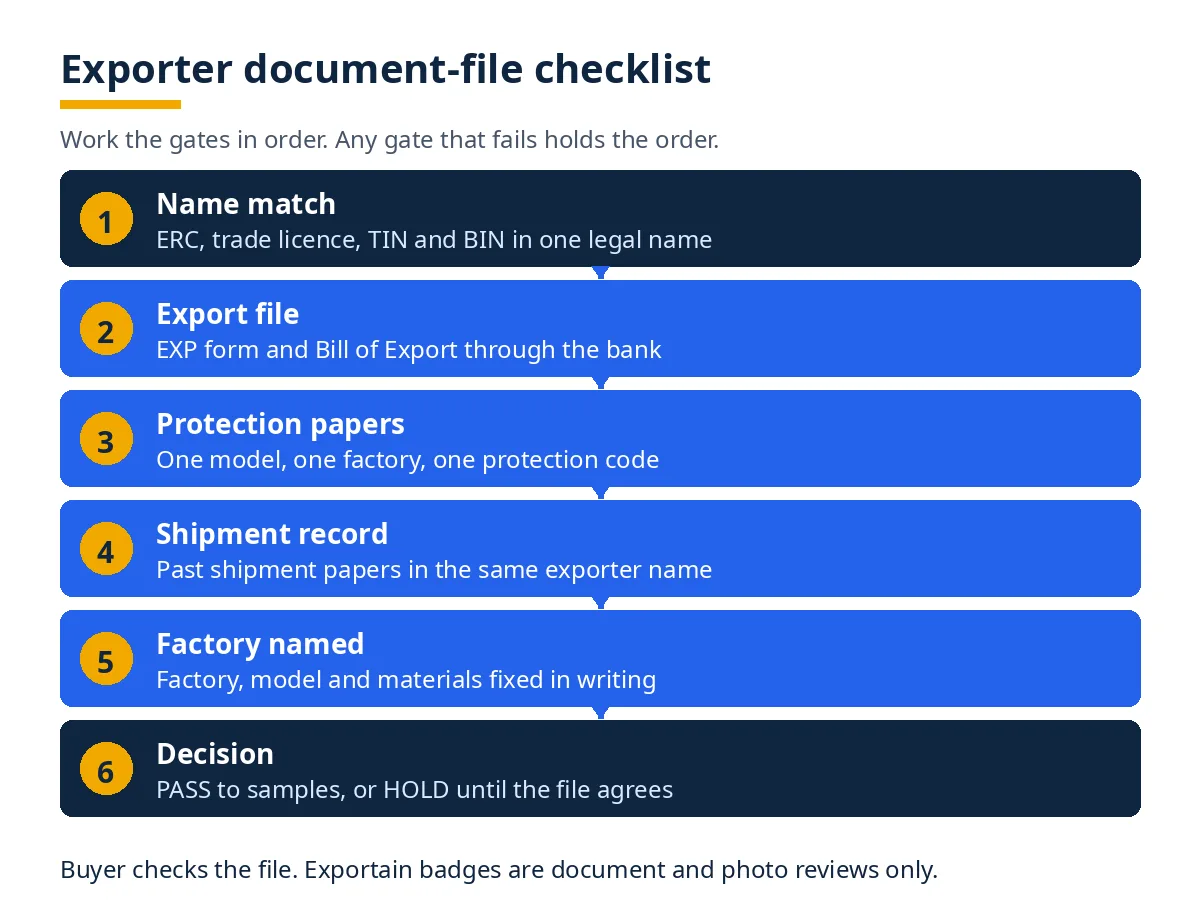
The ERC, trade licence, TIN and BIN papers must carry one legal name, and that name must match the quotation and invoice name exactly.
The test report, certificate and datasheet must name the same model, the same factory and the same protection code, including the edition of the standard.
An EXP form and a Bill of Export in the same exporter name prove a shipment moved through a bank and customs; a logo list proves nothing.
A trading exporter must name its factory in writing and fix that factory for the order; a refusal to name the factory ends the check.
Exportain badges are document and photo reviews, not factory inspections, and never a guarantee of capacity, quality or delivery.
A safety shoe order can fail on paper long before a pair reaches a warehouse. The label may carry the right code and the quotation may look complete, yet the export documents, test reports and shipment record may point at three different businesses, models or factories. This checklist is for a buyer checking an exporter in Bangladesh, not for a buyer touring a factory floor. It covers the export file, the protection papers and the shipment record, and ends with the question that separates a trading exporter from the factory behind it. The buyer does the verifying at every step.
Exporter or factory: settle who you are checking first
Write down who will invoice you, who will ship the goods, and who made the shoes. Those three names are often different, and each one needs its own paper. An exporter sells goods abroad in its own name. A factory makes them. A trading exporter buys from a factory and exports under its own name. None of those roles is wrong on its own. The problem is a file that treats them as one name when the documents show two or three.
Ask the exporter to state its role in writing before you discuss price. A factory exporter should name its own production site and show papers in the same legal name as the quotation. A trading exporter should name the factory, state whether it is fixed for the whole order, and explain who holds the test reports and the conformity file.
What belongs in the export file?
The export file shows that the exporter is allowed to export, is registered for tax, and can move a shipment through a bank and customs. In Bangladesh the central paper is the Export Registration Certificate (ERC), issued by the Office of the Chief Controller of Imports and Exports (CCI&E) under the Ministry of Commerce.1 The ERC is the starting point for a legal exporter, and banks require a valid ERC before opening a letter of credit.1 Registration sits under the Importers, Exporters and Indentors (Registration) Order, and a 2023 Order replaced the 1981 order, covering eligibility, issue, validity, renewal, suspension and cancellation.2
The file has five parts: the ERC, showing the legal name, number and validity period; the trade licence for the current year, in the same name; the Taxpayer Identification Number (TIN) certificate; the VAT registration certificate showing the Business Identification Number (BIN), where the business is VAT registered; and membership of a recognised chamber or trade association, matching the company name and product sector.1 A logo, a website printout or a business card is not part of the export file.
Paper | What it must show | Check the buyer makes |
|---|---|---|
Export Registration Certificate | Legal name, ERC number, validity period | Name matches the quotation and invoice name exactly |
Trade licence | Current year, registered address | Address matches the ERC and bank papers |
TIN certificate | Taxpayer name and number | Name matches the ERC name, not a sister company |
VAT registration / BIN | BIN and registered name | BIN used in the same name on the export papers |
Chamber or association membership | Member name and sector | Name and sector match the exporter and the product |
How do you read an ERC and a BIN without taking a scan at face value?
A scan proves that a document once existed. It does not prove that it is current or that it belongs to the business quoting you. Check the legal name character by character against the quotation, the proforma invoice and the company bank account name. A trading name, a brand name or a shortened name is not the same as a legal name. Check the validity dates. ERC renewal can now cover one to five years in one transaction, and the portal guidance recommends applying at least 60 days before expiry.1 A certificate that expired last month is not cured by a promise that renewal is in hand. Ask for the renewed certificate.
Check the BIN the same way. VAT registration and a BIN are part of normal business operations including banking, export and import, and the registered entity and BIN details should match the trade and bank documents.2 If the BIN belongs to a different legal entity from the ERC, ask which entity is exporting and which is invoicing, and require the answer in writing before you pay anything. Also ask which authorised dealer bank branch the exporter nominates, and whether it holds a General ERC or an Indenting ERC, which covers an agent that arranges deals without directly handling goods.1
How do test reports and certificates prove one shoe?
A protection code sells the shoe, but the code stands or falls on the papers that support it. For the European market the current standard is EN ISO 20345:2022, which sets the minimum requirements for safety footwear, including a toe cap tested to 200 joules of impact and 15 kN of compression.3 Each code adds to the one below: SB gives basic toe protection; S1 closes the heel and adds antistatic behaviour plus heel energy absorption; S1P adds puncture resistance; S2 adds a water-resistant upper; S3 combines the insert with a cleated outsole.3 The 2022 insert codes are P (metal), PL (non-metallic, 4.5 mm nail) and PS (non-metallic, 3 mm nail), and SR marks extra slip resistance.3
For the United States the performance standard is ASTM F2413, with test methods in ASTM F2412, and OSHA recognises ASTM F2413 as the applicable standard for safety footwear in United States workplaces.4 Label codes include I/75 (75 foot-pounds impact), C/75 (2,500 pounds compression), EH, Mt, PR, SD and Cd.4
Match three documents line by line: the test report, the certificate or declaration, and the product datasheet or quotation. All three must agree on model, factory and protection code, including the edition of the standard. If they name different models, factories or codes, the papers describe different shoes. Ask for the test report on the production materials and the production model, not on a reference sample. For leather that touches the skin, REACH entry 47 caps chromium VI at under 3 mg/kg, using the EN ISO 17075 test methods in parts 1 and 2.5 Ask for that report on the leather in your order, by colour.
In EU law, safety footwear falls under Regulation (EU) 2016/425 on personal protective equipment. EU type-examination is required for Categories II and III, with notified-body supervision of production added for Category III.6 The manufacturer must keep the technical documentation and declaration of conformity for ten years after the PPE is placed on the market.6 Find out who is named as certificate holder, which notified body issued the certificate, and whether the named model is the model in your order.
What do shipment and reference checks prove?
A past shipment proves that an exporter has moved goods through a bank and customs before. Every lawful export also needs an EXP form declared through an authorised dealer bank and a customs Bill of Export, and full export proceeds must normally be repatriated within four months of shipment.2 Ask the exporter to describe that sequence, and ask for three shipment references from the last two years: destination country, product, quantity range and year. Then ask for the proof behind one of them: a Bill of Export or a bill of lading with commercial details removed, showing the exporter name, product description and date.
Ask a buyer reference three questions only: what model was supplied, whether the delivered shoes matched the approved sample and the test report, and whether the documents arrived complete and on time. Do not accept a list of company logos as a reference check.
How do you separate a trading exporter from the factory behind it?
Use four questions, and record the answers in writing. First, who owns the factory that will make this model, and what is its legal name and address. Second, who holds the EU type-examination certificate or the ASTM test evidence, the exporter or the factory, and in whose name is it issued. Third, who signs the pre-production sample, and where is the signed sample kept so an inspector can reach it. Fourth, what happens if the factory substitutes a material: who tells you, who issues the new test report, and who stops bulk production until the substitution is approved.
A factory exporter answers all four from its own records. A trading exporter answers them by naming the factory and showing the factory's papers, with a written agreement that the factory, model and materials are fixed for your order. Either answer can support an order. A refusal to name the factory, a certificate in a third company's name with no explanation, or a claim that the factory name is confidential cannot.
Worked example: two files, one passes and one does not
Example figures. Two exporters quote for the same S3 shoe under EN ISO 20345:2022, 2,000 pairs, one size curve, same named delivery basis. Exporter A sends an ERC in the same legal name as the quotation, valid for two more years, a current trade licence, a TIN and a BIN in the same name, and a chamber membership naming footwear. Its test report, EU type-examination certificate and datasheet all name model A-214, the same factory and S3 under the 2022 edition. It names the factory, states that the factory is fixed for the order, and shows one past Bill of Export in the same name for safety footwear shipped the previous year. The file passes to the sample stage.
Exporter B sends an ERC in a different name from the quotation, explains the difference only by telephone, and sends a test report for model B-90 while the certificate names model B-91. It will not name the factory, saying the source is confidential. The price is lower. The file does not pass. The buyer asks for the ERC name explained in writing, a test report and a certificate naming one model, and the factory named in the order. Until those three items arrive, no sample fee and no deposit is paid. The lower price is not a saving. It is the price of a file that cannot be checked.
Red flags that end the check
Stop the check, and do not pay a deposit, when any of these appear: the ERC name and quotation name differ with no written explanation; the certificate or test report names a different model, factory or protection code; the exporter will not name the factory; a certificate cannot be checked with the issuing body; or full payment is demanded before a sample is approved. Do not accept a claim that an Exportain badge proves a factory was inspected. Exportain badges are document and photo reviews, not factory inspections, and a badge is not a guarantee of capacity, quality or delivery.7 Verification checks cover identity, business registration, export registration and factory or office photos, reviewed by Exportain staff.8 That review helps you read a profile. It does not replace your own check of the export file, the protection papers and the shipment record.
Next steps on Exportain
Work the file in the order this checklist uses it: export papers first, protection papers second, shipment record third, and the factory question last. Browse suppliers and read each profile against the name on its ERC, compare the protection codes in the safety shoes manufacturer guide, and check the inspection points in the safety shoes quality control checklist before you approve a sample. When the file is complete, post the requirement through requests for quotation, and confirm the classification with the HS code guide for safety shoes and a customs broker. The price guide helps you read a quotation once the papers match.
Sources
- Export Registration Certificate (ERC) In Bangladesh: How To Apply. Bizmend, (accessed )
- Export Law Bangladesh 2026: Critical Rules for Exporters. TRW (accessed )
- Work Boots by Safety Rating S1-S7 | EN ISO 20345. Tuffshop (accessed )
- Get to know OSHA and ASTM footwear standards. HexArmor (accessed )
- Chromium VI in leather. SATRA (accessed )
- Applying the CE PPE Regulation (EU) 2016/425. easyCE (accessed )
- About Exportain. Exportain (accessed )
- Supplier verification: Earn trust badges buyers can see. Exportain (accessed )
About the author
Sourcing from Bangladesh?
Post a request for quotation and suppliers on Exportain can send you their quotes directly.
Post an RFQ