Safety Shoes Price in Bangladesh: Reading Quotations
How to read a safety shoe quotation from Bangladesh line by line: what the protection set, materials, testing file, size curve, packing, freight, and duty add to the price, and how to compare two quotations for the same shoe on one delivery term.
Short answer
A safety shoe price from Bangladesh is a structure, not a single figure: the protection category and optional markings decide the upper, cap, insert, sole, and lining; the conformity and testing file adds examination, laboratory, and renewal lines; quantity, size curve, packing, freight, insurance, and duty add the rest. Compare quotations only after fixing one specification, one size curve, and one delivery term, and after adding every separate line into one comparable total.
On this page
Key takeaways
A category marking is a package of tested properties for one finished model: compare the full specification, not the category letter, before comparing prices.
Each claimed property adds a material, a test, and a document: upper, cap, insert, sole, and lining lines must each be named in the quotation.
The conformity file is a priced product beside the shoes: type-examination, laboratory tests, a five-year certificate limit, and renewal or recurring checks all belong in the price reading.
Convert every quotation to one delivery term, add the separate testing, packing, freight, and insurance lines, and compare totals: headline unit prices reversed the gap in the worked example.
A safety shoe quotation is a list of priced decisions, not a single number. The protection set, the materials, the size run, the testing file, the packing, and the delivery term each add a line, and a quotation that hides a line looks cheaper than one that shows it. This guide reads a quotation from Bangladesh the way a buyer should: line by line, against one fixed specification, so that two prices are compared only after they describe the same shoe, the same quantity, and the same handover point. No market price is stated anywhere in this guide. Every figure is labelled as an example, and exists only to show how a quotation breaks down.
What a quotation is pricing before any number appears
A quotation prices a specification, and the specification starts with the hazard the shoe must handle. EN ISO 20345 is the main European standard for general-purpose safety footwear fitted with protective toe caps, and it sets test requirements and a marking system for hazards such as toe impact, penetration through the sole, slip, water exposure, heat, and cold.1 Every product under that standard starts with the basic requirements, including a protective toe cap tested at 200 joules, and then adds a category package and any optional symbols the buyer asks for.1 A category bundles tested properties; it does not rank shoes from weak to strong, and the correct model is the one whose tested features match the hazards found in the workplace risk assessment.1
That package logic is the first price driver. Each added property needs a material or part that supplies it, a test that measures it, and a document that records it. A shoe marked S1 for dry indoor work and a shoe marked S7 with whole-footwear water resistance and a penetration insert differ in the upper treatment, the insert, the sole construction, the tests run on the finished shoe, and the papers that must name the model. More letters after the category mean more properties claimed, and each claimed property should be supported by evidence.1 When two quotations carry different markings, the price gap between them is a specification gap, and it should be read as one.
The second price driver sits beside the first: the standard applies to complete footwear, not to a toe cap considered on its own.1 The result depends on the upper, the outsole, the build, the fit, the protective parts, and the finished shoe together, so the papers must describe the precise shoe and build that will ship.1 Pointing to a standard cap or a standard sole, without tying it to that finished shoe, does not establish anything. That rule stops a buyer from paying a standard-model price for a changed construction: any change to the cap, the insert, the upper, the lining, or the outsole after approval creates a different finished model for evidence purposes, and the testing file must follow the change. Ask the supplier to name the model, the category, the optional symbols, and the standard edition in the quotation itself, in the same words the certificate will use. If the quotation names only a trade name or a catalogue code, the price cannot be tied to a protection set, and the comparison in this guide cannot start.
The upper: material, coverage, and water behaviour
The upper is the largest visible material in the shoe, and its choice moves the price through material input, cutting and stitching work, and the water tests it must pass. Class I covers shoes built from leather or other materials, other than shoes that are wholly rubber or wholly polymeric; Class II covers the wholly rubber or wholly polymeric moulded shoes.1 The two classes are construction families, not quality grades, and they must not be confused with the risk categories of the PPE Regulation, which use similar words for a different system.1 A moulded Class II boot and a stitched Class I shoe reach their prices by different routes: one through moulding and material volume, the other through cutting, stitching, and lasting work.
Within Class I, the upper material sets the next split. Leather, textile, and synthetic uppers differ in material cost, in cutting waste, in stitching and edge work, and in how they take a water treatment. The quotation should state the upper material by name, not by a finish word such as nubuck look or leather feel, because the material decides both the heading for customs and the tests the upper must pass. Classification turns on the material covering the greatest external surface area of the upper, with accessories and reinforcements set aside.2 That same material statement therefore serves two purposes: it tells the buyer what is being paid for, and it tells the broker which heading to confirm. For the heading tests in order — cap, upper, sole, construction — see the classification walkthrough; every heading there stays indicative until a broker confirms the complete national line for the entry date.3
Water behaviour is where upper pricing is most often misread. S2 adds water penetration and absorption resistance of the upper to the S1 package, which helps when the upper is exposed to moisture but is not a promise that no water can enter the complete shoe.1 Whole-footwear water resistance is marked WR, and it is built into the S6 and S7 categories.1 The upper test and the whole-shoe test are different tests, with different specimens and different pass conditions, so a quotation that charges for one must not be read as charging for the other. Ask which water property the price covers, and in which words it will appear on the marking. A buyer who needs whole-shoe resistance and pays for an upper-only treatment has bought the cheaper property, and the gap will show up in wet work, not in the quotation.
Colour and finish belong in the same paragraph of the reading. A custom colour or a special finish can pull in a material minimum from the material supplier, a separate dye lot, and a shade-matching step that a stock colour avoids. The MOQ guide records the same mechanism for trims and fabrics: custom inputs bring their suppliers minimums into the factory minimum.4 For uppers, ask whether the colour is a stock colour the supplier already runs, and whether a colour change mid-order would restart a material lot. The answer belongs beside the unit price, because it decides whether the quoted price survives a colour change.
The toe cap and the insert: two parts, two price effects
The toe cap and the penetration insert are often priced as if they were one item. They are two parts, bought from different material streams, tested by different methods, and carrying different failure modes, so a quotation should let the buyer see them separately.
The cap is the part the 200-joule impact test and the 15-kilonewton compression test measure, and both methods cut their test pieces out of finished shoes, keeping a piece of sole plus the lining and upper around the cap, rather than testing a cap taken out of the shoe.5 The clearance left after the impact is checked against the minimum for that shoe size, and the cap must show no crack that lets light through.5 The cap length minimum depends on shoe size, so one size of evidence says nothing about the smallest and largest sizes.5 A quotation that includes testing for one size only has priced a narrower file than a quotation that covers the sizes being ordered.
Cap material changes the manufacturing and testing work around the same impact requirement. Metal caps are examined by eye for corrosion marks after soaking in a salt solution, while non-metallic caps face conditioning for heat, cold, and fuel oil before impact testing.5 Caps made of other materials go through their own conditioning first: heat, cold, acid, alkali, and fuel-oil exposure, each before the impact test.5 The metallic route adds a corrosion step and a heavier part; the non-metallic route adds conditioning steps and a different material stream. Read the cap line for the material itself, not the selling name. A name like composite toe says nothing about the material in the words the tariff or the test method uses, and the cap material also decides whether the tariff line for a protective metal toecap applies.3
The insert adds a second, separate effect. The 2022 edition gives the insert three labels. P means a steel insert put to the 4.5 mm nail test. PL means an insert of another material put to that same 4.5 mm nail test. PS means an insert of another material put to a finer 3.0 mm nail, judged by its own pass rule.1 The insert type therefore decides which test the laboratory runs, which nail size it uses, and which acceptance rule it applies. It also decides the coverage question: how much of the sole the insert spans, in each shoe of the pair. A cheaper insert line can mean a shorter insert, a different test route, or an insert priced for some sizes only. Ask for the insert material and type, the test-route letter, and a statement of how much of the sole the insert spans in both shoes, and check that all three match the marking the shoe will carry.
Where the job calls for metatarsal cover, that guard is a third part, separate from the cap. It guards the top of the foot just behind the cap. If the quotation includes a guard, it should say so as its own line.
The sole, the lining, and the build
The sole carries the shoe, the grip, and the bond to the upper, and its price follows the compound, the construction, and the tests the finished shoe must pass. For the join between upper and outsole, the laboratory cuts pieces from the finished shoe and pulls the join apart — unless nails, screws, or stitching made the join, in which case that pull test does not apply.5 That exception is a price signal: a mechanically attached sole and a bonded sole are priced and tested differently, and a quotation should name the attachment method so the buyer knows which test regime the price assumes.
Optional sole properties each add their own test and material demand. FO means the outsole resists fuel oil, and it does not establish resistance to acids, alkalis, solvents, or a broad chemical mixture.1 HRO means the outsole resists hot contact, and it does not establish thermal insulation of the complete footwear.1 Chemical protection needs its own evidence under the EN 13832 series: compatibility data naming the chemical, its strength, the temperature, how it reaches the shoe, and for how long.1 Each optional symbol therefore adds a question to the quotation reading: which property, tested by which method, on the finished construction. A sole compound that passes a fuel-oil test has not passed a chemical test, and a quotation that lists FO beside a chemical hazard has priced the wrong property.
The lining, the insole or insock, and the closure complete the build, and each one is a named item in the document check. The standard expects an insole to stay fixed: a shoe built with one should not give it up without damage to the shoe, and a shoe built without one should carry an insock fixed in place instead.5 A document review should log each material and build choice that could change performance — cap, insert, outsole, upper, lining, closure — and confirm one model name runs through every paper.1 A lining change, a closure change, or an insole change after approval is a construction change, and the evidence file must follow it. Ask the supplier to list the lining material, the insole or insock arrangement, and the closure type in the quotation, beside the upper and sole lines. A quotation that prices the shoe without naming the lining has left a material input open, and the first production run can fill it with a cheaper lining without changing the headline price. The construction method should be named too: moulded, cemented, and stitched builds use different equipment and mould or last sets, and a change of method after the quotation is a new price, not a variation on the old one.
What the conformity and testing file adds to the price
The conformity file is the part of the price buyers most often treat as paperwork. It is better read as a second product running beside the shoes: a technical file, a set of test reports, a certificate, a declaration, and a marking set, all naming the same model, and all needing renewal on their own timetable.
Under Regulation (EU) 2016/425, manufacturers must ensure PPE is designed and made according to the legislation, subject each item to the relevant conformity assessment procedure, retain the technical file and the EU declaration of conformity for ten years, carry out sample testing where appropriate, and supply use and safety instructions written to be easily understood.6 Importers must ensure the PPE has technical documentation available, that the conformity assessment has been carried out, and that the PPE is correctly marked and accompanied by the required documents.7 The regulation divides PPE into three risk categories, with Category I for minimal risks, Category III for very serious risks, and Category II for the risks in between.6 Conformity assessment for Category II means EU type-examination by a notified body under Module B, plus conformity to type based on internal production control under Module C, while Category III adds supervised product checks or production quality assurance.7
Type-examination itself is a check on the design and documentation of a model, achieved by examining the technical file, including diagrams, material lists, and manufacturing assembly information, and by carrying out tests on the products to ensure they meet the claimed performance levels.7 The test reports are then added to the technical file, and if the examination succeeds, the notified body issues a certificate.7 For Category II products, that is effectively the end of the notified body's involvement, and the certificate holder becomes responsible for ensuring subsequent production remains the same as the model examined.7
Two timetable facts belong in every price reading. First, EU type-examination certificates are time-limited to a maximum of five years, after which they need revalidation, with the renewal application submitted at least six months and no more than one year before expiry, and a simplified renewal where there has been no change to the product, the harmonised standard, or the associated guidance.7 A certificate near expiry is a coming cost: a quotation relying on it should state the expiry date and who pays for renewal. Second, where the model falls in Category III, the notified body carries out ongoing checks on a regular basis while the item remains in production, either by supervised product checks on random samples or by quality-system monitoring at the production site.7 Those recurring checks are a recurring price element, and a quotation for a Category III model should show them as such.
Testing adds its own lines beyond the certificate. Tests are run on specimens from whole footwear, in the sizes ordered, and a change to any named material or construction option means the evidence must be re-examined for the changed model.1 5 Retests after a failed test, tests for additional optional symbols, and tests for additional sizes are separate laboratory events, each needing sample pairs, shipping of samples, and laboratory time. No fee schedule is stated in the sources opened for this guide, and none is stated here: notified-body and laboratory charges are quoted by the body or laboratory for the model, the properties claimed, and the number of sizes. Ask which testing and examination charges are included in the unit price, which are charged separately, and what happens to the price if a test fails and must be repeated. A quotation that shows no testing line at all has not removed the cost. It has moved it to a later invoice, a delayed shipment, or a file that names a different model.
For markets outside the EU, the file changes shape but not character. The United Kingdom treats the same regulation as amended to apply in Great Britain, with UKCA marking, an Approved Body, and designated standards in place of the EU terms.7 Do not accept a European certificate as evidence for a United States order, or the reverse: ask which market file the price covers.
Quantity, size curve, and the tier steps
Quantity moves the unit price through fixed costs spread over more pairs, through material and trim minimums, and through tier steps. Fixed costs such as material lots, line planning, quality checks, and export paperwork stay fixed whatever the pair count, so a minimum order quantity makes sure an order earns enough margin to cover all the processes involved in producing and exporting it.4 A small order spreads those fixed elements over fewer pairs, so it usually costs more per pair or needs a simpler specification.4
What decides the commitment is the counting basis, not the headline number. Suppliers count a minimum in different ways — across the whole order, for each style, or for each colour — and some add a money floor beside the piece count.4 One headline number can therefore describe very different commitments, so read the counting basis with the same care as the number itself.4 For safety shoes, add two more counting questions: whether the minimum is counted per size group, and whether two styles sharing a cap, insert, or upper material count together. The counting rules are set out in how the counting basis changes the smallest order, and this guide does not repeat them. What belongs here is the price consequence: a minimum counted per colour multiplies the smallest order by the colour count, and losing a colour late in planning can undo a minimum that was counted colour by colour. Fix the colour and size mix before comparing prices, and confirm the counting basis in writing in the quotation thread.
With tiered pricing the unit price steps down as quantity climbs, and only the price written into the quotation both sides accept binds either side — a listing price does not.4 Price the quantities on either side of each step before deciding. Example figures only: an order of 2,850 pairs at an example price of USD 10.90 per pair totals USD 31,065, while an order of 3,000 pairs at an example tier price of USD 10.20 per pair totals USD 30,600. The larger order costs USD 465 less in total for 150 more pairs. The figures are illustrations of the arithmetic only, not prices any supplier has quoted. The lesson is procedural: always price the quantity just below and just above a tier break, and buy the extra pairs only when the sizes and colours can be used, stored, or worn. Extra pairs in sizes the workforce does not wear are stock, not savings.
The size curve is the quantity story told size by size. A size curve states how many pairs of each size one model must deliver, planned from the wearers themselves. Lasts — the foot-shaped forms shoes are built around — decide how long, how wide, and what shape the finished shoe takes.8 Specialists can measure lasts against the target market, trial new ranges on wearers, and set digital last measurements beside foot-survey data to judge how much of a population a last is likely to fit.8 That fitting work costs money, and it bites hardest at the smallest and largest sizes, where grading pulls the shape farthest from the sampled size. Example figures only, for one model across sizes EU 39 to 47:
Size | Share of the order | Pairs in a 3,000-pair order |
|---|---|---|
EU 39 | 4 percent | 120 |
EU 40 | 7 percent | 210 |
EU 41 | 12 percent | 360 |
EU 42 | 18 percent | 540 |
EU 43 | 20 percent | 600 |
EU 44 | 16 percent | 480 |
EU 45 | 11 percent | 330 |
EU 46 | 7 percent | 210 |
EU 47 | 5 percent | 150 |
Total | 100 percent | 3,000 |
The shares add to 100 percent and the pairs add to 3,000. Illustration only: build the working curve from the wearers and their fitting trial. Two price effects follow. First, the end sizes carry small quantities, so any per-size setup, mould, or testing element spreads over fewer pairs at the ends, and a supplier unable to produce the end sizes should say so before bulk. Second, dropping the smallest and largest sizes (EU 39 + EU 47) removes 270 pairs, leaving 2,730, which can move the order below a tier break or below a minimum counted per size group. A quotation that prices the full curve and a quotation that prices the middle sizes only are not comparable, even at the same unit price. Ask every supplier to price the same curve, size by size, and to confirm in writing that the end sizes are included.
Beyond the pair: packing, freight, insurance, and duty
A unit price is not a landed cost. Between the factory gate and the buyer's warehouse sit packing, inland movement, export handling, main freight, insurance, and import duty and charges, and the delivery term decides who pays each one. The price reading must therefore separate the pair price from the journey price, and must name the delivery term in full: rule, named place, and version year.
Packing is the first journey line, and it is easy to underprice. Shoe boxes, tissue and stuffing that hold the cap zone and the ankle in shape during transit, carton assortment and marks, and shipping marks that match the packing list are all specified items in the inspection checklist.9 Custom carton print, branded boxes, and special packing each carry their own material minimums, in the same way custom trims do.4 Ask whether the unit price includes standard packing only, and what a custom box or printed carton adds per pair or per carton.
Freight and insurance follow the delivery term. Incoterms define responsibility and liability for goods over the course of a shipment, spell out when responsibility transfers from supplier to buyer, and define who pays which costs for the goods and their transport.10 Under EXW, the buyer assumes responsibility for all costs and risks from pickup at the factory.10 Under DAP the seller runs the whole journey to the named place while import duty, fees, and taxes stay with the buyer; under DDP the seller also handles import clearance and carries the goods to the buyer's door.10 Cargo insurance is a separate cost for buyers under most terms, since all Incoterms except the C terms leave insurance arrangement outside the term.10
The sea and inland-waterway-only rules are four — FAS, FOB, CFR, CIF. CPT is any-mode. DPU is any-mode. DDP is any-mode (seller clears import customs, pays duty). FCA is any-mode.
The four sea rules work only on water; the seven any-mode rules work across sea, air, road, and rail.10 FOB on an air shipment, or DDP with no place named, leaves the buyer without a workable term: the rule does not fit the route, or the handover point is missing. Have the forwarder check the term against the actual route before accepting the quotation, and keep the confirmed term beside the price in the comparison sheet.
Duty and import charges are the last journey line, and they cannot be read from the unit price or the heading alone. A heading alone never fixes the amount payable at import. What is payable follows the complete national line, the origin claimed, any preference or measure in force on the entry date, and the customs value.3 Headings for safety shoes stay indicative, and the complete national line needs broker confirmation for the entry date.3 The heading follows the upper and sole materials, what the shoe is for, ankle coverage, insole length against the 24-centimetre line, heel height, and who will wear it.2 A quotation that states a duty figure without naming the code, the origin, and the entry date has stated a guess. Leave the duty line open in the comparison, marked as the broker figure to come, and never carry a duty rate from one destination, one code, or one date into another order.
How to compare two quotations line by line
Comparison starts by freezing the specification and sending the same request to every supplier: one model, one category and set of optional symbols, one upper, cap, insert, sole, and lining statement, one size curve, one packing specification, and one delivery term. Only then can the lines be compared. The diagram below lists the five moves in order.
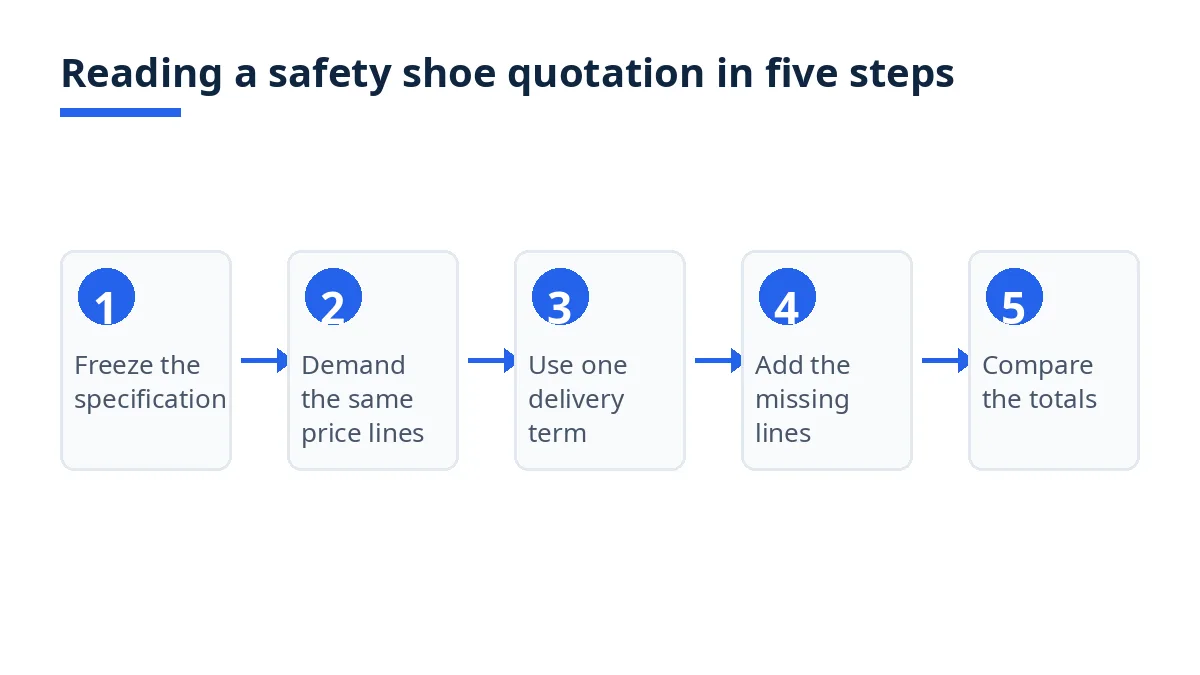
Work the comparison in this order. First, check that every quotation names the same specification, in the same words, for the same model. Second, convert every quotation to one delivery term: if one supplier quotes EXW and another quotes FOB, add the buyer's legs to the EXW price, or ask both suppliers to re-quote on the same term, before any number is compared. Third, add the missing lines: testing and examination charges, packing beyond the standard box, sampling and retest charges, and inspection charges must appear in every column, either as included, as a separate figure, or as a line the buyer must pay elsewhere. Fourth, read the quantity basis: the counting basis for the minimum, the tier each quantity falls in, and the size curve each price covers. Fifth, compare totals, not unit prices, and read the validity, payment terms, and lead time beside the total.
The worked comparison below shows the method on example figures only. Both quotations describe the same model, the same S3S marking, and the same 3,000-pair size curve from the table above. Quotation A is priced FOB. Quotation B is priced EXW, with testing and packing charged separately. All figures are illustrations to show the arithmetic, not prices any supplier has quoted.
Line | Quotation A, FOB | Quotation B, EXW |
|---|---|---|
Unit price per pair | USD 9.75 | USD 8.90 |
Pairs ordered | 3,000 | 3,000 |
Goods total | USD 29,250 | USD 26,700 |
Packing, per pair | Included in the unit price | USD 0.35 per pair, USD 1,050 in total |
Testing and conformity file, one-off for the model | Included in the unit price | USD 1,150 |
Subtotal before the journey | USD 29,250 | USD 28,900 |
Inland movement and export handling | Included to the port under FOB | USD 640, paid by the buyer |
Main ocean freight | USD 1,980, paid by the buyer | USD 1,980, paid by the buyer |
Transit insurance | USD 210, paid by the buyer | USD 210, paid by the buyer |
Comparable total before duty | USD 31,440 | USD 31,730 |
Duty and import charges | Broker figure, left open | Broker figure, left open |
The arithmetic, re-checked two ways: Quotation A, 3,000 pairs at USD 9.75 gives USD 29,250, plus USD 1,980 freight and USD 210 insurance gives USD 31,440. Quotation B, 3,000 pairs at USD 8.90 gives USD 26,700, plus USD 1,050 packing gives USD 27,750, plus USD 1,150 testing gives USD 28,900, plus USD 640 inland and export handling, USD 1,980 freight, and USD 210 insurance gives USD 31,730. The comparable gap is USD 290, with Quotation A lower. The headline gap pointed the other way: USD 0.85 per pair, or USD 2,550 across the order, in favour of Quotation B before the separate lines were added. That reversal is the whole point of the method. A headline unit price comparison would have chosen the dearer quotation by USD 290 and, worse, would have left the testing file as a separate charge to be argued about after the order was placed.
Read the result with its limits. The comparison says nothing about quality, fit, or delivery reliability, which the testing file, the fitting trial, and what an inspector checks before shipment must answer separately.9 It says only that, on these example lines, the two quotations cost nearly the same once every line is counted, and that the cheaper headline hides two charges the dearer headline includes. When the gap is that narrow, the decision should turn on the file: which quotation names the model, the edition, the insert type, and the certificate expiry in writing.
Quotation-reading checklist
Use this checklist on every quotation before shortlisting. Tick a line only when the answer appears in the quotation or in a written message in the same thread, not when it was mentioned in a call or a catalogue page.
The model, the category, the optional symbols, and the standard edition are named for the exact model being priced, in the words the certificate will use.
The upper material, the cap material, the insert material and type, the sole material and attachment method, the lining, and the closure are each stated, not implied by a trade name.
The size curve is priced size by size, the end sizes are confirmed as included, and the curve totals match the order quantity.
The counting basis for the minimum is stated, with any minimum order value beside it, and the tier each quantity falls in is identified.
Testing and conformity charges are shown as included, as a separate figure, or as a buyer-paid line, with the certificate expiry date stated where a certificate is relied on.
Packing is specified by box, tissue and stuffing, carton assortment, and marks, with any custom packing charged as its own line.
The delivery term is named in full — rule, place, and version year — and it fits the transport route the goods will actually use.
Freight, insurance, inland movement, and export handling appear as lines, each assigned to buyer or seller under the named term, with no leg left unnamed.
Duty and import charges are left open as the broker figure, with the complete national line, origin, and entry date confirmed in writing by the broker.
Validity, payment terms, lead time, and the cost of a retest or a repeat sample after a failed test are stated, so the total can be relied on until the file is approved.
Red flags in a safety shoe quotation
A red flag is not proof of a bad supplier. It is a missing line or a vague word that must be closed before the price is trusted. Treat each flag below as a question to put in writing, and hold the shortlist until the answer arrives.
A unit price with no testing line. A quotation that shows a pair price and no testing, examination, or certificate line has not removed the conformity cost. Ask which charges are included, which are separate, and what a failed test costs. A file that names a different model, or a certificate past its renewal date, is the same flag in document form.
A price that excludes packing, freight, or insurance without saying so. Compare the worked example above: separate lines reversed the headline gap. Ask for every journey line by name, and convert every quotation to one delivery term before comparing totals.
A vague delivery term. A rule without a named place, a version year without a rule, or a sea-only rule for air freight cannot be priced or enforced. Confirm the term against the route with the forwarder, and write the confirmed term into the comparison sheet.
One price across different protection sets. A single unit price quoted for two categories, two insert types, or two water properties is pricing a range, not a model. Ask for a price per model and per protection set, and compare only within the same set.
Advertising words in place of markings. Words such as puncture proof or slip proof overstate what any footwear can guarantee, and they do not appear in the marking system.1 The marking system names tested properties with letters and test routes, and each letter should be supported by evidence for the finished model.1 Ask for the marking letters and the test evidence behind each one.
A minimum without a counting basis. A bare number, with no statement of how it is counted — whole order, style, colour, or size group — cannot be planned against. Ask how the minimum is counted, and whether a minimum order value also applies, before fixing the colour and size mix.4
No validity, no lead time, no retest rule. A price without a validity date can move before the file is approved. A lead time without gates hides which model is late. A retest rule left unwritten leaves the cost of a failed test to be argued about after the failure. Ask for all three in the quotation, and record the answers beside the total.
A price that falls when a line disappears. When a revised quotation drops sharply, check which line dropped with it: an end size, a testing charge, a packing specification, or an optional symbol. When a new lower price arrives with a changed sole compound or a shorter size curve, the shoe itself has changed, and the price reading starts again from the specification.
Questions buyers ask about safety shoe prices in Bangladesh
Why do two quotations for the same category differ so much?
Because a category letter is a package, not a full specification. Two shoes marked S3S can differ in the upper material, the cap material, the insert type and test route, the sole compound, the lining, the size curve, the testing file, and the delivery term, and each difference is a price line. The category letters name a package of tested properties, and the papers must describe the precise finished shoe and build that will ship.1 Compare the full specification line by line before comparing the totals, and ask both suppliers to price the same size curve on the same delivery term.
Does a higher price mean a safer shoe?
No, not on its own. A higher price can mean a fuller protection set, a dearer upper material, a complete testing file, or a delivery term that includes freight and insurance. It can also mean a longer journey, a smaller quantity, or a custom colour. Safety is decided by the marking, the test evidence for the finished model, and the documents naming that model, not by the total.1 A dearer quotation with an incomplete file is not safer than a cheaper quotation with a complete one. Judge the file first, and let the price decide only between files that match.
What should a quotation include besides the unit price?
It should include the model and specification in certificate words, the size curve priced size by size, the counting basis and tier for the quantity, the testing and conformity charges, the packing specification, the delivery term in full, every journey line assigned to buyer or seller, the duty position left open for the broker figure, and the validity, payment terms, and lead time. The comparison table in this guide shows the shape: goods, packing, testing file, inland movement, freight, insurance, and duty, each on its own line.
How do I know whether testing and certification are included in the price?
Ask in the quotation thread, and require the answer in writing. The supplier should state which testing and examination charges are included in the unit price, which are charged separately, what the certificate expiry date is, and what a retest costs if a test fails. Certificates are time-limited to a maximum of five years with revalidation, and Category III models carry recurring notified-body checks while in production.7 If the quotation shows no testing line and no expiry date, treat the file as unpriced and ask again before shortlisting.
Next steps on Exportain
Start by sending one fixed specification to several suppliers, so every quotation answers the same model, size curve, and delivery term. Before fixing colours and sizes, read how the counting basis changes the smallest order; before asking the broker question, read which heading the materials point to; and before shortlisting, read how Exportain records supplier checks. Then compare the quotations on the comparison sheet in this guide, line by line, and keep the winning quotation beside its testing file.
Post a free RFQ on Exportain and get quotes from verified Bangladeshi suppliers → https://exportain.com/rfqs
Sources
- EN ISO 20345 Safety Footwear Standard: Classes & Markings. Anbu Safety, (accessed )
- Classifying footwear for import and export. GOV.UK (accessed )
- HS Code for Safety Shoes: Classification Guide for Importers. Exportain, (accessed )
- MOQ Meaning (Minimum Order Quantity). Exportain (accessed )
- Machines for EU safety footwear testing – part 2. SATRA (accessed )
- Regulation (EU) 2016/425 of the European Parliament and of the Council of 9 March 2016 on personal protective equipment - summary. European Union (accessed )
- European conformity assessment of PPE. SATRA (accessed )
- Footwear fit and comfort. SATRA (accessed )
- Quality Control Checklist for Safety Shoes. Exportain, (accessed )
- Incoterms 2026: Meaning, Chart & List Of Incoterms. Freightos, (accessed )
About the author
Sourcing from Bangladesh?
Post a request for quotation and suppliers on Exportain can send you their quotes directly.
Post an RFQ