Top Safety Shoes Manufacturers in Bangladesh: How to Find and Verify Them
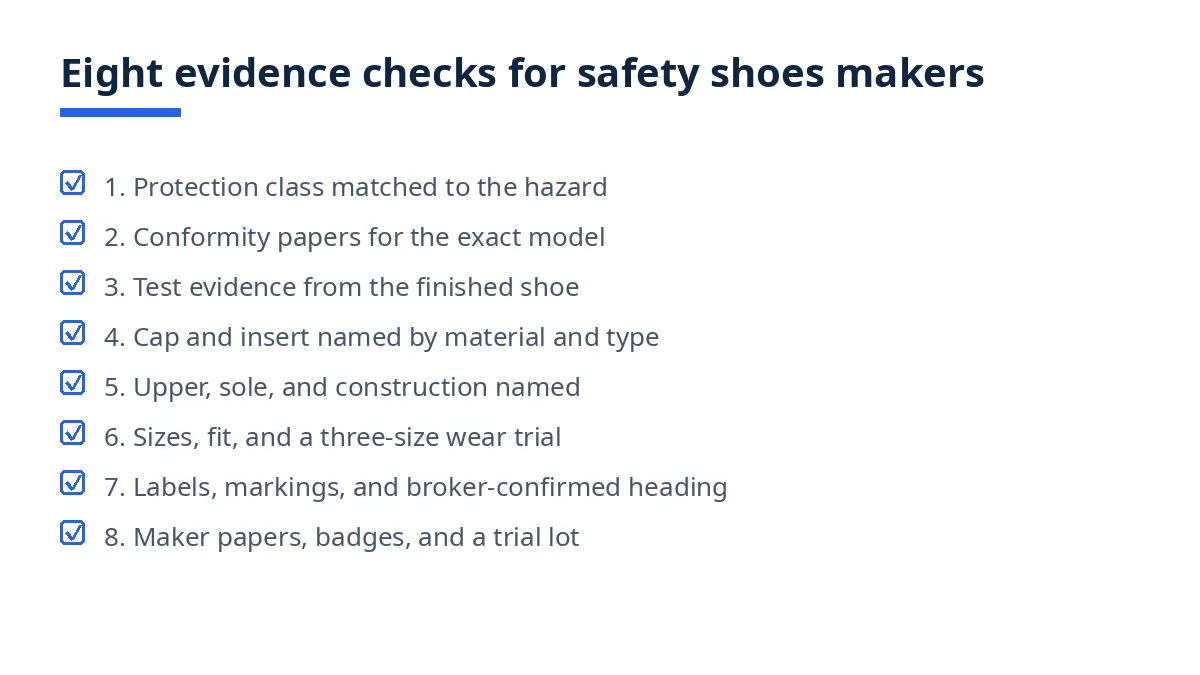
Eight evidence checks for safety shoes makers in Bangladesh: protection class, conformity papers, finished-shoe test reports, cap and insert, materials, fit, labelling and heading, and maker capacity.
Short answer
Judge a safety shoes maker in Bangladesh by the evidence file for one model: the protection class matched to the hazard, the conformity papers naming that model, test reports from the finished shoe, the cap and insert named by material and type, and the size run proved on a wear trial. Shortlist only makers who supply each document for the exact model you will buy, and hold bulk until the trial file is complete.
On this page
Key takeaways
A marking such as S3 names a bundle of tested protections, not a promise about every hazard; match the class and the added codes to the job before you compare prices.
For the EU market, ask for the EU declaration of conformity and the type-examination route for the exact model, and check the notified-body number where the risk category requires one.
Test reports must come from the finished shoe and name the method: impact at 200 joules and compression at 15 kilonewtons decide the toe cap, and the perforation insert is tested against 1,100 newtons.
Prove fit and capacity on a trial run across the full size range; a catalogue photo and a badge record do not prove either.
A safety shoe is bought for the hazards of one job, but it is often sold by its photograph and its price. This article is for buyers whose markets are the USA, the UK, the EU, or the UAE. Work through it model by model: for each model, build one evidence file, and shortlist only the makers whose file is complete.
Start from the hazard, not the catalogue name
Write down the hazards of the job before you open a catalogue. Falling objects call for toe protection. Nails and sharp debris underfoot call for a penetration-resistant layer. Wet floors call for slip resistance tested on the surface the wearer will actually walk on. Work near switchgear calls for a different electrical property from work with static-sensitive components, and the two must not be confused. A shoe that covers one hazard does not cover them all, so the hazard list decides which protections you ask for, and the catalogue name decides nothing on its own.
The standard that frames these protections for the European market is EN ISO 20345:2022, which New Balance Industrial describes as harmonized by Regulation (EU) 2016/425.1 Safety footwear sold in Europe or the United Kingdom must also meet the requirements of EN ISO 20345, EN ISO 20346, or EN ISO 20347, and carry CE marking for sale in Europe or UKCA marking for the United Kingdom.2 That sentence sets the floor for this article: a protection claim needs a standard, a test, and a marking to match, not only a product name. Keep the hazard list beside every later check, because each check below answers one line of it.
Read the marking before you read the catalogue
A marking such as S3 is a bundle of tested protections. Read it as a bundle, and ask what each part of the bundle adds, because two shoes marked S3 can still differ in the insert type inside the sole. The class table below follows the 2022 edition as set out by New Balance Industrial.1
Class | What the bundle adds |
|---|---|
SB | Toe impact protection at 200 joules, toe compression protection at 15,000 newtons, resistance, safety and performance of materials, and slip resistance on ceramic tile with detergent |
S1 | Everything in SB, plus a closed heel area, energy absorption at the seat region, and antistatic properties |
S2 | Everything in S1, plus water penetration and absorption of the upper |
S3 | Everything in S2, plus perforation resistance according to the insert type, and a cleated outsole |
S4 | Class II moulded footwear only, with SB plus a closed heel area, energy absorption at the seat region, and antistatic properties |
S5 | Class II moulded footwear only, with S4 plus perforation resistance according to the insert type, and a cleated outsole |
S6 | Everything in S2, plus water resistance of the whole footwear |
S7 | Everything in S3, plus water resistance of the whole footwear |
Class I footwear is made from leather and other materials, Class II footwear is all-rubber or all-polymeric moulded footwear, and hybrid footwear combines the two constructions.3 The class tells you which construction family the shoe belongs to as well as which protections it carries, so ask the maker to name the class of the model, not only the class letter on the listing.
Added codes after the class letter name single protections. Learn the codes for the hazards on your list, and treat any code you do not recognise as a question to the maker, not as extra protection.1
Code | Meaning in the 2022 summary |
|---|---|
P | Metallic perforation insert: the lowest value needed to perforate the outsole unit must be at least 1,100 newtons |
PL | Non-metallic perforation insert: no perforation at 1,100 newtons and no tent effect, with a 4.5 mm diameter nail |
PS | Non-metallic perforation insert: no perforation at 1,100 newtons on average and not lower than 950 newtons, with a 3.00 mm diameter nail |
M | Metatarsal protection: a guard fitted over the top of the foot to resist impacts from falling objects behind the toe cap, up to 100 joules of impact energy |
A | Antistatic: electrical resistance between 0.1 and 1,000 megaohm, conducting static charge out into the ground |
WPA | Water penetration and absorption: upper materials resist water, with a limit on penetration through upper panels |
WR | Water resistant: the whole footwear resists water ingress, tested by flexing for 80 minutes in water |
HRO | Heat resistant outsole: the outsole is not damaged after contact with heat up to 300 degrees Celsius for one minute |
FO | Fuel oil resistant outsole: the sole resists hydrocarbons |
SC | Scuff cap abrasion: a scuff cap overlay at the toe develops no holes before 8,000 cycles of abrasion testing |
SR | Slip resistance tested on ceramic tile with glycerine, under the 2022 edition |
E | Energy absorption at the seat region, part of the S1 bundle and above |
Two warnings belong with this table. First, antistatic footwear and ESD footwear are both conductive shoes, and both are designed to protect electrical equipment by conducting built-up charge away from the body. Neither is suitable for use on live electrical installations, and neither gives protection against electric shock from alternating or direct current voltages.1 If the job involves live working, say so in words, and ask which protection the model was assessed for, rather than accepting an antistatic code as electrical safety. Second, the upper water test and the whole-footwear water test are different tests. SATRA's account of the 2011 edition describes the upper test, marked WRU, as allowing no more than 0.2 grams of water penetration and no more than 30 percent water absorption after 60 minutes.4 The 2022 summary uses WPA for the upper property and reserves WR for the whole shoe.1 Ask which test the model passed, and do not let a passed upper test stand in for whole-shoe water resistance.
Eight evidence checks for one model
Work the eight checks in order for a single model. Each check names what to ask for, why it decides the order, and what to hold in the maker file. A check that cannot be answered for the exact model you will buy is an open check, and bulk waits until it closes.
Check 1: the protection class, matched to the hazard in writing
Ask the maker to state the class, the added codes, and the standard edition for the model, in the quotation, and to match each item to a hazard on your list. The class decides the bundle, and the added codes decide the single hazards the bundle does not cover by itself. A model marked S3 with a metallic insert and a model marked S3 with a non-metallic insert share a class letter and differ in the insert, the nail size used in testing, and the force the insert must withstand, so the insert type belongs in the same sentence as the class.1 Hold the class statement, the code list, and the hazard match in the file. If the maker answers with a catalogue page instead of a class statement for the model, the check stays open: a catalogue page can describe a range, and a range is not a model.
Check 2: the conformity papers for the exact model
For the European market, ask for the EU declaration of conformity for the model, the EU type-examination route the model followed, and, where the risk category requires it, the notified body and its identification number. Regulation (EU) 2016/425 sets the design and manufacture requirements for personal protective equipment made available on the market, and it applies to PPE imported from a third country as well as to PPE made inside the Union.5 Conformity assessment stays the manufacturer's obligation, and importers must check that the PPE complies, that its assessment was completed, and that its CE marking and technical file can be produced for the authorities.5 The manufacturer must keep the technical documentation and the EU declaration of conformity for 10 years after the PPE has been placed on the market.5
The route depends on the risk category in Annex I of the Regulation. Category I covers only the minimal risks listed there, Category II takes the risks left over after the Category I and Category III lists, and Category III is reserved for the listed risks with the gravest outcomes, death or lasting harm to health: among them are electric shock and live working, high-temperature and low-temperature environments at the stated limits, falling from a height, and harmful noise.5 By those lists, a shoe sold against falling-object impact and sole penetration sits in Category II, because neither risk appears in the Category I or Category III lists, while a shoe sold against a Category III risk follows the Category III route. The procedures are: Category I, internal production control; Category II, EU type-examination and then a conformity-to-type stage run as internal production control; Category III, EU type-examination plus either supervised product checks at random intervals or quality assurance of the production process.5 For Category III PPE, the notified body's identification number follows the CE marking.5 Hold the declaration, the certificate, and the category reasoning in the file, and check that every document names the same model, the same protection set, and the same standard edition. A declaration for a different model, or a certificate whose model name does not match the quotation, proves nothing about the shoes you will receive.
Check 3: test evidence from the finished shoe, named by method
Ask for test reports on the finished shoe, with the method named for each result. Toe protection is tested on specimens prepared from whole footwear, including a section of sole and the linings and upper in the toe cap region, not on a loose cap alone.3 The impact test subjects the specimen to 200 joules, plus or minus 4 joules, from a striker of 20 kilograms, plus or minus 0.2 kilograms, and a modelling clay cylinder inside the cap records the minimum clearance under the cap during the impact.3 The compression test crushes the toe region between two parallel surfaces moving at 5 millimetres per minute, plus or minus 2, under a load of 15 kilonewtons, with the same clay cylinder recording the lowest height the cap reaches.3 The measured height is compared with the minimum clearance for the shoe size, and the cap must not develop delamination or cracks through which light can be seen.3 Metallic toe caps must meet the requirements for metallic caps and non-metallic toe caps the requirements for non-metallic caps, each under its own part of EN ISO 22568, and metallic caps are also checked for corrosion resistance by visual inspection after exposure to a salt solution.3
For penetration resistance, hold the insert type and the test result together: metallic inserts are judged on the lowest perforation value, while non-metallic inserts are judged on perforation at the stated force with the stated nail size, as set out in the code table above.1 For slip resistance, hold the surface and the lubricant the test used, because a result on one surface does not transfer to another. For water, heat, and fuel oil, hold the clause and the edition: the 2011 edition account sets the upper water test at 60 minutes with the 0.2 gram and 30 percent limits, the hot-contact test at 300 degrees Celsius for 60 seconds with no melting and no cracks when the specimen is then bent around a 10 millimetre mandrel, and the fuel-oil test at no more than 12 percent volume increase after immersion.4 Ask the maker which edition each report follows, and read the report for the model name before you read its numbers. A report without a method name, or a method name without a report, leaves the check open.
Check 4: the cap and the insert, named by material and type
Ask the maker to name the toe cap material and the insert material and type in writing, for the model, and to state whether the insert runs the full length of the sole area it is meant to protect. A trade name such as composite toe does not answer the question, because caps of different materials behave differently in testing and are recorded differently in the papers. The corrosion check applies to metallic caps, the conditioning checks for heat, cold, and fuel oil apply to non-metallic caps before impact testing, and the insert type decides which perforation rule and which nail size the test used.1 3 A metatarsal guard, where the job needs one, must be named separately: it sits over the top of the foot, behind the toe cap, and the 2022 summary rates it to 100 joules.1 Hold the material statement, the insert type, and the guard statement in the file. If the maker will name only a trade name, ask again in the RFQ thread and keep the check open until the material and type are stated.
Check 5: upper, sole, and construction, named by material
Ask the maker to name the upper material, the outer sole material, and the construction method for the model. The construction family matters to the tests the shoe must pass: Class II footwear faces a leakproofness test that Class I footwear does not, and the upper water test in the 2011 edition account applies only to Class I footwear, while the outsole heat and fuel-oil tests apply to both classes.4 Bond strength between the upper and the outsole is tested on specimens cut from the shoe, and the test does not apply where the bond was made by a mechanical attachment such as nails, screws, or stitching.3 Where an insole is used, it must not be possible to remove it without damaging the footwear, and where there is no insole, a permanently attached insock must be present.3 Hold the material statement, the construction family, and the bond and leakproofness results that apply to that family in the file. A listing that names only a colour or a finish has not answered this check.
Check 6: sizes, fit, and a wear trial across the size range
Ask for the full size range the maker will produce, the size curve in the order, and a wear trial in at least three sizes: the smallest size, a middle size, and the maximum size. Toe cap clearance is judged against a minimum that depends on shoe size, so a result in one size does not prove the ends of the range.3 The trial should cover walking, standing, and the movements of the job, and the wearers should report pressure at the cap edge, heel slip, and sole flex in their own words. Hold the size list, the trial sizes, and the trial notes in the file, and do not accept a single sample size as proof of fit. Fit failures show up at the ends of the size curve first, and a bulk order that spans the full range inherits every failure the trial did not test.
Check 7: labels, markings, and the heading for customs
Ask the maker how the model will be marked and what the instructions will say, and ask your customs broker to confirm the heading before shipment. Under Regulation (EU) 2016/425, the instructions supplied with PPE must explain the significance of any markings, name the risk the PPE is designed to protect against, cite the Regulation and the harmonised standards used, and, where applicable, name the notified body and give the internet address where the EU declaration of conformity can be accessed.5 Do not confuse that marking regime with the consumer footwear labelling rules: the EUR-Lex summary of the footwear labelling directive requires the upper, the lining and sock, and the outer sole to be labelled where a material covers 80 percent or more of the relevant area, or the two main materials where none reaches 80 percent, with the label visible, securely attached, and accessible on at least one item of the pair, and the person who first places imported footwear on the EU market carries responsibility for the label.6 The same summary states that the directive does not cover footwear used for health and safety purposes in the workplace, which falls under the EU rules on personal protective equipment.6 Hold the marking statement and the instructions draft in the file, and treat the labelling directive as background for consumer footwear, not as the conformity route for safety shoes.
For customs, the heading follows the materials and the construction, not the safety marking. Classification turns on the upper and outer-sole materials, the type and purpose, whether the shoe covers the ankle, the insole length against 24 centimetres, the heel height, and the intended wearer.7 The upper is decided by which material covers the most of its outside, setting accessories and reinforcements aside, and the outer sole by which material meets the ground over the greatest area.7 Leather uppers point to heading 6403 and textile uppers to heading 6404, waterproof rubber or plastics footwear made by moulding and not by stitching or similar assembly points to heading 6401, other rubber or plastics footwear points to heading 6402, and footwear of other materials points to heading 6405.7 The classification walkthrough for safety shoes works through the cap, upper, sole, and construction tests in that order. Ask the broker to confirm the full national code for the entry date in writing, because the heading alone is not a duty rate and a code copied from another destination is not a confirmation.
Check 8: the maker behind the model, and the capacity to deliver it
Ask for the company papers and the production evidence separately, because a good model file and a weak maker file fail in different ways. On Exportain, read each supplier profile's trust and verification checklist line by line: Exportain Verified records that identity, phone, email, and business registration were checked; Export Verified records that the Export Registration Certificate was checked; Factory Verified records that photos of the manufacturer's factory were reviewed; Trading Company Verified records that photos of the trading company's office or warehouse were reviewed; and Trusted Trader records that the seller completed orders on Exportain with no disputes.8 Those badges record a review of documents and photos by Exportain staff. They are not a factory inspection, not a check against a government database, and not a guarantee of production capacity, product quality, or delivery, and membership plans never grant a badge.8 A certificate a supplier attaches to a product listing is shown as reviewed by Exportain only while it is approved and not past its expiry date, and if the certificate matters to your order, confirm it with the body that issued it as well.8
Ask the maker whether it belongs to the Leathergoods and Footwear Manufacturers and Exporters Association of Bangladesh, which presents itself as the trade body for makers and exporters of leather goods, footwear, and synthetic and allied products in Bangladesh, and check any membership claim against the association's own records.9 Ask for the trade licence and the Export Registration Certificate, and check that the company name and address match the quotation and the invoice. Then ask for capacity evidence for the model: the line that will make it, the sizes that line will run, and a trial lot on the bulk line in the full size range before bulk starts. The badge meanings page explains what each badge does and does not tell you. Hold the company papers, the badge record, the membership answer, and the trial-lot result in the file. A maker who answers the model checks well but cannot show a line, a size plan, or a trial lot has not closed this check.
Summary table: the eight checks at a glance
Check | Evidence to hold | Decision it makes |
|---|---|---|
1. Protection class | Class, added codes, standard edition, hazard match | Whether the shoe is specified for the job at all |
2. Conformity papers | Declaration, type-examination route, notified-body number where required, all naming the same model | Whether the model may be placed on the target market |
3. Test evidence | Reports from the finished shoe, method named, model named | Whether the claimed protections were measured |
4. Cap and insert | Cap material, insert material and type, metatarsal guard statement | Whether the protection inside the shoe matches the marking |
5. Upper, sole, construction | Materials, construction family, bond and leakproofness results | Whether the shoe suits the working environment |
6. Sizes and fit | Size range, three-size wear trial notes | Whether the range fits the workforce |
7. Labels and heading | Marking statement, instructions draft, broker-confirmed heading | Whether the shipment clears and the user is informed |
8. Maker and capacity | Company papers, badge record, membership answer, trial lot | Whether the maker can deliver the model on time |
Run a trial that proves fit, size range, and the bulk line
Order the trial as a small production run, not as a single hand-made sample. The trial lot should run on the bulk line, in the full size range, with the production cap, insert, upper, and sole, and with the marking and packing the bulk order will carry. Inspect the trial lot against the frozen reference set: the approved pair, the protection list, the size chart, and the packing specification. Use the safety-shoes inspection list to set the inspection scope, and agree the defect list, the sampling plan, and the buyer-specified tests in writing before the trial starts, so the trial decision rests on agreed criteria rather than on a general impression. If the trial finds a fault in the cap position, the insert coverage, or the sole bond, hold the size run affected, ask what changed in production, and re-run the trial after the correction. A second trial costs far less than a bulk lot that fails inspection at the port of destination.
Read the MOQ and the price drivers in the quotation
Read the minimum as a counting rule before you read it as a number. A minimum can be counted per order, per style or product, or per colour, a supplier can combine a quantity minimum with a minimum order value, and there is no standard minimum for Bangladesh or for footwear that you can safely assume.10 The MOQ counting rules explain how the same number changes the smallest order under each counting basis. Ask how the minimum is counted, and ask what drives it: the cap and insert variants, the upper material, the size curve, the trims and packaging, and the testing and paperwork for the model all pull the number in different directions. Example figures only: with a minimum of 600 pairs per style and colour, two styles in three colours each give a smallest order of 3,600 pairs, and at an example price of USD 6.40 per pair on an FOB basis that order totals USD 23,040. The figures are examples to show the arithmetic, not a price or a minimum any maker has quoted. Compare quotations on the same counting basis, the same size curve, and the same protection set, and confirm the agreed price, the minimum, the lead time, the delivery term, the payment terms, and the validity in the accepted quotation, because the listing alone does not bind either side.10
Name the delivery term the quotation actually uses
Write the delivery term, the Incoterms year, and the named place into the contract, and check that the term fits the transport you will actually use. Put plainly: sea/inland-waterway-only rules are FOUR — FAS, FOB, CFR, CIF. CPT is any-mode. DPU is any-mode. DDP is any-mode (seller clears import customs, pays duty). FCA is any-mode.11 The sea and inland-waterway set holds four rules: FAS, FOB, CFR, and CIF. The any-mode set holds seven: EXW, FCA, CPT, CIP, DAP, DPU, and DDP.11 Under CPT the seller pays the carriage to the named destination, under DPU the seller unloads as well, at the named place, and under DDP the seller carries the whole shipment including customs clearance and fees to the buyer's premises.11 A quotation that names FOB for goods that will travel by air, or DDP without a named place, has not named a term you can rely on. Ask the forwarder to confirm the term against the route before you accept the quotation, and keep the confirmed term in the maker file with the price.
Claims that should stop a shortlist
Stop the shortlist, and ask for the missing evidence, when a claim arrives without the paper behind it. The warning case is recent: a safety shoe sold online was recalled in the United Kingdom after the Office for Product Safety and Standards found it presented a serious risk of injury because, although advertised as anti-smash and anti-puncture, there was no evidence it had undergone conformity assessment as PPE and it was not CE or UKCA marked.2 The British Safety Industry Federation warned that substandard PPE is widely available in the UK market, and reported a 90 percent failure rate for products it bought and tested from non-registered suppliers.2 Treat catalogue language the same way: anti-smash, anti-puncture, non-slip, and waterproof are advertising words until a class, a code, a method, and a report give them measurable meaning. Other claims that should stop a shortlist are a certificate that names a different model, a marking whose insert type the maker will not state, a badge record presented as a factory inspection, a minimum quoted without a counting basis, and a price compared across different protection sets. In each case, the remedy is the same: ask for the document, and keep the maker off the shortlist until it arrives.
Questions buyers ask about safety shoes manufacturers in Bangladesh
What is the biggest mistake buyers make with safety shoes from Bangladesh?
The biggest mistake is comparing prices before comparing protection sets. Two quotations can share a class letter, a photograph, and a price basis, and still differ in the insert type, the test edition, the size range, and the papers behind the model. Compare the eight evidence checks first, and compare prices only between files that match on class, codes, materials, and counting basis.
How can I avoid ordering the wrong protection class?
Start from the hazard list, match each hazard to a class and an added code, and put that match in the RFQ. Ask the maker to confirm the class, the codes, and the standard edition for the exact model in the quotation, and hold the test reports that support each code. If a hazard on your list has no code in the answer, the model is not specified for that hazard, whatever the catalogue name says.
Who is responsible for conformity once the shoes reach the EU?
The manufacturer carries out the conformity assessment and draws up the EU declaration of conformity, and by drawing it up assumes responsibility for the compliance of the PPE with the Regulation.5 Importers must check that the PPE complies, that its assessment was completed, and that its CE marking and technical file can be produced for the authorities.5 As the buyer, your responsibility is to hold the papers, check that they name your model, and refuse a shipment whose papers name something else.
Where can I get help checking a maker before I commit?
Start with the supplier's profile and its trust and verification checklist, then ask the maker for the eight documents in this article, and ask a customs broker to confirm the heading.8 For the inspection itself, use an independent inspector working to your agreed defect list and sampling plan, and confirm any certificate that matters to your customer with the body that issued it.8 Keep every answer in the maker file, so the next order starts from evidence rather than from memory.
Next steps on Exportain
Read the safety-shoes inspection list to set your inspection scope, the classification walkthrough for safety shoes to prepare the broker question, and the badge meanings page before you shortlist. Browse the Bangladeshi supplier directory and open the trust and verification checklist on each profile you shortlist.
Post a free RFQ on Exportain and get quotes from verified Bangladeshi suppliers → https://exportain.com/rfqs
Sources
- Safety Standards. New Balance Industrial (accessed )
- Substandard safety shoes being sold online. SATRA (accessed )
- Machines for safety footwear testing – part 2. SATRA (accessed )
- Machines for EU safety footwear testing – part 10. SATRA (accessed )
- Regulation (EU) 2016/425 of the European Parliament and of the Council of 9 March 2016 on personal protective equipment. European Union, (accessed )
- Footwear labelling. European Commission, EUR-Lex (accessed )
- Classifying footwear for import and export. GOV.UK (accessed )
- How Supplier Verification Works on Exportain. Exportain, (accessed )
- President's Message - LFMEAB. Leathergoods and Footwear Manufacturers and Exporters Association of Bangladesh (LFMEAB) (accessed )
- MOQ Meaning (Minimum Order Quantity). Exportain (accessed )
- Incoterms 2026: Meaning, Chart & List Of Incoterms. Freightos, (accessed )
About the author
Sourcing from Bangladesh?
Post a request for quotation and suppliers on Exportain can send you their quotes directly.
Post an RFQ