FAS vs CIF: Key Differences, Costs and Which One to Choose
CIF contains freight and a minimum insurance policy; FAS contains neither. This comparison builds the total landed cost for LED fittings and tests what the CIF policy actually covers.
Short answer
Under FAS the seller delivers goods alongside the vessel and nobody must insure them, so the buyer buys its own cover if cover is wanted. Under CIF the seller pays freight to the destination port and must buy insurance for the buyer, but only at the minimum Institute Cargo Clauses (C) level. Compare total landed cost, including any top-up to wider cover, rather than comparing headline prices.
On this page
Key takeaways
Under FAS nobody must insure; under CIF the seller must buy cover for the buyer at the minimum Clause C level.
Clause C covers major casualty to the vessel only; theft, water ingress, handling damage and dropped cartons sit outside it.
Risk passes on board at Chattogram under CIF, even though the seller pays freight and insurance to the destination port.
A CIF total without a Clause A top-up can look cheaper while holding only minimum cover for goods whose losses sit outside Clause C.
Write the clause set, the sum insured and the destination into the contract, and read the certificate before the goods sail.
A CIF quotation looks like the safer price: goods, freight and a policy in one figure to the destination port. An FAS quotation looks bare beside it, with freight and insurance still to buy. The comparison that matters is total landed cost and the insurance gap inside it. Under CIF the seller must buy cover for the buyer, but only at a minimum level. Under FAS nobody must buy cover at all. This article builds the total cost for light engineering goods from Chattogram and tests what the CIF policy covers.
What does the cheapest quotation leave out?
Under FAS the seller hands the goods over at the ship's side, in the port named in the contract, and the buyer then pays for loading, contracts the main carriage, and handles import clearance.1 Under CIF the seller delivers the goods on board, pays for the sea voyage to the port the contract names as the destination, and buys a marine policy for the buyer's benefit.2 Risk passes to the buyer on board under CIF, at the port of shipment, even though the seller keeps paying the freight to the destination port. CIF is a two-point clause: risk and cost move at different points.2
Three items sit outside an FAS price and inside a CIF price: loading, ocean freight and the insurance premium. Two items sit outside both: import clearance with duty, and onward transport. The only honest comparison is the buyer total under each term, built from the same goods and route, with the insurance position stated separately.
Who must insure, and to what level, under each term?
Under FAS neither party is obliged to insure. Risk stays with the seller up to the ship's side. From there the buyer carries it, through loading and the voyage, but neither party must buy a policy.1 A buyer that wants cover must arrange it, and the cover should start at the alongside point, not only after loading. Under CIF the seller is obliged to take out insurance that meets the minimum standard, namely Clause C of the Institute Cargo Clauses or a comparable wording.2 The scope of cover can be adjusted by mutual agreement, and the buyer that wants a higher level must agree it in the sale contract or buy additional cover.2
The seller must insure with a reputable provider, with cover from the point of delivery to the destination port, for a sum insured of 110 percent of the goods sales value.2 Both CIF and CIP require cover for at least 110 percent of the contract value, but CIP asks for broad all-risks cover while CIF's minimum is much narrower Clause C cover.3 For high-value light engineering goods, check whether 110 percent covers the full value at risk, including freight and duty. The seller must provide proof of insurance, so the buyer can read the certificate before the goods sail.
What does Institute Cargo Clauses (C) actually cover?
Clause C is the narrowest of the three Institute Cargo Clauses wordings. Clause A covers all risks subject to exclusions, while Clauses B and C cover only named perils, and B names more perils than C.4 Clause C covers major casualty to the vessel: fire, stranding, grounding, sinking, collision, discharge at a port of distress, general average and jettison.4 If the ship arrives safely and the cargo is short, wet or stolen, Clause C pays nothing.4
That shape fits homogeneous bulk cargo, where the realistic loss is a casualty to the ship. It fits electronic goods poorly. Theft, pilferage and non-delivery are covered under Clause A only.4 Water entering the vessel or store, packages dropped during loading, and handling damage are likewise outside Clause C.4 For LED fittings and small electronic components, the realistic losses are theft, water ingress, rough handling and a dropped carton: exactly the losses Clause C does not cover.
Peril or cause of loss | Clause C (CIF minimum) | Clause A (all risks) |
|---|---|---|
Fire or explosion | Covered | Covered |
Vessel stranded, grounded, sunk or capsized | Covered | Covered |
Collision, jettison, general average | Covered | Covered |
Water entering vessel, container or store | Not covered | Covered |
Package dropped during loading or discharge | Not covered | Covered |
Theft, pilferage, non-delivery | Not covered | Covered |
Handling damage and crushing | Not covered | Covered |
Any other accidental cause not excluded | Not covered | Covered |
War and strikes are excluded from all three sets, and exclusions for inherent vice, insufficient packing and delay apply across all three.4 Do not assume the seller-bought policy is Clause A. The certificate names the clause set; read that name before paying the invoice.
How does a claim travel when risk passed at Chattogram?
A claim under CIF starts with a paradox. The buyer has held the risk since the goods went on board at Chattogram, but the policy was bought by the seller and the freight was booked by the seller. The claim still works, provided the buyer holds the insurance certificate, the transport document with the on-board notation, the invoice, the packing list, and photographs taken at discharge before the goods leave the port area.
Under FAS the buyer bought its own policy and holds the certificate directly, and chose the carrier, so the claims procedure is known. The harder part is the start point: the policy must cover loading at Chattogram, because the buyer bears the risk from the alongside point. A policy that starts only on board leaves the lift uninsured.
In both cases, preserve recourse against the carrier. All three clause sets impose a duty to minimize loss and to preserve rights against carriers, and a claim against the shipping line dies at the one-year mark under the standard sea carriage rules.4 Note visible damage on the delivery receipt, notify the insurer and carrier promptly in writing, and keep the goods and packing available for survey.
Worked example: total landed cost for LED fittings under FAS and CIF
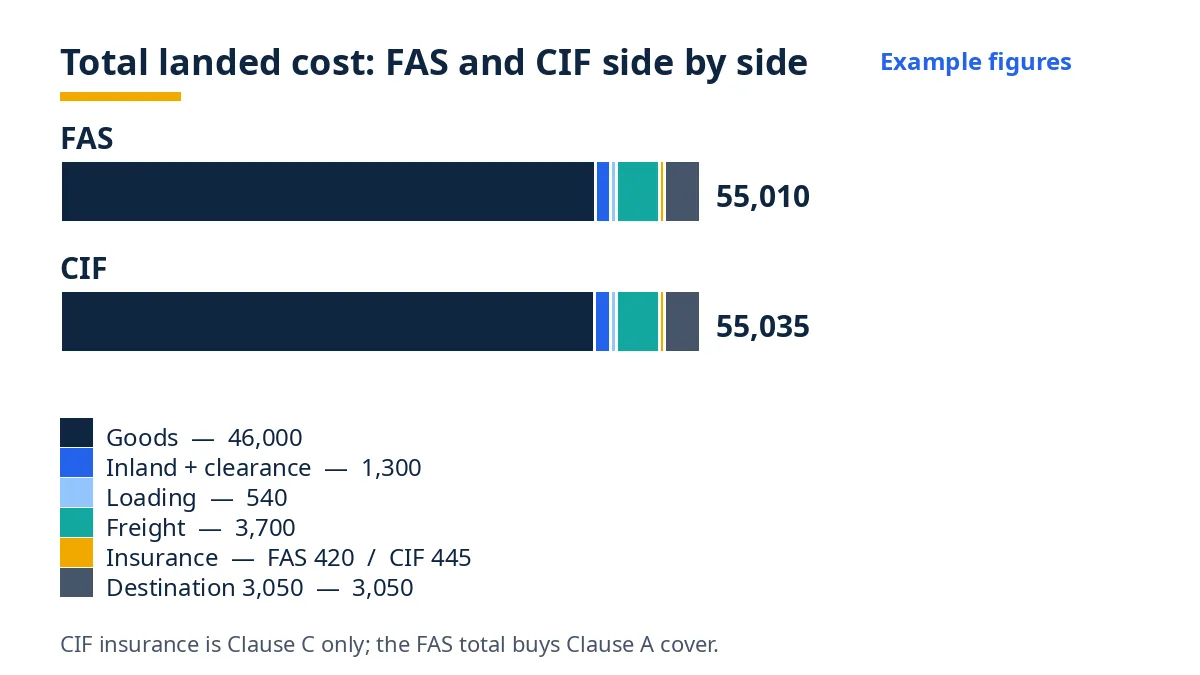
The figures below are Example figures for one container of LED light fittings and small electrical components from Chattogram to Rotterdam. The insurance lines differ: the CIF price contains a Clause C premium bought by the seller, while the FAS price contains no insurance and the buyer buys a Clause A policy separately.
Cost line (Example figures) | FAS Chattogram | CIF Rotterdam |
|---|---|---|
Goods, packed for export | 46,000 | 46,000 |
Inland transport and export clearance | 1,300 | 1,300 |
Loading on board | 540 (buyer pays) | 540 (in seller price) |
Ocean freight | 3,700 (buyer books) | 3,700 (seller books) |
Insurance premium, Clause C at 110 percent | 0 (no policy in price) | 185 (seller buys) |
Seller's price | 47,300 | 51,725 |
Loading, freight and insurance paid separately by buyer | 4,240 (freight 3,700 + loading 540) | 0 |
Buyer-bought Clause A top-up or full policy | 420 | 260 (top-up over Clause C) |
Destination handling, import clearance, duty, onward transport | 3,050 | 3,050 |
Buyer total | 55,010 | 55,035 |
The buyer totals differ by only 25. The CIF quotation is not cheaper in total once the buyer tops up Clause C to Clause A cover. The FAS total buys Clause A cover from the start for 420. The CIF total buys Clause C for 185 plus a 260 top-up, for 445 in total. A buyer that accepts the CIF policy without a top-up would show 54,775, cheaper by 235, but holds only Clause C cover for goods whose realistic losses sit outside Clause C. That saving is an uninsured exposure priced at 235.
The diagram shows the same comparison as stacked costs.
When is seller-bought cover enough, and when must the buyer top it up?
Seller-bought Clause C cover is enough for homogeneous bulk cargo, where the realistic loss is a casualty to the vessel.4 It is also enough when the buyer already holds an open cargo policy on wider terms, so the Clause C policy is a second layer. In those cases still read the certificate, confirm the sum insured is at least 110 percent of the contract value, and confirm the cover runs to the named destination port.2
A top-up is needed when the goods are attractive to thieves, fragile, or handled in cartons through several lifts, which describes most light engineering and electronic goods. It can take two forms: an agreement that the seller buys Clause A cover, reflected in the CIF price, or a separate policy bought by the buyer covering the gap from the on-board point to the destination. Write the clause set, the sum insured and the destination into the contract. A verbal assurance that the goods are fully insured is worth nothing at claim stage.4
What contract lines should the buyer write before payment?
Four lines settle the position before payment. First, the term line: "CIF Rotterdam, Incoterms 2020" or "FAS Chattogram, Incoterms 2020". Second, the insurance line: the clause set, the sum insured, and the party that buys the policy, with the certificate sent before shipment. Third, the freight line under CIF: the sailing schedule and the destination charges included, so handling is not charged twice. Under CFR and CIF the risk and cost split is identical except for insurance.5 Fourth, the claim line: the documents the seller must send, including the transport document and, under CIF, the insurance certificate.
See CFR price meaning, FAS price breakdown, CIF insurance and CIF documents required.
Questions buyers ask about FAS and CIF
Does CIF cover theft of cartons during the voyage?
No, not at the minimum level. Clause C does not cover theft, pilferage or non-delivery, which are covered under Clause A only.4 A CIF buyer that wants theft cover must agree a higher clause set in the sale contract or buy a top-up policy. Read the certificate to confirm which clause set the seller actually bought.
Is a CIF price always higher than an FAS price for the same goods?
The seller's price is higher under CIF, because it contains freight and insurance, but the buyer total need not be higher. Once loading, freight, insurance and destination charges are added to the FAS price, the totals differ by only 25. Compare buyer totals, not seller prices.
Can the buyer upgrade the CIF cover after the purchase order is signed?
An upgrade can be agreed after signing only if the seller and insurer agree it before shipment, with the premium change settled in writing. The practical route is to agree the clause set before signing, or to buy a separate top-up policy. Do not assume a policy can be widened after the vessel sails.
Who claims if the goods arrive damaged at Rotterdam?
The buyer claims, because the buyer has carried the risk since loading at Chattogram under both terms.2 Under CIF the buyer claims under the seller-bought policy, holding the certificate the seller provided. Under FAS the buyer claims under its own policy. In both cases, note the damage on the delivery receipt, notify the insurer and carrier promptly, and preserve the goods and packing for survey.
Next steps on Exportain
Before choosing a term, build the full total and read the insurance certificate. In an RFQ, state the clause set you require and the goods value, so the top-up cost appears in the replies. You can search suppliers in Bangladesh, consult the how-to-buy page, and submit an RFQ naming the term, the destination port and the cover required. Insurance and carriage terms are agreed by buyer and seller directly, because Exportain is not a party to goods contracts and does not arrange freight or customs clearance.6 For the destination-port freight position, see CIF shipping from Bangladesh.
Sources
- FOB & FAS Incoterms® 2020 explained: Key differences. ICC Academy (accessed )
- CIF (Cost Insurance and Freight) | Incoterms 2020. Röhlig Logistics (accessed )
- Incoterms for Sea Freight: How to Make Them Work for You. DHL, (accessed )
- Institute Cargo Clauses A B C Compared: Cover and Gaps. Globalior (accessed )
- CFR Incoterm: Cost and Freight, Risk and Cost. Linbis (accessed )
- About Exportain. Exportain (accessed )
About the author
Sourcing from Bangladesh?
Post a request for quotation and suppliers on Exportain can send you their quotes directly.
Post an RFQ