

CIF Shipping From Bangladesh: How It Works, Costs and Pitfalls
CIF from Chattogram or Mongla puts freight and minimum insurance in the seller's price, while risk passes when goods go on board. This walkthrough follows the port steps, cost split, documents and pitfalls.
Short answer
Under CIF, Cost, Insurance and Freight, the seller in Bangladesh pays ocean freight and minimum cargo insurance to a named destination port, while risk passes to the buyer when the goods are loaded on board at Chattogram or Mongla. CIF is for sea and inland waterway transport only, never for air freight. The buyer pays destination charges, import clearance, duties and onward transport.
On this page
Key takeaways
Under CIF the seller pays ocean freight and minimum insurance to the named destination port, while risk passes to the buyer when the goods are loaded on board in Bangladesh.
CIF is for sea and inland waterway transport only: it cannot be used for air freight from Dhaka airport, where CIP, FCA or CPT fit instead.
The CIF minimum insurance is Institute Cargo Clauses (C) cover at 110 percent of the invoice value, the narrowest standard level, covering only listed risks.
A CIF price ends at the destination port: destination handling, import clearance, duties and onward transport sit with the buyer.
Both ports must be named in full, and the Bill of Export must be approved before the goods are loaded or stuffed for export.
CIF shipping from Bangladesh is a sea-freight bargain, not a door-to-door service. Under CIF, which stands for Cost, Insurance and Freight, the seller in Bangladesh arranges and pays for ocean carriage and minimum cargo insurance to a named destination port, while the buyer takes the risk of loss or damage once the goods are loaded on board the vessel at the port of shipment. That split between who pays and who carries the risk is the point buyers miss.
This guide follows one CIF shipment in order: port of loading, export clearance, loading on board, the ocean voyage, and handover at the destination port. It is for buyers in the United States, the United Kingdom, the European Union and the United Arab Emirates comparing CIF quotations from Bangladeshi sellers.
Chattogram and Mongla: where CIF shipping from Bangladesh starts
A CIF contract needs two named ports: the port of shipment in Bangladesh, where delivery happens and risk passes, and the port of destination, to which the seller pays freight and insurance. Write both in full, with the country for each, so a quotation naming only a city cannot be compared with one that names a port.
Chattogram, formerly Chittagong, is the main seaport of Bangladesh, on the bank of the Karnaphuli River.1 Mongla is one of the three sea ports, at the confluence of the Possur River and Mongla Nulla, about 71 nautical miles upstream of the Bay of Bengal; it began as Chalna Port in 1950 and was renamed the Mongla Port Authority on 8 March 1987.1 Payra, the third seaport, started in 2013.1
Chattogram is the port buyers will see on most garment, textile, jute, leather and light-engineering quotations, as the main seaport.1 Mongla serves south-western cargoes. Confirm which port a quotation assumes before comparing prices, and ask where the goods will be stuffed: factory, inland container depot, or port.
Step-by-step: how a CIF shipment moves from factory gate to destination port
The Incoterms 2020 rules set out 11 rules with a clear allocation of cost, risk and obligations.2 CIF is reserved for sea and inland waterway transport and for use in maritime trade.2 The steps below follow that allocation.
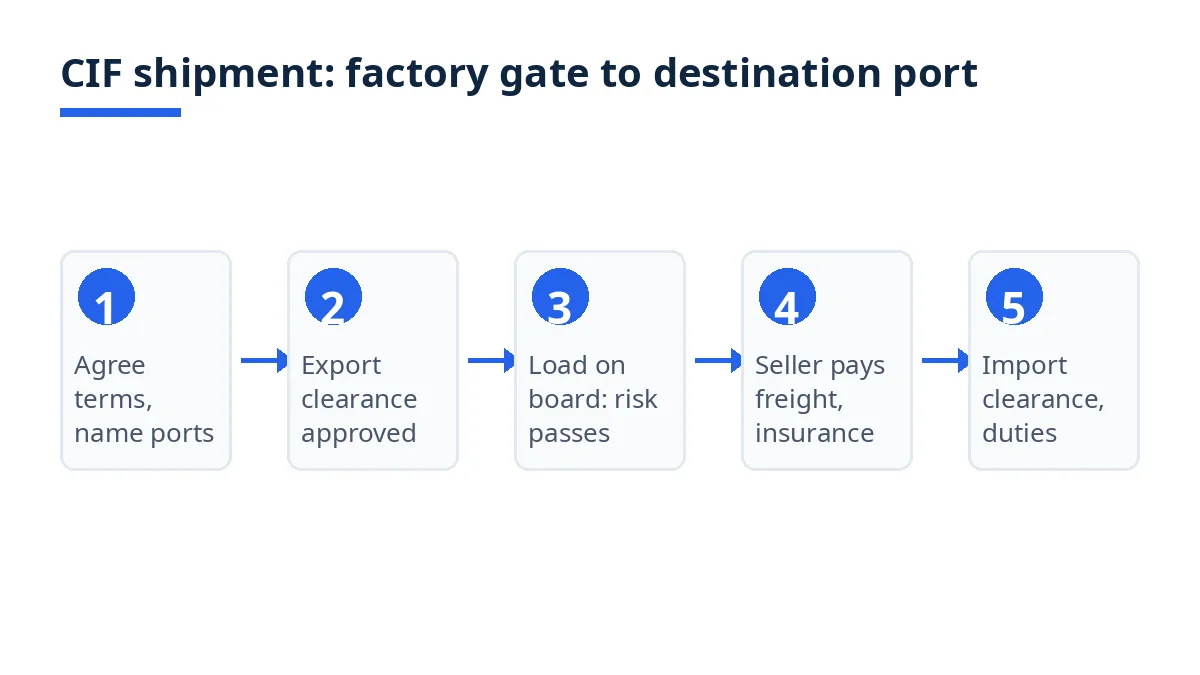
Agree the contract terms in writing. State the goods, quantity, price, "CIF" with the named destination port, the port of shipment, any insurance above the minimum, payment terms and the documents required. A CIF price without a named destination port is incomplete.
Produce, pack and mark the goods for sea carriage. The seller packs the goods to survive ocean carriage and marks cartons as the contract and packing list require.
Complete export clearance in Bangladesh. Goods shall not be loaded or stuffed for export unless an export declaration, the Bill of Export or Shipping Bill, is submitted to Customs and approved.3 Enclosed documents include the export letter of credit or, where there is none, the export contract, purchase order or export guarantee approved by the negotiating bank, the commercial invoice, the packing list, the EXP form certified by an Authorized Dealer, the certificate of origin issued by the Export Promotion Bureau (EPB) or a Chamber of Commerce and Industry, the VAT registration certificate and the Taxpayer Identification Number.3 An Export Registration Certificate may also apply, for example for jute, jute goods and tea.3
Move the goods to the port and load them on board. Once the declaration is approved after documentary check and physical verification, the goods are loaded into containers and stuffed into the ship.3 Where goods are loaded at private inland container depots or the exporter's premises, a gate division officer may check them before they proceed to the port.3 Export is complete once the ship leaves and the customs officer signs the shipping bill as shipped on board.3 Under CIF, loading on board is the delivery point: risk passes to the buyer then, even though the seller keeps paying freight and insurance to the destination port.4
Sail to the named destination port. The seller has contracted and paid for carriage and arranged the insurance below. The buyer carries the risk during the voyage.
Arrive, discharge and hand over the documents. The carrier discharges the goods, the buyer takes delivery and pays the destination charges left to the buyer, and the seller provides the transport and insurance documents.
Clear import customs and move the goods onward. The buyer arranges import clearance, pays destination duties and taxes, and arranges onward transport.4 None of that is in the CIF price, which stops at the destination port.
The cost split: what the CIF price pays for, and what it does not
A CIF quotation bundles the cost of the goods, the premium for the minimum cover, and the freight to the destination port. The CIF meaning guide explains what a CIF price includes and how CIF value is used for customs.
Cost or task | Seller pays | Buyer pays |
|---|---|---|
Goods, packing and marking | Yes | No |
Inland movement to the port of shipment and export clearance | Yes | No |
Ocean freight to the named destination port | Yes | No |
Minimum cargo insurance to the destination port | Yes | No |
Risk of loss or damage after loading on board | No, risk passes to the buyer | Yes |
Unloading and charges at the destination port, unless the contract states otherwise | No | Yes |
Import clearance, duties and taxes | No | Yes |
Onward transport from the destination port | No | Yes |
Ask which destination-port charges, if any, the CIF price already covers, since charges are not all labelled the same way. A CIF price is not a landed cost: the landed cost guide shows how duty, destination handling and onward transport sit on top of it.
Example figures: a contract price of 20,000, ocean freight of 1,800 and a premium of 90 give a CIF price of 21,890. The minimum insured amount would be 22,000, or 110 percent of the contract price. These are example figures only, not a quotation or a rate to expect.
What are the typical costs and timelines?
There are no typical CIF costs or timelines a guide can state as fact for shipments from Bangladesh: freight varies by route, carrier, container type, sailing and season, and timelines vary with production, clearance and the sailing schedule. Ask for the sailing date or window, the container cut-off, the estimated arrival date and the free time allowed at the destination port, and record the answers on the quotation.
Insurance, documents and the handover at the destination port
The insurance minimum, and why the minimum is narrow
Under CIF, the seller must arrange cargo insurance for the buyer's benefit, with minimum coverage under Institute Cargo Clauses (C) at 110 percent of the invoice value.4 The ICC confirms Clauses (C) remains the CIF default, with a higher level by agreement, while CIP now requires Clauses (A).2
Institute Cargo Clauses (A), (B) and (C) are issued by the Lloyd's Market Association and the International Underwriting Association; Clause A is the broadest, all-risks coverage, while Clauses B and C cover only listed risks.5 Clause C is the narrowest: it covers fire, explosion, grounding, collision, discharge at a port of distress, general average and jettison, while certain natural disasters and water damage are not covered.5 Agree wider cover in the contract where needed, and before sailing check the insured amount, currency, clause, claiming party and cover period.
Which documents are needed?
The document set has two halves: the Bill of Export set described above, and the bill of lading plus the insurance policy or certificate. Match names, marks, quantities, weights and values across the invoice, packing list, bill of lading and insurance document before sailing. Where a letter of credit is used, the documents must also match its wording, because the bank examines documents, not goods.
The container question buyers should ask first
CIF suits bulk and conventional cargo delivered directly on board. For containers handed to a carrier before vessel loading, consider CIP where the seller pays carriage and insurance, or CPT where the seller pays carriage without the insurance obligation.4 A container is commonly handed to a carrier at a terminal before loading, while under CIF the seller normally retains risk until loading on board, and terminal handover alone does not transfer risk.4 Ask whether the parties prefer CIP so risk passes on handover to the carrier. The Incoterms guide compares all 11 rules.
Bangladesh-specific rules and tips
Name the port, not the city. Dhaka is not a sea port. Name Chattogram or Mongla as the port of shipment and the destination sea port in full. Goods travelling from a factory near Dhaka to Chattogram use that inland leg as part of the seller's work under CIF, but delivery is still the vessel at Chattogram.
Confirm the Bill of Export before the sailing. Goods shall not be loaded or stuffed unless the Bill of Export is submitted and approved,3 so a sailing before approval is a sailing the goods will miss. Ask for the approval status before the cut-off, and keep a copy of the approved declaration in the shipment file.
Keep one name across every document, and check the certificate of origin. The export declaration specifies the goods, value, exporter, foreign buyer and transport operator.3 The legal name on the trade licence, quotation, invoice, bill of lading and payment instruction should match. The certificate of origin is issued by the EPB or a Chamber of Commerce and Industry,3 and the seller should confirm before shipment whether the destination requires it and in which form.
Dhaka airport and air freight: use CIP or FCA, not CIF
CIF is for sea and inland waterway transport only.4 It cannot be used for air freight, including a shipment flown from Dhaka airport. Use CIP, FCA or CPT instead. Writing "CIF Dhaka airport" on a contract creates a term the carrier, insurer and bank may each read differently.
Mistakes and red flags
What are the most common mistakes?
Reading the CIF price as the delivered price. It ends at the destination port; destination handling, clearance, duties, taxes and onward transport sit with the buyer.4
Assuming the insurance covers everything. The minimum is Clauses (C) cover, the narrowest standard level, covering only the listed risks.5 Agree wider cover where the goods or route call for it.
Naming a port that does not exist for the mode. CIF needs two sea ports. An airport or warehouse address as the named place signals the wrong rule; use CIP, CPT or FCA for air and multimodal movements.
Accepting a quotation without both named ports, or comparing CIF with FOB. Both ports must be named in full, and CIF must be compared with CIF on the same ports, since an FOB price excludes freight and insurance.
Leaving the insurance document until after arrival, and treating a badge as a guarantee. The insurance document must be available in time to claim if the goods arrive damaged. Exportain badges record document and photo reviews, not factory inspections, and a badge is not a guarantee of capacity, quality or delivery.6
Checklist
Before the goods sail, every line below should be answered in writing on the quotation, the purchase order or the contract.
CIF named in full as "CIF" plus the named destination port, with the port of shipment in Bangladesh named separately.
Goods, quantity, packing, marks and price stated, with any insurance above the Clauses (C) minimum.
Port of shipment confirmed as Chattogram or Mongla, and the stuffing point confirmed.
Bill of Export approved, with the invoice, packing list, EXP form and certificate of origin on file.3
Sailing date, cut-off, vessel and voyage, and estimated arrival date confirmed in writing.
Insurance checked: amount, currency, clause, claiming party and cover period.4 5
Transport and insurance documents to be provided, and their delivery route agreed.
Destination charges, import clearance, duties and onward transport assigned to the buyer.
Invoice, packing list, bill of lading and insurance document matched on names, marks, quantities and values.
Air-freight shipments placed on CIP, FCA or CPT, never on CIF.
How Exportain helps
On Exportain, post a request for quotation (RFQ) stating the quantity, the destination port, CIF with both ports named, and the documents you require, so suppliers quote against the same terms. The how-to-buy guide shows the buying steps, from searching the catalogue to comparing quotations.7 Quotations are versioned, and accepting one creates an order record with those terms.7
Exportain Verified means Exportain has checked the seller's identity, phone, email and business registration, and Export Verified means it has checked the Export Registration Certificate.6 Factory Verified means it has reviewed photos of the factory, while Trading Company Verified means it has reviewed photos of the office or warehouse.6 Verification is a document review by staff, not a factory inspection.8 It is free, and membership plans never grant a badge.8
FAQs
What should I know first about CIF?
CIF is a sea and inland waterway rule under Incoterms 2020.4 The seller pays freight and minimum insurance to the named destination port, while risk passes to the buyer on loading on board.4 The buyer handles import clearance, duties and onward transport. CIF cannot be used for air freight; use CIP, FCA or CPT.
What are the typical costs and timelines?
There are no typical CIF costs or timelines to rely on: freight, insurance and sailings vary by route, carrier, goods and season. A CIF price bundles goods, premium and freight to the destination port, and excludes destination handling, duties and onward transport.4 Ask for the sailing, cut-off and arrival dates in writing.
Which documents are needed?
The export set is the Bill of Export with the letter of credit or contract, invoice, packing list, EXP form, certificate of origin, VAT certificate and Taxpayer Identification Number, plus any product-specific document.3 The transport set is the bill of lading and the insurance policy or certificate. Match names, marks, quantities, weights and values across every document before sailing.
What are the most common mistakes?
The most common mistakes are reading the CIF price as a delivered price, assuming the Clauses (C) minimum covers every loss, naming an airport as a CIF port, and comparing CIF with FOB prices. The minimum lists only specific risks such as fire, explosion, grounding, collision and jettison.5 Name both sea ports in full and compare only on the same rule and ports.
Next steps on Exportain
Post an RFQ on Exportain with the destination port, the CIF named ports and the documents you require, then compare replies on the same rule and ports using the how-to-buy guide. Before accepting, read the CIF meaning guide and the landed cost guide.
Sources
- Sea Ports in Bangladesh. Bangladesh Trade Portal (accessed )
- Incoterms® 2020. International Chamber of Commerce (ICC) (accessed )
- Customs Clearance Procedures for Export. Bangladesh Customs, National Board of Revenue (accessed )
- CIF Incoterms (Cost, Insurance and Freight) Explained. iContainers (accessed )
- What are Institute Cargo Clauses (A, B, and C)?. Ship4WD (accessed )
- Trust & Safety Center. Exportain (accessed )
- How to source and buy from Bangladesh. Exportain (accessed )
- Supplier verification: Earn trust badges buyers can see. Exportain (accessed )
About the author
Sourcing from Bangladesh?
Post a request for quotation and suppliers on Exportain can send you their quotes directly.
Post an RFQ


