What Does an FAS Price Include? Cost Breakdown With a Real Example
What an FAS price from a Bangladeshi supplier includes and excludes, line by line, with a worked jute-yarn example from Chittagong and the buyer-side costs that follow.
Short answer
Under Incoterms 2020, an FAS price covers the goods, export packing and marking, transport to the named port of shipment, export clearance, and delivery alongside the vessel nominated by the buyer. It does not cover loading on board, ocean freight, insurance, import clearance, or onward transport at destination, so buyers must add those costs before comparing an FAS quote with a CIF quote.
On this page
Key takeaways
An FAS price ends at the side of the ship: goods, export packing, inland transport to the port, export clearance, and delivery alongside the vessel are included, and nothing beyond that point is.
Loading on board, ocean freight, insurance, import clearance, and onward transport are buyer costs under FAS, and neither party is obliged to insure the cargo.
In the worked example, a USD 15,350 FAS price for jute yarn to Chittagong is followed by at least USD 2,250 of buyer-side loading, freight, and insurance before destination duties.
Always quote FAS with the named port and the Incoterms version in full, and agree in writing which side pays each port charge at the loading point.
FAS suits bulk and break-bulk cargo delivered alongside a vessel; containerized cargo handed over at a terminal usually fits FCA better.
An FAS quote can look like a bargain until the loading invoice arrives. An FAS price stops at the side of the ship, and everything from loading onward sits with the buyer. This article breaks an FAS price down, shows what it leaves out, and works through a Bangladesh example so you can compare quotes on the same basis.
Quick answer
FAS stands for Free Alongside Ship. Under Incoterms 2020, an FAS price covers the goods, export packing and marking, transport to the named port of shipment, export clearance, and delivery alongside the vessel nominated by the buyer. It does not cover loading on board, ocean freight, insurance, import clearance, or onward transport.
What FAS means in plain English
FAS is one of the Incoterms 2020 rules published by the International Chamber of Commerce (ICC). The rules allocate costs, risks, and obligations between seller and buyer, including the delivery point and the point at which risk of loss or damage passes from seller to buyer.1 Under FAS, the seller delivers the goods by placing them alongside the ship nominated by the buyer at the named port of shipment. Once the goods are placed alongside the vessel, delivery is complete and risk passes to the buyer.2
Three features define the term:
FAS applies only to sea and inland waterway transport, not to air, road, or rail shipments.2
The named port matters. A quote should read "FAS Chittagong, Incoterms 2020" or similar. A bare "FAS" price without a port is incomplete.
FAS is a delivery term, not a freight service. It tells you who pays for each leg of the journey; it does not arrange the vessel or include the freight.
FAS therefore suits cargo that can genuinely be delivered alongside a vessel, such as bulk or break-bulk goods. For containerized cargo handed over at a terminal, FCA usually fits better.3
How it works step by step
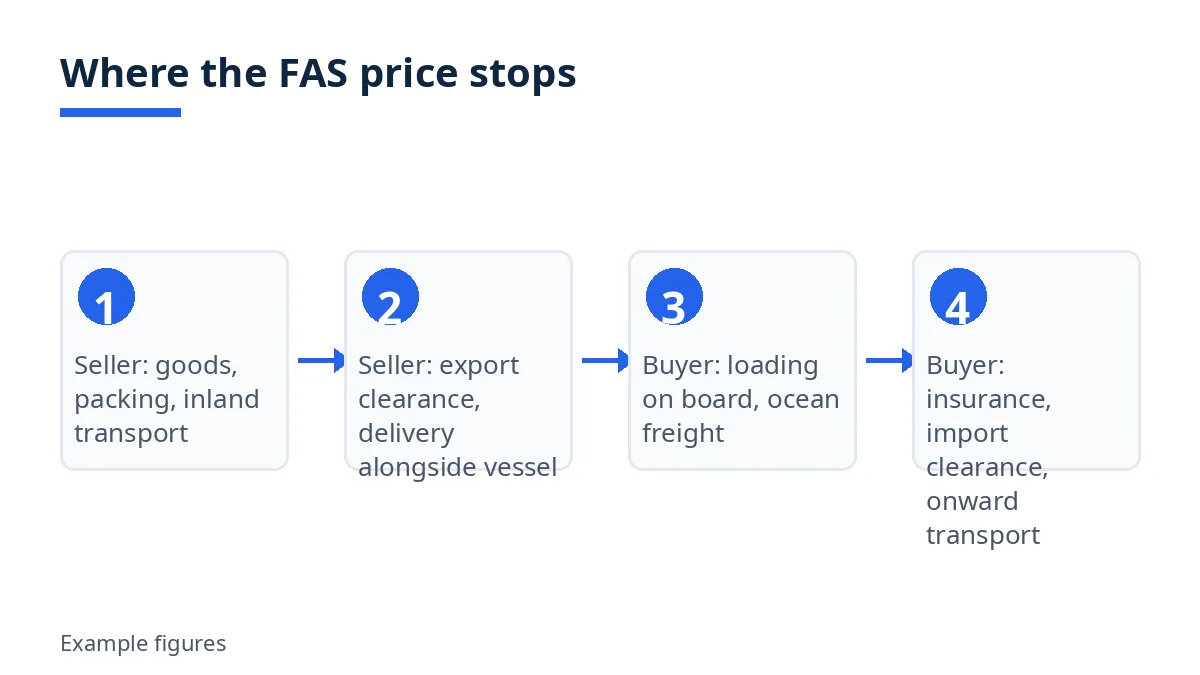
A typical FAS shipment from Bangladesh follows this sequence:
The buyer and seller agree the term in the contract, naming the port of shipment, for example FAS Chittagong, Incoterms 2020.
The buyer nominates the vessel and tells the seller the vessel name, the loading point within the port, and the delivery period in good time.3
The seller packs and marks the goods, arranges inland transport to the port, and completes export clearance.
The seller delivers the goods alongside the nominated vessel and notifies the buyer.2
The buyer takes delivery at the quayside, pays for loading on board, and contracts the carrier for the main voyage.
The buyer arranges insurance if it wants cover, and handles import clearance, duties, and onward transport.
The diagram shows where the FAS price stops.
Who is responsible for what
Read any FAS price against this table.
Cost or task | Paid or handled by |
|---|---|
Goods themselves | Seller |
Export packing and marking | Seller |
Inland transport to the port | Seller |
Export clearance | Seller |
Delivery alongside the vessel | Seller |
Proof of delivery | Seller |
Loading on board | Buyer |
Ocean freight | Buyer |
Marine insurance | Buyer, if the buyer chooses to insure |
Import clearance and duties | Buyer |
Unloading and onward transport | Buyer |
The seller must complete export formalities, and the buyer must complete import formalities and any transit customs clearance.3 Under FAS, neither party is obliged to insure the cargo, so a buyer who wants cover must arrange it separately. Also agree in writing which side pays each port charge at the loading point, since port practice varies.2
Worked example with numbers (Bangladesh shipment)
The figures below are example figures, not market rates. The example order is 10 tonnes of jute yarn from a mill near Narayanganj, sold FAS Chittagong, Incoterms 2020, to a buyer in Europe.
What the FAS price includes
Line | Example figure (USD) |
|---|---|
Goods, ex-works value | 14,000 |
Export packing and marking | 350 |
Inland transport, Narayanganj to Chittagong | 480 |
Export clearance and documentation | 220 |
Port handling to alongside the vessel | 300 |
FAS price | 15,350 |
The FAS price of USD 15,350 is the total the seller charges for delivery alongside the vessel at Chittagong. Export clearance in Bangladesh requires an approved export declaration with documents such as the commercial invoice, packing list, and certificate of origin.4
What the buyer still pays after the FAS price
Line | Example figure (USD) |
|---|---|
Loading on board at Chittagong | 260 |
Ocean freight to destination port | 1,850 |
Marine insurance, buyer-arranged | 140 |
Import clearance, duties, onward transport | Varies by destination |
On these example figures, the buyer adds at least USD 2,250 after the FAS price, before destination duties and inland transport. Before comparing this FAS quote with a CIF quote, add the loading, freight, and insurance lines first: the CIF price already contains freight and insurance, while the FAS price contains neither. The loading line is also the whole difference between FAS and FOB: under FAS, loading is the buyer's cost, while under FOB it is the seller's cost.3
FAS vs related terms
Term | Seller delivers | Loading on board | Ocean freight | Insurance |
|---|---|---|---|---|
FAS | Alongside the vessel | Buyer pays | Buyer pays | Buyer arranges if wanted |
FOB | On board the vessel | Seller pays | Buyer pays | Buyer arranges if wanted |
FCA | To the carrier at a named place | Depends on the named place | Buyer pays | Buyer arranges if wanted |
CIF | On board the vessel | Seller pays | Seller pays | Seller arranges |
FAS and FOB share most features: both apply only to sea or inland waterway transport, both require the seller to complete export formalities, and in both the buyer contracts the carrier and pays port-to-port costs.3 The difference is the delivery point alone. CIF goes further: the seller also arranges and pays for freight and insurance to the destination port.
Common mistakes to avoid
Treating an FAS price as a delivered price. It ends at the quayside; loading, freight, insurance, and import costs all come after it.
Accepting a quote without a named port. Insist on the full term, for example FAS Chittagong, Incoterms 2020.
Using FAS for containerized cargo. Containers delivered to a terminal are usually better handled under FCA.3
Assuming insurance is included. Under FAS, neither party must insure the cargo, so arrange cover yourself if you want it.
Leaving port charges vague. Agree in writing which side pays each charge at the loading point, since port practice varies.2
Giving late vessel details. Late notice of the vessel name, loading point, or delivery period can shift risk and extra costs to the buyer.3
Comparing FAS and CIF prices directly. Add loading, freight, and insurance to the FAS price first.
How Exportain helps
When you post a request on Exportain, ask each supplier to itemize the quote on the same basis: goods, packing, inland transport, export clearance, and port handling up to alongside. Itemized quotes make FAS prices comparable and expose any quote that omits a line the seller should carry. Ask suppliers to state the named port and the Incoterms version in full. Post a free RFQ on Exportain and get quotes from Bangladeshi suppliers on the same FAS basis.
FAQs
What is FAS?
FAS stands for Free Alongside Ship. Under Incoterms 2020, the seller places the goods alongside the vessel nominated by the buyer at the named port of shipment and completes export clearance. It applies only to sea and inland waterway transport.2
How does FAS work in practice?
The buyer nominates the vessel and gives the seller the vessel name, loading point, and delivery period in good time. The seller brings the goods to the port, clears them for export, and places them alongside the vessel. The buyer then pays for loading, contracts the carrier, and handles import clearance.3
Is FAS used for shipments from Bangladesh?
Yes, for sea shipments from ports such as Chittagong, where the seller can deliver goods alongside a vessel. It fits bulk and break-bulk cargo better than containerized cargo, which suits FCA better.3 Before agreeing the term, confirm the named port, the loading point, and which side pays each port charge.
What are common mistakes with FAS?
Treating an FAS price as a delivered price, accepting a quote without a named port, using FAS for containerized cargo, assuming insurance is included, and comparing an FAS price directly with a CIF price. Each comes from reading the FAS price as more than it is: a price up to the side of the ship, and no further.
Next steps on Exportain
See how FAS sits beside the other terms in Incoterms for shipments from Bangladesh.
Compare with CIF cost, insurance and freight if you want a price that already includes freight and insurance to destination.
Work out the full journey cost with landed cost for imports from Bangladesh before you accept any port-side quote.
Sources
- Incoterms® 2020. International Chamber of Commerce (ICC) (accessed )
- FAS - Free alongside ship (Named Place) Incoterms 2020. Export Council of Australia (accessed )
- FOB & FAS Incoterms® 2020 explained: Key differences. ICC Academy (accessed )
- Customs Clearance Procedures for Export. Bangladesh Customs, National Board of Revenue (accessed )
About the author
Sourcing from Bangladesh?
Post a request for quotation and suppliers on Exportain can send you their quotes directly.
Post an RFQ