

Documents Required for CIF Shipments: Complete Checklist
A numbered documents checklist for CIF shipments from Bangladesh: invoice, packing list, bill of lading, insurance document, certificate of origin, and export clearance papers, with what each document must show and who issues it.
Short answer
For a CIF shipment from Bangladesh, the seller must provide the commercial invoice, packing list, on-board clean bill of lading, insurance document with Clause C minimum cover for at least 110 percent of the contract price, certificate of origin where required, and the Bill of Export with the EXP form for export clearance. The buyer completes the payment and import documents. Every document must show the same goods, quantities, ports, and names.
On this page
Key takeaways
CIF is sea and inland waterway only: the seller delivers on board, pays freight and minimum Clause C insurance to the named destination port, and the buyer bears the risk from loading.
Build every document from the commercial invoice, and check the finished set against the invoice and the letter of credit before the vessel sails.
The insurance document must show at least 110 percent of the contract price in the contract currency, Clause C minimum cover, and a beneficiary who can claim.
Bangladesh export clearance needs the Bill of Export with the signed invoice, packing list, AD-certified EXP form, and certificate of origin enclosed.
A CIF shipment is a set of documents as much as it is a set of goods: the buyer pays against the documents, the carrier releases the goods against the bill of lading, and the insurer settles a claim against the insurance document. This checklist is for buyers importing from Bangladesh under CIF in the USA, the UK, the EU, and the UAE.
Why this checklist matters
Under CIF (Cost, Insurance and Freight), the seller delivers the goods on board at the port of shipment, pays the freight, and arranges minimum insurance cover to the named destination port, while the buyer bears the risk from loading onward.1 CIF is for sea and inland waterway transport only, so this checklist covers a sea shipment loading at a Bangladeshi port such as Chattogram.1 The seller must arrange minimum Institute Cargo Clauses (C) cover and provide the insurance document so the buyer can claim under it.2
Each document does a different job: the invoice states the value, the bill of lading entitles the holder to take delivery, and the insurance document is the route to payment after loading. Where payment is by documentary credit, the bank examines the documents, not the goods, so a set that does not match the credit does not get paid even when the goods are in order.3
Before you start
Agree the document set in writing before booking: the term in full, as in CIF Rotterdam, Incoterms 2020, the port of shipment where possible, the payment method, the document list, and the originals and copies required. If payment is by letter of credit, get the credit text first and build the list from it, because the credit decides what the bank will accept.3
Build every document from one set of data: prepare the invoice first, then copy its names, description, quantities, weights, marks, ports, and vessel details into each later document. Name one person to check the finished set against the invoice and credit before presentation.
The full checklist
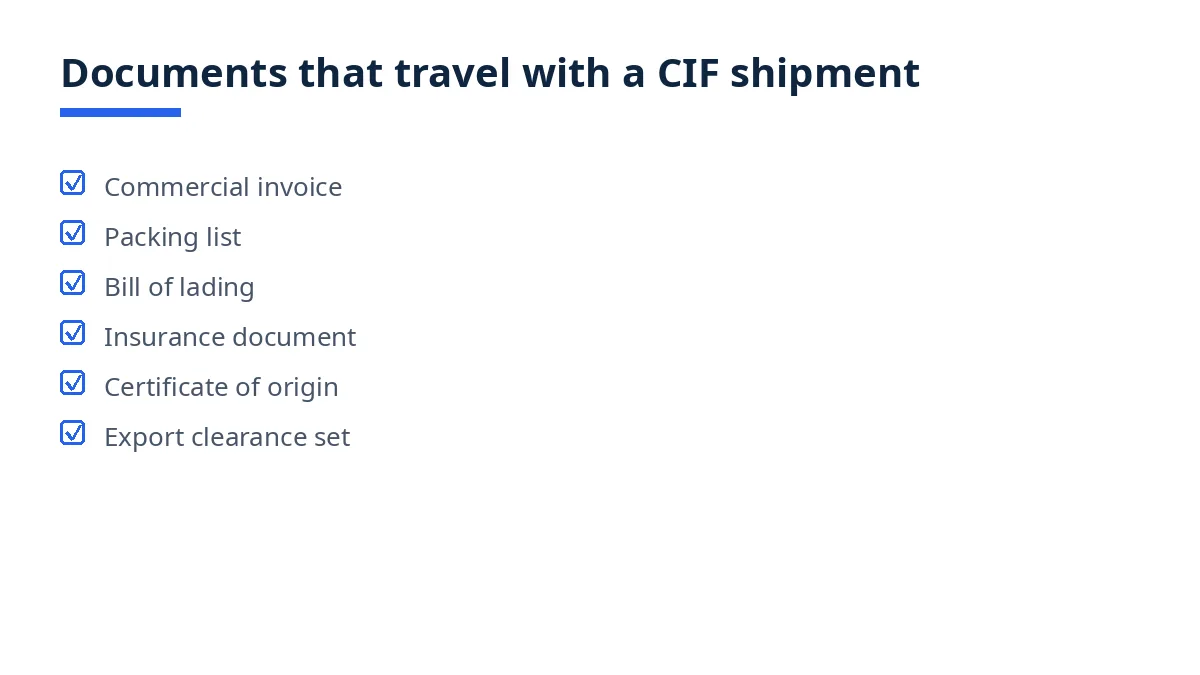
Work through the list in order, ticking each document only after it has been checked against the invoice and, where applicable, the letter of credit.
Commercial invoice. The seller issues it, showing the seller and buyer, goods description, quantity, unit and total price, the CIF term with the named destination port, the currency, and the invoice number and date. Under a letter of credit it must be issued by the beneficiary named in the credit, made out to the applicant, and describe the goods as the credit describes them.3
Packing list. The seller issues it, showing the carton count, the quantity in each, the net and gross weights, the measurements where required, and the shipping marks. Every figure must reconcile with the invoice and the bill of lading package count.
Bill of lading. The carrier issues it on the seller's instructions. Under a letter of credit it will usually need to be an on-board bill of lading, showing shipment on board a named vessel, the ports of loading and discharge, and the carrier's signature.3 Check the shipper, consignee or order party, notify party, description, and prepaid freight, and that it is clean, with no notation declaring a defective condition of the goods or packaging.3
Insurance document. The insurer issues it, and the seller obtains it, as a policy or a certificate showing the insured party, goods, voyage, sum insured, currency, clause level, and date of issue. Under CIF the sum insured must be at least 110 percent of the contract price, in the contract currency, at Clause C minimum cover.2 Under a letter of credit, cover must be effective at the latest from the date of shipment.3
Certificate of origin. The Export Promotion Bureau (EPB) or a chamber of commerce and industry issues it for export goods from Bangladesh.4 It must show the exporter, consignee, goods, and Bangladesh as the country of origin, matching the invoice. Obtain it where the destination authority, a preference arrangement, or the letter of credit requires it.
Bill of Export and EXP form. Goods may not be loaded for export in Bangladesh unless a Bill of Export, also called a shipping bill, has been submitted to Customs and approved, stating the goods, value, exporter, foreign buyer, and transport operator.4 Enclosed with it are the export letter of credit or contract, the signed invoice, the packing list, the EXP form certified by an Authorized Dealer bank, the certificate of origin, the VAT registration certificate, and the Taxpayer Identification Number.4
Export licences and product permits. Some goods need an additional document before export. For jute, jute goods, and tea, an Export Registration Certificate is among the additional documents listed, and tea also requires a consignment-wise export permit from the Bangladesh Tea Board.4 Check the product-specific requirement before booking.
Inspection or quality certificate. An independent inspector issues it only where the contract or letter of credit requires one, showing what was inspected, the quantity and lot, the result against the specification, and the date and place of inspection. Where none is required, do not add one, since its figures are another place for the set to disagree.
Beneficiary certificate and other credit documents. A letter of credit may call for further documents, such as a beneficiary certificate that documents have been sent as required. Prepare each in the exact wording the credit uses, and only where the credit calls for it, since an uncalled-for document can itself become a discrepancy.
Carrier notices. The carrier sends the arrival notice to the notify party on the bill of lading, and the seller or forwarder sends the booking confirmation and sailing details. These are notices, not title documents, so check that the notify party can act on the arrival notice at the destination port.
Buyer payment documents. The buyer, with the issuing bank, prepares the payment set. Under a letter of credit, check the issued credit against the contract before it goes to the seller, since an error in the credit becomes an error in every document prepared against it. Otherwise, keep the purchase order, contract, and payment evidence in the shipment file.
Buyer import documents. The buyer completes the import set at destination from the seller's documents: the import declaration, any import licence required, and the duty and tax payment evidence. Confirm the destination requirements before shipment, since the USA, the UK, the EU, and the UAE do not ask for identical papers.
Common failures and how to fix them
The most common failure is data that differs across the set: a quantity, weight, description, or port that reads one way on the invoice and another way on the packing list, bill of lading, or insurance document. Fix it at the source document, reissue every document that copied the error, and recheck the set.
The next failure is a bill of lading that does not say what the credit asks for: a received-for-shipment bill where an on-board bill is required, or a claused bill where a clean bill is required. Ask the carrier for the on-board notation and a clean document before presentation.3
Insurance failures follow the same pattern: a sum below 110 percent of the contract price, a wrong clause level or currency, or a certificate dated after shipment. Fix each by reissue before the vessel sails, in the same pass as the invoice check.2 3
Late or missing documents turn a paper error into a cost. A presentation must be made within 21 calendar days after shipment and not later than the credit expiry date, and banks have a maximum of five banking days after presentation to examine the documents.3 Ask for the certificate of origin and export clearance copies before sailing.
Downloadable template and summary table
Copy the checklist into the shipment file, add the contract and credit numbers and the vessel and sailing date, and record the checker and check date for each line.
Document | Issued by | Checked against | Used for |
|---|---|---|---|
Commercial invoice | Seller | Contract and credit | Payment, customs value, insurance value |
Packing list | Seller | Invoice and bill of lading | Clearance, count and weight checks |
Bill of lading | Carrier | Invoice and credit | Delivery, carriage evidence |
Insurance document | Insurer, via seller | Invoice and contract | Claim after loading |
Certificate of origin | EPB or chamber | Invoice | Origin and preference checks |
Bill of Export and EXP form | Seller, Customs, bank | Invoice and packing list | Export clearance evidence |
Export licence or permit | Issuing authority | Product requirement | Product-specific export permission |
Inspection certificate | Inspector | Contract or credit | Quality and quantity evidence |
Next steps on Exportain
Exportain is a B2B marketplace where buyers find Bangladeshi suppliers and post requests for quotation. Agree the document list at the enquiry stage, so every quotation is priced on the same CIF term, destination port, and document set. Read the CIF cost, insurance and freight guide for the full rule, compare the other terms in the Incoterms guide for shipments from Bangladesh, and work the figures into your landed cost for imports from Bangladesh. The how to buy guide explains the buying steps on Exportain. Exportain is not a party to the contract for the goods and does not inspect goods, book freight, or clear customs.
Post a free RFQ on Exportain and get quotes from Bangladeshi suppliers → https://exportain.com/rfqs
When should this checklist be used?
Use it three times: when the contract is agreed, when the goods are booked, and in a final pass before the vessel sails.
Who should complete it?
The seller prepares the seller documents, the buyer checks the set and completes the payment and import documents, and a forwarder, broker, or bank can help with the rest. Name one checker, and give that checker the contract, the credit text, and the booking details.
What are the most common failures?
Data that differs across the set, a bill of lading without the on-board notation or clean status the credit requires, an insurance document with the wrong sum, clause, or currency, and a certificate of origin that arrives late. Fix each by correcting the source document and rechecking the set.
Can a third party do it?
Yes. A forwarder can prepare and check the carrier and clearance documents, a broker can arrange and check the insurance document, and an inspector can issue the inspection certificate where one is required. The third party needs the contract, the credit text, and written authority.
Sources
- Incoterms® 2020. International Chamber of Commerce (ICC) (accessed )
- CIF & CIP Incoterms 2020 explained: Key differences. ICC Academy, (accessed )
- UCP 600 - Uniform Rules and Practice for Documentary Credits - Including eUCP Version 2.1. International Chamber of Commerce (accessed )
- Customs Clearance Procedures for Export. Bangladesh Customs, National Board of Revenue (accessed )
About the author
Sourcing from Bangladesh?
Post a request for quotation and suppliers on Exportain can send you their quotes directly.
Post an RFQ


