How to Import Solar Panels From Bangladesh to Netherlands: Step-by-Step Guide
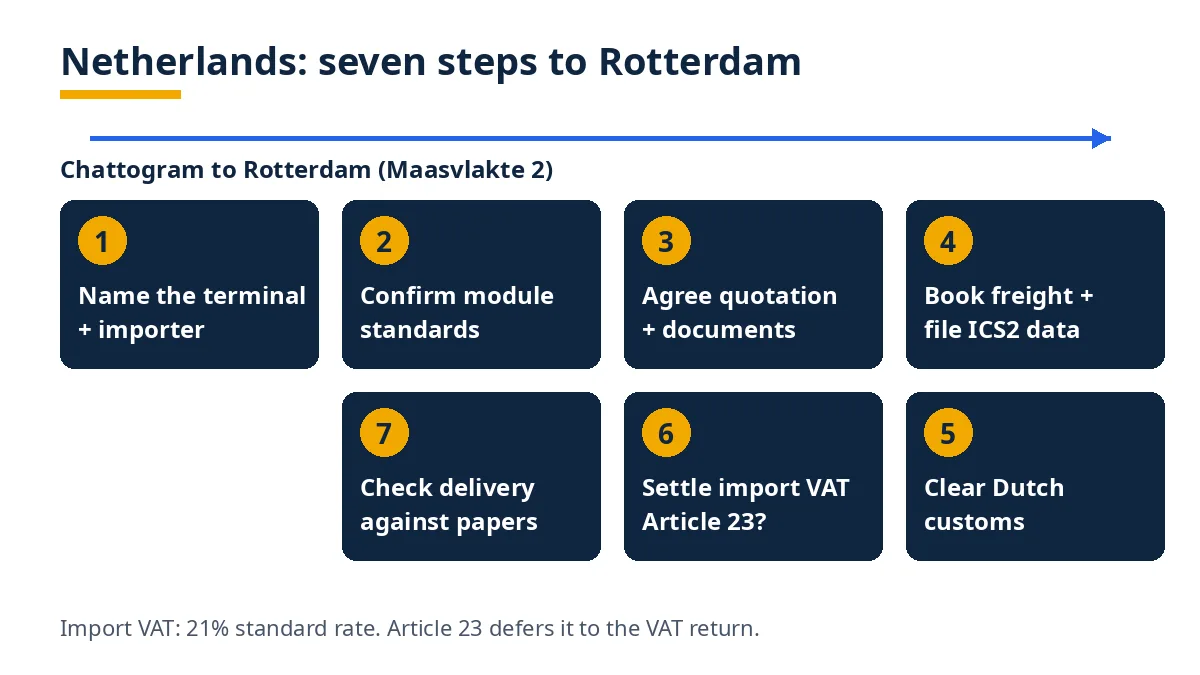
Seven steps take a solar panel shipment from Bangladesh to delivery in the Netherlands: terminal, standards, quotation, freight and advance data, Dutch customs, import VAT, and delivery checks.
Short answer
To import solar panels from Bangladesh to the Netherlands, name the Rotterdam terminal and importer, confirm the exact module's IEC 61215 and IEC 61730 papers, agree quantity and documents in one quotation, book freight and file the ICS2 advance data, clear Dutch customs with REX origin proof, settle 21 percent import VAT or an Article 23 permit, then check delivery against the papers.
On this page
Key takeaways
Name the Rotterdam terminal in the contract; freight priced to a country, not a terminal, cannot be compared.
Both IEC 61215 and IEC 61730 evidence must name the exact model; a change of material or design triggers re-evaluation.
The EBA preference needs REX proof of origin for the consignment, kept with the entry file for at least three years.
Article 23 defers import VAT to the VAT return through a permit and, for a foreign entrepreneur, a tax representative; it does not remove the VAT or the duty.
Rotterdam is where a Bangladesh solar panel shipment first meets the Dutch border, and the order of the work matters more than the speed of any single step. The terminal must be named before freight is priced, the module papers must be settled before the price is agreed, and the Dutch customs and VAT file must be ready before the vessel sails. This guide follows that order in seven steps, from the Rotterdam terminal to delivery after clearance.
Step 1: Name the Rotterdam terminal and the buyer who will import
Start with the discharge point, not with the country. Ask the carrier or forwarder, in writing, which Rotterdam terminal the booked service calls at, what free time applies at that terminal, and what destination charges apply there. The container terminals on Maasvlakte 2 are fully electric, from the automated guided vehicles to the quay cranes, and the APM Terminals terminal there runs entirely on power generated by wind turbines, while Rotterdam World Gateway buildings use thermal storage.1 Put the terminal name in the contract and in the carrier booking, and compare freight quotations only on the same terminal basis.
In the same step, settle who imports the goods. Decide whether the buyer will be the importer of record, whether a Dutch company in the buyer's group will import, or whether a broker will file as declarant for the buyer, and record the EORI number that will appear on the filings. The European Commission states that operators must obtain an EORI number from a Member State customs authority to connect to the advance cargo system, and that the Entry Summary Declaration is filed through that system.2 For the supplier side, the solar panel manufacturers guide explains how to check a supplier's papers before asking for a price.
Step 2: Confirm the module standards before you agree a price
Ask the supplier to specify the precise model, the cell kind, the frame-and-glass construction, the junction-box and connector package, and the manufacturing site for that precise version, and ask for the test reports and certificates naming that model. The supplier should also state, in writing, what change to materials, design, or internal spacing would send the module back for re-evaluation.
Two standards carry the evidence, and each answers a different question. IEC 61215-1:2021 tests whether a terrestrial module design can endure extended outdoor exposure; the standard itself cautions that its results do not predict service life in years.3 The companion safety standard, IEC 61730-1:2023, sets construction rules meant to prevent shock, fire, and injury, and applies only up to 1,500 V DC.4 Its test programme shares samples with the IEC 61215 programme, and a later change to a material, a dimension, or the internal layout means the construction is assessed again under IEC TS 62915 and the IEC 61730 series.4
Step 3: Agree quantity, delivery rule, and documents in one written quotation
Only now ask for the quotation, and ask every supplier for the same items in the same form: the exact module from Step 2, the quantity, the unit price and currency, the delivery rule with the named places, the port of loading in Bangladesh, the named Rotterdam terminal, the sample terms, the lead time with its start date defined, the payment terms, and the validity period. Put every reply into one comparison table. This guide states no typical price and no typical minimum order quantity, because both vary by model, production run, and supplier; ask each supplier to state its minimum in writing for the exact model. The solar panels price guide shows how to read a cost breakdown, and the solar panels MOQ guide shows how to test a minimum quantity before committing.
Agree the documents in the same round, before any deposit is paid: the invoice, packing list and bill of lading, the origin statement, the Step 2 test evidence, and the declaration of conformity for the exact module. Confirm whether the supplier's price includes freight and insurance to Rotterdam or only to the port of loading. For that choice, read the CFR guide for Bangladesh to Netherlands and the FOB guide for Bangladesh to Netherlands before signing.
Step 4: Book freight and file the advance cargo data
Book the sailing to the named Rotterdam terminal, and confirm the booking in writing with the terminal, the sailing schedule for the shipment week, and the free-time period at that terminal. Give the carrier and the broker the full shipment data early: the manufacturer name and address, the country of origin, the commodity code, the consignee details and EORI number, and the commercial description of the modules in the same words as the invoice. Before arrival, the carrier and broker must lodge the full Entry Summary Declaration through ICS2. Customs screen that advance data for safety and security, and a declaration with gaps can be rejected or referred, which holds the shipment up.2 Ask the carrier for the maritime filing deadline for this sailing in writing, meet it, and correct the filing when a fact changes.
Check the packing and loading position at the same time. Confirm the container count, the pallet or loose-load arrangement, the marks and numbers on the cartons, and the weight and dimensions on the bill of lading, and make sure the packing list matches the cartons actually loaded.
Step 5: Clear Dutch customs at Rotterdam
When the vessel arrives, the import declaration is filed with Dutch Customs for release for free circulation, and the broker confirms the classification and the measures in force on the entry date for the exact modules. The code grows by layers. Six Harmonized System digits are followed by two Combined Nomenclature digits, then two TARIC digits for Community measures, then one national digit, and the declaration must carry the complete code.5 Ask the broker to confirm the full code in writing and to state the duty rate that follows from it.
The duty position rests on origin, and origin must be proved. Everything But Arms removes duty and quota limits for least developed countries on every product other than arms and ammunition.6 That is the scheme, not the shipment. To use it, the importer needs a document proving where the goods were made, because the preference is checked by customs before it is granted.7 Origin proof takes the form of a statement on origin: a REX-registered exporter adds it to the invoice or another trade document, while an exporter outside REX can add it only for originating goods worth EUR 6,000 or less ex-works.7 Ask the exporter for its REX number, confirm that the statement covers the goods in this consignment, and keep the records with the entry file. Exporters must keep copies of proof of origin documents and related records for at least three years from the date of issue.7
Step 6: Settle Dutch import VAT, including the Article 23 question
Customs duty and import VAT are separate charges, and the VAT step must be settled before the goods are released. In the Netherlands the standard VAT rate is 21 percent, with a 9 percent rate and a 0 percent rate for other cases.8 Ask the broker or adviser to confirm, in writing, the VAT base, the rate, and the amount payable for this consignment, and pay only against the customs payment notice for this shipment.
Article 23 changes the cash timing, and it must be asked about before the shipment arrives. The reverse-charge mechanism on import means that the importer is not required to pay the VAT on import immediately, and the VAT can instead be paid when the importer files the VAT return, but doing this requires an Article 23 permit.9 A foreign entrepreneur cannot apply for an Article 23 permit directly, but can engage a tax representative, who can apply for the permit on the entrepreneur's behalf.9 Where a tax representative is used, the entrepreneur does not need to register with the Dutch Tax Administration, because the representative declares the VAT due on the VAT return for that period and deducts it as input tax on the same return, so the VAT is not paid in advance on import.9
Step 7: Move the container onward and check the delivery
Once customs release the goods, move the container from the named terminal on the route agreed in Step 1, and confirm the onward booking, the delivery address, and the party who will receive and inspect the modules. On arrival, check the container seal number against the bill of lading, count the cartons against the packing list, and check the module labels against the certificate, the datasheet, and the invoice: the model, the wattage class, and the manufacturer must match across all four.
Keep this file: the quotation and accepted terms, the certificate and test evidence, the declaration of conformity, the bill of lading, the origin statement, the import declaration, the customs payment notice, the invoice and packing list, the VAT return entry, and the delivery record. For the general import file behind this route, see the broader import guide for solar panels, and for the inspection behind the Step 2 papers, see the solar-panel inspection checklist.
Worked example: Rotterdam landed-cost arithmetic
Example figures. A Netherlands buyer imports one container holding 1,200 modules of a single model, with a customs value of EUR 52,000 in the example. The broker settles the full code and the measures applying on the entry date, the exporter provides a REX statement on origin for the consignment, and the example customs duty is therefore zero under Everything But Arms.6 7 The import VAT base in the example is EUR 52,000, and at the standard Dutch rate of 21 percent the import VAT in the example is EUR 10,920.8 Without an Article 23 permit, the buyer pays EUR 10,920 at the border in the example and reclaims it through the VAT return. With an Article 23 permit, the buyer pays no import VAT at the border in the example, and instead declares EUR 10,920 and deducts EUR 10,920 in the same VAT return.9
Item | Example amount | How the figure is reached |
|---|---|---|
Customs value | EUR 52,000 | Illustrative declared value |
Customs duty | EUR 0 | Illustrative, REX statement proves EBA preference |
Import VAT at 21 percent | EUR 10,920 | Illustrative, Dutch standard rate |
Cash at the border without Article 23 | EUR 10,920 | Illustrative, import VAT only |
Cash at the border with Article 23 | EUR 0 | Illustrative, VAT in the return |
Next steps on Exportain
Follow the steps in order, and do not book freight before the terminal, the importer, and the module papers are settled. Send the requirement, naming the exact model and the Rotterdam terminal, through a new RFQ, weigh the replies on an identical delivery basis via suppliers, and read the how-to-buy guide before accepting a quotation. On Exportain, buyers issue RFQs and suppliers answer with quotations; supplier checks look at documents and photographs rather than inspecting a factory, and Exportain stays outside the goods contract.10
Sources
- Making Maasvlakte 2 more sustainable. Port of Rotterdam (accessed )
- Import Control System 2. European Commission (accessed )
- IEC 61215-1:2021 - Terrestrial photovoltaic (PV) modules - Design qualification and type approval - Part 1: Test requirements. International Electrotechnical Commission (accessed )
- IEC 61730-1:2023 - Photovoltaic (PV) module safety qualification - Part 1: Requirements for construction. NEN (accessed )
- Customs Tariff. German Customs Administration (accessed )
- Generalised Scheme of Preferences. European Commission (accessed )
- Proof of origin. European Commission (accessed )
- VAT rates and exemptions. Government of the Netherlands (accessed )
- Reverse-charge mechanism on import: Article 23. Belastingdienst (accessed )
- About Exportain. Exportain (accessed )
About the author
Sourcing from Bangladesh?
Post a request for quotation and suppliers on Exportain can send you their quotes directly.
Post an RFQ