

CFR Shipping From Bangladesh to Netherlands: Costs, Steps and Timeline
Under CFR, a Bangladeshi seller pays ocean freight to Rotterdam while risk passes to the buyer on board at Chattogram. This guide covers the Rotterdam arrival, EU customs and VAT, documents, costs and timeline for a CFR shipment from Bangladesh to Netherlands.
Short answer
Under CFR, a Bangladeshi seller pays ocean freight to Rotterdam while risk passes to the buyer when the goods are loaded on board at Chattogram. CFR covers goods plus freight to the named port only: the buyer arranges cargo insurance, clears Dutch customs, pays import duty and VAT, and arranges onward transport from Rotterdam.
On this page
Key takeaways
Under CFR the seller pays ocean freight to Rotterdam, but risk passes to the buyer on board at Chattogram, and the seller has no obligation to arrange cargo insurance.
Rotterdam is the EU entry point: after Dutch customs clearance, goods move onward within the EU without a second customs border.
A complete ICS2 Entry Summary Declaration must be filed before arrival, with accurate descriptions, HS codes and the consignee EORI.
Dutch import duty is charged on the customs value, which includes transport and insurance costs up to the EU border, and import VAT is charged on top.
Bangladesh currently enjoys duty-free, quota-free EU access under Everything But Arms, but the preference claim and proof of origin must still be checked before sailing.
A CFR shipment from Bangladesh to Netherlands is a sea shipment in which the Bangladeshi seller pays the ocean freight to Rotterdam, while the buyer carries the risk of loss or damage from the moment the goods are loaded on board at Chattogram. That split — seller pays the freight, buyer carries the sea risk — is the point most first-time buyers get wrong, and it shapes the insurance, the documents and the arrival plan in Rotterdam.
Rotterdam matters here beyond being the named port. It is the EU entry point in this guide: once the goods clear Dutch customs, they can move onward within the EU without a second customs border. That makes the Rotterdam arrival, the EU advance cargo filing and the Dutch VAT treatment the parts that differ most from a CFR shipment to a non-EU port.
Why this matters for buyers and sellers
CFR (Cost and Freight) is one of the 11 Incoterms 2020 rules, which give a clear allocation of cost, risk and obligations between buyer and seller.1 CFR applies only to sea and inland waterway transport, and it is unchanged in Incoterms 2020.2 The seller bears costs up to the destination port, but risk transfers to the buyer once goods are loaded on board at origin, and unlike CIF, the seller is not obligated to provide insurance under CFR.2
For the buyer, the advantage is a single freight-inclusive price to Rotterdam and a seller who arranges the ocean leg. The exposure is the uninsured sea leg: if the goods are damaged after loading, the loss is the buyer's unless the buyer arranged cover. For the seller, the exposure is paying freight to Rotterdam while delivery, in the Incoterms sense, already happened at Chattogram.
The container caveat deserves attention. Containers are often handed to a carrier at a terminal before they are loaded onto the vessel, but under CFR that terminal handover does not normally transfer risk: delivery and risk transfer occur on board at the shipment port.2 For container shipments where the seller pays carriage, CPT, or CIP if the seller also arranges insurance, may fit better.2 If both sides still choose CFR for containers, they should write down who insures the terminal-to-loading gap.
Rotterdam's scale is part of why buyers route through it. Container throughput in the port of Rotterdam rose 2.8% in 2024 to 13.8 million TEU, within total throughput of 435.8 million tonnes.3 A high-volume container port gives more sailings and more customs brokers who handle Bangladesh-origin cargo every week.
Step-by-step: how it works
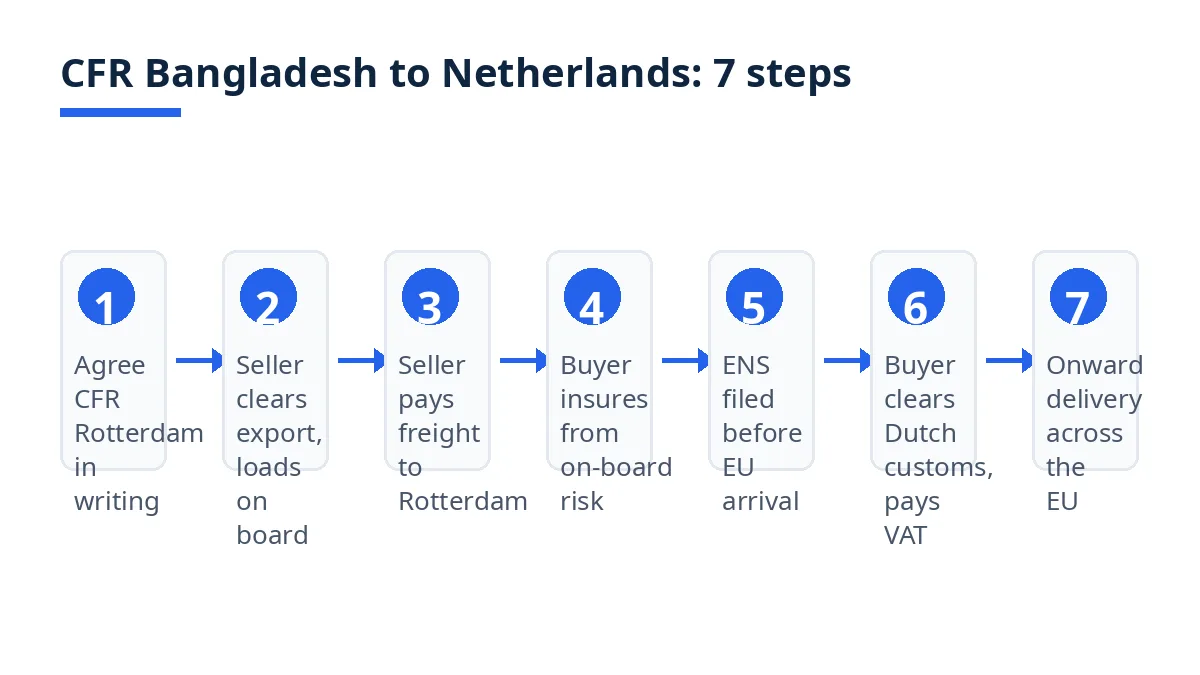
Agree the term in writing, with the named port. Write "CFR Rotterdam, Netherlands, Incoterms 2020" on the quotation, purchase order and proforma invoice, not just "CFR". The named port decides where the seller's freight obligation ends and where the buyer's import clearance begins.
Seller completes export clearance in Bangladesh. Goods may not be loaded unless an export declaration, the Bill of Export or Shipping Bill, is submitted to Customs and approved.4 Enclosed documents include the export contract or purchase order where there is no export letter of credit, the commercial invoice, the packing list, the EXP form certified by an authorized dealer, and a certificate of origin.4
Seller loads on board at Chattogram and pays freight to Rotterdam. The seller books the ocean leg and pays freight to the named destination port.2 Risk passes to the buyer at loading, so the buyer should have cargo insurance in force from that point, not from arrival.
The EU advance filing is made before arrival. Economic operators need to submit a complete Entry Summary Declaration (ENS) in the ICS2 system for all goods transported to or through the EU prior to their arrival.5 To connect to ICS2, operators must obtain an EORI number from one of the EU Member States' customs authorities.5 In practice the carrier or forwarder files the ENS, but the buyer must supply accurate descriptions, HS codes and the consignee EORI in time.
Buyer clears import customs at Rotterdam. When importing from a non-EU country, the buyer files an import declaration with Dutch customs; the carrier or broker usually files it for a fee and advances any import duties and VAT due.6 The buyer always needs an EORI number when dealing with Dutch customs.6
Buyer pays duty and VAT, then arranges onward delivery. Import duties are paid on the customs value, which is the purchase price plus transport and insurance costs up to the EU border or port of entry.6 Once cleared, the goods move within the EU: there is free movement of goods in the EU, so no import duties are paid and no declaration is filed when moving goods from one EU member state to another.6
Buyer confirms receipt and closes the file. Match quantity and condition against the packing list and bill of lading, keep the import declaration and VAT records, and note any damage claim deadline from the insurance policy.
Costs, timelines and documents
What should I know first about CFR?
The CFR price covers the goods plus freight to Rotterdam. It does not cover cargo insurance, Dutch import duty, Dutch import VAT, Rotterdam unloading and handling charges that are not included in the seller's carriage contract, or onward transport from Rotterdam.2 The buyer's obligations are payment for the goods, destination unloading and handling charges not included for the seller's account in the carriage contract, import customs clearance, payment of duties, VAT and other taxes, and inland transport to the final destination.2
Cost line | Paid by | Notes |
|---|---|---|
Goods value | Buyer | As agreed in the sales contract |
Inland transport to Chattogram and loading | Seller | Part of the seller's CFR cost to the destination port2 |
Export clearance in Bangladesh | Seller | Bill of Export and enclosed documents4 |
Ocean freight Chattogram to Rotterdam | Seller | Seller books and pays freight to the named port2 |
Cargo insurance for the sea leg | Buyer | No insurance obligation on the seller under CFR2 |
Rotterdam unloading and handling | Depends on the carriage contract | Confirm in writing whether it is included2 |
Dutch import duty | Buyer | On the customs value, by commodity code6 |
Dutch import VAT | Buyer | Broker often advances it; see below6 |
Onward transport from Rotterdam | Buyer | Road, rail or barge to the final destination |
What are the typical costs and timelines?
No fixed freight rate or transit time can be stated as fact for this route, because both move with the sailing schedule, transshipment routing and the season. Ask the seller or freight forwarder for the sailing schedule, the transshipment port if any, and the free-time period at Rotterdam, and treat any quoted figure as valid only for the stated sailing.
Example figures: a buyer agrees a CFR Rotterdam price of USD 52,000 for one container, made up of goods valued at USD 48,500 and ocean freight of USD 3,500. The buyer separately arranges cargo insurance at USD 400, pays Rotterdam handling of USD 350 that the carriage contract does not include, and pays Dutch import VAT on the customs value. The example shows structure only, not a market rate: the freight line is whatever the seller's booking actually costs for that sailing.
For timelines, work in stages rather than a single delivery week. Example figures: production and export clearance in Bangladesh take the first stage, the ocean leg to Rotterdam the second, and Dutch customs clearance plus onward delivery the third. If any stage slips — a late Bill of Export approval, a rolled sailing, or an incomplete ENS — the arrival week slips with it. Ask for each stage as a separate date.
Which documents are needed?
The export set from Bangladesh is the Bill of Export, the commercial invoice, the packing list, the EXP form certified by an authorized dealer, and the certificate of origin.4 The transport document is the bill of lading, which the buyer or the buyer's bank needs to take delivery at Rotterdam. The import set at Rotterdam is the import declaration, commercial invoice, packing list, bill of lading, commodity code for each product, and consignee EORI number.6 Products need a 10-digit commodity code for import into the Netherlands.6
Two EU-specific items belong on the document checklist. First, the ICS2 Entry Summary Declaration, filed before arrival, with complete data for the mode of transport.5 Incomplete ENS declarations may be rejected, and risk referrals may require additional information or screening before risk assessment can resume.5 Second, where a preferential duty rate is claimed, the proof of preferential origin must match the goods and the claim.
Bangladesh-specific rules and tips
Check the duty position before you price the landed cost. The EU's Everything But Arms (EBA) initiative gives least developed countries duty-free and quota-free access to the EU market for all products except arms and ammunition.7 Bangladesh, as an LDC, currently enjoys duty-free, quota-free access under EBA.7 That does not remove VAT, and it does not remove the need to prove origin: confirm the preference claim and its supporting document with the customs broker before the goods sail, not at Rotterdam.
Treat the 2027 change as a planning risk, not a reason to delay. A new EU Generalised Scheme of Preferences framework is scheduled to take effect on 1 January 2027 and remain in place for 10 years.7 For a shipment sailing now, the current EBA position applies; for a long-term sourcing plan, ask the broker how the preference claim would change after graduation and the transition period.
Use the Dutch VAT mechanics to protect cash flow. The buyer pays import VAT at Rotterdam, and the broker usually advances it.6 KVK's importer guidance uses 21% Dutch VAT in its worked examples for Dutch VAT calculations.6 If the buyer is established outside the Netherlands, ask a Dutch tax adviser about fiscal representation before the first shipment.
Keep one legal name across every paper. The Bangladesh export declaration names the exporter and the foreign buyer,4 and the Dutch import declaration needs the consignee EORI, tied to the buyer's registered identity.5 6 A mismatch between the invoice, the bill of lading and the EORI record is a common cause of a Rotterdam hold.
Confirm the carriage contract's handling terms. The seller pays freight to Rotterdam, but destination unloading and handling charges fall to the buyer unless the carriage contract includes them.2 Ask the freight quotation to state, line by line, which Rotterdam charges are included.
Mistakes and red flags
What are the most common mistakes?
Assuming CFR includes insurance. It does not. CFR leaves the buyer to arrange cargo insurance, and the seller has no obligation to provide it.2 A buyer who discovers this after loading has an uninsured sea leg.
Assuming delivery happens at Rotterdam. Delivery and risk transfer happen on board at Chattogram.2 A claim for damage during the ocean leg is the buyer's claim, even though the seller paid the freight.
Filing the ENS late or with generic descriptions. ICS2 requires a complete ENS before arrival,5 and incomplete declarations may be rejected or referred.5 Generic descriptions, missing HS codes and an invalid consignee EORI hold cargo at the EU border.
Pricing the landed cost without VAT. The CFR price ends at Rotterdam's port charges. Dutch import duty is charged on the customs value, which includes transport and insurance costs up to the EU border,6 and import VAT is charged on top. A landed-cost sheet that stops at the CFR price understates the real cost.
Using CFR for containers without addressing the terminal gap. Containers reach the carrier at a terminal before loading, but risk transfers only on board.2 If neither side insures the gap, a terminal incident becomes a dispute about when the damage happened.
Treating a profile or a badge as a guarantee. A badge is not a guarantee of production capacity, product quality or delivery.8 Sample approval and inspection stay with the buyer.
Checklist
Term written as "CFR Rotterdam, Netherlands, Incoterms 2020" on quotation, order and invoice.
Freight quotation states which Rotterdam unloading and handling charges are included.
Cargo insurance arranged by the buyer from the on-board loading point.
Export set agreed: Bill of Export, commercial invoice, packing list, EXP form, certificate of origin.4
ENS data supplied before sailing: goods descriptions, HS codes, consignee EORI.5
Consignee EORI valid and matching the name on the invoice and bill of lading.6
Commodity codes confirmed at 10 digits, and any preference claim and proof of origin checked.6 7
Dutch import VAT treatment confirmed with a tax adviser before the first shipment.
Onward transport from Rotterdam booked, with a named final destination.
Damage claim route agreed: insurer, surveyor and notification deadline.
How Exportain helps
On Exportain, browse suppliers and post your requirement on the RFQ board with the term "CFR Rotterdam, Netherlands, Incoterms 2020", so suppliers quote against the same named port and freight scope. Ask each reply to state whether Rotterdam unloading and handling charges are included, and to confirm the sailing route and transshipment port.
Read the badges for what they record. Supplier verification is a document review by Exportain's team, not a factory inspection and not a check against any government database.8 It is a document and photo review, not a factory inspection.9 Exportain Verified means Exportain has checked the seller's identity, phone, email and business registration, and Export Verified means it has checked the Export Registration Certificate (ERC).8 Verification is free and never purchased, and membership plans never grant a trust badge.8 When a buyer accepts a quotation, Exportain creates one order and issues one proforma invoice from the accepted terms.8
See the Incoterms guide for the full set of rules and the landed cost guide for building the full cost picture beyond the CFR price.
FAQs
What should I know first about CFR?
CFR means the seller pays ocean freight to the named destination port, here Rotterdam, while risk passes to the buyer when the goods are loaded on board at the port of shipment.2 CFR applies only to sea and inland waterway transport, and the seller has no obligation to arrange cargo insurance.2 The Incoterms 2020 rules give a clear allocation of cost, risk and obligations for each rule.1
What are the typical costs and timelines?
The CFR price covers goods plus freight to Rotterdam. Insurance, Dutch import duty, Dutch import VAT, Rotterdam handling not included in the carriage contract, and onward transport are the buyer's costs.2 No fixed freight rate or transit time can be stated for this route: both depend on the sailing, routing and season, so ask for the sailing schedule and each stage as a separate date. Example figures here show cost structure only, not market rates.
Which documents are needed?
The Bangladesh export set is the Bill of Export, commercial invoice, packing list, EXP form certified by an authorized dealer, and certificate of origin.4 The Rotterdam import set is the import declaration, commercial invoice, packing list, bill of lading, 10-digit commodity codes and the consignee EORI number.6 Before arrival, a complete ICS2 Entry Summary Declaration must be submitted for goods transported to or through the EU.5
What are the most common mistakes?
The most common mistakes are assuming CFR includes insurance, assuming delivery happens at Rotterdam rather than on board at Chattogram,2 filing the ENS late or with generic descriptions,5 pricing landed cost without Dutch import VAT, and leaving the container terminal-to-loading insurance gap unaddressed.2
Next steps on Exportain
Browse suppliers, then post your requirement with the term "CFR Rotterdam, Netherlands, Incoterms 2020" on the RFQ board so suppliers quote against the same port and freight scope. Before you confirm, read the Incoterms guide and the landed cost guide to complete the cost picture.
Sources
- Incoterms® 2020. International Chamber of Commerce (ICC) (accessed )
- CFR Incoterms: Meaning, Costs & Risk. iContainers (accessed )
- Cargo throughput in the port of Rotterdam slightly decreased in 2024. Port of Rotterdam Authority (accessed )
- Customs Clearance Procedures for Export. Bangladesh Customs, National Board of Revenue (accessed )
- Import Control System 2. European Commission (accessed )
- Importing home accessories. Netherlands Chamber of Commerce (KVK) (accessed )
- EU invites Bangladesh to share success story in preferential market access. The Financial Express (accessed )
- Trust & Safety Center. Exportain (accessed )
- Supplier verification: Earn trust badges buyers can see. Exportain (accessed )
About the author
Sourcing from Bangladesh?
Post a request for quotation and suppliers on Exportain can send you their quotes directly.
Post an RFQ


