Quality Control Checklist for Solar Panels From Bangladesh
A numbered QC checklist for solar panels from Bangladesh: documents and certificates, nameplate and serials, flash test records, glass, cells and laminate, dimensions, insulation and EL evidence, junction box and connectors, pallets and packing, with fixes for common failures.
Short answer
Use this solar panels quality control checklist to check module documents and certificates, nameplate values at standard test conditions, serial and flash test records, glass, cells and laminate, dimensions and weight, insulation and electroluminescence evidence, junction box, cables and connectors, and pallet packing on photovoltaic modules from Bangladesh before shipment. Agree tolerances, test methods and acceptance numbers in the purchase order.

On this page
Key takeaways
Agree the datasheet, nameplate drawing, tolerances, test methods and acceptance numbers before inspection, and draw the sample randomly across wattage bins, pallets and production dates.
Check the nameplate against the flash test records serial by serial: IEC 61215-1 requires clear and indelible nameplate markings, with electrical values stated at standard test conditions of 1,000 W/m2, 25 °C and AM1.5.
Use electroluminescence images where the plan includes them, because cracked cells sealed under glass do not show in a visual check: IEC TS 60904-13 sets methods to capture, process and interpret EL images.
Check the pallet as carefully as the module: IEC 62759-1 simulates transportation of complete package units because type approval does not cover transport stresses, so outer modules and packing carry the highest transit risk.
Use this solar panels quality control checklist to check a shipment of photovoltaic (PV) modules before it leaves Bangladesh. A module is judged on the flash tester and in the electroluminescence (EL) image: an overstated nameplate, or a cell cracked under intact glass, shows only after installation if missed. ISO 2859-1 specifies an acceptance sampling system for inspection by attributes, indexed in terms of the acceptance quality limit (AQL), applicable to end items.1
Why this checklist matters
Solar panels concentrate risk in a sealed, layered product: the cells decide the output, the glass and laminate decide how long it survives outdoors, and the frame, junction box and connectors decide whether it can be mounted as documented. A fault sealed inside the laminate does not show on the carton face.
A written checklist removes interpretation. Each point is checked against the approved sample, datasheet and nameplate drawing, and recorded as pass or fail. Sampling and acceptance numbers are set in the purchase order, not in this checklist: ISO 2859-1 indexes its schemes by AQL for lot-by-lot inspection.1 Qualification is separate: IEC 61215-2 states that the objective of its test sequence is to determine the electrical characteristics of the module and to show it can withstand prolonged exposure outdoors.2 See the AQL acceptance quality limit explainer.
Before you start
Do not begin until the references are complete: an approved sample module per type and bin, the datasheet, nameplate drawing, purchase order and packing specification, and the certificate and report file for the exact types. The specification names each type separately: cell technology, rated power and binning, open-circuit voltage (Voc), short-circuit current (Isc), maximum system voltage, dimensions, weight, frame, glass build, junction box, and cable and connector types. Agree the sampling plan in advance,1 and draw the sample randomly across pallets and dates.
IEC 61215-1 sets the test requirements for design qualification and type approval, including marking: its nameplate clause requires clear and indelible markings, with electrical parameters referring to standard test conditions (STC).3 For crystalline silicon, IEC 61215-1-1 adds the special testing requirements, and notes that test results do not predict module lifetime quantitatively.4
IEC 61730-1 specifies the fundamental construction requirements for safe electrical and mechanical operation, assessing prevention of electrical shock, fire hazards and personal injury,5 and IEC 61730-2 provides the testing sequence that verifies that safety.6 Read how to import solar panels from Bangladesh alongside this checklist.
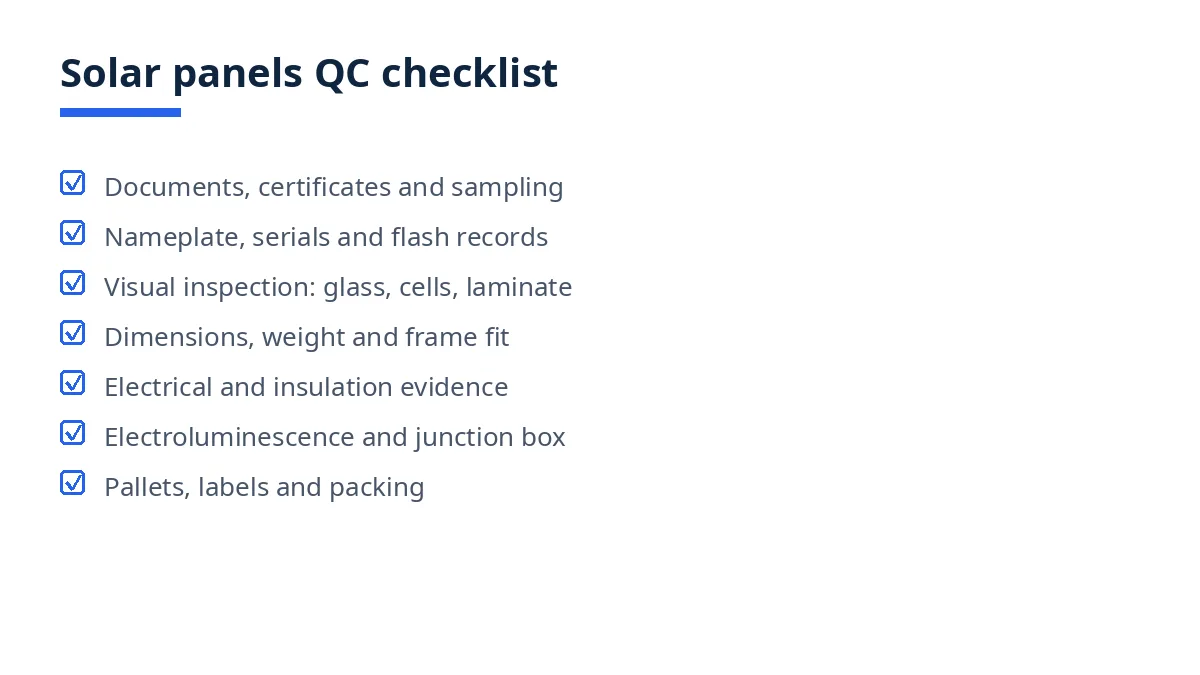
The full checklist (numbered, printable)
Documents, certificates and sampling
Draw the sample randomly across bins, pallets and production dates under the agreed plan, recording pallets and serial ranges sampled.
Check each module against the datasheet and sample: cell technology, power bin, dimensions, frame, glass build, junction box, and cable and connector types must agree.
Check the certificate and report file for the exact type: model, standard editions and report numbers must match the module in hand, not a related model.
Nameplate, labels and serial numbers
Read the nameplate against the drawing: maker name or trade mark, type or model, serial number, manufacture date and place or a traceable serial, maximum system voltage, protection class, Voc, Isc and maximum power (Pmax), each with tolerances. IEC 61215-1 lists these clear and indelible markings.3
Check that nameplate values refer to STC: IEC 61215-1 states the data relative to STC of 1,000 W/m2 irradiance, 25 °C cell temperature and the AM1.5 reference spectrum.3
Scan the serial barcodes against the packing list: no duplicates, no unexplained gaps, each serial matched to its flash record. For bifacial modules, check the nameplate also shows the bifaciality coefficients IEC 61215-1 requires.3
Visual inspection: glass, cells and laminate
Inspect the front glass of sampled modules under strong light for chips, scratches, cracks and coating marks, recording findings by serial.
Inspect the cells through the glass, cell by cell: cracked or chipped cells, discoloration, foreign material and misaligned cells, against the sample.
Treat visual inspection as a named test: in IEC 61215-1 it is MQT 01, assessed against the list of major visual defects.3
Check the laminate and rear cover for bubbles, edge delamination, yellowing, tears and burn marks, including under the junction box.
Check the frame for coating damage, dents and open corner joints, and that mounting and grounding holes match the drawing.
Dimensions, weight and frame fit
Measure length, width and thickness including frame on sampled modules against datasheet tolerances, recording actual values.
Measure mounting hole positions and spacing against the drawing, because these decide racking fit, and weigh sampled modules against the datasheet weight.
Electrical checks: flash test and current-voltage records
Review the flash test record per serial: Pmax, Voc and Isc against the nameplate bin and its tolerance. IEC 61215-1 verifies rated label values against measured values at Gate No. 1.3
Confirm the flash measurements used a stated method: IEC 60904-1 describes procedures for measuring current-voltage characteristics of PV devices in natural or simulated sunlight, for a cell, sub-assembly or module.7
Read the Pmax spread across the serial list, not only the average: a cluster at the bottom of the bin is raised before packing continues.
Insulation and safety evidence
Review insulation and wet leakage evidence in the type test file, not by repeating qualification tests at shipment: IEC 61215-1 lists the insulation test (MQT 03) and wet leakage test (MQT 15) as qualification tests.3
Check the safety file covers construction and testing: IEC 61730-2 test categories are general inspection, electrical shock hazard, fire hazard, mechanical and environmental stress.6
Electroluminescence and hidden cracks
Where EL imaging is in the plan, review one EL image per sampled serial for dark areas, cracks and interrupted fingers, against patterns agreed in the purchase order. IEC TS 60904-13 specifies methods to capture EL images, process them into metrics, and interpret observed features, for modules in forward bias, with a normative annex on quantifying cell cracks.8
Compare EL findings with the flash record for the same serial: a module with a cracked area on EL and low power is segregated, not averaged into the lot.
Junction box, cables and connectors
Check junction box bonding: box fully seated, seal continuous with no gap or lift, lids closed, cable entries sealed.
Check the component evidence in the file: IEC 61215-1 lists a cord anchorage test for the junction box, citing IEC 62790, and IEC 62852 compliance for connectors with the module cable size and type.3
Check cables for type, length and cross-section against the datasheet, with no cuts, and polarity markings legible.
Check that connector model and manufacturer match the documentation: IEC 61215-1 states that a statement of type only is not sufficient, and the model, types and manufacturer shall be included.3
Packing, pallets and transport protection
Check packing orientation, modules per pallet, corner protection and separators against the packing specification.
Check each pallet for sound timber, complete wrapping and strapping, and a straight stack, and re-check outer modules of opened pallets: they carry the highest handling risk.
Check carton and pallet labels against the order and packing list: model, wattage bin, quantity, serial range and gross weight must agree.
Treat transport as a tested condition: IEC 62759-1 simulates transportation of complete package units, with vibration and shock testing, because type approval does not consider transport stresses.9
Weigh and measure sample pallets, and check pallet count and modules against the packing list.
Common failures and how to fix them
The most frequent failure is a nameplate the flash records do not support, usually because two bins were mixed on one pallet or labels were printed from another model file. Stop, hold the lot, reconcile the flash list serial by serial against the bin, and relabel before packing restarts. Next are cracked cells that show on EL while the glass looks clean, which trace to handling or packing: segregate the affected pallets and EL-check neighbouring serials as their own group.
Edge delamination points to the lamination cycle or damp storage: quarantine that production window and re-inspect it separately. A lifting junction box points to adhesive cure: re-bond by the manufacturer process and allow full cure before boxing. Connector substitution breaks the documented basis of the file: refit the documented model.3
Above the agreed acceptance level, options are re-inspection after sorting or rework, documented partial acceptance, or rejection.
Downloadable template and summary table
Copy the checklist into your inspection sheet, add tolerances and acceptance numbers, and record a result per serial.
Section | Checks | Evidence |
|---|---|---|
Documents and sampling | Sample, certificates, reports | Plan, report file |
Nameplate and serials | Markings, STC values, serials | Label drawing, flash list |
Visual and laminate | Glass, cells, delamination, frame | Panel check, photos |
Dimensions and weight | Length, width, holes, weight | Measurements |
Electrical | Flash records, I-V method, binning | Flash list per serial |
Safety and EL | Insulation evidence, EL images | Test file, EL per serial |
Packing and pallets | Orientation, labels, protection | Packing list |
How Exportain helps
Exportain is a B2B marketplace connecting buyers with Bangladeshi suppliers of solar panels and electrical products, so this checklist specification can be agreed at the enquiry stage. Browse suppliers, use inspection services, and plan the final check with the pre-shipment inspection guide. Supplier profiles show which document and photo checks have been recorded, not factory inspections. Exportain is not a party to the goods contract and does not inspect goods.
FAQs
When should this checklist be used?
Use it at final inspection, when modules are finished, flashed and largely packed. For larger and first orders, also use the document and binning points during production, while labels can still be corrected.
Who should complete it?
The buyer, a local agent or an independent inspector can complete it, using the approved sample, datasheet and nameplate drawing.
What are the most common failures?
A nameplate bin the flash records do not support, cracked cells visible only on EL, edge delamination, a lifting junction box, substituted connectors and transit damage to outer modules are the failures buyers find most often.
Can a third party do it?
Yes, if you share the references, tolerances, flash and EL criteria and acceptance levels first, and the inspector reports values per serial.
Next steps on Exportain
Agree your datasheet, nameplate drawing, tolerances and inspection plan before production, then read how to import solar panels from Bangladesh and the pre-shipment inspection guide, and plan the check with inspection services. You can post an RFQ via RFQs and compare quotes from Bangladeshi suppliers.
Sources
- ISO 2859-1:1999 - Sampling procedures for inspection by attributes — Part 1: Sampling schemes indexed by acceptance quality limit (AQL) for lot-by-lot inspection. International Organization for Standardization (accessed )
- IEC 61215-2:2021 - Terrestrial photovoltaic (PV) modules — Design qualification and type approval — Part 2: Test procedures. International Electrotechnical Commission, (accessed )
- IEC 61215-1:2021 - Terrestrial photovoltaic (PV) modules — Design qualification and type approval — Part 1: Test requirements. International Electrotechnical Commission (accessed )
- IEC 61215-1-1:2021 - Terrestrial photovoltaic (PV) modules - Design qualification and type approval - Part 1-1: Special requirements for testing of crystalline silicon photovoltaic (PV) modules. International Electrotechnical Commission (accessed )
- IEC 61730-1:2016 - Photovoltaic (PV) module safety qualification — Part 1: Requirements for construction. International Electrotechnical Commission, (accessed )
- IEC 61730-2:2016 - Photovoltaic (PV) module safety qualification — Part 2: Requirements for testing. International Electrotechnical Commission, (accessed )
- IEC 60904-1:2020 - Photovoltaic devices — Part 1: Measurement of photovoltaic current-voltage characteristics. International Electrotechnical Commission, (accessed )
- IEC TS 60904-13:2018 - Photovoltaic devices — Part 13: Electroluminescence of photovoltaic modules. International Electrotechnical Commission (accessed )
- IEC 62759-1:2022 - Photovoltaic (PV) modules — Transportation testing — Part 1: Transportation and shipping of module package units. International Electrotechnical Commission (accessed )
- pre-shipment inspection
- quality control
- buyer guide
- Bangladesh sourcing
- Solar products
- Electronics and electrical
About the author
Sourcing from Bangladesh?
Post a request for quotation and suppliers on Exportain can send you their quotes directly.
Post an RFQ