FAS vs CFR: Key Differences, Costs and Which One to Choose
FAS leaves the freight booking with the buyer; CFR gives it to the seller. This comparison follows the freight decision from quotation to arrival for containerized goods from Chattogram.
Short answer
Under FAS the buyer books the main carriage and pays ocean freight from the port of shipment, while the seller delivers alongside the vessel. Under CFR the seller books and pays freight to the named destination port, but risk still passes to the buyer on board at Chattogram. The buyer totals can match; the difference is who chooses the carrier, who sees the rate move, and who holds the freight documents.
On this page
Key takeaways
Under FAS the buyer books and pays the freight; under CFR the seller books and pays it to the named destination port.
Risk passes on board at Chattogram under CFR, even though the seller keeps paying freight to the destination port.
Neither term obliges either party to insure, so the buyer must arrange its own cover under both terms.
Compare buyer totals with the freight element separated, on the same sailing window and validity period.
Destination handling already inside the seller's freight must not be charged again by the destination agent.
FAS and CFR differ first in who books the ship, and second in price. Under FAS the buyer books the main carriage and pays the ocean freight. Under CFR the seller books it and pays the freight to the named port of destination. That booking decision decides who chooses the carrier, who sees the rate move, and who answers when the vessel runs late. This article follows the freight decision from quotation to arrival for containerized garments and home textiles from Chattogram.
Who books the ship under FAS and under CFR?
Under FAS the buyer must contract the carrier, pay the freight, and cover loading on board, while the seller delivers the goods alongside the vessel and completes export formalities.1 2 Under CFR the seller contracts and pays the freight to the named port of destination, but the seller's delivery, and the transfer of risk, happen when the cargo goes on board at the load port.3 Both terms apply only to sea and inland waterway transport, and both leave import clearance and duty with the buyer. The freight booking is the dividing line: FAS keeps it with the buyer from the quay, while CFR moves it to the seller until the destination port.
Booking the ship is more than paying a freight invoice. The party that books chooses the carrier, the sailing and the routing, receives the sailing notices, and negotiates free time at destination. A buyer under FAS keeps that control. A buyer under CFR gives it to the seller, and receives a price containing a freight rate the buyer never saw quoted. The error is comparing the two prices as if they bought the same control.
How does the named place change the freight bargain?
The named place in each term points to a different port. Under FAS the contract names the port of shipment, for example "FAS Chattogram, Incoterms 2020", because delivery happens alongside the vessel there. Under CFR the contract names the port of destination, for example "CFR Southampton, Incoterms 2020", because the seller's freight obligation runs to that port.3 Name the port precisely in both cases. A vague destination such as "CFR Europe" does not fix the freight boundary, and a vague shipment port does not fix the delivery point.
The named destination port under CFR is a cost boundary, not a delivery point. The seller pays to the named port but delivers at the load port, and cost runs to the destination while risk stopped at Chattogram, on board.3 Everything beyond the named port is the buyer's cost and risk. Under FAS there is no destination cost boundary in the seller's price. A single CFR price hides the freight element inside the goods price, so a buyer cannot tell from the quotation alone whether the rate was sharp or padded.
What happens to risk while the seller-paid freight is running?
Under CFR the buyer carries the risk for the whole ocean voyage, even though the seller booked and paid for it.3 If a container is damaged by rough seas or the vessel is delayed, the buyer bears the loss, and the seller has already fulfilled the delivery duty by getting the cargo aboard at the origin port. Neither party is obliged to insure under CFR, so a buyer who skips marine cargo insurance carries the voyage risk uninsured.3 The buyer under FAS is in the same risk position from the alongside point, and must also arrange its own cover if cover is wanted. The difference is not the risk. The difference is who chose the carrier that carries that risk.
Under CFR the buyer should ask, before shipment, for the carrier name, the vessel name, the sailing date and a copy of the bill of lading with the on-board notation, which under a letter of credit is also the date the bank checks against the latest shipment date.3
Freight question | FAS | CFR |
|---|---|---|
Who contracts main carriage? | Buyer | Seller |
Who pays ocean freight? | Buyer, from Chattogram | Seller, to named destination port |
Named place in contract | Port of shipment | Port of destination |
Delivery and risk pass | Alongside the vessel | On board at the port of shipment |
Who chooses carrier and sailing? | Buyer | Seller |
Insurance obligation | None on either party | None on either party |
Import clearance and duty | Buyer | Buyer |
How does a freight rate move between quotation and sailing?
Ocean freight rates move between quotation and sailing. Under FAS the movement falls on the buyer, because the buyer buys the freight when booking. If the rate rises, the buyer's total rises. If it falls, the buyer keeps the gain. Under CFR the movement falls on the seller first, because the seller must honor the quoted price containing the freight element, and the buyer sees none of that unless the seller reopens the price.
A buyer that ships regularly and holds carrier contracts can manage freight movement itself and will often prefer FAS, where the cost is transparent. A buyer that ships occasionally and wants a fixed total to the destination port will often prefer CFR. In either case, fix the freight position in writing: state whether the quoted freight is fixed or subject to change, state the validity period, and state what happens if the carrier applies a surcharge after booking.
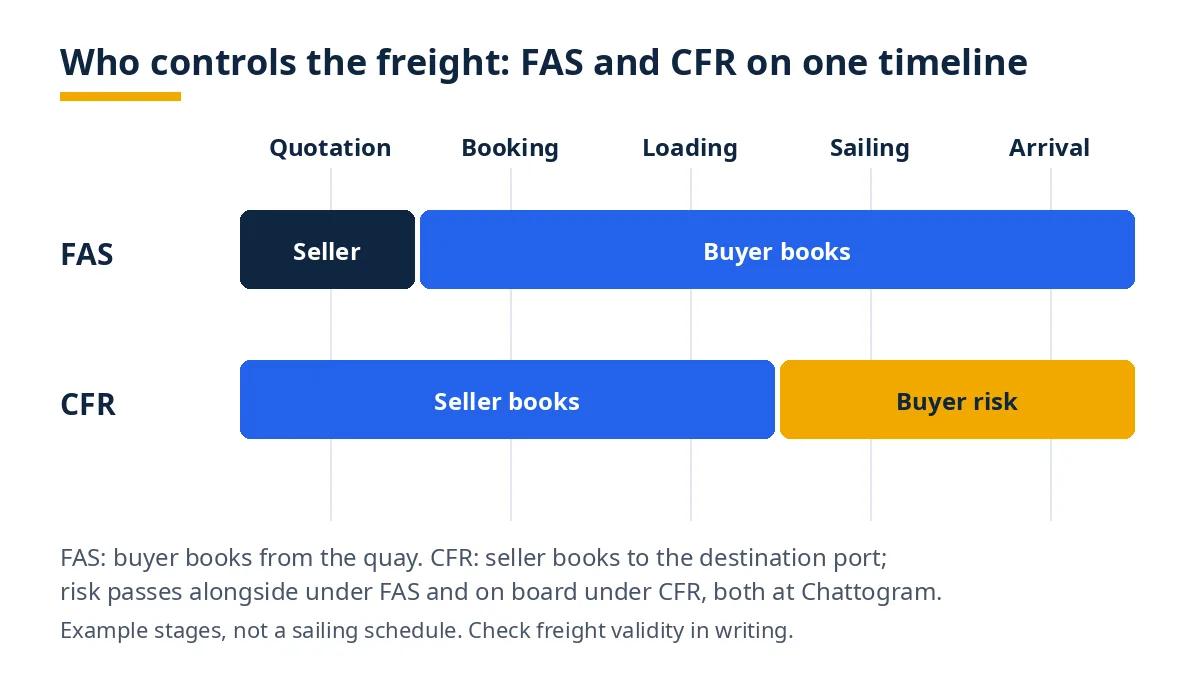
The diagram below follows the freight decision from quotation to arrival.
Worked example: containerized home textiles priced under FAS and under CFR
The figures below are Example figures for one 40-foot container of home textiles, including towels and bed linen, from Chattogram to Southampton. The freight line is the same in both columns, so the comparison isolates the booking decision rather than a rate difference.
Cost line (Example figures) | FAS Chattogram | CFR Southampton |
|---|---|---|
Goods, packed for export | 38,500 | 38,500 |
Inland transport and export clearance | 1,400 | 1,400 |
Loading on board | 620 (buyer pays) | 620 (in seller price) |
Ocean freight, Chattogram to Southampton | 3,900 (buyer books) | 3,900 (seller books) |
Seller's price | 39,900 | 44,420 |
Freight and loading paid separately by buyer | 4,520 | 0 |
Cargo insurance, buyer-arranged | 290 | 290 |
Destination handling, import clearance, duty, onward transport | 2,480 | 2,480 |
Buyer total | 47,190 | 47,190 |
The buyer totals match because the freight rate is the same. In real quotations the rates will differ. Ask each seller for the freight element separately, even under CFR, and ask the buyer's own forwarder for a parallel quote for the same sailing window. Only a separated freight line reveals whether the seller's rate beats the buyer's own rate.
When does buyer-booked freight beat seller-booked freight?
Buyer-booked freight wins when the buyer already moves volume on the route. A buyer that ships several containers a month from Chattogram, holds a carrier contract, or consolidates with other suppliers can usually beat a single seller's spot rate, and can choose sailings that fit the buyer's warehouse plan. It also wins when the buyer needs control over routing, for example when a direct sailing matters more than the lowest rate, or when the buyer must avoid a transshipment port. Under FAS the buyer makes those calls directly, without asking the seller to change a booking the seller has already made.
Seller-booked freight wins when the buyer ships rarely or has no carrier relationship in Bangladesh. The seller may hold better rates, and the buyer avoids booking and tracking a vessel from another time zone. It also suits a buyer that needs one fixed price to the destination port, provided the quotation states the freight validity and the destination charges included.
What freight traps should the buyer check before agreeing CFR?
Three traps recur in CFR files. The first is destination handling charged twice: once inside the seller's freight, and once by the destination agent to the consignee. If the carriage contract the seller signed covers discharge or destination terminal handling, the seller has paid it, and the destination agent should not invoice the consignee for it again.3 Ask for the carriage contract terms, or ask the destination agent to confirm which charges the freight already covers, before paying any destination invoice.
The second trap is a slow sailing chosen for a low rate. Free time at destination runs against the consignee, so delay falls on the buyer, although the seller picked the carrier and the service, and a cheap booking on a slow string can cost the buyer more than it saved the seller.3 Ask for the sailing schedule and transit time before agreeing a CFR price. The third trap is demurrage when free time is short. Confirm the free-time allowance at the named destination port in writing.
The container point also belongs in the check. The sea rules suit bulk and non-containerized cargo, and a container is handed to a terminal days before loading, so between gate-in and loading the seller carries the risk of goods it no longer controls.3 For containerized goods the ICC steers traders toward FCA or CPT, because the sea-only terms suit bulk or break-bulk cargo, not containers.4 Many buyers still quote CFR for containers; see what a CFR price means and how an FAS price is built.
Questions buyers ask about FAS and CFR
Who pays the freight if the vessel is delayed after loading?
The freight has already been contracted and, under CFR, paid by the seller to the named destination port, but the delay itself is the buyer's risk from the on-board point.3 Under FAS the buyer contracted the freight and carries both the freight cost and the delay risk. In either case the buyer pays destination waiting costs, such as demurrage, unless the carriage contract gives longer free time. Check the free-time terms before the vessel sails.
Can a CFR quotation be compared directly with an FAS quotation?
No, not on the headline figures. The CFR price contains freight to the destination port, while the FAS price stops alongside the vessel at Chattogram. Separate the freight element from the CFR price, add the buyer's loading, freight, insurance and destination charges to the FAS price, and compare the buyer totals on the same sailing window. The worked example above shows the method.
Does CFR include insurance?
No. CFR obliges neither party to insure, and the buyer arranges its own cover if cover is wanted.3 The seller must contract cover only under CIF, at the minimum level unless the parties agree more. Do not read a CFR price as an insured price, and do not assume the seller's freight booking includes a policy for the buyer.
Should a first-time buyer choose FAS or CFR for a first container?
A first-time buyer with no carrier contract should usually choose CFR, because the seller books the voyage and the buyer has one price to the destination port. A buyer with a forwarder already handling Bangladesh shipments should consider FAS. Either way, ask for the freight element, the sailing schedule and the free-time terms in writing before paying a deposit.
Next steps on Exportain
Start from the booking decision, then request the separated lines from every supplier: goods, loading, the freight element and the validity period. Look through supplier profiles, open the buying guide, and create an RFQ that names the term, the destination port and the container count. The carriage contract is agreed between buyer and seller: Exportain does not act as a party to goods contracts, and it neither books freight nor clears customs.5 For the insurance position under CFR, see CFR documents required, and for the seller's freight duty under the other C term, see CFR shipping from Bangladesh.
Sources
- FOB & FAS Incoterms® 2020 explained: Key differences. ICC Academy (accessed )
- FAS Incoterms (Free Alongside Ship): Meaning and Use. iContainers (accessed )
- CFR Incoterm: Cost and Freight, Risk and Cost. Linbis (accessed )
- Incoterms for Sea Freight: How to Make Them Work for You. DHL, (accessed )
- About Exportain. Exportain (accessed )
About the author
Sourcing from Bangladesh?
Post a request for quotation and suppliers on Exportain can send you their quotes directly.
Post an RFQ