Shipping CFR From Bangladesh: How It Works, Costs and Pitfalls
CFR from Bangladesh means the seller pays ocean freight to your named port while risk passes to you at loading in Chattogram or Mongla. Costs, documents, and pitfalls explained.
Short answer
Under CFR (Cost and Freight), Incoterms 2020, a Bangladeshi seller pays ocean freight to the named destination port, clears the goods for export, and delivers them on board at Chattogram or Mongla. Risk passes to the buyer at loading, the seller has no insurance obligation, and the buyer handles import clearance, duties, and onward transport. CFR applies only to sea and inland waterway carriage, never air freight.
On this page
Key takeaways
Under CFR, the seller pays ocean freight to the named destination port, but risk passes to the buyer when the goods are loaded on board at the port of shipment in Bangladesh.
CFR imposes no insurance obligation on the seller; a buyer who wants cover for the ocean leg must arrange it before loading or agree it in writing.
CFR applies only to sea or inland waterway carriage and cannot be used for air freight, including any shipment via Dhaka airport.
No approved Bill of Export means no loading in Bangladesh, so the export declaration set must be ready before a sailing date is promised.
Compare CFR quotations only on the same named destination port, Incoterms version, and goods specification, with one goods description across every document.
When a Bangladeshi seller quotes you CFR, the price includes the goods and the ocean freight to your named port. It does not include insurance, and it does not mean the seller still carries the risk while the ship is at sea. For cfr shipping from bangladesh, risk passes to you the moment the goods are loaded on board at the port of shipment, even though the seller has paid the freight for the whole voyage to the destination port.
This guide follows a CFR shipment from the Bangladesh side.
Why CFR shipping from Bangladesh matters
CFR, short for Cost and Freight, is one of the 11 Incoterms 2020 rules published by the International Chamber of Commerce (ICC), giving a clear allocation of cost, risk, and obligations between buyer and seller.1 CFR belongs to the sea and inland waterway family: the seller contracts and pays for the carriage to the named destination port, delivers the goods on board at the port of shipment, and clears them for export.2
CFR matters for two reasons. First, you do not book the ocean leg yourself. Second, you take the sea risk from loading, so the insurance decision is yours. A lower-looking CFR price may reflect a different freight arrangement, destination port, or no insurance. Compare quotations only on the same destination port, Incoterms version, and specification.
How CFR works step by step from Chattogram and Mongla
A CFR shipment follows the same sequence whether the load port is Chattogram (Chittagong) or Mongla. Mongla, the south-western seaport, supports the export of frozen fish, shrimp, crab, jute and jute goods, clay, tiles, silk textiles, and general cargo.3
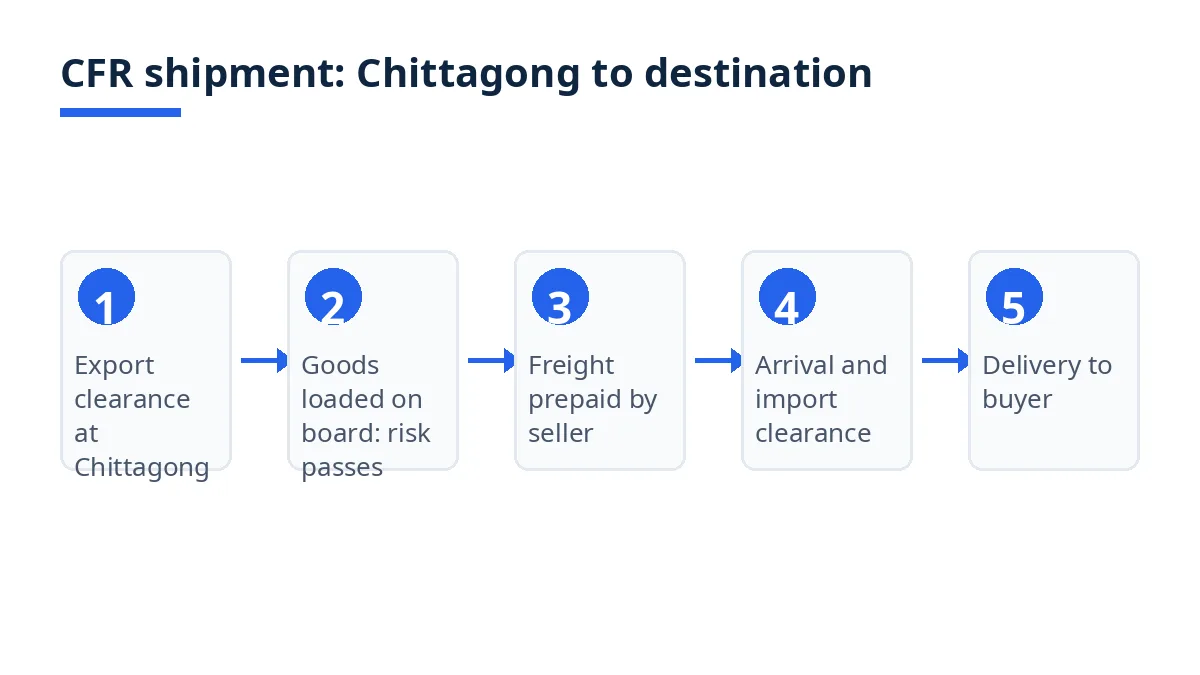
1. Agree the contract terms in writing
State the rule, the version, and both ports in full: "CFR [named port of destination], Incoterms 2020." Record the goods, quantity, packing, unit price, payment terms, and who arranges insurance, if anyone does.
2. Export clearance in Bangladesh
Before loading, the seller completes export clearance. Under section 131 of the Customs Act, 1969, goods shall not be loaded or stuffed for export unless an export declaration, known as the Bill of Export or Shipping Bill, is submitted to Customs and approved.4 The declaration specifies the goods description, value, exporter name, foreign buyer name, and transport operator name.4 No approved declaration means no loading.
3. Loading on board: delivery and risk transfer
Delivery under CFR happens when the goods are placed on board the vessel at the port of shipment, and risk of loss or damage passes to the buyer at that moment, even though the seller still pays the freight to the destination port.2 If the goods are damaged at sea after loading, the loss falls on the buyer unless cover was arranged. Keep the on-board date, vessel name, and bill of lading number together, because a claim starts from those details.
4. Freight prepaid by the seller to the destination port
The seller arranges and pays for the carriage to the agreed destination port and provides the documents needed to obtain the goods from the carrier.2 Check the bill of lading: the destination port must match the contract, destination unloading and handling charges must be shown as included or falling to you, and the consignee and notify party must match your import documents. A freight-prepaid bill of lading does not pay your import duty or onward transport.
5. Arrival, import clearance, and delivery to you
At the destination port, you take over: import clearance, duties and taxes, and onward transport to your warehouse. The seller's freight obligation ends at the named destination port. Arrange your customs broker and onward transport before the vessel arrives.
CFR is for sea and inland waterway only, never air
CFR can be used only for carriage by sea or inland waterway.2 It cannot be used for air freight. A quotation offering "CFR Dhaka airport" is not a valid CFR term. Dhaka airport (Hazrat Shahjalal International Airport) appears here only as that invalid example. If your goods will fly, use a rule written for any mode of transport, such as FCA (Free Carrier), and name the airport and hand-over point in the contract.
CFR compared with CIF and FOB
The risk point is the same under all three rules. What changes is who pays the freight and who must insure.
Rule | Seller pays ocean freight | Seller must arrange insurance | Risk passes | Buyer arranges import clearance |
|---|---|---|---|---|
CFR | Yes, to the destination port | No | On board at the shipment port | Yes |
CIF | Yes, to the destination port | Yes, minimum cover | On board at the shipment port | Yes |
FOB | No, buyer pays freight | No | On board at the shipment port | Yes |
CIF is CFR plus a seller-arranged insurance obligation. Under CIF, the seller must take out marine insurance, and the buyer is the beneficiary, with the lowest level of cover defined in the Institute Cargo Clauses as the default.2 Under CFR, the exporter is not responsible for insuring the goods while they are in transit to the destination port.2 Read the CIF guide before deciding whether the insurance obligation is worth moving to CIF.
Costs, timelines, and documents
What are the typical costs and timelines?
There are no typical CFR costs or timelines for every shipment from Bangladesh. Freight varies with the destination port, sailing, container size, and season. Ask each seller for an itemized quotation on the same destination port and Incoterms version, with the sailing schedule and free-time period at destination.
The worked example below uses labeled example figures only. It is not a quotation.
Example figures: one 20-foot container of jute shopping bags, CFR to a named European destination port. Goods value 18,000 dollars. Inland transport to Chattogram, export clearance handling, and port charges 900 dollars. Ocean freight prepaid by the seller 2,400 dollars. The CFR price is therefore 21,300 dollars. Insurance is not included. Buyer-arranged cover at an example premium of 180 dollars sits outside the CFR price, as do destination charges, duty, taxes, and onward transport.
Cost line | Example figure | Paid by |
|---|---|---|
Goods value | 18,000 dollars | Buyer, under the sale contract |
Inland transport, export clearance handling, and origin port charges | 900 dollars | Seller, inside the CFR price |
Ocean freight to the named destination port | 2,400 dollars | Seller, inside the CFR price |
CFR price | 21,300 dollars | Buyer pays the seller |
Cargo insurance arranged by the buyer | 180 dollars | Buyer, outside the CFR price |
Destination charges, duty, taxes, and onward transport | Not in this example | Buyer |
For timelines, work backwards from the sailing date. Production, inspection, export clearance, and movement to the port must finish before the vessel's cut-off. Ask for each date as a separate line: goods ready, documents ready, container delivered to the port, vessel departure, and expected arrival.
Which documents are needed?
The export set starts with the Bill of Export. Enclosed with it for all export consignments are: the export letter of credit, or the export contract, purchase order, or export guarantee approved by the negotiating bank if there is no letter of credit; the signed commercial invoice with a detailed goods description; the packing list with quantity, weight, and packing information; the EXP form certified by Authorized Dealers; the certificate of origin issued by the Export Promotion Bureau or a Chamber of Commerce and Industry; the VAT registration certificate; and the Taxpayer Identification Number.4 Product-specific papers sit on top of that set, including an Export Registration Certificate for jute, jute goods, and tea.4
The transport document is the second half of the set. Under CFR, the seller must provide the documents needed to obtain the goods from the carrier.2 In practice that means the bill of lading, showing shipper, consignee, notify party, vessel, ports, freight-prepaid status, and goods description. Check every field before the vessel sails.
Bangladesh-specific rules and tips
File the Bill of Export before you promise a sailing date. Goods shall not be loaded or stuffed for export unless the export declaration is submitted and approved.4 Allow time for a documentary check and any physical verification Customs requires.4
Keep one name and one description across every paper. The export declaration specifies the description of goods, value, exporter name, foreign buyer or importer name, and transport operator name.4 Use the same legal names and goods description on every document in the set.
Confirm the EXP form route early. The EXP form, certified by Authorized Dealers, is enclosed to ensure the realization of export proceeds.4 Ask the seller to confirm the position with its bank in writing at order stage.
Choose the load port for your cargo. Mongla supports exports including jute and jute goods, frozen fish and shrimp, clay, tiles, and silk textiles.3 Ask which port the freight quotation is built on, and do not accept a CFR price that assumes one port while the goods load at another.
Check product-specific papers. The Customs page lists product-wise additional documents, including the Export Registration Certificate for jute, jute goods, and tea, and a consignment-wise export permit from the Bangladesh Tea Board for tea.4 Confirm the extra paper and lead time before agreeing the shipment date.
Read the bill of lading as a contract document. Confirm the freight-prepaid notation, destination port, number of originals, and consignee and notify party entries. If the sale is under a letter of credit, confirm it matches the credit terms exactly.
Mistakes and red flags
What are the most common mistakes?
Treating CFR as delivery at the destination port. Delivery happens on board at the port of shipment, and risk passes there.2 A buyer who plans as if the seller carries the risk to arrival discovers the gap only when damage is found at discharge.
Assuming the CFR price includes insurance. CFR imposes no insurance obligation on the seller.2 Arrange cover yourself before loading, or agree in writing that the seller will arrange it and state the cover level.
Accepting a CFR price without a named destination port. "CFR Europe" names no port. The seller's freight obligation runs to the named port of destination,2 so insist on the port name in the contract, quotation, and bill of lading.
Using CFR for air freight. CFR applies only to sea or inland waterway carriage.2 A CFR quotation for a flight, including any naming Dhaka airport, is invalid. Use FCA for air shipments.
Comparing CFR and FOB prices on different bases. Under FOB, the buyer pays the ocean freight. Under CFR, the seller pays it. Compare the two only after adjusting for freight, on the same sailing and destination port.
Leaving the terminal hand-over gap unwritten. If the container reaches a terminal days before loading, write down who bears the risk in that interval.
Red flags: no named destination port, no Incoterms version, or a seller who cannot describe the Bill of Export set.
Checklist
Confirm every line in writing before you order.
Rule, version, and named destination port stated: CFR [named port of destination], Incoterms 2020.
Port of shipment named: Chattogram or Mongla, matching the freight quotation.
Goods, quantity, packing, unit price, and payment terms agreed.
Insurance position stated: buyer-arranged cover before loading, or seller-arranged cover with the level written down.
Bill of Export set confirmed (see the documents section).4
Product-specific documents confirmed, including any Export Registration Certificate or permit.4
Freight terms confirmed: destination port, freight-prepaid status, and destination charges.
Bill of lading fields checked against the invoice.
Sailing schedule, cut-off, document deadline, and destination free time confirmed.
Customs broker and onward transport arranged before arrival.
Air-freight check passed: no CFR term used for any flight, including via Dhaka airport.
How Exportain helps
On Exportain, post a request for quotation (RFQ) stating the quantity, destination port, and Incoterm, so suppliers quote against the same requirement. The buying guide describes the RFQ step in those terms: state quantity and unit, target price, destination, Incoterm, required certifications, and deadline.5 Compare the CFR replies on the same destination port and Incoterms version, and ask each supplier for the port of shipment, freight basis, and insurance position before you accept.
Keep the paper trail in one place: the RFQ, the quotations, the accepted terms, and the messages about the Bill of Export set and the bill of lading. Read the how-to-buy guide for the full buying sequence, and the Incoterms guide before choosing between CFR, CIF, and FOB. Exportain is a marketplace, not a party to the goods contract, and it does not book freight or clear customs for you.
FAQs
What should I know first about CFR?
CFR means the seller pays the cost and freight to the named port of destination, while risk passes to you when the goods are loaded on board at the port of shipment.2 The seller must clear the goods for export and provide the documents you need to obtain them from the carrier.2 CFR imposes no insurance obligation on the seller, and it applies only to sea or inland waterway carriage, never air freight.
What are the typical costs and timelines?
There are no typical CFR costs or timelines for every shipment; freight and destination charges vary with the port pair and sailing. Ask for an itemized quotation on one named destination port. Example figures only: goods 18,000 dollars, origin costs 900 dollars, prepaid freight 2,400 dollars, CFR price 21,300 dollars.
Which documents are needed?
The Bangladesh export set is the Bill of Export with the export letter of credit or contract, commercial invoice, packing list, EXP form, certificate of origin, VAT certificate, and Taxpayer Identification Number, plus product-specific papers where they apply.4 The transport document is the bill of lading, which must match the set on ports, parties, and goods description.
What are the most common mistakes?
The most common mistakes are treating CFR as delivery at the destination port, assuming the price includes insurance, accepting a quotation with no named destination port, and using CFR for air freight. CFR pays the freight and passes the risk at loading.2 Write the destination port and insurance position into the contract, and compare quotations only on the same basis.
Next steps on Exportain
Read the Incoterms guide to compare CFR with the other ten rules, then the CIF guide if you want the seller to arrange insurance. When ready to buy, follow the how-to-buy guide and post an RFQ naming the destination port, Incoterm, and insurance position, so suppliers on Exportain quote on the same CFR basis.
Sources
- Incoterms® 2020. International Chamber of Commerce (ICC) (accessed )
- Incoterms 2020: Group C rule explained. Export Development Canada, (accessed )
- Mongla Port emerging as regional transit hub with enhanced capacity. Bangladesh Sangbad Sangstha, (accessed )
- Customs Clearance Procedures for Export. Bangladesh Customs, National Board of Revenue (accessed )
- How to source and buy from Bangladesh. Exportain (accessed )
About the author
Sourcing from Bangladesh?
Post a request for quotation and suppliers on Exportain can send you their quotes directly.
Post an RFQ