

Solar Panels Price in Bangladesh: FOB Cost Breakdown for Buyers
An FOB price for solar panels from Bangladesh ends at loading on board the vessel. See which lines sit inside that price, which sit outside it, and how to compare quotations line by line.
Short answer
Under a free on board (FOB) quotation for solar panels from Bangladesh, the seller's price covers the panels, export packing, inland transport to the named port of shipment, export clearance, origin handling and loading on board the vessel. Ocean freight, marine insurance, destination charges, import clearance, duties and destination transport sit outside the FOB price and are for the buyer. Compare quotations only on the same panel specification, Incoterm and named port, with each FOB line shown.
On this page
Key takeaways
Under FOB, the seller's price ends when the panels are loaded on board the vessel at the named port of shipment, and the buyer bears the cost and risk after that point.
The FOB price covers the panel unit price, export packing, inland transport, origin handling, loading and export clearance, while ocean freight, marine insurance and destination costs sit outside it.
A quotation without a named port of shipment, a panel specification and a line-by-line FOB split cannot be compared with any other quotation.
Finished photovoltaic modules are classified under HS 8541.43, with cells, inverters and batteries under their own headings, so each part should be classified and priced separately.
Exportain verification is a document and photo review, not a factory inspection, and a badge is not a guarantee of capacity, quality or delivery.
A solar panel quotation that reads as a single price hides the decision a buyer actually has to make. Under a free on board (FOB) quotation, the seller's price ends when the panels are loaded on board the vessel at the named port of shipment, and everything after that point is a separate cost for the buyer. This guide takes that FOB figure apart line by line.
FOB is one of the 11 rules in Incoterms 2020, published by the International Chamber of Commerce (ICC), which provides a clear allocation of cost, risk and obligations for each rule.1 FOB applies to sea and inland waterway transport only, and risk transfers when the goods are on board the vessel at the named port of shipment.2 Every line before loading belongs in the seller's FOB price, and every line after loading belongs outside it.
Why this matters for buyers and sellers
For a buyer, the FOB price is not the landed cost. Ocean freight, marine insurance, import clearance, duties at destination and inland transport after arrival all sit outside an FOB price.2 Comparing an FOB quotation with a cost, insurance and freight (CIF) quotation without separating those lines compares two different bundles. For a seller, the same boundary protects the quotation: packing, inland transport, export clearance, origin handling and loading are inside the FOB price,2 so the seller is not expected to absorb the ocean leg as well.
The boundary also decides risk. Before loading, the seller bears the risk; after loading, the buyer bears the risk for the ocean transit.2 FOB imposes no insurance obligation on either party, so a buyer who buys no marine cover carries the ocean leg uninsured.
What should I know first about solar panels?
Know the product and the delivery term together. The product half is the panel: wattage, cell technology, dimensions, frame and connector type, and test documentation required for the destination market. The delivery half is the Incoterm and named place: under FOB, the named port of shipment fixes where the seller's price and risk end.2 A quotation without wattage, panel specification and named port cannot be compared with any other quotation.
Finished photovoltaic modules, the assembled panels a buyer normally orders, are classified under HS heading 8541.43, while photovoltaic cells not assembled into modules fall under a separate subheading.3 Confirm which product the quotation covers: finished modules, cells, or a wider system including inverters and mounting parts, which carry their own headings.3 See the HS code for solar panels guide.
Step-by-step: how it works
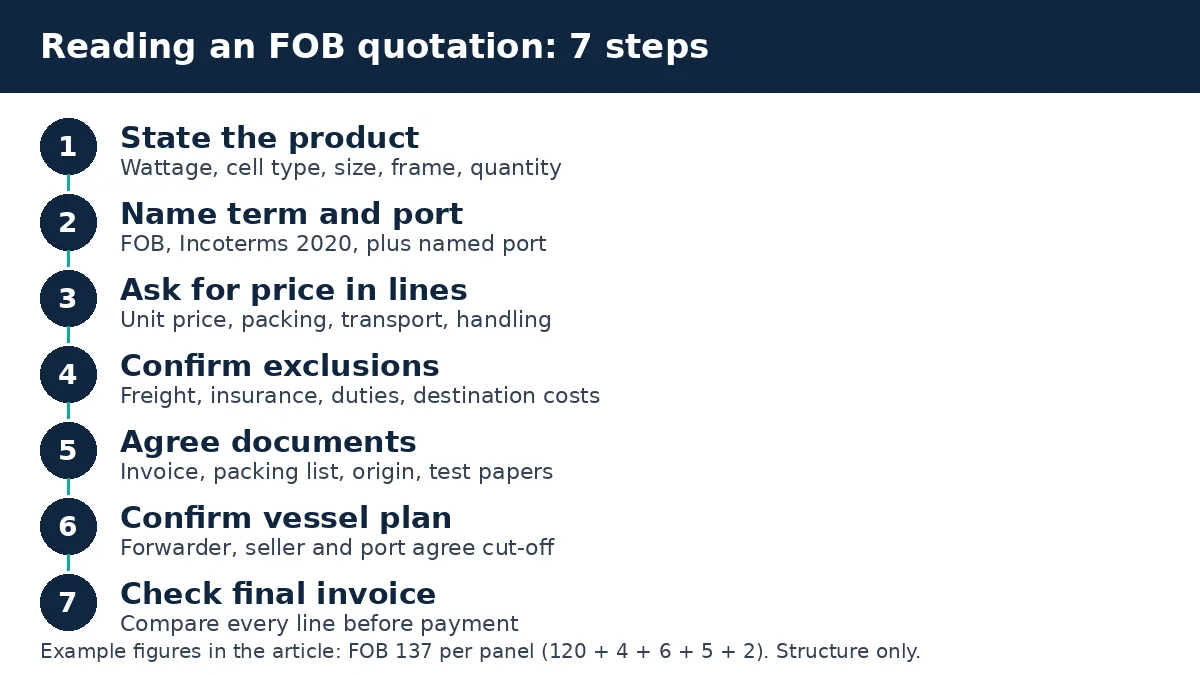
State the product in full. Give wattage, cell technology, dimensions, frame and connector type, quantity in panels and watts, and packing requirement.
Name the term and the port in every request. Write "FOB, Incoterms 2020" plus the named port of shipment, and ask every supplier to quote on exactly that term and port.
Ask for the FOB price in lines. Ask for panel unit price, export packing, inland transport, origin handling, loading and export clearance as separate lines, with any other charge named rather than folded into the unit price.
Confirm what the quotation excludes. Ask the supplier to state in writing that ocean freight, marine insurance, destination charges, import clearance, duties and destination transport are excluded, and who arranges each.
Agree documents and inspection before confirming. Put invoice, packing list, certificate of origin and test documentation on the purchase order, and agree whether inspection happens before packing, at loading, or both.
Confirm vessel and loading plan with the buyer's forwarder. The buyer nominates the vessel under FOB,2 so forwarder, seller and port plan must agree on vessel, cut-off and loading window.
Check the final invoice against the quotation line by line. Compare specification, quantity, unit price, each FOB line, Incoterm and named port, and question any changed line before payment.
Containerized cargo needs one extra check at step 2. Under FOB the seller carries risk until the container is on board, but the buyer's forwarder may already control the container from the factory gate, and damage on the move to the port can become a dispute over whose insurance responds.2 The guidance notes the ICC recommendation to use free carrier (FCA) for containerized cargo loaded at the seller's facility, because FCA transfers risk at handover to the carrier.2 Ask whether FCA fits that pattern better, and record the answer on the purchase order.
Costs, timelines and documents
What are the typical costs and timelines?
There are no typical FOB costs or timelines for solar panels from Bangladesh that a guide can state as fact, because each quotation depends on panel specification, quantity, packing, distance to the port and vessel schedule. Require the same structure from every supplier.
Cost line | Inside FOB | Outside FOB |
|---|---|---|
Panel unit price | Yes | No |
Export packing | Yes | No |
Inland transport | Yes | No |
Origin handling | Yes | No |
Loading on board | Yes | No |
Export clearance | Yes | No |
Ocean freight | No | Yes, buyer |
Marine insurance | No | Yes, buyer |
Destination charges | No | Yes, buyer |
Import clearance, duties | No | Yes, buyer |
Destination transport | No | Yes, buyer |
The seller pays export packaging, export clearance, inland transport, origin handling and loading, while the buyer pays ocean freight, marine insurance, import clearance, duties and destination transport.2
Example figures: a quotation is built as a panel unit price of 120, export packing of 4, inland transport of 6, origin handling of 5 and export clearance of 2, giving an FOB price of 137 per panel. The example shows structure only, not a market price, a typical cost or a lead time. Add ocean freight, insurance, destination charges, import clearance and destination transport as separate lines outside the FOB price; that total is the figure to compare with a delivered quotation.
Timelines follow the same logic: there is no standard timeline, because sampling, production, packing, inland movement, vessel cut-off and loading each depend on the order. Ask for dates as separate lines for each stage.
Which documents are needed?
Goods may not be loaded for export from Bangladesh until an export declaration, the Bill of Export or Shipping Bill, is submitted to Customs and approved, with description, value, exporter, foreign buyer and transport operator specified.4 Documents enclosed with the Bill of Export for all consignments are the export letter of credit, or where there is none the export contract, purchase order or export guarantee approved by the negotiating bank; the commercial invoice with a detailed description signed by the exporter; the packing list with quantity, weight and packing information; the EXP form certified by an authorized dealer; the certificate of origin issued by the Export Promotion Bureau (EPB) or a Chamber of Commerce and Industry; the VAT registration certificate; and the taxpayer identification number.4 Additional product-wise certification may be necessary for some categories.4
The purchase order should carry panel specification, quantity, unit price and each FOB line, Incoterm and named port, inspection basis and packing requirement. Ask the supplier to confirm in writing which test documentation accompanies the shipment. Confirm that names, quantities, values and HS classification match across invoice, packing list, certificate of origin and Bill of Export.
Bangladesh-specific rules and tips
Keep export papers consistent with the FOB boundary. The Bill of Export names the exporter, foreign buyer and transport operator,4 so the legal name on trade licence, quotation, invoice and payment account should match, and the invoice value should be the FOB value on the same term and port as the quotation.
Confirm classification for the exact product shipped. Finished modules sit under HS 8541.43, and that heading should be confirmed for the product as shipped, not assumed from a catalogue description.3 If the order includes inverters, batteries or mounting parts, ask for each part classified and priced separately.3
Ask for the standard and test documentation by name. IEC 61215-1 lays down requirements for the design qualification of terrestrial photovoltaic modules suitable for long-term operation in open-air climates, and it applies to terrestrial flat-plate modules including crystalline silicon and thin-film types.5 The same standard states that test results are not construed as a quantitative prediction of module lifetime.5 Ask the supplier to confirm in writing which edition and part the panels are qualified to, and whether the destination market requires a separate safety qualification.
Do not confuse domestic solar policy with export price. Bangladesh updated its net-metering framework in 2025, with the Sustainable and Renewable Energy Development Authority (SREDA) noting that 100 percent of sanctioned load is now allowed for net-metered rooftop solar, compared with 70 percent in the past.6 Those rules govern domestic rooftop generation in Bangladesh, not the FOB price of panels for export.
Agree inspection in writing. ISO 2859-1:2026 defines a system of acceptance sampling plans for inspection by attributes, indexed by acceptance quality limit (AQL), for lot-by-lot inspection.7 AQL is the maximum average percentage of defective items considered acceptable during random sampling.7 Agree inspection level, AQL values, defect classification and inspection point before production.
Mistakes and red flags
What are the most common mistakes?
Comparing an FOB price with a delivered price. An FOB price excludes ocean freight and insurance,2 while a CIF price includes them. Compare only quotations on the same Incoterm, named port and panel specification, and add excluded lines to the FOB figure before ranking.
Accepting a single-line price. One figure for panels, packing, transport, handling, loading and clearance hides the line most likely to move. Ask for each FOB line separately.
Leaving the named port vague. "FOB Bangladesh" is not a usable term. FOB requires a named port of shipment,2 and the port fixes inland distance, terminal handling and loading point.
Assuming insurance is included. FOB imposes no insurance obligation, and a buyer who buys no marine cover carries the ocean risk uninsured.2 State in writing who buys insurance, for what value, and to which destination point.
Using FOB for a loading pattern it fits poorly. For containerized cargo loaded at the seller's facility, risk transfer under FOB can become unclear between factory gate and vessel, and FCA is the recommended alternative for that pattern.2
Treating a badge as a quality guarantee. Exportain verification is a review of documents and photos by Exportain staff, not a factory inspection, and a badge is not a guarantee of production capacity, product quality or delivery.8 Keep sample approval and pre-shipment inspection as the buyer's own controls. See how supplier verification works on Exportain.
Skipping the document match. A quotation, invoice, packing list, certificate of origin and Bill of Export that disagree on product, quantity, value or port will cause delay. The export declaration already requires description, value, exporter, buyer and transport operator to be specified,4 so a mismatch is visible before loading if the buyer checks the set.
Checklist
Before confirming an FOB order for solar panels, every line below should be answered in writing.
Panel specification: wattage, cell technology, dimensions, frame and connector type, quantity in panels and watts.
Delivery term and named port: FOB, Incoterms 2020, plus the named port of shipment, on every quotation.
FOB price split: panel unit price, export packing, inland transport, origin handling, loading and export clearance.
Excluded lines stated: ocean freight, marine insurance, destination charges, import clearance, duties and destination transport, with who arranges each.
Loading pattern: whether FOB or FCA fits factory-loaded containers, and the answer recorded.
Classification: finished modules under HS 8541.43, with inverters, batteries and mounting parts classified and priced separately where included.3
Standard and test documentation confirmed by edition and part.5
Inspection agreed: level, AQL values, defect classification and inspection point, following ISO 2859-1.7
Export document set: contract or purchase order, commercial invoice, packing list, EXP form, certificate of origin, VAT registration and taxpayer identification number.4
Final invoice checked line by line against the quotation before payment.
How Exportain helps
On Exportain, browse suppliers and post a request for quotation (RFQ) on the RFQ board with panel specification, quantity, packing requirement and delivery term with its named port, so suppliers quote against the same specification and FOB boundary. Ask each reply for the FOB price split into its lines, and for excluded lines to be stated rather than assumed. Read badges for what they record: Exportain Verified means Exportain has checked identity, phone, email and business registration, Export Verified means it has checked the Export Registration Certificate (ERC), and Factory Verified means it has reviewed photos of the manufacturer factory.8 Verification is a document review by staff, free, and never granted by membership plans,8 so sample approval and inspection stay with the buyer.
Read how to import solar panels from Bangladesh alongside this cost breakdown, and the solar panels quality control checklist before agreeing the inspection point. The MOQ definition guide explains how minimums are set.
FAQs
What should I know first about solar panels?
Know product and delivery term together. A quotation needs panel specification, quantity and Incoterm with named port before its price can be compared. Under FOB, the seller's price and risk end when panels are loaded on board at the named port of shipment.2 Finished modules are classified under HS 8541.43.3
What are the typical costs and timelines?
There are no typical FOB costs or timelines to rely on, because each quotation depends on panel specification, quantity, packing, distance to the port and vessel schedule. The FOB price covers panel unit price, export packing, inland transport, origin handling, loading and export clearance, while ocean freight, marine insurance, destination charges, import clearance, duties and destination transport sit outside it.2 Ask for each line separately.
Which documents are needed?
The export set enclosed with the Bill of Export is the export letter of credit or, where there is none, the export contract, purchase order or export guarantee approved by the negotiating bank; the commercial invoice; the packing list; the EXP form certified by an authorized dealer; the certificate of origin issued by the EPB or a Chamber of Commerce and Industry; the VAT registration certificate; and the taxpayer identification number.4
What are the most common mistakes?
Comparing an FOB price with a delivered price, accepting a single-line price, leaving the named port vague, assuming insurance is included, using FOB for factory-loaded containers without addressing the risk gap, treating a badge as a quality guarantee,8 and skipping the document match.4 Each is fixed at quotation stage, in writing, before panels move.
Next steps on Exportain
Browse suppliers, then post your panel specification, quantity and named port on the RFQ board and ask every reply for the FOB price split into its lines. Before you confirm, read how supplier verification works on Exportain and the solar panels quality control checklist.
Sources
- Incoterms® 2020. International Chamber of Commerce (ICC) (accessed )
- FOB Incoterms Explained: A Complete Guide for Importers and Freight Forwarders 2026. GoFreight (accessed )
- Solar Products in Egypt: Know Your HS Code Before You Ship. SGS (accessed )
- Customs Clearance Procedures for Export. Bangladesh Customs, National Board of Revenue (accessed )
- IEC 61215-1:2021-RL en. NEN (accessed )
- Bangladesh revises net metering rules to expand solar. pv magazine (accessed )
- ISO 2859-1:2026 - Sampling procedures for inspection by attributes — Part 1: Sampling schemes indexed by acceptance quality limit (AQL) for lot-by-lot inspection. ISO (accessed )
- How Supplier Verification Works on Exportain. Exportain, (accessed )
About the author
Sourcing from Bangladesh?
Post a request for quotation and suppliers on Exportain can send you their quotes directly.
Post an RFQ


