HS Code for Solar Panels: Classification Guide for Importers
Solar panels take subheading 8541.43 for photovoltaic cells assembled in modules or made up into panels, while loose cells take 8541.42, kits that form a photovoltaic generator are tested against heading 8501, and national codes run to 8-10 digits.
Short answer
Solar panels are classified in heading 8541 as photosensitive semiconductor devices. Photovoltaic cells assembled in modules or made up into panels take subheading 8541.43, and cells not assembled take 8541.42. A panel combined with a battery, controls or an inverter into a photovoltaic generator is tested against heading 8501. Confirm the full 8-10 digit national code for the exact product form before filing.
On this page
Key takeaways
A standard solar panel takes subheading 8541.43, photovoltaic cells assembled in modules or made up into panels, while loose cells not yet assembled take 8541.42.
In the United States the statistical suffix splits by cell type: 8541.43.0010 for crystalline silicon cells as defined in Chapter 85 statistical note 12, and 8541.43.0080 for other cells.
A panel presented with a storage battery, controls or an inverter as a photovoltaic generator is tested against heading 8501, at 8501.71, 8501.72 or 8501.80 by output and current type.
Chapter 85 note 2 keeps goods described in heading 8541 out of headings 8501 to 8504, so a module stays in 8541 and the generator test applies to the combined presentation.
Only the first six digits are shared worldwide: the EU extends to eight digits and the United States and United Kingdom to ten, so confirm the full national code per product form.
If you import photovoltaic modules, the hs code for solar panels is the line your customs entry, duty calculation and origin claim depend on. The Harmonized System is a multipurpose international product nomenclature developed by the World Customs Organization (WCO), comprising more than 5,000 commodity groups, each identified by a six-digit code, and used by more than 200 countries and economies as a basis for their customs tariffs.1 For solar goods, the code turns on the form at the border: loose cells, assembled panels, and a panel combined into a generator do not share one line. This guide covers classification only; the ordering steps are in how to import solar panels from Bangladesh and the inspection points in the solar panels quality control checklist.
Quick answer: indicative HS heading (with verify note)
The HS organises its approximately 5,000 six-digit categories by sections, chapters (2 digits), headings (4 digits) and sub-headings (6 digits).2 Solar panels sit in Chapter 85 under heading 8541, which covers photosensitive semiconductor devices, including photovoltaic cells whether or not assembled in modules or made up into panels.3
Product form | Indicative code territory | Why |
|---|---|---|
Photovoltaic cells assembled in modules or made up into panels | Subheading 8541.43 | The subheading text names this exact form |
Photovoltaic cells not assembled in modules or made up into panels | Subheading 8541.42 | Loose cells take their own subheading |
Panels combined with batteries, controls or an inverter as a photovoltaic generator | Heading 8501, tested first | The Chapter 85 notes define photovoltaic generators under heading 8501 |
Verify the form, not the product name. Inside heading 8541, the split runs on assembly: 8541.42 covers cells not assembled, and 8541.43 covers cells assembled in modules or made up into panels.3 The UK tariff lists the same split.4 A listing that says only solar panel does not settle which side a shipment sits on. Treat 8541.43 as indicative for a standard framed module and confirm the full national code before filing.
How HS codes are structured (2-4-6 digits)
Each pair of digits narrows the category: chapter 85 for electrical machinery and equipment, heading 8541 for semiconductor and photosensitive devices, then a six-digit subheading by assembly state, for example 8541.43 for cells assembled in modules or panels, and a national extension of 8 to 10 digits.2
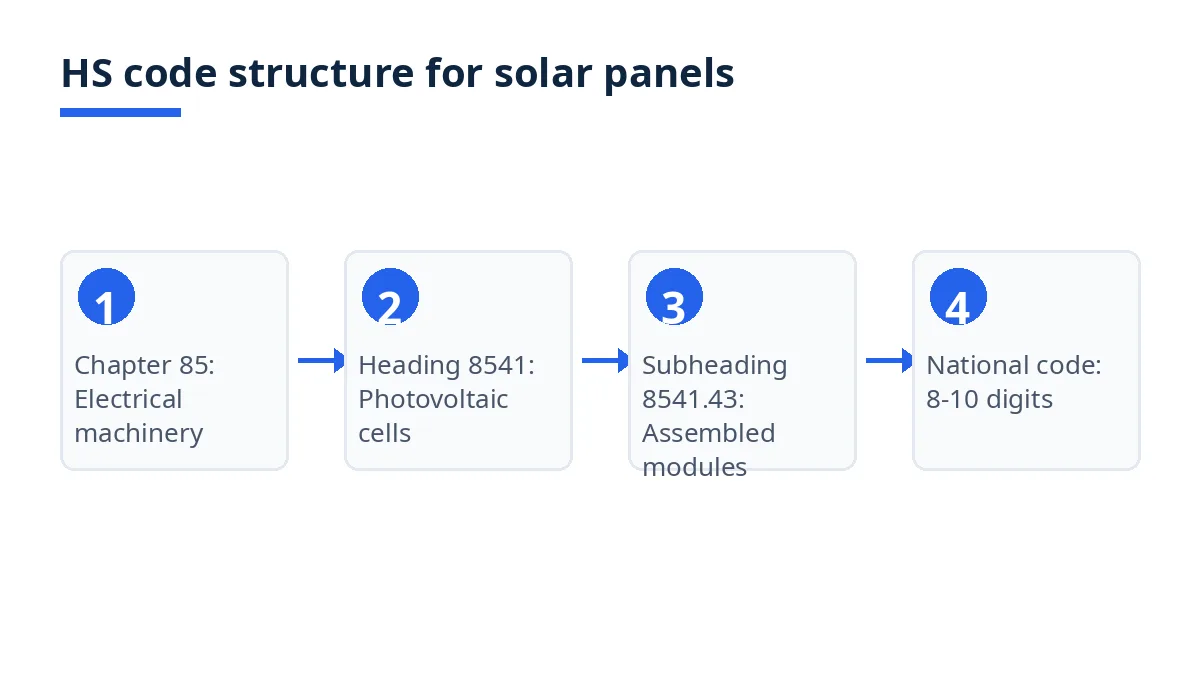
Countries subdivide the six-digit categories into national subheadings for tariffs and statistics.2 The current version is HS 2022.2 Read the HS code explainer, the guide to classifying your product and the 6-digit HS code guide for more.
Factors that decide the code for solar panels
Assembly state decides the subheading. The United States schedule lists 8541.42.00 for cells not assembled and 8541.43.00 for cells assembled in modules or made up into panels.3 A framed module, its cells laminated and connected as one panel, is assembled. Loose cells for local module assembly are not, and take 8541.42.
Cell type splits the United States statistical suffix. Under both 8541.42.00 and 8541.43.00, suffix 10 covers crystalline silicon photovoltaic cells of a kind described in statistical note 12 to Chapter 85, and suffix 80 covers other cells.3 Note 12 defines crystalline silicon photovoltaic cells as cells of a thickness equal to or greater than 20 micrometers, having a p/n junction (or a variant of one), whether or not further processed by cleaning, etching, coating or metallization.3 A thin-film module takes the other suffix. Record cell technology and thickness for every model.
A panel presented as a generator is tested against heading 8501. Statistical note 9 to Chapter 85 states that, for heading 8501, photovoltaic generators consist of panels of photocells combined with other apparatus, for example storage batteries and electronic controls such as a voltage regulator or an inverter, and panels or modules equipped with elements, however simple, which supply the power directly to, for example, a motor or an electrolyser.3 A kit presented as a working generator, panels plus battery and inverter, needs the 8501 test, where photovoltaic DC generators sit at 8501.71 and 8501.72 by output and photovoltaic AC generators at 8501.80.3
Chapter note 2 protects heading 8541. Chapter 85 note 2 provides that headings 8501 to 8504 do not apply to goods described in heading 8511, 8512, 8540, 8541 or 8542.3 The UK chapter notes carry the same rule.4 A module described in heading 8541 therefore stays in 8541: the generator analysis applies to the combined presentation in note 9, not to every panel sharing a consignment with accessories. Classify each presentation on its own facts, and take a binding decision when a kit sits on the boundary.
Separate components keep their own headings. An inverter shipped on its own is not a panel. Heading 8504 covers electrical transformers, static converters (for example, rectifiers) and inductors, the heading tested for a standalone inverter.3 Batteries, mounting structures and cables likewise take their own lines. Do not file a full system invoice under 8541.43 because the panels are the largest item by value.
Output is reported, and parts have their own line. For the United States statistical numbers under 8541.42 and 8541.43, importers report the total watts at maximum power based on standard test conditions, following IEC 60904, Photovoltaic Devices.3 Parts sit at 8541.90, where the schedule lists frames for photovoltaic cells assembled in modules or made up into panels on their own statistical line.3 Keep rated wattage and the parts list in the shipment file.
National codes: US HTS, EU CN/TARIC, UK commodity code
United States: HTS, ten digits. The schedule carries the split at 8541.42.00 and 8541.43.00 and adds statistical suffixes: 10 for crystalline silicon cells of a kind described in note 12, and 80 for other cells.3 A crystalline silicon module is therefore filed at 8541.43.0010 and a module of other cells at 8541.43.0080. Photovoltaic DC generators take 8501.71.0000 at an output not exceeding 50 W and the 8501.72 lines above that output.3 Read the full ten-digit line for each product form.
European Union: CN at eight digits, TARIC for measures. The Combined Nomenclature integrates the HS and adds EU subdivisions, producing eight-digit codes.2 At eight digits the lines read 8541 42 00 for cells not assembled and 8541 43 00 for cells assembled in modules or made up into panels, the same eight-digit structure the UK tariff lists for these subheadings.4 Read the confirmed line in TARIC for the entry date and for origin Bangladesh, and check the origin rules behind any preference claim.
United Kingdom: commodity code. The UK builds its commodity code on the same first six digits, with its own extension after them.2 The UK tariff page for heading 8541 lists cells not assembled at 8541 4200 00 and cells assembled in modules or made up into panels at 8541 4300 00, with parts at 8541 9000 00.4 Take the full code from the UK Trade Tariff for your product form and entry date.
How to confirm the code officially
Write a precise description: cell technology, cell thickness where the statistical note turns on it, assembly state, rated output in watts, and everything presented with the panel, such as a battery, an inverter, a controller, cables and mounting parts.
Start from the official tariff for the destination: the USITC HTS, TARIC or the UK Trade Tariff, and read the heading text, chapter notes and statistical notes. In the United States schedule, statistical notes 9 and 12 to Chapter 85 decide many solar cases.3
Check published rulings for similar products. For the United States, the USITC advises traders to use the Customs Rulings Online Search Service (CROSS), because the correct classification of many items can be found there.5
For a borderline presentation, such as a kit combined with a battery and an inverter, apply for a binding decision before you ship. In the EU, a Binding Tariff Information (BTI) application needs a separate application for each type of product and a detailed description.6 In the United Kingdom, a legally binding decision is generally valid for 3 years, through an Advance Tariff Ruling.7 In the United States, if the merchandise is not described in any ruling on CROSS, you may request a binding ruling from U.S. Customs and Border Protection.5
Give your broker the description and the confirmed code for each product form, and use the same codes throughout the entry.
Common classification mistakes
Filing loose cells as panels. The 8541.42 and 8541.43 split turns on assembly: cells not assembled take 8541.42, and cells assembled in modules or made up into panels take 8541.43.3 4
Filing a generator kit as panels. Panels combined with storage batteries and controls, or supplying power directly to a load, meet the note 9 description of photovoltaic generators under heading 8501.3 Test the kit against 8501.71, 8501.72 and 8501.80 before settling on 8541.43.
Filing every module on the crystalline silicon suffix. Note 12 limits that suffix to crystalline silicon cells at least 20 micrometers thick with a p/n junction.3 A thin-film module takes suffix 80.
Filing the whole system under the panel code. A standalone inverter is tested against heading 8504, static converters,3 and frames and other parts of heading 8541 goods sit at 8541.90.3 Split the invoice by product form.
Copying a code from another country. The EU extends the six digits to eight,2 and the United States and United Kingdom extend the 8541 lines to ten.3 4 A code complete in one market is incomplete in another.
Related duties and documents
This guide states no duty rates: the code decides which duty line and measures customs applies, and treatment on the assembled-panel line does not carry to loose cells or a generator line. Read the measures beside your confirmed code for your origin and entry date, and check what proof of origin a preference claim requires.
Keep the classification file together: the datasheet with cell technology and thickness, the assembly state, the rated watts at maximum power under standard test conditions,3 the confirmed code per product form, any binding decision and the origin evidence. List panels, loose cells, inverters, batteries and parts as separate invoice lines, each with its own code.
FAQs
What is the HS code for solar panels?
Cells assembled in modules or made up into panels take subheading 8541.43, and cells not assembled take 8541.42.3 4 In the United States, a crystalline silicon module is filed at 8541.43.0010.3 A panel combined with a battery, controls or an inverter into a photovoltaic generator is tested against heading 8501 instead.3
Is the HS code the same in every country?
Only the first six digits are harmonised. Beyond six digits, each country adds its own lines: eight in the EU Combined Nomenclature,2 and ten in the US and UK, where the 8541 lines split further by cell type and form.3 4
How do I confirm the correct code?
Describe the product form precisely, read the heading text and chapter notes in the destination tariff, and check published rulings, such as CROSS for the United States.5 For a borderline kit, apply for a binding decision before shipping: a BTI in the EU,6 an Advance Tariff Ruling in the UK,7 or a CBP binding ruling in the US.5
What happens if I use the wrong code?
Duty, licensing and quota treatment are worked out from the code on the declaration, so a wrong code brings the wrong treatment. A binding decision taken in advance helps you calculate the duties and restrictions that will apply.7
Next steps on Exportain
Browse Bangladeshi suppliers on Exportain, a B2B marketplace where supplier profiles carry document and photo review badges, and post a free RFQ at Exportain RFQs with the confirmed code per product form. The harmonized system tariff code explainer is the background read. Exportain is not a party to the goods contract and does not inspect goods, book freight or clear customs, so keep your broker and binding decision at the centre of the entry.
Sources
- What is the Harmonized System (HS)?. World Customs Organization (accessed )
- Harmonised System. European Commission (accessed )
- Harmonized Tariff Schedule of the United States, Chapter 85 (2026 Revision 17). U.S. International Trade Commission (accessed )
- Semiconductor devices; photosensitive semiconductor devices, including photovoltaic cells: UK Integrated Online Tariff, heading 8541. GOV.UK, HM Revenue and Customs (accessed )
- MTB 2019: Get Out Ahead of the Pack with a Binding Ruling from CBP. U.S. International Trade Commission (accessed )
- European Binding Tariff Information (EBTI). European Commission, Directorate-General for Taxation and Customs Union (accessed )
- Check what you'll need to get a legally binding decision on a commodity code. GOV.UK, HM Revenue and Customs (accessed )
About the author
Sourcing from Bangladesh?
Post a request for quotation and suppliers on Exportain can send you their quotes directly.
Post an RFQ