Top Finished Leather Manufacturers in Bangladesh: How to Find and Verify Them
Seven tests for finding and verifying finished leather manufacturers in Bangladesh: material, maker, hide specification, sample and laboratory evidence, batch capacity, minimum and price unit, and identity, with a one-page summary table.
Short answer
Find finished leather manufacturers in Bangladesh by testing the material first: confirm species, preparation state, form, grain, and finish, name the tannery and finishing site, fix one hide specification sheet, approve sealed samples hide by hide with laboratory reports naming the leather, prove capacity with a trial lot, count the minimum on a stated unit, and check identity, badges, and the shipment file. Hold the order while any test is open.
On this page
Key takeaways
Finished leather is material further prepared after tanning or crusting, so record species, preparation state, form, grain, and finish before any price.
Name the tannery, the finisher, and the producing site per stage: a seller name without a site is not an answer.
Judge sealed samples unrolled, hide by hide, and require laboratory reports naming the leather and method, with certificates confirmed with the issuer.
A badge records only the document and photo checks its name records; capacity, quality, and delivery stay the buyer's own checks.
Finished leather is a material, not a made article: hides or sides bought by area, grade, and finish, to be cut later for shoes, bags, belts, or upholstery. The supplier who matters is the one who made the leather in the sample, and a price means nothing until its unit is fixed.
This article names no companies and ranks no supplier. It sets seven tests for finished leather manufacturers in Bangladesh, from hide to shipment file: the material itself, the maker, the hide specification, the sample and laboratory evidence, batch capacity, the minimum and price unit, and identity with the shipment file. Illustrative figures are labelled "Example figures"; no factory name, capacity, price, or certificate is stated as a fact.
Test 1: Start from the material, not the company name
Finished leather means leather further prepared after tanning or crusting.1 A wet-blue hide, or a crust hide dried but not finished, is not finished leather in tariff terms, even if a supplier describes it as finished.1 Ask for the preparation state in writing: wet-blue or crust at a finished-leather price is a different product, still needing finishing. Trade names such as nappa or suede describe look and finish, not the tariff facts; record the animal, preparation state, form, grain, and finish behind the name.1
The animal decides the heading before anything else. Finished leather from bovine, including buffalo, or equine animals falls indicatively under heading 4107; sheep or lamb leather falls under 4112, and other animals under 4113.1 Special finishes override the ordinary headings: chamois, patent, patent laminated, and metallized leather fall under heading 4114, even when the animal is bovine.1 Sheets, sides, and skins imported to be cut remain Chapter 41 material; once leather is cut and sewn into a jacket, belt, bag, or glove, the article takes Chapter 42.1
Record: species, preparation state, form, grain, and finish. If the supplier cannot state all five, the shortlist has not started.
Test 2: Name the maker of the leather, not only the seller
Three different businesses can sell the same sample. A tannery tans raw hides and finishes the leather. A finisher buys tanned or crust leather and applies the finish. A trader buys finished leather and sells it on from a warehouse. Ask who tanned the sample leather, who finished it, and at which site each stage happened, and ask which stages, if any, were bought in. A company name without a site is not an answer.
The site question carries extra weight in Bangladesh. Tanneries moved from Hazaribagh to the Savar Tannery Industrial Estate, and the central effluent treatment plant (CETP) at Savar has yet to function effectively, which has limited access to major global markets.2 Export Promotion Bureau data put leather and leather goods exports at $1.14 billion in FY25, while leather alone stood at $128 million in FY25, down from $400 million in FY15.2 The Leather Working Group (LWG) standards cover raw material traders through to leather manufacturers and subcontractors, including traders of finished leather, so a trader is not outside the audit system by definition.3 Check the site address against the quotation, invoice, and any certificate.
Record: tannery, finisher, trader, site per stage, and document address.
Test 3: Fix the hide specification before any price
Fix the specification in one written sheet before asking for prices: animal and tannage, finish type, thickness and where it is read, grade rules, shade standard, area and the unit it is measured in, and the packing method. The finish type sets the first group of checks. Aniline shows the pore structure clearly with no topcoat, semi-aniline through a light pigmented coating, and pigmented leather under an opaque pigment layer.4
Grade and thickness are where bulk lots diverge from samples. Finished leather is graded, not passed as a perfect sheet, and grading turns on the position and size of each natural mark: damage in a corner area may mean only a grade drop, while damage in the main area may scrap the hide.4 Thickness is gauged under a specified load, at agreed points including the spine and the belly, because one hide can be thicker at the spine than at the belly.4 Agree the grade map, showing prime and secondary areas, and the thickness points before production, and state the buyer tolerance for each reading. Shade needs the same treatment: shade, thickness, grain, and softness move from hide to hide and across one hide, so the shade standard and the light source must be agreed before the lot is judged.4
Agree the area method, the unit, and whether the area quoted is whole-hide or usable area after grading. Example figures: a lot of 120 hides at an example area of 20 square feet per hide totals 2,400 square feet on whole-hide area, but the usable area after grading is lower, and the price per square foot on the two totals is not the same price. Reconcile the lot total by the agreed method.4
Record: one specification sheet per finish and color, with grade map, thickness, shade, area, and packing.
Test 4: Judge the sample hide by hide, then the laboratory paper
Approve one sealed sample per finish and color, showing grain, shade, softness, and finish, kept flat, away from light, and apart from other colors.4 Judge each sample hide unrolled, never folded: rolling prevents creases, and folding leaves marks that can stay permanently.4 Check finish, surface, back, and edges, using low-angle light for loose grain and diffuse light for defect contours.4
Laboratory evidence comes after the sample, and it must name the leather. Where the buyer specification requires it, colorfastness to rubbing is tested under ISO 17075 and flex resistance under ISO 5402-1, the flexometer method, each with the method named and the result judged against the buyer specification; no universal grade or pass mark is stated for either test.4 The LWG audit, first launched in 2005, assesses a tannery across 17 sections, with minimum thresholds of 85 percent for Gold, 75 percent for Silver, 65 percent for Bronze, and 50 percent for Audited, and the final medal is the lowest category achieved.3 Certification lasts 24 months for manufacturing facilities and 12 months for part-processed material traders, while traders are rated as Approved when certified.3 LWG states that certification does not guarantee no restricted substance failures in a final product, and that the audit is not a legal compliance assessment and grants no operating permit.3 Leather counts as chrome-free below 1,000 mg/kg of total chromium under BS EN 15987, and Gold and Silver certification requires chromium VI below 3 mg/kg.3 Require reports naming the product, leather, and method, send the restricted substances list before sampling, and retest on any change of leather, tannery, dye, or finish.
Record: sealed samples, the hide-by-hide record, and laboratory reports naming the leather and method, with scope and expiry checked with the issuer.
Test 5: Test capacity through batches, not through a claimed number
Capacity for finished leather shows in repeat batches: the same finish, shade, and grade mix, lot after lot, at the agreed thickness and area. Test it with a trial lot, judged on the same hide-by-hide record as the bulk lot. Ask for the lot size normally finished in one run, and whether the order will be finished in one run or several; several runs mean several shade and finish risks, and each run needs its own sample approval. Ask for the lead time from approved sample to finished lot, and what holds it. A change of tannery is a change of leather, and it restarts the sample and laboratory evidence in Test 4.
Record: trial lot record, shade-band and hold rule, lead-time stages, and the supplying tannery. Order the bulk lot only on a trial record that passed.
Test 6: Count the minimum and the price on the same unit
A minimum order quantity (MOQ) sets the smallest quantity a supplier accepts on normal terms. It may be counted per order, per style, or per color, and may sit alongside a minimum order value.5 Ask whether the minimum is counted per hide, per side, per square foot or square metre, per finish, per color, per lot, or by order value, and whether more than one minimum applies at once.5 There is no standard MOQ for Bangladesh that can safely be assumed; each supplier's stated minimum must be read, with its unit, on the listing and confirmed in the quotation.5 A quotation must state unit price, MOQ, lead time, Incoterm, payment terms, and validity, so the minimum and the price can be compared field by field across suppliers.5 Example figures: a minimum of 500 square feet per color, across three colors in one finish, means a smallest order of 1,500 square feet, not 500.
Price moves with the same drivers as the minimum: animal and tannage, grain, finish type, thickness, grade mix, shade sorting, area yield, and packing. To lower a minimum, ask about finished stock, fewer colors and finishes, standard packing, a surcharge, a trial order, or sharing a planned run, and expect a trade-off in unit price.5 In the request for quotation, state the quantity and its unit, the quantity per finish and color, the specification sheet reference, the Incoterm and destination, and whether the order is a trial.5
Record: counting unit and basis in writing, and complete quotation fields.
Test 7: Check identity, badges, and the shipment file together
Request the trade licence and Export Registration Certificate (ERC) from the supplier, and check that the company name and address match the quotation and the invoice.6 On Exportain, read each badge for the checks its name records: Exportain Verified, Export Verified, Factory Verified, Trading Company Verified, and Trusted Trader.6 The trust and verification checklist also lists a payment account line, checked against the verified company name.6 A missing badge means a check has not been approved, not that it failed.6
Read the limits with the same care as the badges. Verification is a document and photo review by Exportain staff: not a factory inspection, not a check against any government database, and a badge is not a guarantee of capacity, quality, or delivery.6 Verification is free, membership never grants a badge, and certifications marked "Verified by Exportain" appear only while approved and unexpired, while seller-typed entries are marked as declared by the seller and unverified; confirm any certificate with its issuer.6 Exportain is not a party to the trade and holds money only when both parties agree to a funds hold.6 For payment, cash in advance is the least attractive option for a buyer, while a letter of credit protects both sides because payment depends on documents showing the goods were shipped as agreed.6 Agree the Incoterm, payment schedule, inspection, and shipment terms in writing before paying, and report suspected fraud or misrepresentation through the Trust Center.6
Keep the specification sheet, the confirmed code for each leather type, any binding decision, and the origin evidence with the shipment documents, with each leather type as a separate invoice line, and re-check the code if the specification changes.1 Confirm the roll packing: hides rolled, never folded, paper between rolls, no weight on the finish, rolling neck to butt, because the butt is the stiffest part and does not take a sharp bend well.4 Pay no deposit while any of the seven tests is open.
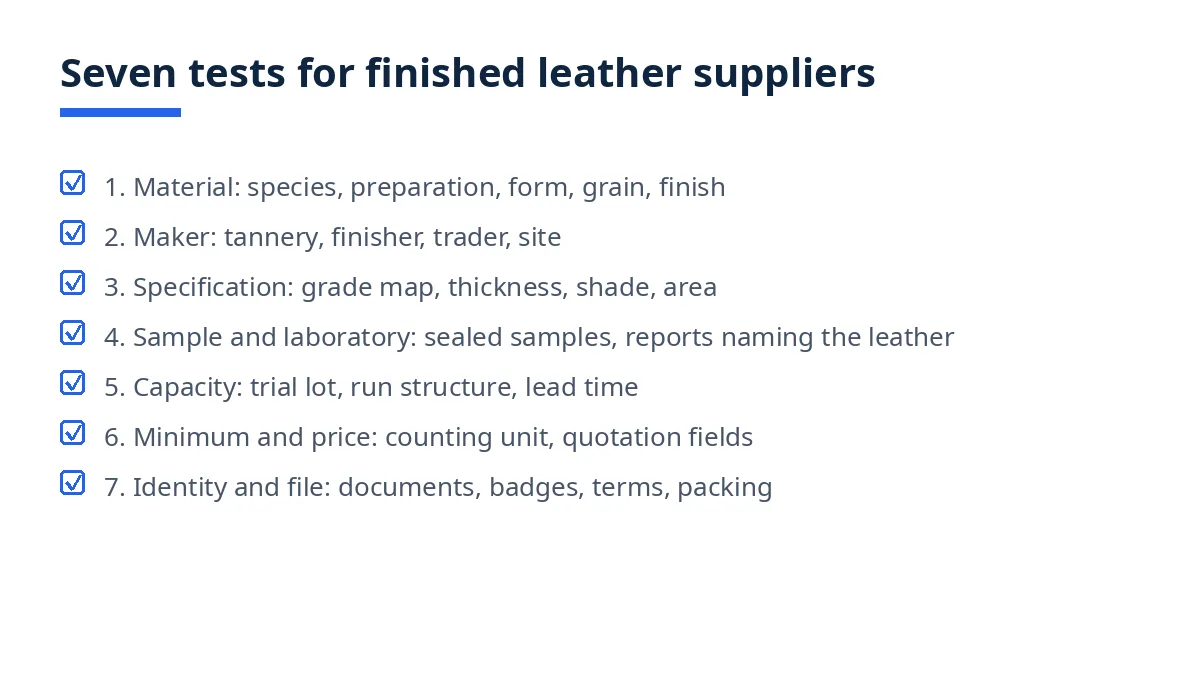
Summary table: seven tests, one supplier file
Test | Evidence to hold | Walk-away signal |
|---|---|---|
1. Material | Species, preparation state, form, grain, finish | Trade name only, or wet-blue as finished |
2. Maker | Tannery, finisher, trader, site per stage | Seller named, maker and site unnamed |
3. Specification | One sheet per finish and color, grade map, area method | Prices before the sheet exists |
4. Sample and laboratory | Sealed samples, hide-by-hide record, reports naming the leather | Sample judged flat, or paper for another leather |
5. Capacity | Trial lot record, run structure, lead-time stages | A claimed number with no trial or batch record |
6. Minimum and price | Counting unit in writing, complete quotation fields | Minimum with no unit, or price on another unit |
7. Identity and file | Documents, badge meanings, terms, packing | Names differ, badge as guarantee, terms unwritten |
Order only when every test is marked pass.
What is the biggest mistake buyers make with finished leather suppliers in Bangladesh?
Buying from a company name, a photograph, or a headline price before fixing what the leather is. A photograph cannot show whether the hide is wet-blue or finished, which tannery made it, whether the finish matches the end use, or whether the price is per hide, per side, or per square foot. Fix the material, the maker, and the specification sheet first, then judge the sample hide by hide.1 4
How can I avoid a bulk lot that does not match the sample?
Seal one sample per finish and color, agree the grade map, shade standard, thickness points, and area method in writing, and judge the bulk lot by that record. Retest whenever the leather, tannery, dye, or finish changes.4 Laboratory reports must name the leather and the method for each limit the destination market applies.3
Who is responsible for verifying a finished leather supplier?
The buyer owns the decision. The supplier supplies documents and the sample, the issuing body confirms certificates, a broker completes classification, and an inspector or laboratory completes sample and chemical checks. A badge records only the checks its name records, and verification is a document and photo review, not a factory inspection or a guarantee.6
Where can I get help verifying a finished leather supplier on Exportain?
Start on the Trust Center and the supplier verification guide, then open the trust and verification checklist before shortlisting.6 Use the finished leather quality control checklist and classification guide, and ask a broker where the leather is borderline.1 4 Report suspected fraud or misrepresentation through the Trust Center.6
Next steps on Exportain
Browse Bangladeshi suppliers and open each checklist. Read how supplier verification works on Exportain, the finished leather quality control checklist, the HS code guide for finished leather, and the MOQ guide. Then post a free RFQ with your specification sheet, quantities and unit per finish and color, and destination.
Sources
- HS Code for Finished Leather: Classification Guide for Importers. Exportain, (accessed )
- How Bangladesh squanders its leather potential – hide by hide, Eid by Eid. The Business Standard, (accessed )
- Certification - Leather Working Group. Leather Working Group (accessed )
- Quality Control Checklist for Finished Leather. Exportain, (accessed )
- MOQ Meaning (Minimum Order Quantity). Exportain (accessed )
- How Supplier Verification Works on Exportain. Exportain, (accessed )
About the author
Sourcing from Bangladesh?
Post a request for quotation and suppliers on Exportain can send you their quotes directly.
Post an RFQ