

Quality Control Checklist for Finished Leather From Bangladesh
Finished leather quality control checklist for Bangladesh orders: hide grading by area and position, finish type, thickness, shade across hides, surface defects, hand-feel and flex, back and edge condition, lab evidence, and roll packing, with a numbered checklist, failure fixes, and a summary table.
Short answer
This finished leather quality control checklist covers hide identity and area, grading by position and size, aniline, semi-aniline and pigmented finish checks, thickness readings against a buyer tolerance, shade consistency across hides, surface defects, hand-feel and flex, back and edge condition, lab evidence by named method, roll packing that prevents creasing, and the sampling decision. Use it before production, during production, and at final inspection on finished, packed rolls.
On this page
A roll of finished leather looks uniform outside, and its problems only show when unrolled, laid flat, and compared hide by hide. One hide can be thicker at the spine than at the belly, another can carry a scar across its best cutting area, and a third can sit a shade away from the lot. This checklist covers the material itself, as it leaves the tannery, before cutting.
Why this checklist matters
Finished leather is graded, not passed or failed as a perfect sheet. Natural marks are inherent in hides, so the goal is grading rather than zero defects.1 Grading turns on position and size: damage in a corner area may mean only a grade drop, while damage in the main area may scrap the hide.1 A buyer ordering without a grade rule is buying an argument about every scar, not a specification.
The second reason is variation inside one lot. Genuine leather varies more batch to batch than synthetic material, and inspection relies more on samples and measurement.1 Shade, thickness, grain, and softness move from hide to hide and across one hide. Recording each point gives the buyer a record to cut from, sort by, or reject on.
Before you start
Settle the reference set in writing first.
Approved hide samples. One sealed sample per finish and color, showing grain, shade, softness, and finish. Keep samples flat, away from light, and apart from other colors.
Area and thickness method. How area is measured, which unit is used, and where thickness readings are taken. Thickness is gauged under a specified load, for whole leather and test samples.2
Grade rules by position. A map of each hide showing prime and secondary areas, and how a defect in each area affects the grade. Grade rules must come from the buyer's acceptance specification, not the equipment or tannery alone.1
Finish and defect list. The finish type, the defect classes, and photos of borderline scars, holes, grain damage, and veining.
Sampling plan and lab methods. The standard, inspection level, and AQL values the buyer has specified per defect class, plus the lab method for each test. AQL figures here are buyer-specified only, never a universal rule.
Light and handling rules. The light source for shade checks, the flat surface for unrolling, and the rule that hides are unrolled, never folded. Leather should never be folded; rolling prevents creases.3
The full checklist (numbered, printable)
Work in order, hide by hide. Mark each item pass, fail, or not applicable, and photograph every fail with its position marked.
Hide or skin identity and tannage. Animal source, tannage, and lot identity against the order, per hide.
Area and usable area. Area of each hide by the agreed method and unit, lot total reconciled, usable area marked after mapping.
Position map for each hide. Prime and secondary areas and edges marked first, since a defect counts differently by position.1
Grade per hide. Grade under the buyer's rules, recorded with the defects that set it.
Finish type against the order. Aniline, semi-aniline, or pigmented finish as specified, against the approved sample.
Finish evenness and pore visibility. Finish even across the hide, pore visibility matching the type: aniline shows the pore structure clearly, semi-aniline through a light pigmented coating, pigmented leather covered by a pigmented coating.4 Aniline has no topcoat, semi-aniline a thin topcoat, pigmented leather an opaque pigment layer.5
Thickness readings across the hide. Readings at agreed points, including spine and belly, gauge method recorded.2
Thickness against the buyer tolerance. Each reading against the buyer-specified thickness and tolerance. No universal thickness or tolerance is stated.
Softness and hand-feel against the sample. Hand-feel of each hide against the sample for softness and temper.
Hand flex and bend check. Each hide bent gently by hand at several points, watching for cracking, stiffness, and loose grain.
Shade against the approved standard. Shade of each hide against the approved standard under the agreed light, since batch shade varies and needs a stable light and color datum.1
Shade across hides in the lot. Hides laid side by side under the same light, checking drift hide to hide and patches within one hide.
Surface defects, graded by position and size. Scars, insect holes, blood veins, loose grain, cracking, wrinkles, and holes, each with position and size.1 Low-angle light exposes loose grain and cracking; diffuse light reveals defect contours.1
Loose grain and finish cracking. Grain checked for looseness, collapse, and cracking, especially at edges and bends.1
Finish lifting, peeling, and flaking. Finish checked for lifting, peeling, and flaking, especially where rolled or handled.
Back and flesh condition. Back of each hide even and clean, no cuts through it, deep flesh damage, or contamination.
Edge condition. Cut edges clean and intact, no tearing, fraying, or ragged sections.
Odor, mold, and stains as a buyer finding. Odor, mold spots, water marks, and stains recorded as findings for the buyer to judge, affected hides separated from clean hides.
Counts, labels, and lot reconciliation. Hide count, area total, color and finish marks, and roll labels against the packing list and order.
Colorfastness lab evidence, by named method. Where the buyer specification requires it, colorfastness to rubbing under ISO 17075, method named and result against the buyer specification, no universal grade or pass mark stated here.6
Flex lab evidence, by named method. Where the buyer specification requires it, flex resistance under ISO 5402-1, the flexometer method, cycle count and result against the buyer specification. The method folds a test piece, examines it periodically for damage, and the specification normally defines the cycles required without damage.7
Abrasion and tear lab evidence, by named method. Where the buyer specification requires it, abrasion and tear resistance by the methods the buyer specification names, each method and result against the buyer specification.
Roll packing that prevents creasing. Hides rolled, never folded, paper between rolls, no weight on the finish, since folding leaves marks that can stay permanently.3 Rolling runs neck to butt, because the butt is the stiffest part and does not take a sharp bend well.3
Sampling decision. The agreed sampling plan applied to the finished, packed lot. As a published standard-table example only, a lot of 150,001 to 500,000 hides at General Inspection Level II gives code letter P, sample 800, and acceptance and rejection numbers of 14 and 15 for major defects at a buyer-specified AQL 1.0.8 9 Those numbers are buyer-agreed values for that tighter plan, not values the standard mandates for finished leather. A pre-shipment inspection samples finished, mostly packed goods, not every piece, and is not a guarantee.6
Common failures and how to fix them
Shade drift across hides in one lot. Hides matching singly but drifting as a set are a dye-lot and sorting problem. Lay the set out under one light, re-sort into shade bands, and hold any band outside the standard.
Finish cracking at the fold. Cracking where a hide was bent or rolled tightly points to the finish, not the grain. Re-check the finish against the sample, loosen the roll, and re-run the flex check.
Thin belly area found only at cutting. A hide reading correctly at the spine and thin at the belly is a measurement-point problem. Add belly readings and judge yield on the thinnest cutting area.
Loose grain missed under flat light. Loose grain hidden under direct light and shown under low-angle light is a lighting problem. Re-check suspect hides under low-angle light and mark the map.
Crease set from folded packing. A sharp line staying after unrolling is a packing problem. Re-roll loosely neck to butt, rest flat, and re-check the crease; if the mark stays, grade the hide down by the area affected.
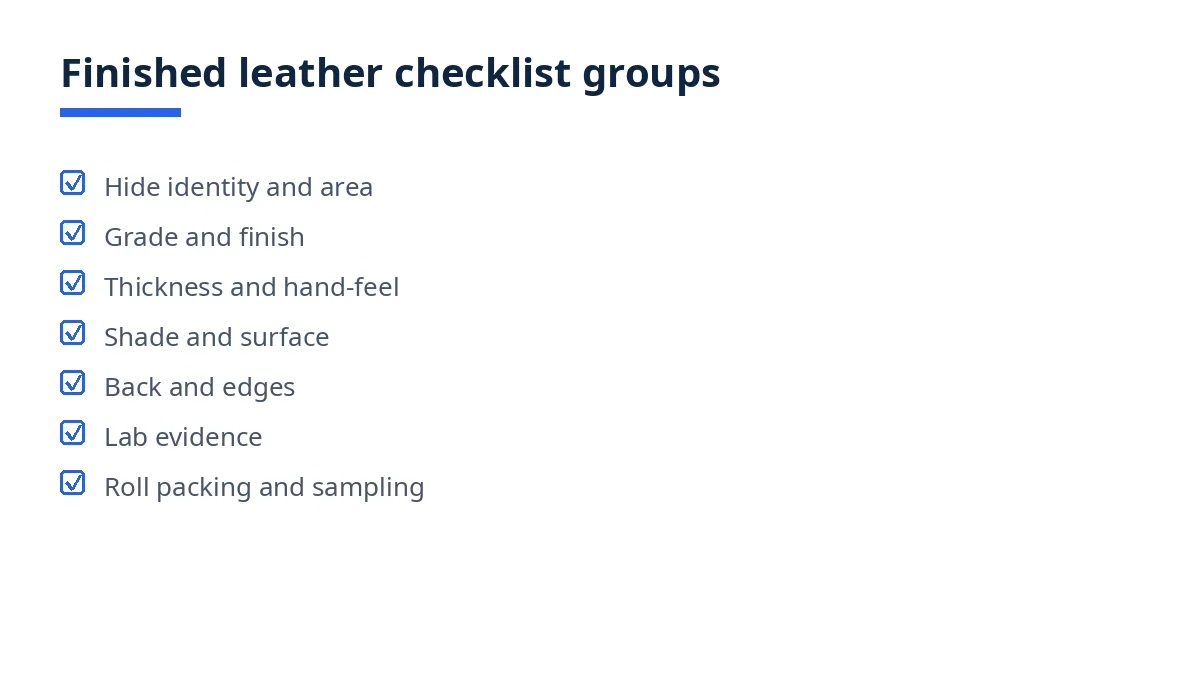
Downloadable template / summary table
No file download is offered with this article. Use the table below as the printable summary, one row per sampled hide.
Check group | What to check | Record |
|---|---|---|
Identity and area | Source, tannage, area | Per hide |
Grade and finish | Map, grade, finish | Grade and finish |
Thickness and hand-feel | Readings, tolerance, softness, flex | Readings and match |
Shade and surface | Standard shade, lot shade, defects | Position and size |
Back and edges | Back, edges, odor, mold | Buyer finding |
Counts and labels | Count, area, labels | Against packing list |
Lab evidence | Tests by named method | Method and result |
Packing and sampling | Roll packing, lot, sample | Counts and decision |
How Exportain helps
Exportain connects buyers with Bangladeshi sellers and service providers, and it does not itself inspect goods. The inspection contract is always between buyer and provider, and the provider works to the buyer's checklist and pass criteria. For the inspection step, see the inspection services category on Exportain, with the exact caveat that applies there: No services published in this category yet. Use this checklist as the material-specific layer the provider checks against, alongside the approved samples and grade rules.
FAQs
When should this checklist be used?
At three stages: before production, when samples, finish, and grade rules are approved; during production, when early finished hides show whether faults repeat; and at final inspection, on finished, packed rolls before shipment.
Who should complete it?
The buyer, the buyer's inspection provider, or the tannery's own quality team can each complete it, but the roles must stay separate: a tannery checking its own hides is factory quality control, not an independent inspection. The final check must follow the buyer's samples, grade rules, and defect list.
What are the most common failures?
In leather inspection, recurring failures are shade variation within a batch, surface defects such as scars, insect holes, and grain damage, loose grain and cracking, uneven finish, and packing faults that crease or mark the finish. A leather goods inspection account lists uneven dyeing, scratches and dents, inconsistent grain, and insufficient protective packaging among its common defects.6
Can a third party do it?
Yes. A third-party provider can carry out the sample, during-production, and pre-shipment checks against this checklist and the buyer's sampling plan, and arrange laboratory testing where the buyer specification requires it. Require a report recording lot, sample size, defects with photographs and position marks, thickness readings, shade findings, lab methods and results, and packing findings.
Next steps on Exportain
Write the hide specification, grade rules, finish type, and sampling plan into one requirement, then read the AQL guide and the pre-shipment inspection guide before setting values for a finished leather order.
Sources
- Genuine Leather Inspection | Grading and Defects. NITR (accessed )
- ISO 2589:2016 - Leather Thickness Measurement Standard for Quality. ISO (accessed )
- How To Store Leather Correctly - Leather Storage Complete Guide. World of Leathers (accessed )
- Leather A–Z. German Leather Federation (accessed )
- What Is Aniline Leather?: Knowing more about leather. Steel Horse Leather (accessed )
- Leather Goods Inspection and Quality Control in Asia & China. V-Trust (accessed )
- ISO 5402-1:2022 - Leather Flex Resistance Testing Flexometer Method. ISO (accessed )
- AQL Meaning: Acceptance Quality Limit, Tables. Exportain (accessed )
- AQL Calculator — Free ISO 2859-1 Sample Size Tool. SDF Clothing (accessed )
- pre-shipment inspection
- quality control
- Bangladesh sourcing
- aql inspection
- Leather goods
- Finished leather
About the author
Sourcing from Bangladesh?
Post a request for quotation and suppliers on Exportain can send you their quotes directly.
Post an RFQ


