

HS Code for Finished Leather: Classification Guide for Importers
Finished leather is classified as a material, not as a finished article. This guide explains heading 4107 for bovine and equine leather, the headings for other animals, and the national codes to confirm.
Short answer
Finished leather from bovine or equine animals is indicatively classified under heading 4107, leather further prepared after tanning or crusting, with the six-digit line set by whole hide versus sides and by full grain, grain split, or other. Sheep and lamb leather falls under 4112, other animals under 4113, and made-up articles such as jackets under 4203. Confirm the full national code for your shipment before filing.
On this page
If you buy sheets, sides, or skins of finished leather to be cut for shoes, bags, belts, or upholstery, the code you declare is for the material itself, not for the article it will become. That distinction sets this guide apart from the guides for leather bags, belts, and jackets, which classify articles that are already made up. The Harmonized System is a multipurpose international product nomenclature developed by the World Customs Organization (WCO), comprising more than 5,000 commodity groups, each identified by a six-digit code, and used by more than 200 countries and economies as a basis for their customs tariffs.1 This guide covers classification only and states no duty rates.
Here, finished leather means leather further prepared after tanning or crusting. A wet-blue hide, or a crust hide dried but not finished, is not finished leather in tariff terms, even if a supplier describes it as finished. A jacket cut from finished leather is an article, not material.
Quick answer: indicative HS heading (with verify note)
The indicative heading for finished leather from bovine (including buffalo) or equine animals is 4107. In the Harmonized Tariff Schedule of the United States (HTS), heading 4107 covers leather further prepared after tanning or crusting, including parchment-dressed leather, of bovine (including buffalo) or equine animals, without hair on, whether or not split, other than leather of heading 4114.2
Six-digit line | Form and grain |
|---|---|
4107.11 | Whole hides and skins, full grains, unsplit |
4107.12 | Whole hides and skins, grain splits |
4107.19 | Whole hides and skins, other |
4107.91 | Other, including sides, full grains, unsplit |
4107.92 | Other, including sides, grain splits |
4107.99 | Other, including sides, other |
Treat 4107 as indicative. It covers bovine and equine animals only: sheep or lamb leather falls under 4112, and other animals under 4113.3 There is no single code for all finished leather, because the animal comes first. Confirm the six-digit line and full national code in the destination tariff for your exact leather, and ask your broker or customs authority where the case is borderline.
How HS codes are structured (2-4-6 digits)
Chapters sit at two digits, headings at four, and subheadings at six, with each country adding its own digits after the sixth.1 2
Level | Digits | For bovine finished leather |
|---|---|---|
Chapter | 2 digits (41) | Raw hides and skins (other than furskins) and leather |
Heading | 4 digits (4107) | Leather further prepared after tanning or crusting |
Subheading | 6 digits (4107.11) | Whole hides and skins, full grains, unsplit |
National extension | 8 to 10 digits | Set by the importing country |
The diagram below shows the four levels for a bovine finished leather shipment.
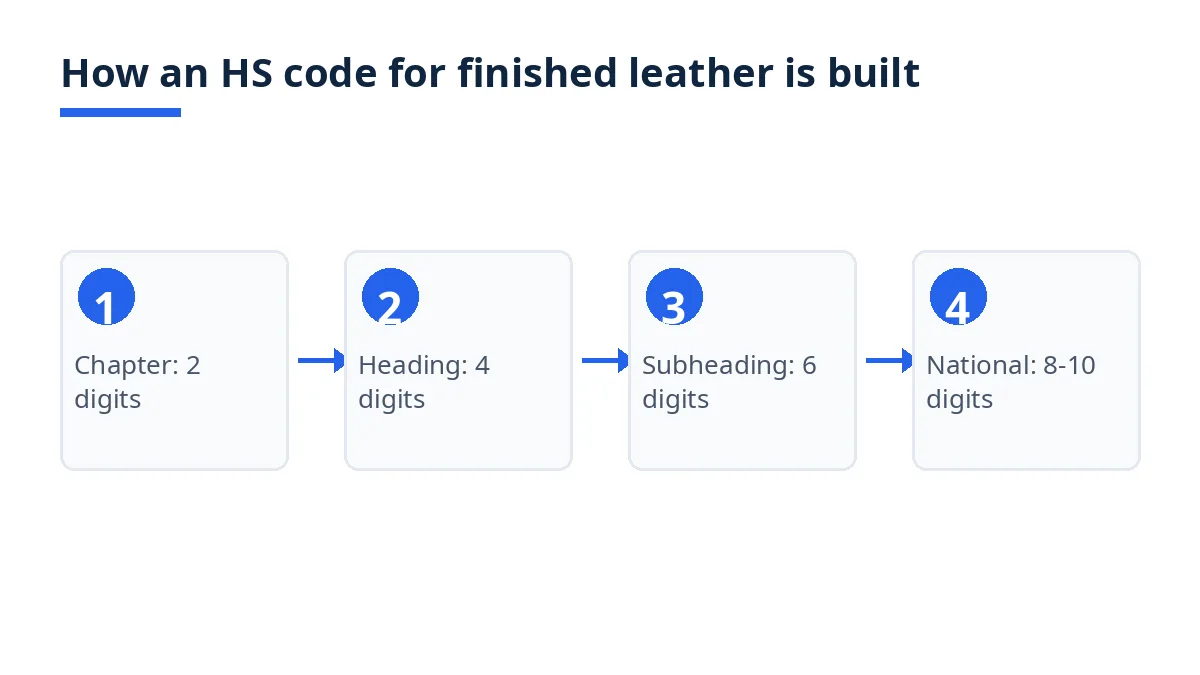
Only the first six digits are shared internationally: never file one country's national line in another country.
Factors that decide the code for finished leather
Check these factors in order.
Further prepared after tanning or crusting comes first. Headings 4104, 4105, and 4106 cover tanned or crust hides and skins, but not further prepared: 4104 for bovine and equine animals, 4105 for sheep and lamb, and 4106 for other animals.3 For those headings, crust includes hides and skins retanned, colored, or fat-liquored (stuffed) prior to drying.2 Leather only tanned or brought to crust stays there; leather finished after that stage moves to 4107, 4112, or 4113. Hides that have undergone a reversible tanning process stay in the raw headings 4101 to 4103.2
Animal decides the heading. Further prepared bovine or equine leather falls under 4107, sheep or lamb leather under 4112, and other animals under 4113, including goats, swine, and reptiles.3 Record the species exactly, with a line for each species in a mixed shipment.
Whole hides versus sides, then grain. Heading 4107 splits first into whole hides and skins (4107.11, 4107.12, and 4107.19) and other, including sides (4107.91, 4107.92, and 4107.99).2 Within each group, the tariff separates full grains unsplit, grain splits, and other, so a full-grain unsplit whole hide is 4107.11 while the same grain as sides is 4107.91. Record form and grain state before choosing the six digits.
Special finishes override the ordinary headings. Chamois (including combination chamois) leather, patent leather, patent laminated leather, and metallized leather fall under heading 4114, even when the animal is bovine.3 Test the finish first: a patent bovine leather is a 4114 case, not a 4107 case. Composition leather in slabs, sheets, or strip falls under heading 4115, as do parings and waste not suitable for making leather articles.3 A reconstituted or bonded sheet is not finished leather under 4107, 4112, or 4113.
Material versus article is the deciding test for a buyer of finished leather. Sheets, sides, and skins imported to be cut and made up remain Chapter 41 material. Once leather is cut and sewn into a jacket, belt, bag, or glove, the article takes Chapter 42: jackets and coats under 4203.10, belts and bandoliers under 4203.30, and containers such as handbags, cases, and pocket articles under 4202.3 The United States schedule records end uses such as bag, case, strap, and collar as statistical suffixes under 4107 lines, but those suffixes describe the material, not a made article; the heading stays 4107 until the leather is made up.2
National codes: US HTS, EU CN/TARIC, UK commodity code
Each line below belongs to one country only: use it for that country, on the entry date.
United States: HTS, ten digits. For whole hides and skins, the schedule lists 4107.11.10 for upper and lining leather of small-area bovine leather, 4107.11.20 for not fancy, 4107.11.30 for fancy, 4107.11.40 for buffalo, 4107.11.50 for upholstery leather, and 4107.11.60 for upper and sole leather.2 For other, including sides, it lists 4107.91.40 for buffalo, 4107.91.50 for upholstery leather, and 4107.91.60 for upper and sole leather.2 In the United States notes, fancy means leather embossed, printed, or otherwise decorated, including leather with accentuated grain.2 Statistical suffixes extend these lines to ten digits, for example by separating upper leather from lining leather.
European Union: CN at eight digits, TARIC for measures. Under 4107, the European Union lines include 4107.11.11.00 for boxcalf and 4107.11.19.00 for other (small-area whole hides, full grains); 4107.12.91.00 for bovine leather and 4107.12.99.00 for equine leather (grain splits); 4107.19.10.00 for small-area bovine leather (other group); 4107.91.10.00 for sole leather and 4107.91.90.00 for other (sides, full grains); 4107.92.10.00 for bovine leather and 4107.92.90.00 for equine leather (sides, grain splits); and 4107.99.10.00 for bovine leather and 4107.99.90.00 for equine leather (sides, other).4 5 Boxcalf has no United States counterpart, so it must not be carried into a United States entry.
United Kingdom: commodity code. For other, including sides, the United Kingdom tariff lists 4107 9110 00 for sole leather and 4107 9190 00 for other (full grains unsplit); 4107 9210 00 for bovine leather and 4107 9290 00 for equine leather (grain splits); and 4107 9910 00 for bovine leather and 4107 9990 00 for equine leather (other).6 These lines look like the European Union lines, but they are United Kingdom codes: confirm the current line on the import date.
How to confirm the code officially
Write a precise description: species, preparation state (tanned, crust, or further prepared), finish (including chamois, patent, or metallized), form (whole hides or sides), grain, surface area where the national line turns on it, and the fact that the goods are material for making up.
Start from the destination tariff (USITC HTS, TARIC, or UK Trade Tariff) and read the heading text and chapter notes. Classification follows the heading terms and relevant notes, and subheadings are compared only at the same level.6
Check published rulings for similar leather, and compare the reasoning, not just the code.
For a borderline case, apply for a binding decision before you ship, separately for each type of leather.
Give your broker the description and confirmed code for each leather type for the invoice, packing list, and declaration. Re-check when the specification, destination, or tariff edition changes.
Common classification mistakes
Filing every finished leather under 4107. The animal test comes first: sheep and lamb leather belongs under 4112 and other animals under 4113.3
Filing wet-blue or crust leather as finished leather. Tanned or crust leather that is not further prepared stays under 4104, 4105, or 4106.3
Filing patent, chamois, or metallized leather under 4107. Those special finishes fall under heading 4114, which the 4107 heading text expressly excludes.2 3
Filing made articles as material, or material as articles. A jacket is 4203.10 and a belt is 4203.30, while the sheet they were cut from was 4107, 4112, or 4113.3
Copying a full code from another country. The United States fancy and upholstery splits, the European Union boxcalf split, and the United Kingdom sides lines have no counterparts in each other.2 4 6 A six-digit match does not mean the national code also matches.
Filing by trade name instead of tariff facts. Names such as nappa or suede describe look and finish, not the heading. Record the animal, preparation state, form, grain, and finish behind the name.
Ignoring the whole-versus-sides split. A full-grain whole hide at 4107.11 and full-grain sides at 4107.91 differ at six digits.2 State the form of the shipment.
Using a supplier export code as the import code. A supplier code is a starting point for the six digits only. The full national code belongs to the destination tariff.
Related duties and documents
This guide states no duty rates: the code decides which duty line and measures customs applies, and a rate on one line does not carry to another line, origin, or entry date. Read the treatment beside your confirmed code.
Keep the classification file with the shipment documents: the supplier specification, the confirmed code for each leather type, any binding decision, and the origin evidence, with each leather type as a separate invoice line. Re-check the code if the specification changes.
FAQs
What is the HS code for finished leather?
There is no single code for all finished leather. For bovine or equine leather further prepared after tanning or crusting, the indicative heading is 4107, with the six-digit line set by whole hides versus sides and by grain.2 Sheep or lamb leather falls under 4112 and other animals under 4113.3 Confirm the full national code before filing.
Is the HS code the same in every country?
Only the first six digits are harmonized. The system is used by more than 200 countries and economies as a basis for their customs tariffs, but each country subdivides the six-digit categories further.1 The European Union extends to eight digits in its Combined Nomenclature and to ten in TARIC; the United States and the United Kingdom work to ten digits, with their own splits.4 6
How do I confirm the correct code?
Describe the leather precisely, read the heading text and chapter notes in the destination tariff, and extend the six digits in that tariff.6 Check published rulings, and for a borderline case, apply for a binding decision before shipping.
What happens if I use the wrong code?
Duty, licensing, and quota treatment follow the code on the declaration, so a wrong code brings the wrong treatment and can delay clearance. If you find an error after filing, tell your broker promptly and correct the entry rather than reusing the wrong code.
Next steps on Exportain
Post a free RFQ on Exportain with the animal, preparation state, grain, and form stated for each leather type. Browse suppliers, and read the HS code explainer and how to classify your product before confirming codes with your broker. Exportain is not a party to the goods contract and does not inspect goods, book freight, or clear customs.
Sources
- What is the Harmonized System (HS)?. World Customs Organization (accessed )
- Harmonized Tariff Schedule of the United States Revision 11 (2023) - Chapter 41: Raw hides and skins (other than furskins) and leather. U.S. International Trade Commission (accessed )
- Textiles, leather and furskins. European Commission (accessed )
- Browse HS Codes - 41: Raw hides and skins (other than furskins) and leather (European Union). Tariffy (accessed )
- Heading 4107 - Northern Ireland Online Tariff. GOV.UK (accessed )
- Subheading 410791 - Other, including sides - UK Integrated Online Tariff. GOV.UK (accessed )
About the author
Sourcing from Bangladesh?
Post a request for quotation and suppliers on Exportain can send you their quotes directly.
Post an RFQ


