Kids' Shoes Price in Bangladesh: FOB Cost Breakdown for Buyers
Read a kids' shoes FOB quotation the way a costing sheet reads: factory gate to ship's rail, line by line, with the charges FOB leaves out stated separately.
Short answer
An FOB price for kids' shoes from Bangladesh covers the shoes plus delivery onto the buyer's nominated vessel at Chattogram, export clearance, and loading. It does not cover ocean freight, insurance, import duty, or delivery after arrival. Compare quotes line by line: factory-gate cost, inland transport, port and document charges, and testing. A quote that hides those lines is not comparable with one that shows them.
On this page
Key takeaways
FOB ends when the shoes are loaded on board the buyer's nominated vessel; freight, insurance, duty, and onward delivery sit outside the FOB price.
Ask for the build-up: factory-gate cost, inland transport, port and document charges, and testing, each on its own line.
Order size, materials, and testing move the unit price more than the port charges do.
A lower FOB price with fewer lines shown is usually a narrower quote, not a cheaper shipment.
A kids' shoes quotation from Bangladesh usually arrives as one number: an FOB price per pair. That number is easy to compare and easy to misread. Two suppliers can quote the same FOB price for shoes that will land at very different costs, because the lines inside the price differ and the charges outside it differ more.
This guide takes the FOB price apart. It is written for buyers comparing quotations for children's shoes from Bangladeshi factories, and it ends with the questions that separate a complete quote from a narrow one.
What does FOB mean for a kids' shoes order?
Under FOB (Free on Board), the seller delivers the goods loaded on board the vessel the buyer nominates at the named port of shipment, and risk passes to the buyer at that point.1 For Bangladesh that port is normally Chattogram. The seller carries the shoes from the factory to the port, loads them, and completes export formalities. The buyer contracts the carrier, pays the ocean freight, and handles import formalities and any transit customs after arrival.1
Two consequences follow. First, the FOB price stops at the ship's rail: everything after loading is your cost, not the seller's. Second, FOB was written for goods delivered directly onto a vessel, and the ICC Academy notes that containerised cargo is normally handed to a terminal days before loading, in which case FCA is the more appropriate rule.1 Most kids' shoes move in containers, so if your forwarder collects from a container terminal rather than the vessel, ask the seller to quote FCA alongside FOB and compare the two delivery points before you choose.
FOB also says nothing about quality, materials, or testing. A price quoted "FOB Chattogram" tells you where cost and risk transfer. It does not tell you what the shoes are made of, which sizes are included, or whether any chemical or lead testing has been done. Those answers belong in the quotation lines, not in the Incoterm.
The cost lines inside an FOB quote
A complete FOB quotation for kids' shoes has five groups of lines. Ask for each one separately; a single blended number hides the line you most need to negotiate.
Factory-gate cost. Materials, labour, and factory overhead for the finished pair, packed in export cartons. Materials dominate: upper material (leather, synthetic, or textile), lining, insole board, outsole compound, laces or straps, and trims. A canvas upper with an EVA outsole and a leather upper with a rubber outsole are different products at different costs, so the material specification must sit next to the price.
Testing and compliance. Children's products sold in the United States must meet lead limits of 90 ppm in surface coatings and 100 ppm total lead in accessible component parts, must be tested by a CPSC-accepted third-party laboratory, and must carry a Children's Product Certificate.2 Testing is a per-batch cost, not a per-pair cost, so it weighs heaviest on small orders. Ask whether the quoted price includes the test reports and the certificate, and which laboratory issued them.
Inland transport and handling. Factory to Chattogram, including loading at the factory, trucking, and any warehouse handling. Distance matters: a factory near Dhaka and a factory near Chattogram do not carry the same inland line.
Port, terminal, and document charges. Terminal handling, export documentation, and customs formalities at Chattogram. These are the smallest lines in most quotes, but they are the lines most often dropped from a low quote and added back later as extras.
Seller margin. Every quote contains one. It is not a line you will see itemised, but it is the line that moves when you negotiate volume, payment terms, or repeat orders.
Worked example: 5,000 pairs, canvas school shoes
The figures below are example figures for one order: 5,000 pairs of canvas children's shoes, sizes for ages 4 to 10, one colour, packed 24 pairs per carton. They show how the lines add up, not what any factory charges today.
Cost line | Example figures |
|---|---|
Factory-gate cost, 5,000 pairs at USD 3.40 | USD 17,000 |
Inland transport and handling, factory to Chattogram | USD 450 |
Port, terminal, and document charges | USD 280 |
Testing allocation (one batch, CPSC-accepted laboratory) | USD 600 |
Export clearance and loading on board | USD 320 |
FOB total | USD 18,650 |
FOB unit price | USD 3.73 per pair |
The arithmetic is 17,000 + 450 + 280 + 600 + 320 = 18,650, and 18,650 divided by 5,000 pairs is USD 3.73 per pair. Two lines deserve attention. Testing adds USD 0.12 per pair at this volume; at 1,000 pairs the same USD 600 test bill would add USD 0.60 per pair. And the port and document lines together add only USD 0.12 per pair, which is why a quote that omits them looks cheaper than it is.
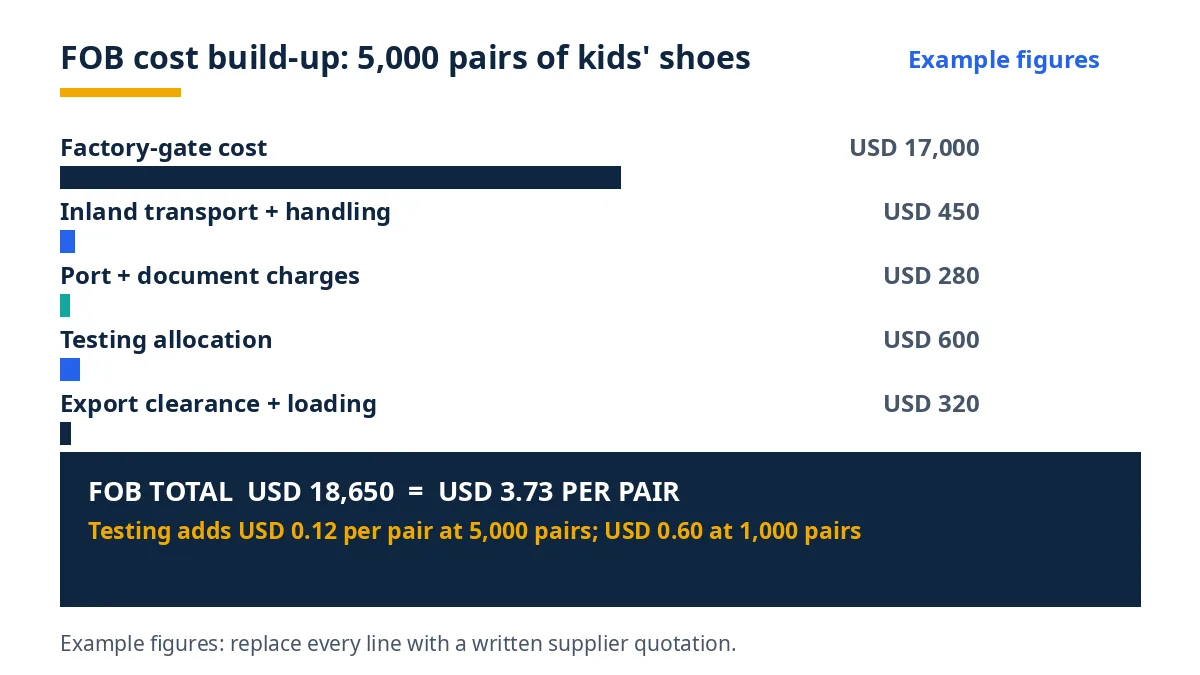
Read the worked example as a structure, not as a price list. Your numbers will differ by material, size range, order size, and factory location. What should not differ is the structure: five lines, each stated, each comparable across suppliers.
What moves the price up or down
Materials. The upper material is usually the main cost driver, followed by the outsole compound. Synthetic uppers cost less than leather; rubber outsoles cost more than EVA. When a quote falls well below comparable quotes, the first question is what changed in the material specification, not how the seller found an efficiency.
Size range and size mix. Children's shoes span many sizes, and the size mix changes material use per pair. A quote for "kids' shoes" without a size range is incomplete: confirm the age range, the size curve, and whether small and large sizes carry the same unit price.
Order size. Fixed lines (testing, documentation, tooling for a new last) spread across more pairs as the order grows. This is the same mechanism that makes minimum order quantities matter so much in this category: small orders carry the same fixed costs as large ones. Our guide to typical MOQ for kids' shoes in Bangladesh shows how order size changes the unit economics.
Testing scope. A quote that includes CPSC-accepted laboratory testing and a Children's Product Certificate is not more expensive than one that omits them; it is more complete.2 If your market is the European Union rather than the United States, the testing scope changes: confirm which chemical and labelling rules your buyer applies, and price the testing for that market, not for a generic "export quality" claim.
Packaging. Individual boxes, hang tags, barcodes, and retail-ready packing add cost per pair. Confirm whether the price covers export cartons only or retail packaging as well, and who supplies the artwork and barcodes.
What FOB does not cover
Everything after loading is outside the FOB price: ocean freight from Chattogram, marine insurance, destination port charges, import duty, import VAT or sales tax, customs brokerage, and delivery to your warehouse.1 For a landed-cost comparison, collect those lines from your forwarder and broker and add them to each FOB quote on the same basis. A quote that looks cheapest at FOB can land dearest if its sailing, transit time, or documentation forces a costlier freight choice.
Bangladesh's footwear sector gives context for why so many buyers are testing this supply base. Between July 2024 and May 2025, exports of other footwear (excluding leather footwear) rose 30.25 percent year on year to USD 494.28 million, while leather footwear exports rose 28.96 percent to USD 620.17 million, according to Export Promotion Bureau data reported by World Footwear.3 Total leather exports reached USD 1.06 billion in the same period, up 12.55 percent, driven primarily by footwear.3 Growth in supply does not by itself make a quotation good; it does mean more factories are quoting, which makes line-by-line comparison more valuable, not less.
Questions to ask before you accept a quote
Put these six questions to every supplier, and keep the answers in writing:
Does the price include testing by a CPSC-accepted laboratory and a Children's Product Certificate, and which laboratory issued the reports?2
Which upper, lining, and outsole materials are priced, and are they named in the quotation?
What size range and size curve does the unit price cover?
Does the price cover export cartons only, or retail boxes, hang tags, and barcodes?
Is delivery to the container terminal or loaded on board the vessel, and which Incoterm applies to the delivery point your forwarder actually uses?
Which port, terminal, and document charges are included, and which will be invoiced separately?
Suppliers who answer all six in writing are easier to compare than suppliers who answer with a lower number. The wholesale kids' shoes guide covers how wholesale pricing differs from a single-order FOB quote, and the HS code guide for kids' shoes helps you confirm the classification your broker will use at import.
Next steps on Exportain
Compare quotations on the same five lines, confirm the testing and certificate position in writing, and check the delivery point against your forwarder's actual collection point. You can browse Bangladeshi suppliers, post an RFQ with your size curve and material specification attached, and read how to buy for how quotations and orders work on Exportain. For the delivery-term choice itself, see FAS vs FOB.
Sources
- FOB & FAS Incoterms® 2020 explained: Key differences. ICC Academy (accessed )
- Business Guidance FAQ. U.S. Consumer Product Safety Commission (accessed )
- Bangladesh: leather and non-leather footwear exports on the rise in 2024-2025. World Footwear, (accessed )
About the author
Sourcing from Bangladesh?
Post a request for quotation and suppliers on Exportain can send you their quotes directly.
Post an RFQ