

Quality Control Checklist for Kids' Shoes From Bangladesh
Kids' shoes quality control checklist for Bangladesh orders: insole length and toe room in every size, sole flexibility, heel and ankle support, child-usable closures, small-part checks, pair matching, labels, lab evidence, and shape-holding packing, with a numbered checklist, failure fixes, and a summary table.
Short answer
This kids' shoes quality control checklist covers insole length and toe room in every size, sole flexibility, heel and ankle support, closures a child can manage, small detachable parts, inside finish, materials, left and right pair matching, labels, buyer-specified lab tests, and shape-holding packing, with a numbered checklist, failure fixes, and a summary table.
On this page
A child who cannot yet explain a bad fit will simply stop walking happily, drag a toe, or kick a shoe off. A kids' shoe order cannot be judged like an adult order: the wearer is still growing, cannot always report pressure, and will test every closure and decoration harder than an adult would. A shoe that looks right on a table can still pinch at the forefoot, bend in the wrong place, slip at the heel, or shed a small part on the first day of wear.
Why this checklist matters
Footwear inspection checks workmanship, materials, measurements, construction, function, labeling, and packaging.1 For kids' shoes, measurement carries extra weight: a young child's foot is soft, and a shoe pressing any part of it can change how toes sit, while a narrow front can push toes over each other.2 There should always be a gap between the longest toe and the shoe, and a child may not be able to say a shoe is too tight.2 The inspector has to catch that.
Flexibility matters as much as length: a flexible sole, flexibility at the toes, and a soft upper are basic marks of a good children's shoe, bending where the foot bends.2 The shoe should be high enough to keep the ankle in position, with a low heel spreading weight across the foot.2 Small parts need separate attention: beads, buttons, and applique can come loose under rough wear, and a piece off a toddler's shoe can become a choking hazard.3
Before you start
Freeze the reference set before inspection: sealed approved pair per style and age group, tech pack, size chart, insole lengths, material and color standards, artwork, labels, barcode, and packing specification. Freeze the smallest, largest, and a middle size, and note both feet, since one foot is often slightly longer.2
Agree three things in writing in the purchase order: the defect list, each defect classed as critical, major, or minor, with reference photos for borderline cases; the sampling plan, with standard, level, and acceptance and rejection numbers per class; and the buyer-specified tests, each named with method and result. The acceptable number of defects depends on the AQL level agreed between buyer and supplier, and specifications should define how pairs are counted and defects classified.1 No test grade or pass mark here is a universal rule: name the method, record the result, and judge it against the order value. Book final inspection when production is complete and goods are mostly packed.4
The full checklist (numbered, printable)
Print this section and tick each item Pass, Fail, or Not applicable.
Approved pair and age-group map. Each style and age group has its own sealed approved pair and packing specification, so a toddler style is never judged against a school-age pair.
Insole length in every size. Measure insole length for every size against the chart, not only a middle size, since a grading error shows first at the ends.1
Toe room and forefoot width. Check toe room ahead of the longest toe and forefoot width against the buyer specification, with toes free to move and no pressing.2
Both-feet fit note. Record fit against the longer foot where fitting notes require it.2
Heel grip and slip check. Check on a last or form that the heel stays seated without slipping or rubbing.
Sole flexibility by hand. Bend each sampled shoe by hand at the forefoot; look for cracking, separation, or a bend point away from where the foot bends.1
Sole softness and upper softness. Press sole and upper and note stiffness: a stiff build trapping the foot is a finding.2
Heel height and ankle support. Measure heel height against the chart and check ankle height and support against the approved pair.2
Heel stability standing. Stand each pair level and check for rocking, tipping, or a heel off-center under the shoe.1
Outsole tread and grip pattern. Check tread against the approved pair, complete across the sole and identical on both shoes, so the sole is not smooth where grip is specified.2 5
Closures a child can manage. Operate every closure as the child would: hook-and-loop, buckle, zip, and elastic, closed and reopened repeatedly.1
Lace and strap security. Check lace length, eyelet fixing, and strap anchoring, and note any lace or strap coming undone easily, since undone laces can trip an unsteady walker.3
Small detachable parts. Pull and twist every bead, button, applique, charm, and trim by hand as specified, and record any part that loosens.3
Sharp edges, points, and protrusions. Run a hand inside each shoe and over every trim, and record sharp edges, points, exposed fasteners, and protrusions.1
Needle and metal check. Where the order requires it, pass sampled pairs through metal detection and record the result.1
Upper material and finish. Check upper material, texture, thickness, and finish against the approved pair, with clean edges and no weak areas.1
Stitching and seams. Check stitching for loose, broken, or skipped stitches, open seams, and untrimmed ends, holding under a hand pull.1
Lining and insole. Check lining fit and insole placement, material, and breathability against the approved pair.2
Color and shade within pairs. Check color evenness within each pair and across the lot against the approved pair under the agreed light.1
Left and right pair matching. Compare the two shoes for shape, size, shade, sole pattern, and stitching, since a visible left/right difference can make a pair unacceptable.1
Washable materials as a buyer-spec item. Where the order names a wash method, record method and result on a sample pair, including any change in shape, color, or closure function, judged only against the order value.
Odor, dampness, and mold. Check for strong chemical odor, dampness, and mold inside the shoe and packing, and photograph affected pairs.
Labels and barcodes. Check size, material, and origin labels for correct content and spelling in position, and that the barcode scans and matches the carton.1
Buyer-specified lab tests. Where the order names colorfastness, abrasion, flexing, or sole bond tests, each is run by its named method and result recorded, with no universal grade or pass mark.1
Shape-holding packing. Pack as specified so the toe shape holds: stuffing and inserts in place, straps and laces laid so they cannot mark the other shoe, with no crushing.
Sampling decision on the finished, packed lot. As a published-table example only, a large repeat order of 600,000 pairs at General Inspection Level III gives code letter R and a sample of 2,000.6 With buyer-specified AQL 1.0 for major and AQL 2.5 for minor defects, the published table gives acceptance and rejection numbers of 21 and 22 for both classes at this code.6 At the largest codes the table gives the same pair for both levels. Those are buyer-agreed order values, not standard-mandated values.7 A pre-shipment inspection samples finished, mostly packed goods, not every piece, and is not a guarantee.4
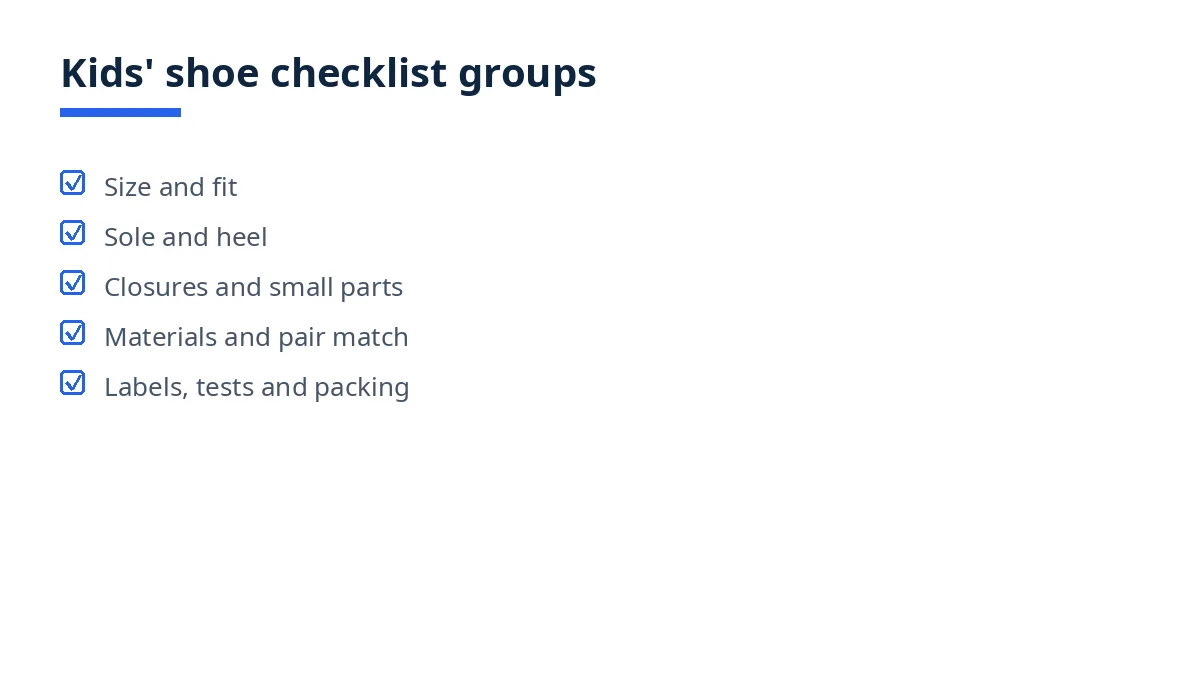
Diagram: kids' shoe checklist groups.
Common failures and how to fix them
Pinched forefoot at an end size. A size passing in the middle and pinching at an end points to a grading error. Hold end sizes, re-grade, and re-check both ends.
Sole bending behind the forefoot. A shoe creasing behind the ball of the foot instead of at it will feel stiff. Hold the style, check bend point, and re-check by hand.
Closure a child cannot work alone. A tab that will not hold, a buckle that slips, or a zip that catches leaves the child dependent on an adult. Isolate the batch, rework, and retest.
A decoration coming loose. A bead or charm moving under a hand pull is a safety finding, not a cosmetic one. Hold the lot, refix or remove the part, and add a hand-pull check.
Heel slipping off in wear. A heel lifting while flexed points to heel shape or counter fit on that run. Measure both shoes flat, isolate the run, and re-check.
Shade split inside a pair. Shoes matching under one light and differing under another are a light and lot problem. Re-check under a second light and trace the lot.
Toe shape crushed in the box. A toe flattened by tight packing is a packing fault, not a making fault. Re-pack with specified stuffing and inserts.
Downloadable template / summary table
No file download is offered with this article. The table below is the template.
Group | What to record | Result |
|---|---|---|
Size and fit | Insole length, toe room, width, heel grip | Pass/fail |
Sole and heel | Flex point, softness, heel, ankle, tread | Pass/fail |
Closures and small parts | Closures, lace security, part pull, edges | Pass/fail |
Materials and pair match | Upper, stitching, lining, color, pair match | Pass/fail |
Labels, tests, packing | Labels, barcode, tests, packing, sampling | Pass/fail |
For the sampling row, use the table values for your agreed plan; item 26 shows a Level III plan for 600,000 pairs.
How Exportain helps
Exportain connects international buyers with Bangladeshi sellers and service providers; buyers can post a requirement describing style, age group, size run, and inspection scope. The inspection services category page currently shows "No services published in this category yet", so confirm any provider, scope, and price directly before booking. The inspection contract is always between buyer and provider, and Exportain does not inspect goods.4
FAQs
When should this checklist be used?
Use it when the approved pair per style and age group is sealed, during production, and at final inspection on finished, packed goods.
Who should complete it?
The buyer writes the checklist and defect list; an independent inspector or the buyer's quality team completes the checks.
What are the most common failures?
A pinched forefoot at an end size, a sole bending in the wrong place, a closure a child cannot work, a decoration coming loose, a slipping heel, a shade split, and a crushed toe. Record size, age group, color, style, and date with every failure.
Can a third party do it?
Yes. A third-party firm works to the buyer's checklist and pass criteria, and the booking party receives the report.4 Agree scope, sampling plan, tests, and re-inspection payer before production.
Next steps on Exportain
Read the AQL acceptance quality limit guide to find the code letter and sample size for your lot.
Read the pre-shipment inspection guide to set the timing and scope of the final inspection.
Browse the inspection services category, which currently shows "No services published in this category yet", and confirm any provider directly.
Sources
- Footwear Inspection: Complete Guide to Quality Control and Inspection Standards. ECQA (accessed )
- How does quality footwear affect child development?. Dr Luigi (accessed )
- Toddler fashion choices that can be safety hazards. Ovia Health (accessed )
- Pre-Shipment Inspection (PSI). Exportain (accessed )
- Footwear Product and Component Safety Requirements. Textile Industry (accessed )
- AQL Calculator | Sample Size and ISO 2859-1 Tool. AQMBD (accessed )
- AQL Meaning: Acceptance Quality Limit, Tables. Exportain (accessed )
- pre-shipment inspection
- quality control
- Bangladesh sourcing
- aql inspection
- Footwear
- Kids shoes
- Children's footwear
About the author
Sourcing from Bangladesh?
Post a request for quotation and suppliers on Exportain can send you their quotes directly.
Post an RFQ


