FAS vs DAP: Key Differences, Costs and Which One to Choose
FAS ends at the ship's side in Chattogram. DAP ends at your named destination, unloaded by you. The difference is who carries the journey and who clears import.
Short answer
FAS and DAP differ in where the seller's job ends. Under FAS, the seller delivers alongside the buyer's vessel at Chattogram; the buyer pays loading, freight, and import clearance. Under DAP, the seller carries the goods to a named inland destination and delivers them ready for unloading, bearing the journey risk, while the buyer unloads and clears import. Choose FAS when you control freight; DAP when you want one delivered price at destination.
On this page
Key takeaways
FAS delivery happens alongside the vessel at the port of shipment; DAP delivery happens at the named destination, ready for unloading.
Under DAP the seller bears risk for the whole journey; under FAS the buyer bears risk from the ship's side onward.
Under both rules the buyer handles import clearance, duty, and VAT; DAP never includes import clearance.
Under DAP the buyer unloads at their own risk and cost unless the carriage contract says otherwise.
FAS and DAP sit at opposite ends of the seller's journey. One ends before the goods leave the port of shipment. The other ends at a named destination inland, with the seller carrying the risk for the whole trip. Buyers who confuse the two either pay for freight they thought the seller was paying, or wait at a destination for goods whose import clearance is their own job.
This comparison explains the difference through one shipment: woven shirts from Chattogram to a buyer's distribution centre near Warsaw, Poland. The rule names, delivery points, and cost split below follow the ICC Academy's explanations of Incoterms 2020.
What is the one decision that separates FAS from DAP?
The decision is the delivery point. Under FAS (Free Alongside Ship), the seller's duty ends once the goods sit beside the vessel the buyer has nominated at the loading port, and risk passes to the buyer there.1 Under DAP (Delivered at Place), the seller delivers the goods at the agreed place of destination, ready for unloading, and risk transfers there.2 Everything else in the comparison follows from that one difference: who arranges the main carriage, who bears the risk during it, and who stands at the destination with the unloading crew.
FAS belongs to the sea and inland waterway family: it applies only to port-to-port shipments by sea or inland waterway.1 DAP belongs to the any-mode family: it works for sea, air, road, rail, and multimodal shipments.2 A buyer moving containerised shirts from Chattogram to Warsaw will usually use more than one mode, which is itself a reason to look past FAS unless the sea leg is genuinely the whole arrangement.
What does the seller do under FAS?
Under FAS the seller transports the goods to the port, completes export formalities, places the goods alongside the nominated vessel within the agreed period, and notifies the buyer.1 The buyer owes the seller timely notice of the vessel and the precise delivery spot inside the port. If that notice never arrives and the vessel closes for cargo, the buyer carries the risk and the extra costs from the moment of the failure.1
The buyer then appoints the carrier, pays the freight, covers the loading costs at the port, and handles import formalities and any transit customs.1 FAS suits bulk cargo that can genuinely be placed alongside a ship: minerals, grains, cement, steel, and vehicles.1 The ICC Academy warns that containerised goods are normally delivered to a container terminal, not alongside the ship, and may sit there for days before loading; in that case FCA is the more appropriate rule.1 Woven shirts in cartons, stuffed into containers at a terminal, are exactly that case. FAS is the right comparison here because it shows the far end of buyer responsibility, not because it is the usual choice for containerised garments.
What does the seller do under DAP?
Under DAP the seller arranges and pays carriage to the agreed destination, completes export clearance and any transit customs formalities, bears the risk of loss or damage for the whole journey, and delivers the goods at the buyer's disposal, ready for unloading, at the named place.2 Delivery and destination are the same place under DAP: the named destination is both where the goods are delivered and where risk transfers.2
The buyer takes delivery by unloading the goods at their own risk and expense, and manages and pays for all import clearance formalities.2 There is no insurance duty on the seller under DAP, although the seller carries the transit risk up to the destination.2 Note the unloading cost point carefully: the buyer bears unloading costs unless the transport contract includes them for the seller, in which case the buyer still bears the unloading risk.2 If your DAP quote assumes the seller's truck driver unloads, write that into the contract; the rule alone does not promise it.
Side by side: FAS against DAP
Question | FAS | DAP |
|---|---|---|
Delivery point | Alongside the vessel at Chattogram | Named destination, ready for unloading |
Risk transfers | At the ship's side | At the named destination |
Main carriage | Buyer contracts and pays | Seller arranges and pays |
Loading at origin port | Buyer pays | Seller's carriage covers it; buyer unloads at destination |
Export clearance | Seller | Seller, plus transit formalities |
Import clearance, duty, VAT | Buyer | Buyer |
Unloading at destination | Buyer, at buyer's risk and cost | Buyer, at buyer's risk and cost |
Insurance duty | None on either party by the rule | None on either party by the rule |
Modes | Sea and inland waterway only | Any mode, including multimodal |
The table shows why the two prices are never directly comparable. A FAS price excludes the main carriage; a DAP price includes it. Comparing them without adding the missing leg to the FAS side understates the FAS shipment by the whole ocean and inland journey.
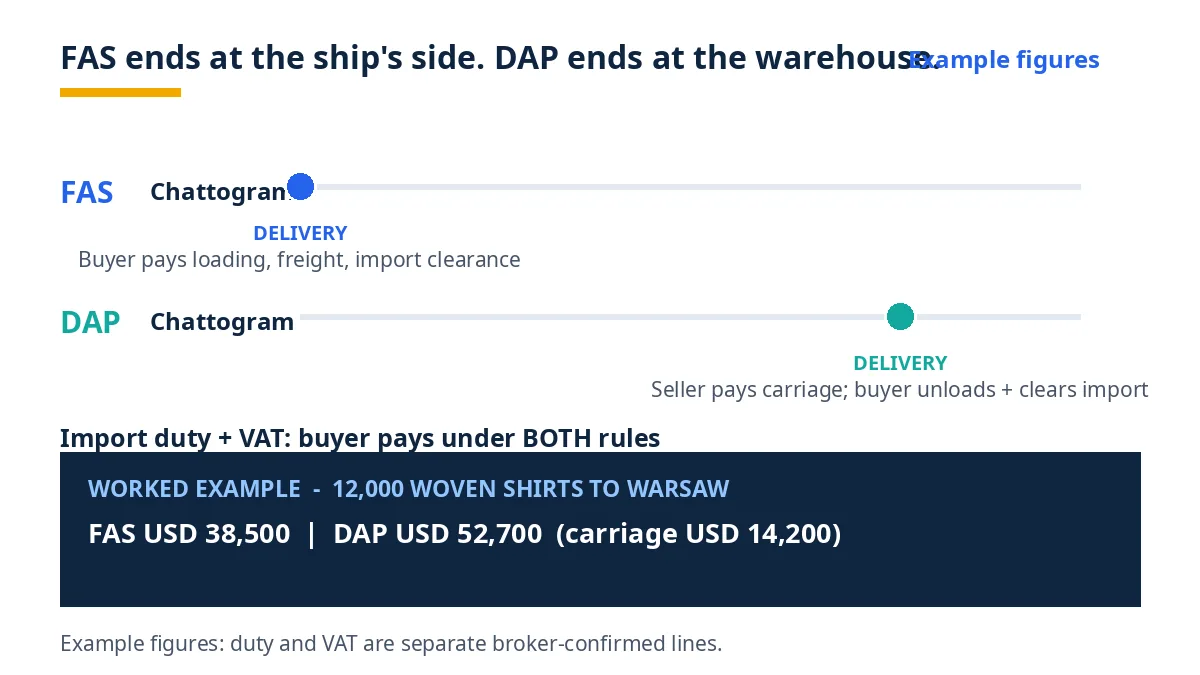
Worked example: 12,000 woven shirts to Warsaw
The figures below are example figures for 12,000 woven cotton shirts from Chattogram to a distribution centre near Warsaw. They compare the two rules on the same goods, not two different shipments.
Line | FAS Chattogram | DAP Warsaw warehouse |
|---|---|---|
Goods, export packing, export clearance | USD 38,500 | USD 38,500 |
Main carriage Chattogram to Warsaw, including insurance arranged for the journey | Buyer pays separately | USD 14,200 |
Delivered price under the rule | USD 38,500 | USD 52,700 |
Import clearance, duty, and VAT | Buyer pays separately | Buyer pays separately |
Unloading at destination | Buyer pays separately | Buyer pays separately |
The DAP figure is 38,500 + 14,200 = USD 52,700. The FAS figure looks USD 14,200 lower only because the carriage sits outside it. Once the buyer adds freight, insurance, and destination handling to the FAS side, the comparison becomes honest. Import duty and VAT stay on the buyer's side under both rules, so neither price includes them; the buyer needs an EORI number for EU customs clearance, since an EORI number is mandatory for customs operations in the EU customs territory and a person holds only one valid EORI number at a time.3
When does FAS win?
FAS wins when the buyer already controls the freight. If you run consolidated sailings from Chattogram, hold annual ocean contracts, or buy through a freight partner who loads at the port, FAS keeps the seller's price clean and leaves the journey in your hands. It also wins when the goods genuinely go alongside the vessel rather than into a container terminal, which is rare for garments and common for bulk cargo.
FAS loses when the buyer has no freight arrangement and discovers at the port that loading, storage, and carriage are all unpriced. The rule gives the seller no duty to solve that problem.
When does DAP win?
DAP wins when the buyer wants one delivered price at a named place and one party carrying the journey risk. It suits buyers without an EU freight setup, buyers consolidating from several Bangladeshi suppliers into one destination, and buyers who want the seller to answer for the goods until they arrive. It also suits multimodal routes where the sea leg is only part of the trip, since DAP covers any mode.2
DAP loses when the buyer cannot clear import promptly. Under DAP the buyer bears all risks during the import clearance process, and if the buyer is unwilling to assume that risk, DDP rather than DAP is the rule to consider, noting that a foreign seller may have difficulty carrying out import clearance in the destination country.2 DAP also loses when the destination has no unloading capacity on the delivery day: the buyer unloads at their own risk and cost, so a missed forklift booking becomes the buyer's delay, not the seller's.
Contract lines to write in either case
Whichever rule you choose, write these five lines into the sales contract:
The rule, the named place, and the Incoterms 2020 version: for example, "DAP buyer's distribution centre, Warsaw, Incoterms 2020" or "FAS Chattogram, Incoterms 2020".
The vessel or carrier details the buyer must confirm, and the deadline for that notice.
Who pays unloading at the destination, and whether the carriage contract includes it.
Who arranges insurance for the journey, and for what value, since neither rule imposes an insurance duty.
The documents the seller must provide for import clearance, and the deadline for each.
A rule name without a named place is not a delivery term; it is an argument waiting to happen. Our FAS vs FOB comparison covers the nearer neighbour of FAS, and FAS vs CPT covers the case where the seller pays the carriage but delivery still happens at origin.
Next steps on Exportain
Fix the delivery point before inviting quotations, and hold every supplier to the same rule and named place. State the rule and destination in your RFQ, shortlist from Bangladeshi suppliers, and follow how to buy to turn a quotation into an order.
Sources
- FOB & FAS Incoterms® 2020 explained: Key differences. ICC Academy (accessed )
- DAP & DDP Incoterms 2020 explained: Key differences. ICC Academy (accessed )
- Economic Operators Registration and Identification number (EORI). European Commission (accessed )
About the author
Sourcing from Bangladesh?
Post a request for quotation and suppliers on Exportain can send you their quotes directly.
Post an RFQ