FCA vs FAS: Key Differences, Costs and Which One to Choose
FCA hands goods to the buyer's nominated carrier at a named place, for any mode. FAS places goods alongside the buyer's nominated vessel at a named port, and the buyer pays to load them. This comparison prices one lot of jute yarn both ways, with every figure labelled as an example.
Short answer
FCA suits cargo handed to a carrier the buyer nominates at a named place — inland, at a terminal, or at the seller's premises — and it works for any mode of transport. FAS suits sea or inland-waterway cargo placed alongside a vessel the buyer nominates at a port, with the buyer paying to load the goods on board. Choose by the handover you can perform: carrier handover points to FCA; quayside delivery to a named vessel points to FAS.
On this page
Key takeaways
FCA delivery is handover to the carrier the buyer nominates at a named place; FAS delivery is placement alongside the vessel the buyer nominates at a named port.
At the seller's premises, FCA delivery completes when the goods are loaded on the buyer's collecting vehicle; at another named place, it completes when the goods arrive ready for unloading.
Under FAS the buyer pays for loading on board; under both terms the buyer arranges main carriage, clears import, and pays duty.
Neither term requires the seller to insure the buyer's risk; buy cover from the handover point, including the loading lift under FAS.
A bale of jute yarn can leave Bangladesh by two different doors: a carrier's truck or a terminal gate inland from the port, or the quay beside a named vessel at Chattogram. In an FCA vs FAS comparison, FCA names the first door and FAS names the second. The price, the risk point, and the loading bill follow from which door the contract names, so settle the door before comparing quotations.
Decide the mode before you compare the price
Ask what will carry the goods before asking what each term costs. FCA works for any mode of transport, single or combined, because delivery is handover to a carrier at a named place that need not sit at a port.1 FAS works only for sea and inland waterway transport, because delivery is placement alongside a vessel at a named port of shipment.2 Only FAS, FOB, CFR and CIF are confined to sea and inland waterway transport.3 A shipment that flies, travels by road or rail, or changes mode on the way cannot be described by FAS. A shipment that sails can use either term, and then the choice turns on the handover: a carrier the buyer nominates, or a vessel the buyer nominates.
Question | FCA | FAS |
|---|---|---|
Transport modes | Any mode, single or combined | Sea and inland waterway only |
Delivery point | Named place, to the carrier the buyer nominates | Named port, alongside the vessel the buyer nominates |
Risk passes | At handover to the carrier | When the goods sit alongside the vessel |
The lift on board | Buyer | Buyer |
Sea leg booking and payment | Buyer | Buyer |
Insurance for the buyer | None owed by the seller | None owed by the seller |
The buyer books the main carriage, clears import, and pays duty under both terms, and the seller clears export under both.4 Neither term asks the seller to arrange cover for the buyer.3 The split is narrower: the place of delivery, the party or vessel named there, and the loading lift between alongside and on board.
The nomination in each term names a different party
Under FCA the buyer nominates a carrier or another person, and the seller delivers the goods to that carrier at the agreed place.1 Under FAS the buyer nominates a vessel, and the seller places the goods alongside that vessel at the named port.2 Write both nominations into the contract in full. For FCA, name the place and the point within it, such as a terminal gate or a warehouse bay, with an address the driver can reach. For FAS, name the port, the loading point within it, and the vessel, so the seller is not left to choose a quay that suits the seller while the buyer's vessel waits elsewhere.5
The buyer must give the seller the vessel name, the loading point, and the timing in good time. If the vessel arrives late, leaves before the agreed date, or refuses goods delivered on time, the buyer bears the consequences, and the same applies when the buyer has not passed on those details in time.5 Under FAS the seller must provide proof of delivery, such as a dock receipt or a ship's receipt, so agree the exact document before the goods move.5 Under FCA, agree a signed carrier receipt naming the goods, the date, and the point of handover.
FCA at the seller's premises and FCA elsewhere are not the same handover
FCA contains two handovers, and the contract must show which one applies. When the named place is the seller's premises, delivery is complete when the goods are loaded onto the means of transport the buyer arranged, and loading is the seller's job.2 When the agreed place lies elsewhere, such as a container yard, an airport cargo shed, or a rail depot, delivery is complete when the goods, loaded on the seller's means of transport, reach that place and stand ready for unloading, at the disposal of the carrier or the person the buyer nominated.2 In the second case the seller does not unload.
Both forms suit container cargo and multimodal movement, because the risk point sits at handover to the carrier rather than at loading on board a vessel.1 A container handed to a carrier at a terminal days before sailing is already delivered under FCA. In either form the seller completes export formalities and meets the security requirements for transport.1 The buyer then runs the main carriage, the import file, and the onward leg, and buys any cover it wants from the handover point onward.
FAS ends at the ship's side, before the lift
Under FAS the seller brings the lot to the named port, finishes the export file there, and sets the goods down beside the vessel the buyer nominated, on a quay or a barge, in a position from which they can be taken on board without difficulty.2 5 Delivery is complete at that moment, and risk passes to the buyer there.2 The seller does not load the goods on board. The buyer organises the loading, pays for it, and bears the risk of the lift and of everything after it, including the main carriage and the import file.6
FAS fits cargo that can be brought to the ship's side in one piece: bulk goods, breakbulk loads, and heavy or oversized pieces that the vessel's own gear or the quay facilities can lift.5 It fits poorly where the goods must first pass through a terminal the seller cannot control. Before agreeing FAS, settle how long the goods may wait at the quay, who pays for waiting and storage if the vessel is delayed, and what happens if the loading point changes.
The money, the risk, and the paperwork, split at the handover
Costs follow delivery in both terms: costs incurred before delivery sit with the seller, and costs incurred after delivery sit with the buyer, since both terms belong to the group in which the buyer arranges the main carriage.3 The table below splits the common legs. It assumes the named place under FCA is a terminal away from the seller's premises; at the seller's premises the loading line moves to the seller.
Job or charge | FCA payer | FAS payer |
|---|---|---|
Goods and export packing | Seller | Seller |
Inland carriage to the handover point | Seller | Seller |
Export clearance and security | Seller | Seller |
The vessel loading lift | Buyer | Buyer |
Carriage to Rotterdam | Buyer | Buyer |
Insurance premium, if cover is bought | Buyer | Buyer |
Import clearance, duty, and taxes | Buyer | Buyer |
Destination handling and onward carriage | Buyer | Buyer |
Insurance deserves a separate line in every quotation, because neither term requires the seller to arrange it. A policy owed to the buyer arises under two rules only, CIP and CIF. FCA and FAS sit outside that pair.3 Each side should insure the part of the journey for which it bears the risk. The buyer should check that its policy starts at the right point: at handover to the carrier under FCA, and at the alongside point under FAS, covering the loading lift rather than starting only once the goods are on board.6 A policy that starts at sailing leaves the loading operation, and any wait at the quay, outside the cover the buyer thought it had bought.
Jute yarn priced both ways: Chattogram to Rotterdam
All amounts in this section are example figures. They show how the two columns add up; no leg is a live quotation. A buyer orders one lot of baled jute yarn from a mill, for delivery to Rotterdam. Under FCA the lot goes to a container terminal at Chattogram and is handed to the carrier the buyer nominated. Under FAS the same lot goes to the quay and is placed alongside the vessel the buyer nominated. The FAS column assumes quayside delivery is workable for this lot and that a loading contractor is booked; a containerised lot handled only through a terminal would be priced under FCA instead. Duty and import taxes appear as an example amount, since this article consulted no tariff schedule for the destination. Ask a broker for the figure to use instead before relying on either total.
Price element | FCA to the terminal | FAS alongside the vessel |
|---|---|---|
Goods and export packing | 24,600 | 24,600 |
Inland carriage to Chattogram | 780, in the seller price | 780, in the seller price |
Handover handling and waiting | 340, in the seller price | 670, in the seller price |
Export papers and security | 210, in the seller price | 210, in the seller price |
Loading on board | Buyer pays 520 | Buyer pays 520 |
Main carriage to Rotterdam | Buyer pays 2,850 | Buyer pays 2,850 |
Transit insurance premium | Buyer pays 185 | Buyer pays 205 |
Import clearance charge | Buyer pays 310 | Buyer pays 310 |
Duty and import taxes (illustrative amount) | Buyer pays 1,240 | Buyer pays 1,240 |
Seller quoted price | 25,930 | 26,260 |
Buyer-paid legs after the price | 5,105 | 5,125 |
Buyer total | 31,035 | 31,385 |
The chart below sets the two seller figures against what each buyer still has to settle, with example figures marked as such.
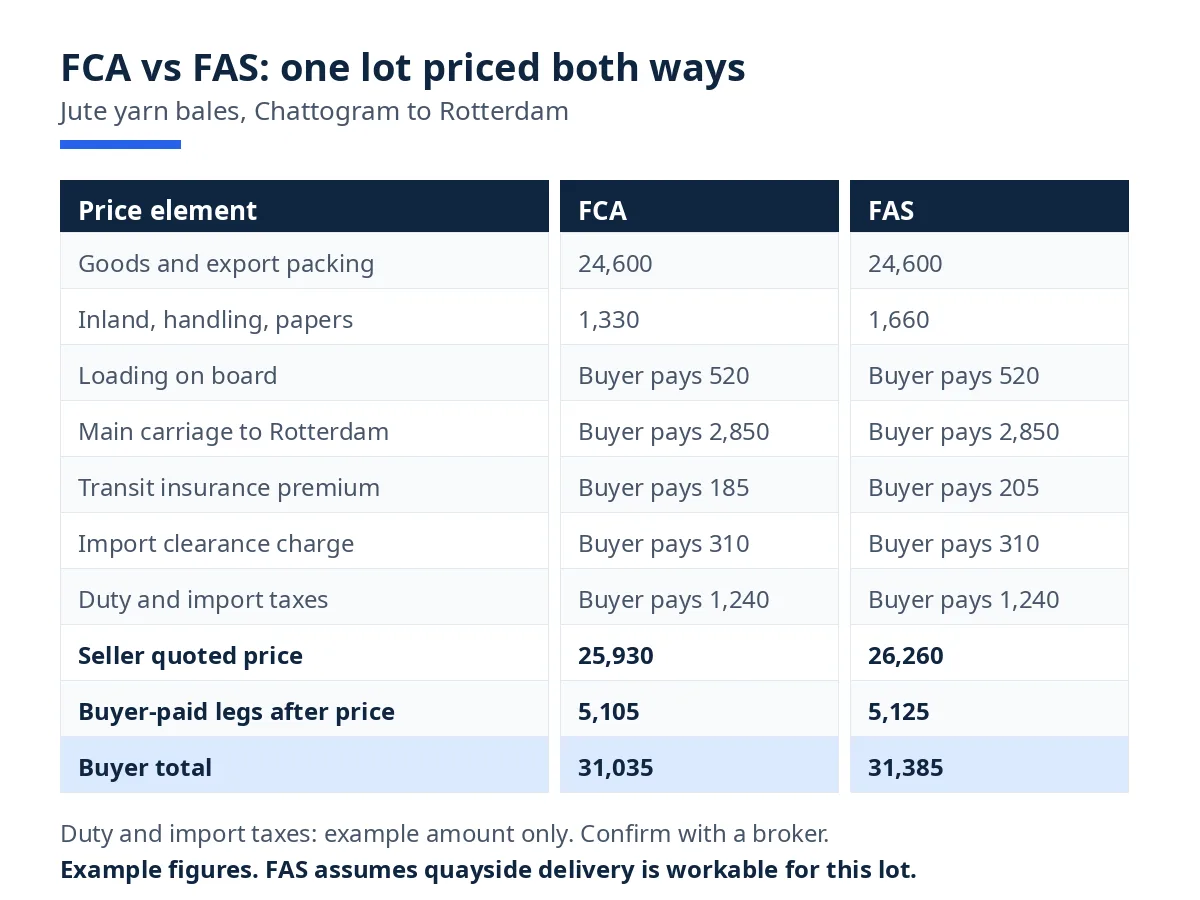
Each column adds up as follows. On the FCA side, 24,600 plus 780 plus 340 plus 210 gives a seller price of 25,930, and the buyer-paid legs of 520 plus 2,850 plus 185 plus 310 plus 1,240 give 5,105, for a buyer total of 31,035. On the FAS side, 24,600 plus 780 plus 670 plus 210 gives a seller price of 26,260, and 520 plus 2,850 plus 205 plus 310 plus 1,240 give 5,125, for a buyer total of 31,385. The seller prices sit 330 apart, and the buyer totals sit 350 apart: quay handling and waiting at the ship's side, against terminal handling at the FCA point, plus 20 for the premium covering the loading lift. Loading on board, main carriage, clearance, and duty cost the same in both columns, because the buyer pays them in both. Set quotations side by side only once loading, carriage, clearance, duty, handling, and the onward leg are all included in each total, with duty confirmed by a broker.
Cargo fit: containers, bulk, and the load that decides the term
Start from how the goods will actually reach the vessel. Containerised cargo is usually delivered to a terminal managed by the shipping line or a port operator, days before loading, and the seller cannot place a container alongside the vessel itself.5 For that cargo, FCA is the workable term: handover at the terminal completes the seller's delivery, and risk moves at a point the parties can point to.5 Bulk cargo, breakbulk cargo, and heavy pieces that travel on a conventional vessel suit FAS, because the goods can be delivered directly to the ship's side and loaded by the buyer's arrangements.5 6
Jute yarn shows both sides of the test. Yarn baled and stuffed into containers at the mill or at a terminal belongs under FCA, with the handover at the terminal or at the mill. A breakbulk lot of yarn that reaches the ship's side directly belongs under FAS only when the quay, the vessel, and the loading contractor are all confirmed in advance. Air, road, and rail legs point the same way: FAS cannot describe them, while FCA covers any mode and any combination of modes.1 When the goods change hands at a terminal before sailing, name FCA and name the handover point. When the whole question is a named vessel at a named port, and the goods can be set beside it, FAS is open for discussion.
Why CIF answers a different question
Buyers sometimes treat CIF as a dearer version of FAS. It is not. CIF is also confined to sea and inland waterway transport, and it also delivers when the goods go on board the vessel, but the seller pays the freight to the named destination port and buys insurance for the buyer's risk during the voyage.7 The default cover is Clause C of the Institute Cargo Clauses, the minimum level, at 110% of the invoice value, and the parties may agree broader cover in the contract.7 Risk still passes on board at the port of shipment, while the seller keeps paying freight after that point. Under FCA and FAS, by contrast, the buyer arranges and pays for the main carriage and buys any cover it wants, and no policy is owed by the seller. The comparison in how a CIF seller's freight and Clause C insurance change the comparison sets out that split in full. Choose CIF when the buyer wants the seller to fund carriage and insurance to the destination port. Choose FCA or FAS when the buyer wants to hold the carriage booking, the carrier choice, and the insurance decision itself.
Bangladesh checks before you name the place or the port
Agree these points in writing before signing the purchase order. Name the FCA place or the FAS port with the precision a driver or a quay crew needs: a terminal name and address under FCA, or a port, loading point, and vessel name under FAS. Fix the nomination and its timing: who nominates the carrier or the vessel, by what date, and through which contact, so a late nomination does not leave goods waiting at the seller's cost. Confirm the seller can complete export clearance for the goods as packed and marked, and agree the documents and the proof of delivery the seller will hand over. Settle loading in full under FAS: the contractor, the gear, the cost, and who bears the risk of the lift, plus waiting and storage charges if the vessel runs late. Settle insurance start points in the same document: cover from handover under FCA, and cover from the alongside point, including the lift, under FAS. Finally, leave duty out of the term comparison until a broker confirms it. The duty bill depends on how the goods are classified, where they originate, their value, and the rules of the destination country, and this article gives no duty rate.
FCA vs FAS: questions buyers ask when both look plausible
Which term gives the lower buyer total for the same lot?
In the worked example the FCA total sits 350 dollars under the FAS total, at 31,035 against 31,385. The gap reflects handover charges and the premium for cover spanning the loading lift in this example, and another lot may price differently. Do not rank quotations until loading, carriage, clearance, duty, handling, and the onward leg are all included in both totals, with duty confirmed by a broker.
Can FAS cover a container load shipped from Chattogram?
No, not in the usual container flow. Containers are delivered to a terminal and stacked there before loading, so the seller cannot place them alongside the vessel, and the alongside point in a FAS contract would not match the physical movement.5 6 Use FCA for container loads, naming the terminal or the seller's premises as the place of delivery. Keep FAS for cargo that reaches the ship's side directly, such as bulk, breakbulk, or heavy loads, with the vessel and the loading point named in the contract.
Can the term change after the purchase order is signed?
It can, by a written amendment signed before the goods move, provided the price and the papers are rebuilt around the new term. A switch to FAS needs a vessel nomination, a loading contractor, a quay waiting allowance, and cover that starts at the alongside point, all priced into a fresh quotation. A switch to FCA needs a named place and a carrier nomination, with the quay wait and the loading lift taken out of the seller's side. In both directions, align the order, the invoice, the packing list, and the transport document on the new term, and settle the new price, the loading position, and the cover start before dispatch, since the risk point follows the term.
What must a first-time buyer settle before agreeing FAS?
Four items, settled before the order is signed. The vessel, named in the contract, with the loading point and the delivery window. The loading contractor, with the gear, the cost, and the risk of the lift assigned in writing. Insurance that starts at the alongside point and covers the lift, with the policy checked against the contract. And the proof of delivery the seller will provide, plus the fallback if the vessel is late or refuses the goods, so a delay at the quay does not become a dispute about who owned the goods while they waited.5
Next steps on Exportain
Place the pair among the full set of eleven Incoterms 2020 rules for shipments out of Bangladesh, and check the CIF contrast in how a CIF seller's freight and Clause C insurance change the comparison before deciding whether the buyer or the seller should fund carriage and cover. When the handover is settled, ask sellers to quote on that exact place or port by following the steps for asking Bangladeshi sellers to quote on a named place or port.
Sources
- FCA & FOB Incoterms 2020 explained: Key differences. ICC Academy (accessed )
- Place of delivery & risk transfer in trade contracts. ICC Academy (accessed )
- Insider thoughts: Bob Ronai on Incoterms 2020 Rules; What are they about?. International Chamber of Commerce (accessed )
- Should tariffs be part of Incoterms® training?. ICC Academy (accessed )
- FAS Incoterm 2020. Röhlig Logistics (accessed )
- FAS Incoterms (Free Alongside Ship): Meaning and Use. iContainers (accessed )
- CIF Incoterms (Cost, Insurance and Freight) Explained. iContainers (accessed )
About the author
Sourcing from Bangladesh?
Post a request for quotation and suppliers on Exportain can send you their quotes directly.
Post an RFQ