FCA vs FOB: Key Differences, Costs and When to Use Each
A sealed container can change hands days before it is loaded on a vessel. FCA and FOB price that gap differently: one ends at handover to the carrier, the other ends on board. This comparison follows one jeans shipment from Gazipur to Hamburg and prices it both ways.
Short answer
FCA delivers denim jeans, or any cargo, to the carrier the buyer names, at an agreed place: risk passes at that handover, even if the container still waits at a terminal. FOB delivers only when the goods are loaded on board the vessel the buyer names at the port of shipment, and FOB works only for sea and inland waterway transport. For containerized cargo, FCA usually matches the physical journey; FOB suits cargo loaded straight onto the vessel.
On this page
Key takeaways
FCA risk passes when goods are handed to the carrier or person the buyer named at the agreed place and point; FOB risk passes when goods are loaded on board the nominated vessel at the named port of shipment.
FCA works for any mode, including multimodal container journeys; FOB works only for sea and inland waterway transport, one of four sea-only rules with FAS, CFR and CIF.
A container handed to a terminal under FCA sits at the buyer's risk before loading, while under FOB the seller carries the risk until the goods are on board, unless an early-transfer exception applies.
Neither term obliges the seller to insure the buyer; cover must start at the buyer's own risk point, and the FCA on-board bill of lading option needs a written agreement in the sales contract.
In the worked example both terms total 15,588 dollars before duty; the FOB seller price runs 715 higher because it already includes the road leg, terminal handling and loading.
A sealed container leaves a factory in Gazipur on a truck, reaches a terminal at Chattogram, and waits. Days can pass before a crane lifts it onto a vessel. The question FCA and FOB answer differently is who answers for the container during those days, and whose price already includes getting it onto the ship.
Under FCA, the seller hands the goods to the carrier the buyer named, at a place and point both sides agreed, and risk passes at that handover. Under FOB, the seller's work ends later, once the goods sit loaded on the buyer's vessel at Chattogram, and risk passes at that loading. The two prices for the same container therefore stop at different moments, and the gap between those moments is where most FCA-versus-FOB arguments start.
This article follows one container of denim jeans from Gazipur to Hamburg, prices it under each term, and shows when the on-board bill of lading option changes the choice.
The container call in one table: handover to a carrier, or loading on board
Question | FCA (Free Carrier) | FOB (Free On Board) |
|---|---|---|
Delivery happens | At the agreed place and point, when goods pass to the carrier or person the buyer named | On board the vessel the buyer nominated, at the named port of shipment |
Risk passes | At handover to that carrier or person | When the goods are loaded on board |
Modes allowed | Any mode, including journeys that mix modes | Sea and inland waterway transport only |
Named place in the contract | An agreed place and point, which can be the seller's premises or another place such as a container terminal | A named port of shipment, plus the loading place and point inside the port |
Main carriage | Buyer contracts and pays | Buyer contracts and pays |
Export formalities | Seller | Seller |
Import formalities and duty | Buyer | Buyer |
Insurance for the buyer | No policy owed by the seller; the buyer arranges cover from handover | No policy owed by the seller; the buyer arranges cover from loading |
Loading onto the vessel | Buyer, through the carrier it hired | Seller |
Physical fit | Containerized cargo, pallets, and multimodal journeys | Cargo loaded straight onto the vessel, such as bulk cargo |
Mode comes first, because it decides whether FOB can be used at all. Only FAS, FOB, CFR and CIF are confined to sea and inland waterway transport. FCA sits among the any-mode rules, which fits a journey that starts on a truck, pauses at a terminal, and continues by sea.1
Two handover points: a carrier at an agreed place, and a vessel at a port
FCA gives the parties two ways to fix the handover. At the seller's premises, the seller puts the goods onto the collecting vehicle the buyer sent, and delivery is complete at that loading. At another agreed place, such as a port container terminal, an airport cargo terminal, or a rail terminal, the seller brings the goods to the buyer's carrier or named contact with unloading still ahead of them.1 In both cases the seller completes the export formalities, and the buyer arranges the onward transport and handles the import formalities.1
That second form is the one container trade uses most. A seller in Gazipur can drive a sealed box to a Chattogram terminal, hand it to the buyer's carrier there, and finish its part while the box still sits on land. Risk has already passed, because delivery under FCA is the handover itself, not the later loading. The seller's price under FCA covers the goods and their packing, the loading onto the collecting vehicle where delivery happens at the seller's premises, and the export formalities; transport beyond the delivery point is the buyer's.1
FOB keeps the seller in the chain longer. The seller must transport the goods from its premises to the port of shipment, load them on board the buyer-nominated vessel, and complete the export formalities.2 Risk of loss or damage transfers to the buyer at that loading point, at the port of shipment.2 The buyer designates the carrier, establishes the transport contract, and pays the freight to the destination port, and the buyer handles the import formalities and any transit customs in other countries.2
The distinction matters most for who must act before the vessel arrives. Under FOB, the buyer must tell the seller in time the vessel's name and the specific loading place and point within the port.2 If that notice arrives late or never arrives, and loading cannot go ahead, the buyer takes the risk from that point, even with the goods still ashore, under the FOB rule's early-transfer provision.2 The same early transfer applies where the nominated vessel runs late and the seller cannot load on the agreed date, leaving the buyer to pay for keeping the goods at the port and to answer for them while the vessel is still on its way, and where the buyer gives late notice and the vessel closes for cargo earlier than the notified time.2 Under FCA, the equivalent discipline is precision about the agreed place and point: a terminal name without a gate, bay, or collection window leaves the carrier and the seller arguing over where the handover was supposed to happen.
The days in between: who answers for a box that waits at the terminal
Containerized cargo rarely moves straight from a factory gate onto a vessel. The usual path is factory to terminal, terminal stack to vessel, with a wait in between that neither party controls. FCA matches that path because its delivery point can be the terminal itself: the seller hands the box over, risk passes, and the wait belongs to the buyer and the buyer's carrier and cover. FOB does not match it as neatly, because its delivery point sits on the far side of the wait. The seller keeps the risk while the box sits at the terminal, and must still load it when the vessel is ready.
The ICC Academy guidance on the neighbouring sea-only pair makes the same practical point: when goods are containerized, sellers typically deliver them to a container terminal rather than to the vessel, containers may remain at the terminal for days before being moved to the vessel, and in such cases the FCA rule is more appropriate.2 That advice appears in the FAS and FOB comparison, and it applies with equal force here, since FOB shares the on-board delivery point that creates the gap.
The gap also decides when cover must start. Neither term puts the buyer's insurance on the seller: the insurance duty in Incoterms 2020 sits with CIP and CIF, not with the F rules.1 2 A buyer under FCA therefore needs cover running from the handover at the agreed place, including the terminal wait and the loading that follows. A buyer under FOB needs cover running from loading on board, while the seller's own interest covers the wait only so far as the seller chooses to insure it. Cover that begins only at sailing leaves the factory leg, the road leg, and the terminal wait bare under FCA, and leaves the wait bare under FOB only where the seller has bought no cover of its own. Line each policy up with the risk moment named in the contract, and read the policy wording before the container is collected.
A further difference hides inside the loading itself. Under FCA at the seller's premises, the seller puts the goods on the collecting vehicle. At another agreed place, the buyer takes the goods off the seller's vehicle and puts them onto the next leg of the journey.1 Under FOB, the seller loads the vessel. Where a container arrives sealed, the loading question is usually a crane question rather than a labour question, but the contract should still say who pays the terminal for each lift, because a lift charged to the wrong side is the most common small dispute in a container shipment.
Money, risk and papers, leg by leg
The table that follows tracks one sealed box from a factory gate to a vessel, and names the payer for each leg under each term. It takes the FCA handover point as the seller's Gazipur premises and the FOB named port as Chattogram. Real contracts divide the middle legs in different ways, so put the division in writing rather than leaving it to habit.
Job or charge | FCA payer | FOB payer |
|---|---|---|
Goods, with export packing | Seller | Seller |
Loading onto the buyer's collecting vehicle at the factory | Seller | Seller, as part of getting the goods to the vessel |
Export formalities and transport security compliance | Seller | Seller |
Inland carriage to Chattogram and terminal handling | Buyer, through its carrier | Seller, as part of delivery to the vessel |
Loading on board the vessel | Buyer, through its carrier | Seller |
Main carriage (ocean freight) to Hamburg | Buyer | Buyer |
Cover in transit | Buyer, from handover | Buyer, from loading on board |
Vessel name and loading-point notice | Buyer names the carrier and the place; the seller is told where handover happens | Buyer must give vessel name and loading place and point in time; late or missing notice moves risk and costs early |
Import formalities, duty, and onward carriage from Hamburg | Buyer | Buyer |
Two paper duties deserve their own lines in the order. First, the seller under either term must assist the buyer with information in the seller's possession, including transport-related security requirements the buyer needs to arrange carriage, at the buyer's risk and cost.2 That assistance duty applies across the E and F group rules.2 Second, the seller owes the buyer prompt word when the goods are on board, or when the vessel has not taken them within the agreed window.2 A buyer who learns about a missed loading from the carrier, days later, has lost the chance to re-plan the next sailing.
Priced both ways: denim jeans from Gazipur to Hamburg
Treat every number in this section as an illustration for one shipment. A forwarder and a broker should price each leg again for a real order. A buyer orders one container of denim jeans from a factory in Gazipur, for Hamburg, Germany. Under FCA the handover point is the seller's Gazipur premises, and the buyer's carrier collects the sealed container there. Under FOB the named port of shipment is Chattogram, and the seller carries the container to the port and loads it. The same box carries two seller prices, because the FOB price includes the road, terminal-handling, and loading charges that the FCA price leaves to the buyer.
Price element | FCA at Gazipur | FOB at Chattogram |
|---|---|---|
Goods and export packing | 11,840 | 11,840 |
Factory loading | 95 | 95 |
Export papers | 210 | 210 |
Inland carriage, Gazipur to Chattogram | Buyer pays 410 | 410 |
Terminal handling at Chattogram | Buyer pays 165 | 165 |
Loading on board | Buyer pays 140 | 140 |
Ocean freight to Hamburg | Buyer pays 2,610 | Buyer pays 2,610 |
Transit premium | Buyer pays 118 | Buyer pays 118 |
Seller's quoted price | 12,145 | 12,860 |
Buyer-paid legs after the price | 3,443 | 2,728 |
Buyer total before duty | 15,588 | 15,588 |
The chart puts the two seller prices next to the charges left for the buyer, with the illustration label on it.
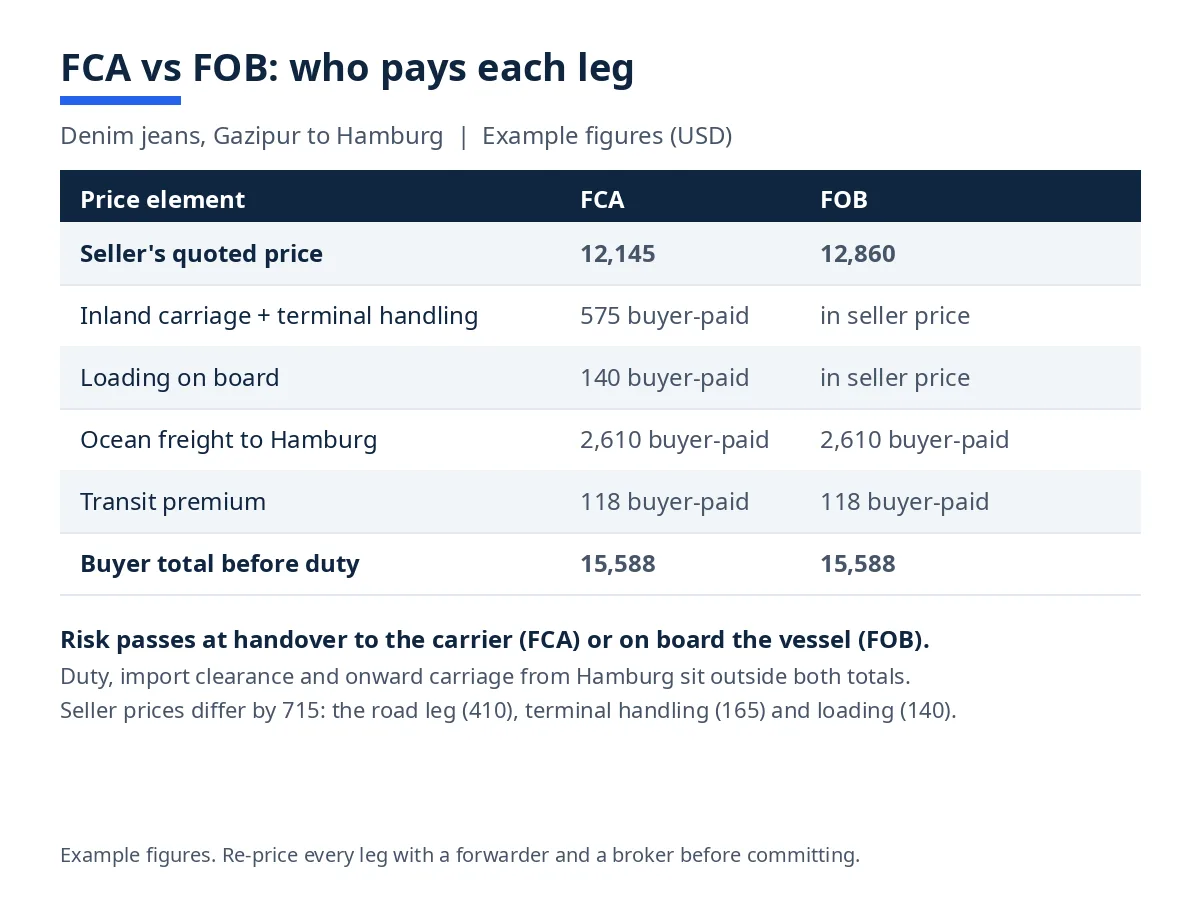
Both columns reach the same figure by different routes. The 715 gap is made of three items already inside the FOB price: 410 for the road, 165 for terminal handling, and 140 for loading. The FCA buyer then pays 3,443 after the price, against 2,728 for the FOB buyer, and both buyers land at 15,588: FCA as 12,145 plus 3,443, FOB as 12,860 plus 2,728. An FOB quotation 715 above an FCA quotation is not 715 dearer. It is 715 of origin and port work already paid for, with the risk during that work still on the seller until loading.
Neither total includes what Hamburg will cost: duty, clearance, or the last leg to the warehouse. No German duty percentage is quoted, because no German tariff schedule was opened for this article. Get the broker's duty figure first, then add duty, clearance fees, and the final leg to each column before comparing headlines. The same check applies to the transit premium: the figure is the same in both columns, but the cover starts at different moments, so confirm with the insurer that the FCA policy runs from the Gazipur handover and the FOB policy from loading at Chattogram. For a fuller build-up from either quotation to a warehouse figure, use the landed-cost method that adds duty, clearance, and the last leg to either quotation.
The choice in practice: cargo shape, carrier control, and how the seller is paid
Start with the shape of the cargo. Goods that travel in a sealed container, on a pallet, or across two or more modes fit FCA, because FCA is suitable for any mode of transportation, including multimodal shipments, and container transport in particular suits the rule.1 Goods that can be delivered directly onto a vessel fit FOB: the guidance names bulk loads a crane can place straight into a hold, such as minerals, cement, steel, grain, oil, and new vehicles, as the natural FOB load.2 Denim jeans in a sealed container sit firmly on the FCA side of that line. A bulk load of jute or steel that a crane can place straight into a hold sits on the FOB side.
Next, weigh carrier control. Under both terms the buyer contracts the main carriage and pays the freight.1 2 FCA adds a practical advantage for a buyer with a carrier network: the buyer can collect at the factory or at a terminal it already uses, set the sailing, and keep the box moving on its own contracts from the handover onward. FOB adds a practical advantage for a buyer whose carrier relationship is port-based: the seller brings the goods to the vessel, and the buyer's involvement starts at loading. A buyer with no carrier of its own, and no agent in Bangladesh to receive a handover, will find either term awkward, and should settle the carrier question before signing, not after.
Then check how the seller gets paid. Where payment runs through a letter of credit that calls for an on-board bill of lading, FOB gives the seller that document naturally, because the seller presents the goods to the carrier and loads them. Under FCA, delivery finishes before loading, so the seller would not normally hold an on-board document. Incoterms 2020 added an option for exactly this situation: the parties may agree in the sales contract that the buyer must instruct its carrier to issue a bill of lading with an on-board notation to the seller, so the seller can satisfy the credit.3 Treat the option as a contract clause, not as an automatic right. It must be agreed in writing, the buyer must actually give the instruction, and the carrier may still decline or delay, since the document cannot be issued before the goods are loaded, which can hold up payment under the credit.3 Where the credit insists on an on-board document and the carrier will not commit, FOB removes the problem at the cost of the container gap described above. Where the bank will accept a received-for-shipment document, FCA with the agreed option keeps the container logic intact.
Situation | Term that fits |
|---|---|
Sealed container, palletized load, or a journey mixing truck, terminal, and vessel | FCA |
Bulk or break-bulk cargo loaded straight onto the vessel | FOB |
Buyer runs its own carrier network and wants control from the factory or terminal | FCA |
Buyer wants the seller to bring the goods to the vessel and load them | FOB |
Payment by letter of credit calling for an on-board bill of lading, with no agreed FCA option | FOB |
Payment by letter of credit, with the FCA on-board document option agreed in the contract | FCA |
Buyer has no carrier, agent, or broker arranged in Bangladesh | Neither term alone; arrange carriage and clearance help first |
Ordering from Bangladesh on either term: names, notices, and the loading window
Write the term the way it will be read at the port. An FCA order needs the full agreed place and point: the factory address and collection point, or the terminal name with its gate and delivery window. An FOB order needs the named port of shipment and the loading place and point inside it, plus the vessel's name given in time.2 A quotation that says only "FCA Bangladesh" or "FOB Bangladesh" names no place at all, and no carrier, terminal, or vessel crew can act on it. Put the same place, in the same words, on the quotation, the invoice, the packing list, and the shipping paperwork.
Put five details in writing before the truck is booked. The exact place or port, with the point inside it. The carrier the buyer named, and the contact who answers on collection and sailing days. The notice the buyer owes under FOB: vessel name, loading place and point, and the date or period, sent early enough for the seller to load.2 The loading and terminal charges, and which side pays each lift. The cover start date under each term, matched to the risk point. An open item among the five comes back as a wait, a storage charge, or an argument about when risk passed, after the container has already moved.
For a Bangladesh order, add one more check before the truck leaves Gazipur: confirm the seller's export file is ready and the export formalities are the seller's under both terms.1 2 A late paper from either side stalls a journey whose risk point has already been fixed in the contract. Check the sequence once more when the shipping paperwork arrives, and keep the carrier's contact and the vessel details in the same file as the order, so a delayed vessel or an early closing for cargo is answered with a notice, not with a search through old messages.
Questions buyers ask about FCA and FOB
Does FOB cover a sealed container handed over at the factory?
No. FOB delivery happens on board the vessel at the named port of shipment, and risk passes at loading.2 A box given to a carrier at a factory or a terminal has not reached the FOB delivery point, so the FOB seller still carries the risk during the road leg and the terminal wait, unless an early-transfer exception applies. For a factory handover, agree FCA at the seller's premises, or FCA at the terminal, and write the place and point into the contract.1
Which term costs less for the same jeans shipment?
In the priced example, neither. Both columns total 15,588 dollars before duty, because the same legs are paid for in both cases and only the payer changes. The FOB seller price runs 715 higher, and the FCA buyer pays 715 more after the price. Compare headlines only after the charges left for the buyer have been added to each seller figure, then add duty, clearance fees, and the final leg to both columns. A cheaper headline that leaves the road leg, the terminal handling, or the loading unbought is not cheaper. It is incomplete.
Can FCA still give the seller an on-board bill of lading?
Yes, where the parties agree it in the sales contract. The buyer then instructs its carrier to issue a bill of lading with an on-board notation to the seller, so the seller can present it under a letter of credit.3 The agreement must be in the contract, the buyer must give the instruction, and the carrier is not bound to comply; the document also cannot appear before loading, which may delay payment.3 Without that agreed option, an FCA seller has no natural route to an on-board document, and FOB is the simpler choice where the credit demands one.
Can the term change from FOB to FCA after the purchase order is signed?
Yes, while the goods are still with the seller. Both sides sign a written change that re-prices the deal and fixes every paper at the same time: a fresh order, a fresh quotation, and an invoice, packing list, and shipping paperwork that all name FCA. Moving from FOB to FCA pulls delivery back to the agreed place and pulls the risk moment earlier with it, and takes the road, terminal, and loading charges out of the seller's price. The reverse move puts them back in and pushes delivery onto the vessel. Where a letter of credit names the old term, the credit needs its own amendment too, because the bank checks the papers against the credit. Fix the new price, the named place, and when cover begins before the truck rolls, because risk already transferred on board cannot be transferred back.
Next steps on Exportain
Start with the FOB rule in full, including the vessel-nomination notice that moves risk early, then see how FCA and FOB sit inside the eleven-rule set for shipments from Bangladesh. When the term and the named place are settled, ask suppliers to quote on them through the buying steps on Exportain that set out how to request a quotation on a chosen term.
Sources
- FCA & EXW Incoterms® 2020 explained: Key differences. ICC Academy (accessed )
- FOB & FAS Incoterms® 2020 explained: Key differences. ICC Academy (accessed )
- Incoterms 2020 FCA: Spotlight on Free Carrier. Shipping Solutions, (accessed )
About the author
Sourcing from Bangladesh?
Post a request for quotation and suppliers on Exportain can send you their quotes directly.
Post an RFQ