Private Label Sandals and Slippers in Bangladesh: Brand Surface Control
A brand owner's control guide for private label sandals and slippers from Bangladesh: clear the name, approve every marked surface, meet EU and US labeling rules, number each pack level, and lock the approved pair and pack before bulk.
Short answer
Private label sandals and slippers from Bangladesh carry a brand on seven surfaces: footbed, sole, strap, label, hangtag, box and carton. Clear the brand name in each selling market first, then approve each surface on its own material at print size. EU labeling follows the 80 percent materials rule, US marking needs a permanent English origin name, and every packaging level needs its own GTIN. Hold one approved pair and pack as the bulk standard.
On this page
Key takeaways
Count seven marked surfaces before artwork starts: footbed, sole, strap, label, hangtag, box and carton, each approved on its own material.
Clear the brand name in each selling market before any surface is cut; company registration alone creates no trademark rights.
EU labeling turns on the 80 percent rule for the upper, lining and sock, and outer sole; US marking needs a conspicuous, permanent English origin name.
Give every packaging level its own GTIN, scan a printed box before bulk, and hold one approved pair and pack as the standard bulk must match.
A brand owner ordering private label sandals and slippers from Bangladesh is buying pairs to sell and a set of marked surfaces that must all say the same thing. The name on the footbed, the mark pressed into the sole, the label on the strap, the hangtag, the box and the export carton each carry part of the brand, and each one can fail on its own. This guide works through those surfaces one at a time, so each can be approved before bulk production starts. Money figures in the worked example are illustrations only, marked as example figures throughout that section.
Count the marked surfaces on private label sandals and slippers in Bangladesh
List every surface that will carry the brand before any artwork is drawn. A sandal or slipper has more marked surfaces than a closed shoe, because the footbed and the straps stay visible while the pair is worn. Count them in the order a shopper meets them: the pair first, then the box, then the carton.
Surface | Where it sits | The question it must answer |
|---|---|---|
Footbed print | Under the foot | Does the mark survive wear? |
Sole mark | Pressed into the outer sole | Does it stay readable at small size? |
Strap mark | Printed or embossed on a strap | Does the color hold on this material? |
Woven or printed label | Fixed inside the pair | Does the wording match the pair? |
Hangtag | Attached to the pair | Does it name the right style, color and size? |
Retail box | The pack the shopper takes home | Do the end-label fields match the pair inside? |
Export carton | The shipping carton | Do the carton marks match the papers? |
Treat each surface as a separate approval. A mark signed off for the box is not signed off for the footbed, because the material, the size and the wear are different. When a surface is added late, such as a hangtag requested after the box artwork is done, it needs its own proof round and its own print minimum. Record the surface list in the order file, with the approval state of each line, so a missing approval is visible before bulk is released.
Clear the name before any surface is cut
No surface should be cut, printed or moulded until the brand name is cleared for every market where the pairs will be sold. Registering a company name is not the same step as clearing a trademark: company registration tells a state that a business intends to trade under a name, while a trademark identifies the source of goods for shoppers, and the two give different protection.1 In the United States, trademark rights derive first from actual use of the mark in commerce, not merely from applying to register it.1 A clearance search should therefore check the trademark database and ordinary trade use for a name that is already taken, or near enough to a live mark to confuse shoppers, before the name is adopted.1
Run the search on the exact name and on close variants: different spellings, sound-alikes and the dominant word on its own. Where a close mark appears, take legal advice before adopting the name. Record the decision, the markets searched and the date in the factory file. If the name changes after artwork exists, every surface proof restarts, because the footbed print, the sole mould, the label, the hangtag, the box and the carton all carry the same name.
The footbed and the sole: marks that take wear
The footbed is the most exposed brand surface on open footwear. It sits under the foot, takes sweat, friction and flexing, and is the first mark a wearer sees when the pair comes off. The sole mark sits at the other end of the pair: it is pressed or moulded into the outer sole, it meets the ground, and it often carries the size and the country of origin. Decide which method will carry each mark, and write the method into the order file. Under the EU footwear labeling rules, the required information may be put on the footwear by printing, sticking, embossing or using an attached label, and it must be visible, securely attached and accessible.2
For the footbed, ask for a worn-pair check, not only a fresh print. Have the sample pair worn, flexed and checked again, looking for smearing, lifting at the edges and fading where the heel and the ball of the foot land. For the sole, ask for a mould proof at print size, and check that the smallest letters stay open and readable once the compound fills the mould. Keep the size wording and the origin wording in the same place on every pair, and identical on the footbed, the sole, the box and the carton. A size shown one way on the sole and another way on the box is a mismatch a retailer or a customs officer will find first.
Straps, woven labels and hangtags: small marks, tight limits
Straps give a brand owner very little room. A strap mark must be read at a glance, from a short distance, on a narrow band of material that bends every time the pair is put on. Supply a simplified version of the mark for small surfaces, with fine lines and small lettering removed, and state the smallest letter height the factory may use for each mark. Judge color on the material the mark lands on, not on a screen: a woven label, a printed strap and a cardboard box take the same color reference differently, so agree one physical color reference for each material, judge every proof against it under the same agreed lighting, and write the reference, the material and the lighting used onto the proof record.
A woven or printed label inside the pair must describe the pair it is fixed to. Check the label wording against the sample pair it belongs to, style by style and color by color, and check it again after the pair has been flexed, so a label that lifts or curls is caught before bulk. The hangtag is the surface a shopper handles first in a store. It should name the style, the color and the size of the pair it is attached to, and its code should match the code on the box. Count hangtags with the same care as pairs: a hangtag printed for one colorway and attached to another turns a correct pair into a wrong listing.
One pair, four readings: what the pair itself must say
The same pair is read four ways in the four target markets. The table gives the reading that matters for the brand surfaces; the paragraphs after it give the detail. For the United Kingdom and the United Arab Emirates, confirm the exact wording with the broker before shipment, because neither reading can be taken from the EU or US rule.
Market | The pair surface must show | Who answers for it |
|---|---|---|
European Union | Materials of the upper, lining and sock, and outer sole | The person who first places the footwear on the EU market |
United States | English name of the country of origin, marked to last | The importer, through the marking on the article or its container |
United Kingdom | Classification under heading 6402, confirmed with the broker | The importer, through the broker-settled classification |
United Arab Emirates | Wording confirmed with the broker and a notified body | The importer, on written confirmation |
In the European Union, the label must give the material that makes up at least 80 percent of the surface area of the upper and of the lining and sock, and at least 80 percent of the volume of the outer sole. If no material alone reaches the 80 percent mark, the two leading materials go on the label instead.2 The information may be given as pictograms or as written indications, it must appear on at least one article in each pair, and the person responsible for first placing imported footwear on the EU market answers for its accuracy.2 Choose pictograms or words once, for the whole order: a mixed order reads as two different products.
In the United States, every article of foreign origin, or its container, must carry the English name of the country of origin where the ultimate purchaser can see it, in a form as legible, lasting and permanent as the article or container allows.3 Where an article is excepted from marking, its outermost container must still be marked with the country of origin.3 Where a container bears a US address, the country of origin must appear in close proximity to that address.3 Articles not marked as required face an additional duty of 10 percent of the final appraised value.3 The practical point is simple: the origin name must sit where the buyer will see it, and it must stay there through handling, packing and unpacking.
In the United Kingdom, heading 6402 is the heading for other footwear whose outer soles and uppers are rubber or plastics.4 Within it, commodity 6402 2000 00 covers strap-and-thong footwear whose uppers are plug-assembled to the sole, and commodity 6402 9950 00 covers slippers and other indoor footwear with plastic uppers.4 The tariff page for 5 April 2025 showed a third-country duty of 16.00 percent for those commodities.4 Treat that figure as indicative only: ask the broker to confirm the current rate and the classification for the exact pair before quoting a landed cost.
Materials under the brand surface must also meet chemical limits in the EU. REACH Annex XVII restricts substances in consumer products, and compliance can be shown by check testing or by an audit of raw materials and production.5 The limits that most often touch sandals and slippers are:
Material | Restricted substance | Limit |
|---|---|---|
Leather in skin contact | Chromium VI | 3 mg/kg maximum |
Dyed textiles and leather | Azo-dye amines | 30 mg/kg maximum |
Polymer materials | PAHs (polycyclic aromatic hydrocarbons) | Under 1 mg/kg |
Plastics and synthetic rubber | Cadmium | Under 100 mg/kg |
Ask for the test record behind each figure, naming the method used and the batch tested, and hold it against the same style and colorway as the bulk pairs. A test record for one colorway does not cover another, because dyes and pigments change with the color.
The box, the carton and the code
The retail box is a brand surface and a retail surface at once. Its end label should carry the style, the color, the size curve, the pair count and the code, in fields a store worker can read without opening the box. Proof the box artwork at print size on the production board, and scan a printed box sample with the scanner the retailer will use. Artwork that reads on a screen can fail once printed on board, when bars thicken, quiet space closes up or the code folds over an edge.
Give every packaging level its own code. A brand owner can allocate a different GTIN-13 to each level, or create GTIN-14s from the GTIN-13 assigned to the base item, and the description for each level should state what the level contains and the quantity inside it.6 The first digit of a GTIN-14, from 1 to 8, does not indicate which packaging level the number identifies, so the numbers can be allocated in any order.6 GTIN-14s beginning with 9 are reserved for boxes of variable-measure goods and should not be used for cases of fixed-weight items such as pairs of sandals.6 Record which code belongs to which level in the factory file, and never reuse a code from a discontinued pack for a new one.
The export carton carries the last brand surface: the carton marks. State the style, color, size curve, pair count, country of origin and carton number on the carton, and make the marks match the packing list and the pair label exactly. Where the carton is the outermost container that reaches the buyer, the origin marking rules for containers apply to it as well.3 Open one finished carton from each style and colorway before the shipment is sealed, and count the pairs inside against the carton mark.
Printed items carry minimums of their own. Labels, hangtags, printed polybags and branded cartons each arrive with a supplier minimum, and a label printed only in bulk can set the floor for the whole order, even when the pair count on its own would pass.7 Count the order in print sets — one set for each style-and-color pairing — and have the quotation list the pair minimum, every print minimum and any below-minimum surcharge on separate lines. Read how Exportain counts a minimum first, then ask in writing how each minimum in your quotation is counted: per order, per style or per color.
Lock the surfaces: artwork approval and the factory file
Approval works surface by surface. Hold one reference pair and one reference pack, approved in full, and check bulk against them. A photograph proves position and scale; it does not prove that a footbed print survives wear or that a strap color holds on its material. Hold the physical pair for the wear checks, and the physical pack for the code and carton checks.
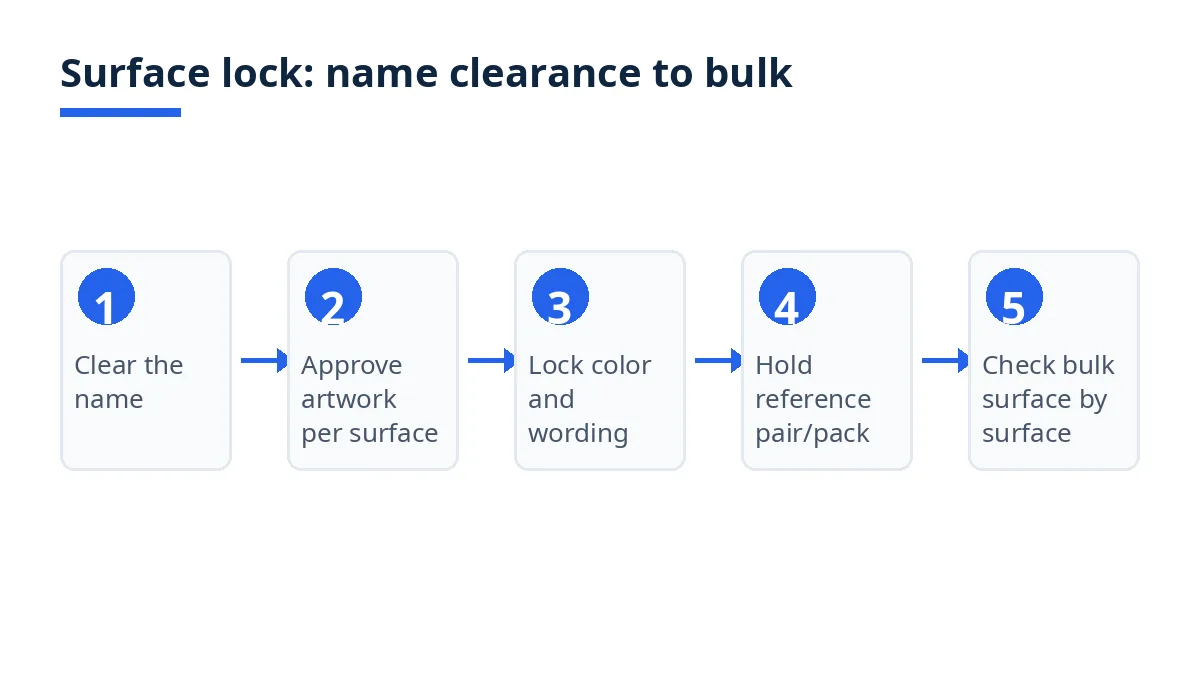
Name cleared. The brand name, the markets searched and the decision are recorded before artwork starts.
Artwork approved per surface. Each surface is proofed at print size on the production material, and signed with a version number and a date.
Color and wording locked. One physical color reference per material, one wording sheet per market, and the lighting used for judging are all recorded.
Reference pair and pack held. One approved pair and one approved retail pack are kept as the standard bulk must match.
Bulk checked surface by surface. Each surface on bulk pairs is read against the reference pair and pack, and any surface that changes re-opens its own approval.
Name one person on the brand-owner side to approve every change, and record each approval with the file name, the version and the date. Write down who owns each item in the file: the factory normally keeps the shoe shape, the pattern and the sole unit, while the brand owner keeps the brand assets it supplies, including the word mark, the logo artwork, the label artwork and the box artwork. Add any exclusivity by market, period and style in writing, before sampling. A change to one surface restarts approval for that surface only, but bulk must wait until that surface is signed again.
Worked example: surfaces, sets and spares
Example figures throughout this section. Take an order of two styles in three colorways, at 400 pairs per colorway. The pair total is 2 multiplied by 3 multiplied by 400, which is 2,400 pairs (2 x 3 x 400 = 2,400). The order has six style and color combinations, so it needs six print sets: one label set, one hangtag set and one box set per combination. Five surfaces carry the brand on each pair in this example: footbed, sole, strap label, hangtag and box. That is 2,400 multiplied by 5, which is 12,000 surface applications to check in bulk (2,400 x 5 = 12,000).
Order printed items with spares. At 5 percent spares, label and box sets total 2,400 multiplied by 1.05, which is 2,520 sets (2,400 x 1.05 = 2,520). The spare sets cover misprints, damaged boxes and replacement pairs without a second print run. Brand-side charges in this example are artwork plates at 480 US dollars, sample rounds at 310 US dollars and inspection at 260 US dollars, giving 1,050 US dollars in total (480 + 310 + 260 = 1,050). Dropping one colorway cuts the pair total to 1,600, the print sets to four and the spare sets to 1,680 (1,600 x 1.05 = 1,680), because each colorway carries its own print set. Run that arithmetic before adding a colorway: it adds pairs, a print set and a proof round, not pairs alone.
Surface failures to catch before bulk
Footbed print smears after a wear trial. Run the worn-pair check on the sample pair, and re-check the heel and ball areas before bulk.
Sole mark fills in and reads as a blur. Proof the mould at print size, and check the smallest letters once the compound has filled it.
Strap color drifts from the box color. Judge both against the physical reference for their own material, under the same lighting, and do not accept a screen match.
Hangtag names the wrong colorway. Read the hangtag, the label and the box end label side by side for one pair from each combination.
Box code fails on the printed board. Scan a printed box sample with a retail scanner, and re-proof the code if bars thicken or quiet space closes.
Carton mark promises a size curve the pairs do not match. Open one finished carton per combination and count the pairs inside against the mark before sealing.
Which surfaces on a sandal or slipper can carry my brand?
Seven: the footbed print, the sole mark, the strap mark, the woven or printed label, the hangtag, the retail box and the export carton. The footbed and the sole take wear, the strap and the label work at small size, and the box and the carton carry the codes and marks a store and a customs officer read. Approve each surface on its own material, at its own size, before bulk.
Must the brand name be cleared before artwork is approved?
Yes. Clear the name in each selling market, across the trademark database and ordinary trade use, and take legal advice where a close mark appears.1 Company registration alone gives no trademark rights, and in the United States rights derive first from use in commerce.1 A name change after artwork exists restarts every surface proof, from the footbed print to the carton marks.
How do I check a footbed print or sole mark will survive wear?
Have the sample pair worn and flexed, then check the footbed print again at the heel and ball areas for smearing and lifting. Proof the sole mark in the mould at print size, and check that the smallest letters stay open once the compound fills it. A photograph shows position and scale only; the wear decision needs the physical pair in hand.
What must the box and carton show that the pair does not?
The box end label carries the style, color, size curve, pair count and code for the pair inside, and each packaging level carries its own GTIN, allocated as a GTIN-13 or built as a GTIN-14 from the base item number.6 The carton adds the pair count, the country of origin and the carton number, matching the packing list exactly. Scan a printed box before bulk, and open one finished carton per combination to count the pairs against the mark.
Next steps on Exportain
Send every supplier the same surface list and the same lock list, so each quotation answers the same marked surfaces and can be set side by side. Start from the supplier directory on Exportain, read what each badge record covers before shortlisting anyone, and test each quotation against Exportain's page on how a minimum is counted. A badge records a document and photograph review by Exportain staff: it is not a factory visit, not a check against a government database, and not a promise about capacity, quality or delivery.8
Sources
- To Search or Not to Search, That is the Question – Company Name vs. Trademark Clearance. Nelson Mullins, (accessed )
- Directive 94/11/EC of the European Parliament and of the Council of 23 March 1994 on the approximation of the laws, regulations and administrative provisions of the Member States relating to labelling of the materials used in the main components of footwear for sale to the consumer. Official Journal of the European Communities, (accessed )
- PART 134—Country of Origin Marking. Electronic Code of Federal Regulations (accessed )
- Other footwear with outer soles and uppers of rubber or plastics - UK Integrated Online Tariff. GOV.UK (accessed )
- How REACH Annex XVII affects the manufacture of consumer products. SATRA (accessed )
- How to identify different packaging levels in My Numberbank. GS1 UK (accessed )
- MOQ Meaning (Minimum Order Quantity). Exportain (accessed )
- How Supplier Verification Works on Exportain. Exportain, (accessed )
About the author
Sourcing from Bangladesh?
Post a request for quotation and suppliers on Exportain can send you their quotes directly.
Post an RFQ